How to fill out the T-4 in Georgia
A field-by-field walkthrough of the Georgia T-4 (Notice of Satisfaction of Security Interest or Lien Holder's Affidavit) for licensed used car dealers — what goes in every section, who signs what, and the documents you attach. Verified against the official form as of October 2026.
Don't waste another second filling out the Georgia T-4.
Let DealerVLO fill out every form for you instantly.
Filing these every week? DealerVLO fills the T-4 from the deal you already entered, $29/month flat. See pricing
Switching from another DMS? Compare DealerVLO to DealerCenter, Frazer, or Lot Wizard.
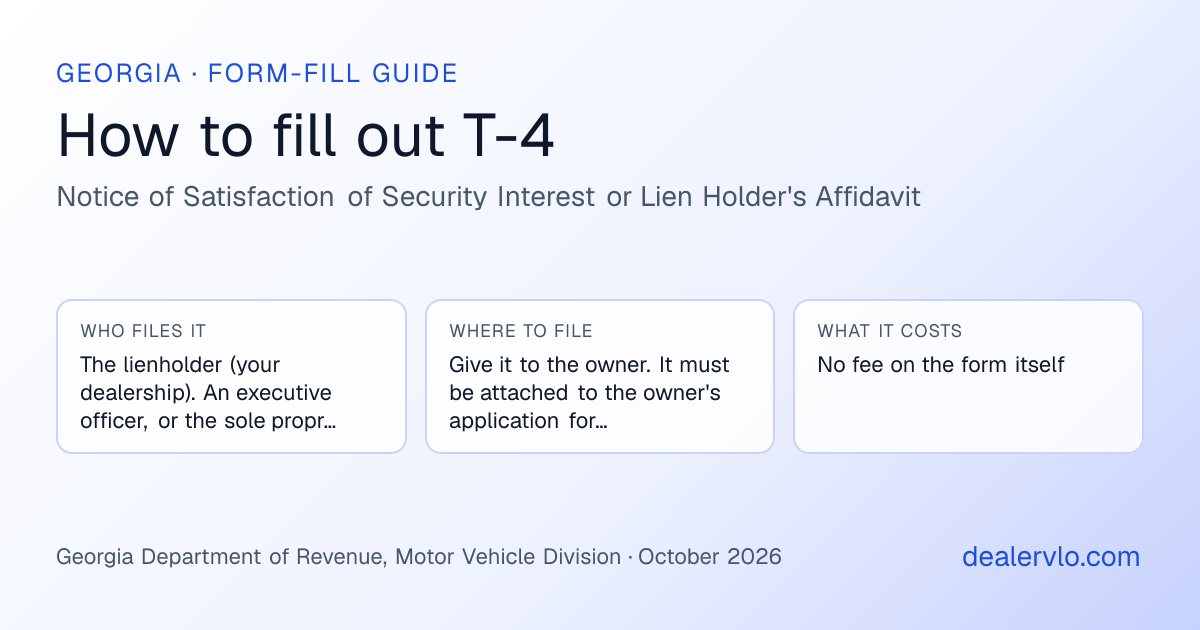
Filling out the GA T-4 after a sale:
- What it is
- Georgia DOR's sworn affidavit that a lien on a paper-title vehicle is satisfied
- Who completes it
- The lienholder (your dealership). An executive officer, or the sole proprietor or partner, signs in front of a notary
- Where to file it
- Give it to the owner. It must be attached to the owner's application for certificate of title at the county tag office
- Processing time
- Release within 10 days after the lien is satisfied (O.C.G.A. 40-3-56)
- Cost
- No fee on the form itself
This guide is informational and does not replace the official Georgia instructions. Always confirm the current form and procedure with the Georgia Department of Revenue, Motor Vehicle Division before you file.
The T-4 is one car's paperwork. A 20-second read on your lot, and the tax-and-fee math for the whole deal — built for dealers, no signup. Free calculators dealers actually use — no signup, no email.
DealerVLO fills the official Georgia T-4 straight from your deal: your dealership's legal name (check it matches the lienholder name on the title; the deal page reminds you) and business address as lienholder, the owner names and residence address, and the vehicle's year, make, model, body style and VIN. The affiant's name and license number, state of title records, title number, account number, the Yes box and the notary block stay blank. It's in the servicing section of a BHPH deal where you carry the note, not every deal. $29/month, free to try — cancel any time.
What the T-4 is and why it matters
Form T-4 is Georgia's sworn lienholder affidavit that a lien on a vehicle has been paid off. On a buy-here-pay-here deal you're the lienholder, so when the customer makes the last payment, releasing the lien is your job. O.C.G.A. 40-3-56 gives you ten days after the lien is satisfied to execute the release and get it to DOR and the owner.
Read this first: the T-4 is not for electronic liens. The form itself says it can't be used by an ELT participant for a lien that was recorded electronically, and DOR has required lienholders who create a lien in coordination with a Georgia dealer, buy-here-pay-here dealers included, to file and release liens through ELT since October 1, 2020. So most Georgia BHPH liens recorded since then get released through your ELT provider, not on paper. The T-4 is for a lien on a paper title. In DealerVLO it's in the servicing section of a BHPH deal where your dealership carries the note, not on every deal. The button is labelled "T-4 (paper-title liens only)," and the note above it tells you to release an ELT lien through your ELT service provider instead.
The current form is Form T-4 (Revised February 2015) from the Georgia Department of Revenue. DOR's lien-release page calls it the "Form T-4 Lien or Security Interest Release." It's one page: the affiant and lienholder, the owner, the vehicle and title record, an acknowledgment box, the signature, and a notary block. It prints three rules at the bottom: it must be attached to the application for certificate of title, any alteration or correction voids it, and all earlier revisions are obsolete.
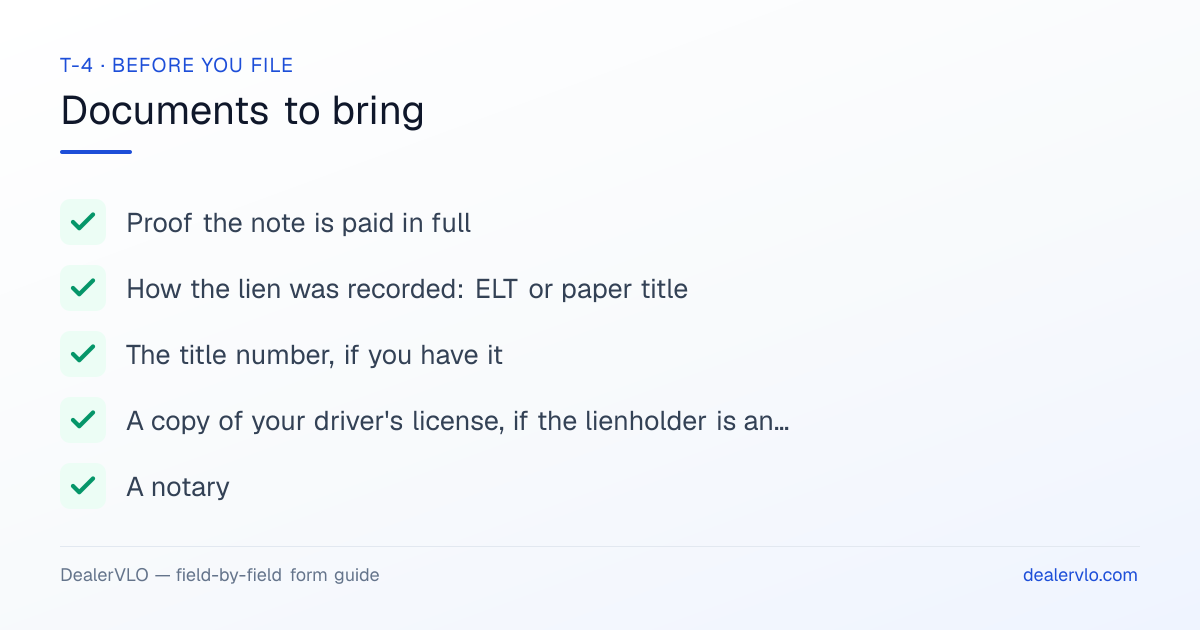
Documents to have before you start
Gather these before you complete the T-4. A missing attachment is the number-one reason the the Georgia Department of Revenue, Motor Vehicle Division bounces a title application back.
- Proof the note is paid in full — Your payment ledger showing the final payment. The T-4 swears the lien is satisfied, so don't sign it on a promise.
- How the lien was recorded: ELT or paper title — If the lien is on Georgia's Electronic Lien and Title system, release it through your ELT provider. DOR says it will not release a lien that was recorded electronically.
- The title number, if you have it — From the paper title or your deal file. DealerVLO leaves this box blank because the deal doesn't record it.
- A copy of your driver's license, if the lienholder is an individual — The form says an individual lienholder's driver's license copy must accompany it. A dealership that's a company doesn't need this.
- A notary — The affiant swears to the T-4 in front of a notary. Line one up before you hand the form over.
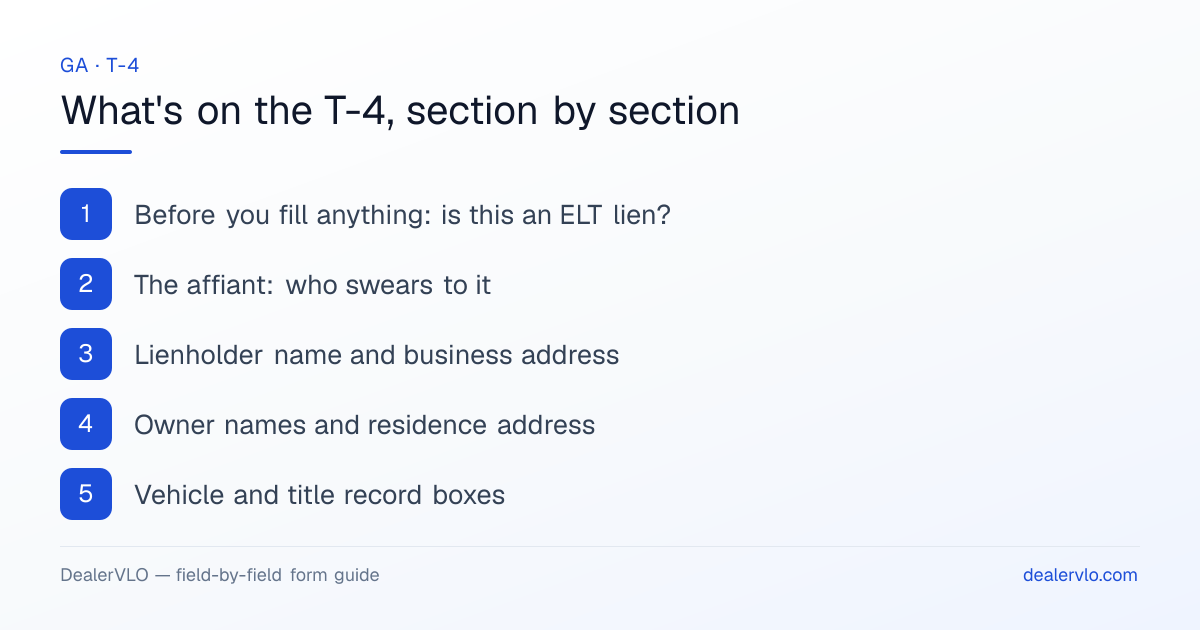
T-4, section by section
Before you fill anything: is this an ELT lien?
DOR's notice to lienholders says that starting October 1, 2020, lienholders who create five or more liens a year on Georgia titles, or who create a lien in coordination with a Georgia motor vehicle dealer, must file and release liens electronically. The notice names dealer-financed and buy-here-pay-here dealers, and says DOR will treat any dealer-financed or BHPH deal by a Georgia dealer as created in coordination with a dealer. You file the lien with an ELT number from an approved ELT service provider, and you must use ELT to release any electronic lien. The T-4 itself repeats this: it's not permitted for any ELT participant on a lien recorded electronically. If your lien went on electronically, log in to your ELT provider and release it there. DOR's 2014 ELT bulletin says an electronic release through the ELT portal satisfies the ten-day release requirement.
| Field | Who fills it |
|---|---|
Lien recorded electronically (ELT) Release through your ELT provider. Don't use the T-4. | You (dealer) |
Lien recorded on a paper title Sign the release on the title, or use the T-4 if the title isn't available. | You (dealer) |
The affiant: who swears to it
The form opens with "Personally appearing before the undersigned officer, duly authorized by law to administer oaths, comes" and a line for the person swearing to the affidavit. For a corporation or LLC that's the full legal name of an executive officer. For a sole proprietor or partner, it's the full legal name and driver's license number. This is the person who signs at the bottom in front of the notary, so don't fill it in until you know who's signing.
| Field | Who fills it |
|---|---|
Full legal name of executive officer, or sole proprietor/partner name and driver's license number The person who will sign before the notary. DealerVLO leaves it blank. | You (dealer) |
Lienholder name and business address
Next comes the legal business name of the security interest or lien holder "as listed on Certificate of Title," then your business address with city, state and ZIP. Match the title exactly. If the lien was recorded under your corporate name, don't put your DBA here. If the lienholder is an individual, a copy of that person's driver's license must go with the form.
| Field | Who fills it |
|---|---|
Legal business name of lien holder, as listed on the title DealerVLO prints your dealership's legal business name. If the title shows the lienholder differently (a DBA, an abbreviation), correct it before you sign. | You (dealer) |
Business address, city, state, ZIP | You (dealer) |
Owner names and residence address
Write the owner names as they appear on the certificate of title, then the owner's residence address with city, state and ZIP. There are extra lines for more owners. Copy the names from the title, not from your customer file, in case the title reads differently.
| Field | Who fills it |
|---|---|
Owner(s) names as on the title Both names when there's a co-owner. | You (dealer) |
Residence address, city, state, ZIP | You (dealer) |
Vehicle and title record boxes
Six boxes identify the vehicle and its title: vehicle year and make, VIN, model and body style, state of title records, title number, and account number. The VIN has to match the title. State of title records is where the vehicle is titled. The form doesn't explain what goes in the account number box, so if you're not sure, ask the county tag office before you guess. A wrong number is a correction, and corrections void the form.
| Field | Who fills it |
|---|---|
Vehicle year and make | You (dealer) |
Vehicle identification number All 17 characters, matching the title. | You (dealer) |
Model and body style | You (dealer) |
State of title records DealerVLO leaves it blank. | You (dealer) |
Title number DealerVLO leaves it blank. | You (dealer) |
Account number DealerVLO leaves it blank. | You (dealer) |
The acknowledgment box, signature and notary block
A paragraph says you understand that DOR can investigate titling issues, may have title history or address information you don't have, and can reject a title application. The affiant checks "Yes" to acknowledge it. Then the sworn statement: the affiant is over the age of majority and gives the affidavit on personal knowledge. The sole proprietor, partner or executive officer signs and dates it, and the notary completes the jurat (day, month, year), the notary's residence address, signature and seal, printed name, commission expiration date and business phone.
| Field | Who fills it |
|---|---|
"Yes" acknowledgment box Checked by the affiant. DealerVLO leaves it blank. | You (dealer) |
Sole proprietor/partner or executive officer signature and date Sign in front of the notary. | You (dealer) |
Notary jurat, signature, seal, printed name, commission, phone Completed by the notary. | At the counter |
Paper title in hand? Sign the release on the title
On a paper title, DOR's normal route is the title itself. When the debt is paid, complete the Release of Lien or Security Interest section on the title: the lienholder's name as recorded on the title, an authorized agent's signature, and the release date. Mail or deliver the title to the next recorded lienholder within five days, or to the owner if there isn't one. DOR says to give the owner a completed, signed T-4 when the title isn't available at release, and the county tag office can verify a T-4 before accepting the application. Either way, the owner then applies for a clean title with the release attached.
| Field | Who fills it |
|---|---|
Release section on the paper title Lienholder name as recorded, authorized signature, release date. | You (dealer) |
Title to the next lienholder, or to the owner | You (dealer) |
T-4 verified at the county tag office | At the counter |
Common T-4 mistakes that cause rejections
The form says it's not permitted for a lien recorded electronically, and DOR won't release an ELT lien itself. Release it through your ELT provider.
The T-4 is an affidavit sworn before an officer authorized to administer oaths. An unsworn T-4 isn't complete.
The lienholder line asks for the legal business name as listed on the title. Match it exactly.
The form says any alteration or correction voids it. Print a clean T-4.
O.C.G.A. 40-3-56 gives you ten days after the lien is satisfied to execute the release and get it to DOR and the owner.
Common questions
What is Georgia Form T-4?+
Form T-4 is the Georgia Department of Revenue's Notice of Satisfaction of Security Interest or Lien Holder's Affidavit. The lienholder swears, in front of a notary, that the lien on a described vehicle is satisfied. It gets attached to the owner's application for certificate of title. The current form is revised February 2015.
Can a buy-here-pay-here dealer use the T-4 in Georgia?+
Only for a lien on a paper title. Since October 1, 2020, DOR has required lienholders who create a lien in coordination with a Georgia dealer, BHPH dealers included, to file and release liens electronically through an ELT service provider. The T-4 says it can't be used for a lien recorded electronically. If your lien is on ELT, release it there.
How long does a Georgia lienholder have to release a lien?+
Ten days. Under O.C.G.A. 40-3-56, when a lien listed on a title is satisfied, the holder must execute a release in the form the commissioner prescribes and mail or deliver it to the commissioner and the owner within ten days. DOR's ELT bulletin says an electronic release through the ELT portal meets that requirement for ELT participants.
Does the Georgia T-4 need to be notarized?+
Yes. It's an affidavit: the executive officer, sole proprietor or partner signs before a notary, who completes the jurat, signs, and seals it.
Do I need a T-4 if I have the paper title?+
Usually not. DOR's process is to complete the Release of Lien or Security Interest section on the title, with the lienholder's name as recorded, an authorized signature and the release date, and send the title on. DOR says to give the owner a signed T-4 when the title isn't available at release.
What does the owner do with the T-4?+
The form says it must be attached to the application for certificate of title. The owner takes it to the county tag office, which can verify the T-4 before accepting the application.
Is there software that fills out the T-4 automatically?+
Yes. Dealer management software like DealerVLO fills the official Georgia T-4 from the deal you already entered: your dealership's legal name (check it matches the lienholder name on the title; the deal page reminds you) and business address as lienholder, the owner names and residence address, and the vehicle's year, make, model, body style and VIN. The affiant's name and license number, state of title records, title number, account number, the Yes box and the notary block stay blank. It's in the servicing section of a BHPH deal where you carry the note, not every deal. Signatures stay blank for ink. It's $29/month flat with a 14-day free trial, and the same deal also generates your federal documents (Bill of Sale, FTC Buyers Guide) and your state title paperwork.
- Vehicle lien release forms by state
- How to fill out the Georgia MV-1 title application
- Vehicle power of attorney forms by state
- How to get a used car dealer license in Georgia
- Georgia dealer plates
- E-signatures and e-titling for Georgia dealers
- Georgia affidavit of repossession (T-16)
- Title application forms in every state
- How much is a dealer's license? Cost in every state
Stop filling out the T-4 by hand.
DealerVLO fills the official GA T-4 straight from your deal jacket: your dealership's legal name (check it matches the lienholder name on the title; the deal page reminds you) and business address as lienholder, the owner names and residence address, and the vehicle's year, make, model, body style and VIN. The affiant's name and license number, state of title records, title number, account number, the Yes box and the notary block stay blank. It's in the servicing section of a BHPH deal where you carry the note, not every deal. $29/month. 14-day free trial, cancel any time.
Curious how it works? See how DealerVLO auto-fills every dealer document — bill of sale, FTC Buyers Guide, odometer disclosure, and state title & registration forms for all 50 states, from one deal.
Bond amounts, fees, and form rules change. Get a short email when your state does. No spam, unsubscribe anytime.