How to get a used car dealer license in Michigan
A practical walkthrough of the Class B (Used Vehicle Dealer) application — fees, bond, timeline, and what to expect at each step. Verified against the official agency as of October 2026.
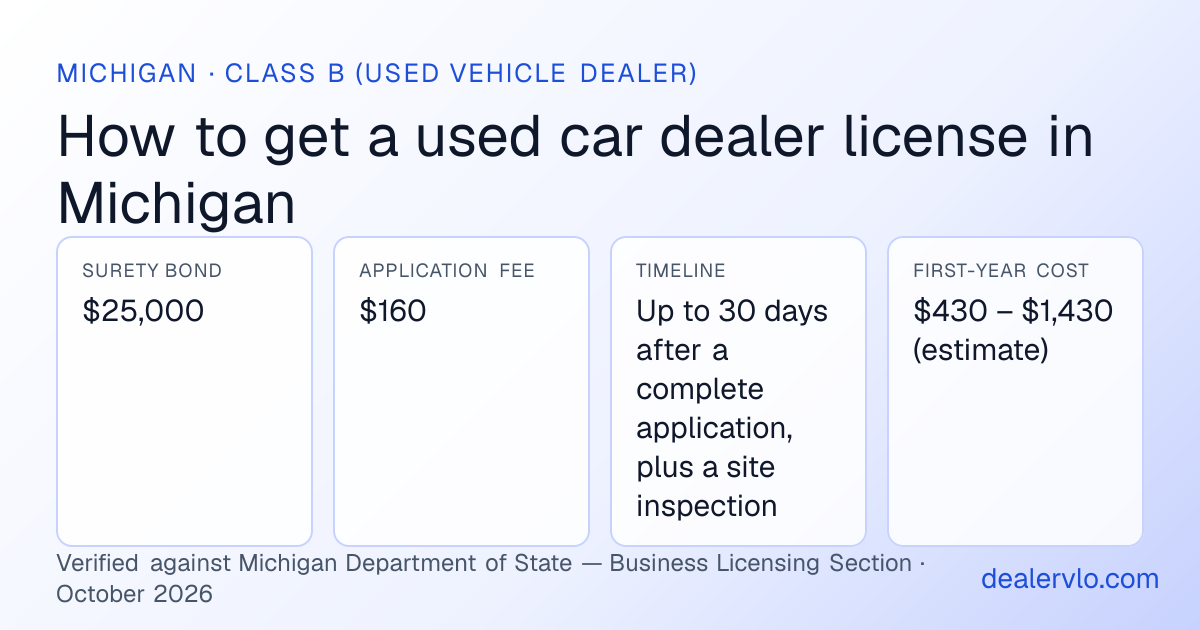
Getting a Class B (Used Vehicle Dealer) used-car dealer license in Michigan:
- Surety bond required
- $25,000
- Application fee
- $160
- License term
- 1 year (expires December 31)
- Typical timeline
- Up to 30 days after a complete application, plus a site inspection
- Typical first-year cost
- $430 – $1,430 (estimate)
This guide is informational and does not replace official Michigan requirements. Always verify with Michigan Department of State — Business Licensing Section before applying.
Two numbers worth knowing before you commit. Free calculators dealers actually use — no signup, no email.
Inventory with VIN auto-decode, the deal jacket, and every MI + federal form your sales need. $29/month, free to try — cancel any time.
Who can apply for a Class B (Used Vehicle Dealer) license
Michigan's Class B license is the used vehicle dealer license. It lets you buy and sell used vehicles to and from the public and other licensed dealers. The Michigan Department of State issues it. You need a dealer license once you buy, sell, broker, or deal in 5 or more titled vehicles in a 12-month period (MCL 257.248).
In Michigan this is also commonly called an auto dealer license, car dealer license, or motor vehicle dealer license — all the same Class B (Used Vehicle Dealer) authority to sell used vehicles.
- Pre-licensing dealer training, completed by each owner, partner, or officer in the 6 months before you apply (free, held online)
- An established place of business that meets MCL 257.14: an enclosed building that isn't a residence, an office of at least 150 sq ft, a working restroom and phone, display space for 10 vehicles, and a permanent sign
- Zoning and municipal approval forms, each signed within 90 days of when the state receives your application
- A $25,000 Michigan vehicle dealer surety bond on the state's Uniform Vehicle Dealer Surety Bond form
- Michigan no-fault fleet insurance (20/40/10) for "any vehicle" or "all owned vehicles," shown on an ACORD 25
- Your own registered repair facility, or a servicing agreement with one within 10 miles
- Articles of incorporation or organization, or an assumed name filing
- Fingerprint background check for everyone listed on the application (wait for the state's instructions)
- Posted business hours of at least 30 hours a week
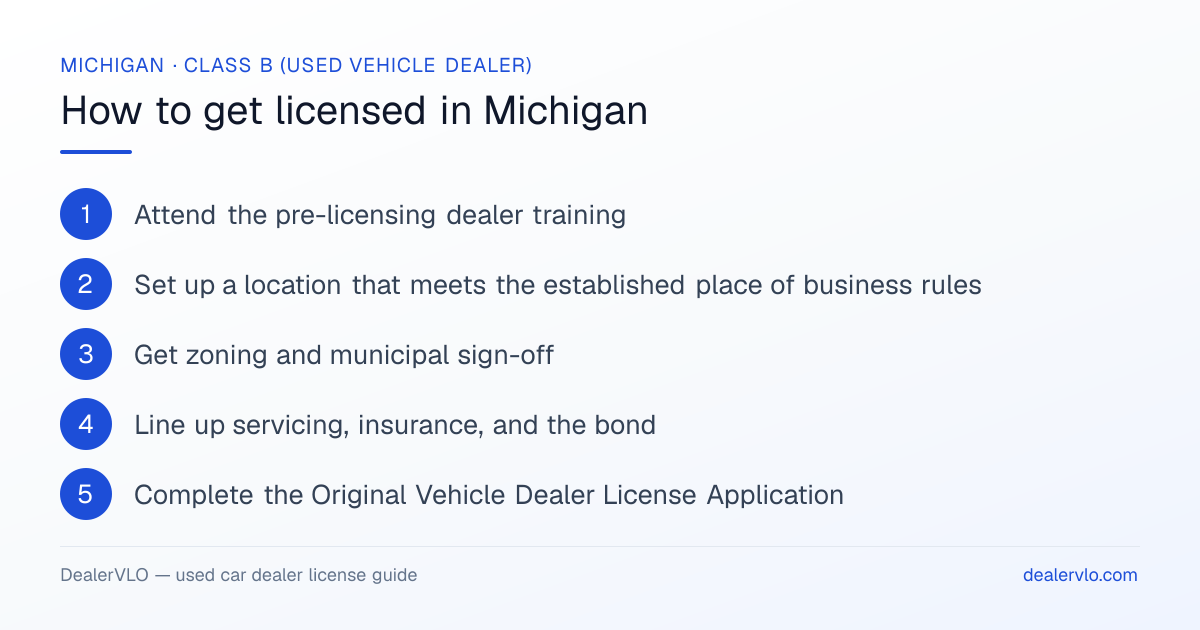
Step-by-step process
- 1
Attend the pre-licensing dealer training
Michigan law (PA 420 of 2018) requires every applicant, partner, or officer on a new Class B application to complete the pre-licensure dealer training in the 6 months before the application date. The Department of State runs it on Microsoft Teams at no cost. To sign up, email blrd@michigan.gov with the date you want, every attendee's name, email, and phone, and the dealership name and address. You list each person's training date on the application.
- 2
Set up a location that meets the established place of business rules
A Class B dealer needs a permanently enclosed building you own, lease, or rent — not a residence, tent, or temporary stand. Inside: an office of at least 150 sq ft with standard furniture, working utilities, a working restroom, and a working phone (a cell phone is fine) in the business name. Outside: at least 1,300 sq ft to display 10 vehicles, plus 650 sq ft of customer parking, surfaced and lit during business hours. Add a permanent exterior sign with the dealership name visible from the road, and post hours of at least 30 a week. You can't combine space with another dealer to meet the minimums.
- 3
Get zoning and municipal sign-off
Your local zoning authority and your municipality each complete a form in the application packet. Both must be signed within 90 days of when the state receives your application. In Detroit, the forms go through the Department of Buildings and Safety Engineering, Zoning Division, and only forms with the city seal are accepted.
- 4
Line up servicing, insurance, and the bond
Register your own repair facility or sign the packet's Servicing Repair Facility Agreement with a registered facility within 10 miles. This applies even if you sell everything as-is or wholesale. Get 20/40/10 fleet-type Michigan no-fault insurance showing "any vehicle" or "all owned vehicles" on an ACORD 25 in the exact business name. Then get the $25,000 surety bond from a surety authorized in Michigan, executed by a Michigan-licensed agent.
- 5
Complete the Original Vehicle Dealer License Application
Fill out form AR-0032 from the application packet. Include the zoning and municipal forms, the designated branch office selection (up to three Secretary of State branches where you'll submit transactions), your business formation or assumed name filing, the repair facility registration or agreement, the ACORD 25, the original bond, and a check or money order to the State of Michigan for $160 plus $10 per dealer plate. Class B dealers must buy at least two plates. Mail it to the Business Licensing Section in Lansing or apply online. A business email address is required.
- 6
Complete fingerprinting when instructed
After the state receives your application, it sends the form and instructions for the background check, which includes fingerprints. Don't get fingerprinted before those instructions arrive. Everyone listed as an owner, partner, officer, member, or director needs fingerprints on file.
- 7
Pass the pre-license inspection
The Department of State inspects the business location before issuing the license. The Department says dealer applications can take up to 30 days to process, and missing documents delay them. Once you're licensed, a designated person must attend continuing education dealer training within 90 days of the issue date.
Michigan dealer license classes: which one you need
Michigan sorts dealer licenses by letter. Each class carries a $160 annual fee, and the Department of State limits which classes can be combined. For a used-car business, two classes matter: Class B and Class W.
Class B is the used vehicle dealer license. It covers retail and dealer-to-dealer sales, and it carries the full lot rules, the $25,000 bond, the training requirement, and at least two dealer plates.
Class W is the wholesaler license. A Class W dealer buys from and sells to licensed dealers only. Any online or classified ad has to state the license class and that buyers must be licensed dealers. A wholesaler must buy or sell at least 24 vehicles in Michigan each year to keep the license. The $25,000 bond doesn't apply to Class W.
- Class A — new vehicle dealer, under a franchise or manufacturer contract
- Class B — used vehicle dealer; retail and wholesale; $25,000 bond; minimum two dealer plates
- Class D — broker; arranges sales without taking ownership (consignment lots and auctions are brokers); $25,000 bond
- Class W — wholesaler; sells only to licensed dealers; no bond; one dealer plate the first year
- Classes C, E, F, G, H, R — parts dealers, distressed vehicle transporters, scrap processors, salvage pools, and recyclers
Can you get a Michigan dealer license without a lot?
Not for retail. A Class B dealer needs at least 1,300 sq ft to display 10 vehicles, plus 650 sq ft of customer parking, at the licensed address. A residence doesn't qualify, and two dealers can't pool space to meet the minimums.
A Class W wholesaler skips the display lot. In fact, the wholesaler's premises can't be used to display vehicles at all, though it can store vehicles you've bought before you sell them to a dealer. You still need a real office: a permanently enclosed building (not a commercial mailbox), an office at least 8 feet by 8 feet with a door and four rigid walls, working utilities and a phone in the business name, a working restroom, a desk and a locking filing cabinet, and an exterior sign. Post at least 15 business hours a week between 8 a.m. and 5 p.m., Monday through Friday. The location can't be within 200 feet of another licensed wholesaler.
So the honest answer: if you only want to sell to other dealers, Class W works without a lot. If you want to sell to the public, you need the Class B lot.
Buy-here-pay-here or in-house financing: the DIFS installment seller license
The Class B license lets you sell. It doesn't let you finance. Michigan's Motor Vehicle Sales Finance Act says you can't be in the business of an installment seller of motor vehicles under installment sale contracts unless you're licensed under that act (MCL 492.103). The act defines an installment sale contract as a retail sale where part or all of the price is paid in 2 or more scheduled payments after the agreement.
The Department of Insurance and Financial Services (DIFS) issues the installment seller license on Form FIS 1028. The statute sets the fee at $30 for an installment seller license that lets you finance contracts between you and your buyer, and licenses expire July 1 each year. Check DIFS's current fee schedule before you pay. A separate sales finance company license covers buying contracts written by other sellers.
If you carry notes, DealerVLO tracks buy-here-pay-here accounts with a collections panel for payments and balances. It doesn't lend money, pull credit, or handle any DIFS or Department of State filing. The license and the contract forms are on you.
Buying at dealer-only auctions with a Michigan license
A lot of people want a dealer license so they can buy at dealer-only auctions. A Class B or Class W license is what those auctions are built around, but each auction sets its own registration paperwork, so ask the auction what it needs before you plan around it.
Michigan has three rules worth knowing. A broker (Class D) can't buy vehicles at auctions. A Class W wholesaler can only resell to licensed dealers, so if you plan to retail what you buy, you need Class B. And only a licensed Salvage Vehicle Agent can buy salvage or scrap titled vehicles at an auction.
Michigan also keeps licenses for working dealers. The Department of State won't renew a dealer license if the licensee didn't buy or sell more than 5 vehicles in the 12 months before renewal. A license used only for occasional auction access is at risk.
Why Michigan dealer applications stall
The Department of State says applications can take up to 30 days, and missing documents delay them. The packet points to the same trouble spots again and again:
- A bond that doesn't show the exact business name and address from the application, leaves out individual owners or partners, or is missing a signature (attorney-in-fact, licensed agent, principal, and both witnesses) or the attorney-in-fact's power of attorney
- Zoning or municipal forms signed more than 90 days before the state receives the application
- An ACORD 25 that doesn't say "any vehicle" or "all owned vehicles" — the application can't be processed without it
- Names that don't match across the application, bond, insurance certificate, and formation or assumed name filing
- Missing pre-licensing training dates, or training taken more than 6 months before the application
- No repair facility registration or servicing agreement within 10 miles
- A location that fails the inspection: office size, restroom, display and parking space, lighting, sign, or posted hours
- False statements — a false certification on a dealer license application is a felony under MCL 257.903
Once you're licensed: the paperwork on every deal
When you sell to a non-dealer, you must apply for title and registration on the buyer's behalf within 21 days of delivery, using the Michigan Application for Title and Registration (RD-108). Give the buyer a copy of every document they sign, including the RD-108 and the front and back of the title.
Our Michigan RD-108 guide walks through the form field by field. DealerVLO fills a print-ready RD-108 worksheet from the deal — buyer, vehicle, price, and trade — so you're not retyping it at the branch. It's a worksheet, not the official state form.
Unless the vehicle is exempt, the seller completes the odometer statement on the title before the sale is final. For Michigan's separate odometer statement and when you need it, see our Michigan BDVR-108 guide, and our odometer disclosure guide for when a written mileage statement is required.
Michigan dealer license cost — fees breakdown
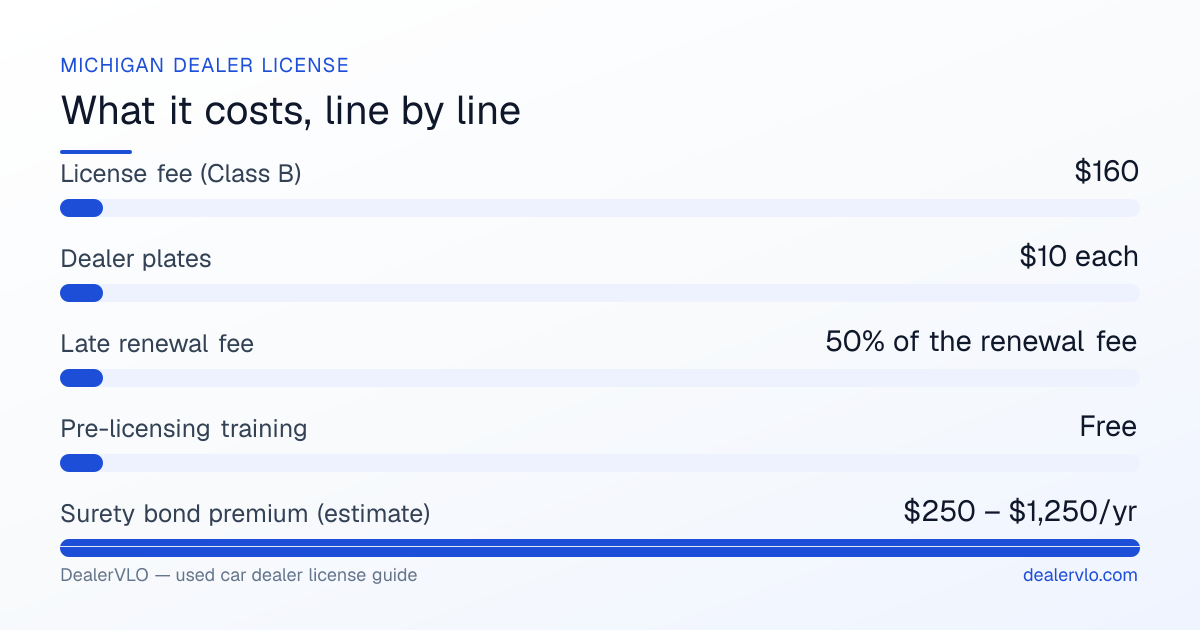
| Item | Amount |
|---|---|
License fee (Class B) Annual; same $160 for every class; non-refundable | $160 |
Dealer plates Class B must buy at least 2 at application | $10 each |
Late renewal fee During the 30-day late period after December 31 | 50% of the renewal fee |
Pre-licensing training Held on Microsoft Teams by the Department of State | Free |
Surety bond premium (estimate) Market estimate of 1–5% on the $25,000 bond; set by your credit | $250 – $1,250/yr |
Installment seller license (DIFS) Only if you finance sales; statutory fee, check DIFS's current schedule | $30 |
The Michigan auto dealer bond: $25,000
Michigan requires every used-vehicle dealer to post a $25,000 surety bond. The bond protects buyers from misconduct (odometer fraud, undisclosed liens, deceptive trade practices) and the state from unpaid taxes.
You don't pay the full bond amount up front — you pay an annual premium to a surety company, typically 1–5% (estimate) of the bond's face value. Your actual premium depends on personal credit and business history.
Class A, B, and D dealers must file a $25,000 bond on Michigan's Uniform Vehicle Dealer Surety Bond form (Classes C, E, F, G, R, and W are exempt). It covers buyers, sellers, lenders, and government agencies for losses from fraud, cheating, or misrepresentation, plus sales and use tax deficiencies. The surety pays only after a court judgment or a final Department of State order. A paid claim reduces your coverage below the required $25,000, and you can only do business while a $25,000 bond is in effect. The premium range is a market estimate, not a state figure.
Renewal
Michigan dealer licenses expire December 31 every year. Renew online through e-Services before then — paper renewals are no longer accepted, and multi-year renewals are encouraged. There's a 30-day late period with a late fee of 50% of the renewal fee. Let the license lapse more than 30 days and you must apply for a new one (MCL 257.248(8)(h)). The Department won't renew a dealer that didn't buy or sell more than 5 vehicles in the prior 12 months, and Class B dealers must send a designated person to continuing education training every 24 months.
Common questions
What is a Class B dealer license in Michigan?+
Class B is Michigan's used vehicle dealer license. It lets you buy and sell used vehicles to and from the public and other licensed dealers. It requires a $25,000 bond, pre-licensing training, a lot that meets the established place of business rules, at least two dealer plates, and a $160 annual fee.
How many cars can I sell in Michigan without a dealer license?+
Fewer than 5 in a 12-month period. Michigan law requires a dealer license for anyone in the business of buying, selling, brokering, leasing, or dealing in 5 or more titled vehicles in 12 months. The Dealer Manual says anyone who sells 5 or more in 12 months without a license is presumed to be an unlicensed dealer, and administrative fines may be assessed.
Can you get a dealer license in Michigan without a lot?+
Only a wholesale one. A Class W wholesaler needs a real office (at least 8 by 8 feet with a door, a restroom, a phone, and a locking file cabinet) but no display lot, and can only sell to licensed dealers. A retail Class B license needs display space for 10 vehicles plus customer parking.
Can I sell cars from home in Michigan?+
Not as a licensed dealer. A Class B dealer's building can't be a residence, and a Class W office can't be a commercial mailbox or temporary quarters. Both need an exterior sign, posted hours, and zoning and municipal approval.
Can I buy at dealer-only auctions with a Michigan dealer license?+
Dealer-only auctions are built around licensed dealers, but each auction sets its own registration rules, so ask the auction. A broker (Class D) can't buy at auctions, and a Class W wholesaler can only resell to dealers. To retail what you buy, get Class B.
Do I need a separate license to finance cars in-house in Michigan?+
Yes. Under the Motor Vehicle Sales Finance Act, selling vehicles on installment sale contracts (2 or more scheduled payments) as a business requires a license from DIFS. Dealers apply for the installment seller license on Form FIS 1028.
Does Michigan require dealer training?+
Yes, for Class B. Every applicant, partner, or officer must complete pre-licensing training in the 6 months before applying. After the license is issued, a designated person must attend continuing education training within 90 days and then every 24 months. The Department of State runs the training online at no cost.
How long does it take to get a Michigan dealer license?+
The Department of State says dealer applications can take up to 30 days, and missing documents delay them. Plan for the training first (it has to fall within 6 months of your application), then fingerprints and a pre-license inspection of your location before the license is issued.
How much does a Michigan dealer license cost?+
Plan for about $430 – $1,430 (estimate) in the first year. That covers the $160 application fee and the $25,000 surety bond — you pay an annual premium of roughly 1–5% (estimate) of the bond, not the full amount — plus business-formation, facility, and dealer-plate costs. See the full fees breakdown above.
How do I get dealer plates in Michigan?+
Dealer plates are separate from the license itself. Once your Class B (Used Vehicle Dealer) license is approved, you apply for dealer plates and pay a per-plate fee (listed in the fees breakdown above). You can't obtain dealer plates before the license is issued.
- Michigan Department of State — Vehicle dealers (license types, fees, plates, training, renewal)
- Michigan Department of State — Vehicle Dealer License Application Packet (instruction booklet, bond form, AR-0032, checklist)
- Michigan Dealer Manual, Chapter 1: Licensing of Vehicle Dealers (rev. April 2025)
- Michigan Vehicle Code, MCL 257.248 — Dealer license
- Motor Vehicle Sales Finance Act, Act 27 of 1950 (MCL 492.101 et seq.)
- DIFS — Motor Vehicle Sales Finance Act FAQ
Got your MI dealer license? Run your lot in DealerVLO.
Inventory with VIN auto-decode, the deal jacket, your Michigan title paperwork and the federal forms filled from each deal, and your own dealer website at your custom domain. $29/month. 14-day free trial, cancel any time.
Bond amounts, fees, and form rules change. Get a short email when your state does. No spam, unsubscribe anytime.