How to get a used car dealer license in Kansas
A practical walkthrough of the Used Vehicle Dealer application — fees, bond, timeline, and what to expect at each step. Verified against the official agency as of October 2026.
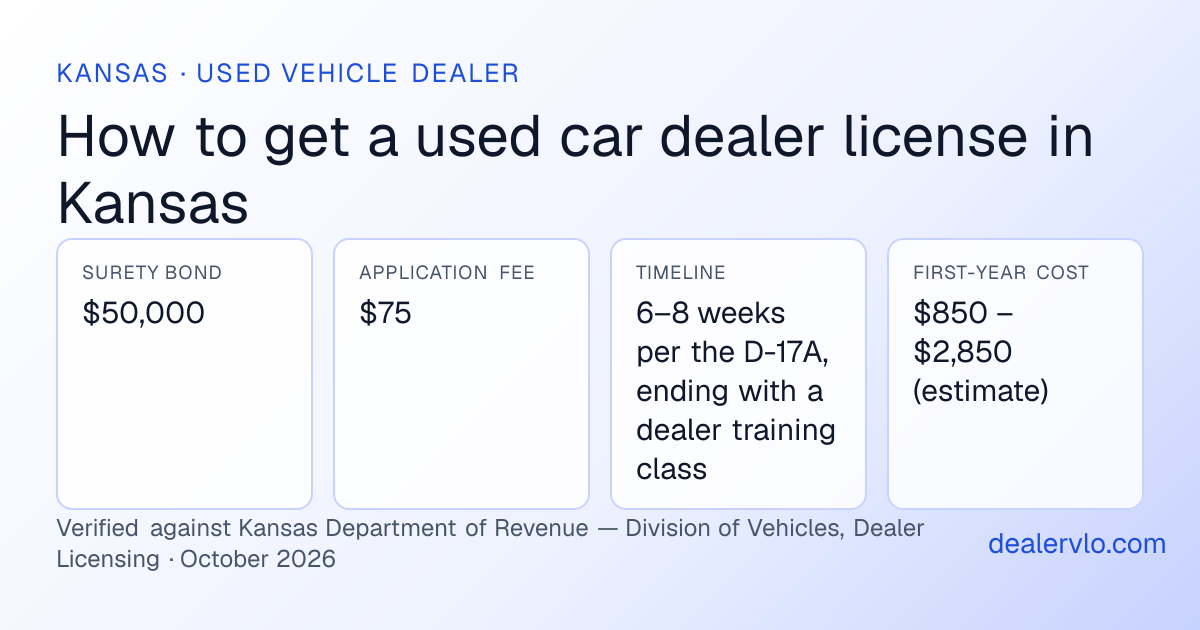
Getting a Used Vehicle Dealer used-car dealer license in Kansas:
- Surety bond required
- $50,000
- Application fee
- $75
- License term
- 1 year (expires December 31)
- Typical timeline
- 6–8 weeks per the D-17A, ending with a dealer training class
- Typical first-year cost
- $850 – $2,850 (estimate)
This guide is informational and does not replace official Kansas requirements. Always verify with Kansas Department of Revenue — Division of Vehicles, Dealer Licensing before applying.
Two numbers worth knowing before you commit. Free calculators dealers actually use — no signup, no email.
Inventory with VIN auto-decode, the deal jacket, and every KS + federal form your sales need. $29/month, free to try — cancel any time.
Who can apply for a Used Vehicle Dealer license
Kansas's used vehicle dealer license lets you buy, sell, and exchange used vehicles. The Kansas Department of Revenue issues it through Dealer Licensing in the Division of Vehicles. The Department says you're a dealer if you buy a vehicle intending to sell it for a profit, or sell 5 or more vehicles in a calendar year. Once licensed, you handle dealer work online through the Dealer Portal, including printing 60-day temporary permits.
In Kansas this is also commonly called an auto dealer license, car dealer license, or motor vehicle dealer license — all the same Used Vehicle Dealer authority to sell used vehicles.
- An established place of business: a building that isn't a residence, owned or leased, set up as an office where you get mail, keep records, and do business
- Lot space to display at least as many vehicles as you have dealer plates (K.S.A. 8-2404(l))
- An operable telephone listed with the phone company in the business name
- Zoning approval for your license type, signed by the city or county zoning agent on the application
- A sign in the business name with durable letters at least 10 inches high, visible from the street (smaller only if local zoning requires it)
- A Kansas sales tax registration in the same business name, and a state tax clearance certificate for every owner and the business
- Your county treasurer's signature confirming you owe no personal property taxes
- A $50,000 surety bond, or an equal deposit with the State Treasurer
- Liability and property damage insurance on your place of business and all inventory, in the business name and address
- Articles of incorporation if you're an entity, or three credit references if you're a sole proprietor or partnership
Step-by-step process
- 1
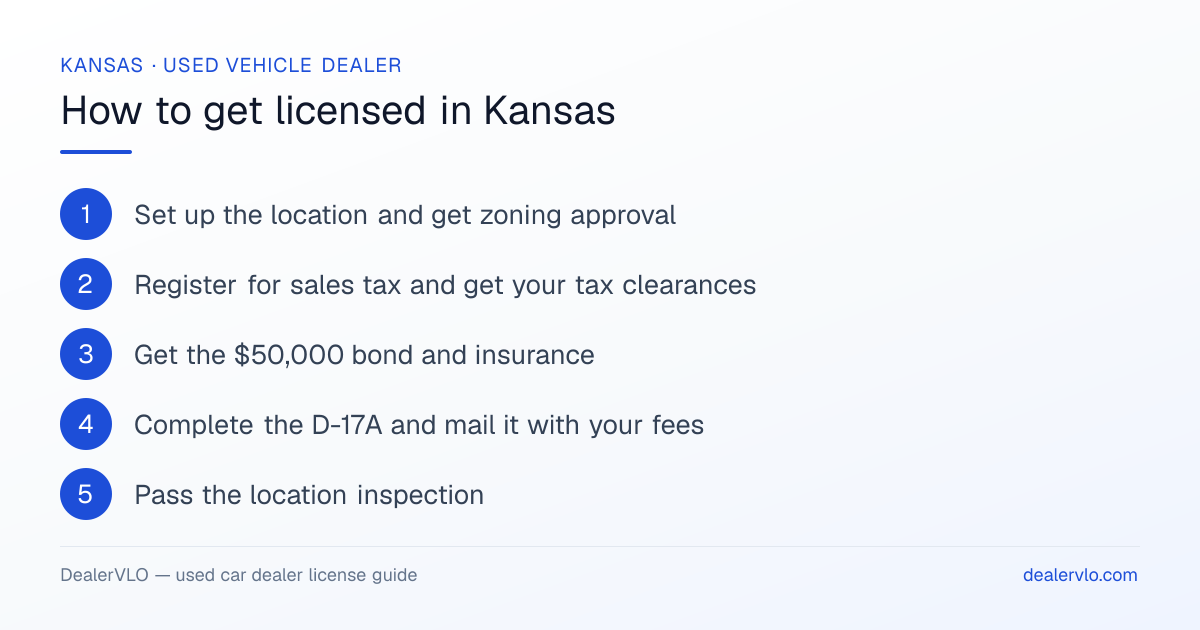
Set up the location and get zoning approval
Find a building or structure, owned or leased, that isn't any part of a residence. It has to work as an office where you receive mail, keep records, and run the business. Add lot space for at least as many vehicles as you'll have dealer plates. A new dealer starts with 3 plates per plate type, so plan on room for at least 3 cars. Get a phone line listed in the business name and put up a sign with durable letters at least 10 inches high. The zoning agent completes and seals the zoning section of the application for your specific license type.
- 2
Register for sales tax and get your tax clearances
Register for a Kansas sales tax number in the exact business name you'll license. The Department won't issue the license until it has a copy of that registration. Then apply online for a Certificate of Tax Clearance for each owner and for the business. A tax clearance isn't the same thing as a Secretary of State letter of good standing. Your county treasurer also signs the application to certify that your personal property taxes are paid.
- 3
Get the $50,000 bond and insurance
K.S.A. 8-2404(i) requires used and new vehicle dealers to carry a $50,000 corporate surety bond from a company authorized in Kansas, written in the name of the State of Kansas. Write it in the corporate name if you're a corporation, all owners' names d.b.a. the dealership if you're a partnership, or your name d.b.a. the dealership if you're a sole owner. Attach the power of attorney. You can deposit $50,000 in cash, Kansas or U.S. bonds, or certificates of deposit with the State Treasurer instead. Your insurer sends a certificate showing public liability and property damage coverage on the business and your inventory.
- 4
Complete the D-17A and mail it with your fees
Fill out the Application for Vehicle Dealer License (D-17A). Check one license type per application. Enclose the original bond with power of attorney, the insurance certificate, tax clearances, your sales tax certificate, articles of incorporation or three credit references on the referees' letterhead, the completed zoning and personal property tax sections, a picture of your location with the sign, and your fees. The license is $75. Dealer plates are $275.50 for the first auto plate and $30.50 for each additional one. Mail it to Kansas Department of Revenue, Attn: Dealer License, PO Box 2369, Topeka, KS 66601-2369.
- 5
Pass the location inspection
Kansas won't license a dealer until the Division inspects and approves the established place of business (K.S.A. 8-2404(k)). The first inspection is free. Each additional inspection needed to approve the location costs $30 (K.S.A. 8-2404(f)), so have the sign, phone, lot, and office ready before you apply.
- 6
Attend dealer training and receive your license
Once your application, documents, and fees are complete and reviewed, Dealer Licensing schedules you for a dealer training class and emails the invitation. You get the license when you finish the class. The D-17A says to allow 6–8 weeks for a new or used dealer application. Set up your Kansas Customer Service Center account early, since most dealer transactions run through the Dealer Portal.
Kansas dealer license types: which one you need
Kansas licenses each dealer type separately, and most cost $75 a year (K.S.A. 8-2404(e)). A dealer licensed for both new and used vehicles pays one $75 fee. Three types matter for a used-car business:
Kansas also bans brokering. No one may act as a broker in advertising, buying, or selling new or used motor vehicles (K.S.A. 8-2404(u)). The narrow exception is a licensed dealer brokering certain used or repossessed recreational vehicles.
- Used vehicle dealer — buys, sells, and exchanges used vehicles, retail and wholesale; $75; $50,000 bond
- Wholesale vehicle dealer — buys vehicles to resell to other dealers; $75; still needs an inspected place of business, and the D-17A doesn't exempt it from the bond
- Auction motor vehicle dealer — runs auctions where licensed dealers sell vehicles to other licensed dealers; $75
- Also licensed separately: new vehicle dealers (franchise required), salvage vehicle dealers, rebuilders, and lending agencies
Can you get a Kansas dealer license without a lot?
Not really. Every dealer that needs an established place of business — and that includes wholesalers — must own or lease lot space to display vehicles at least equal in number to the dealer plates assigned to it (K.S.A. 8-2404(k) and (l)). New dealers start with 3 plates per plate type.
Your office can't be in a residence, either. Kansas defines an established place of business as a building or structure other than one occupied or used, in whole or part, as a residence. The only exception is a farm residence for a dealer who earns at least half their income from farming and deals only in vehicles and equipment that don't need highway registration.
A building can house more than one business if it has suitable space for the dealership (K.S.A. 8-2404(o)). So sharing a commercial building can work. Running a dealership from your house can't.
Buy-here-pay-here in Kansas: the OSBC consumer credit filing
Your dealer license lets you sell. Financing your own sales falls under the Kansas Uniform Consumer Credit Code (UCCC), which the Office of the State Bank Commissioner (OSBC) runs. The UCCC filing rules apply to any creditor entering into consumer credit transactions in Kansas (K.S.A. 16a-6-201).
The OSBC says a Consumer Credit Filer license is required for businesses that extend credit with a finance charge, prepare retail installment contracts and assign them to a third party, or extend credit under a written agreement allowing more than four installments even without a finance charge. You're exempt if you're not regularly engaged in it, which the OSBC defines as extending credit more than 25 times in the preceding calendar year.
File within 30 days after you start the business in Kansas (K.S.A. 16a-6-202), using the OSBC Online site. Filings renew each year by August 31, with a fee set by the administrator for each location (K.S.A. 16a-6-203). Report changes in name, status, or locations within 30 days.
If you carry notes, DealerVLO tracks buy-here-pay-here accounts with a payment schedule and a collections panel. It doesn't lend money, pull credit, or handle any OSBC or Department of Revenue filing. The filing and the contract forms are on you.
Buying at dealer-only auctions with a Kansas license
Many people want a dealer license so they can buy at dealer-only auctions. Kansas has a license built for those sales: the auction motor vehicle dealer, defined in K.S.A. 8-2401 as an auction where licensed dealers sell vehicles they own to other licensed dealers. Each auction still sets its own registration paperwork, so ask what it needs.
To retail what you buy, you need the used vehicle dealer license. A wholesale license only lets you resell to dealers. Kansas-based auctioneers can also sell 72-hour transport permits so a buyer can drive a purchase home with the bill of sale.
Plates follow sales. The handbook says dealers need 5 sales per plate type to keep or increase their plate count, and the Department cuts plates at renewal when reported sales fall short. A license used only for occasional auction buying will lose plates.
Why Kansas dealer applications stall
Dealer Licensing asks for everything in one package. These are the usual holdups:
- A business name that doesn't match the sales tax registration — the Department needs the registration before it issues the license
- Missing tax clearance certificates for any owner or for the business itself
- A zoning section with any blank area, which voids the zoning certification, or zoning that isn't specific to your license type
- The county treasurer's personal property tax certification left unsigned
- A bond written in the wrong name for your entity type, or missing its power of attorney
- An insurance certificate that isn't in the business name and dealership address
- A location that fails inspection: residence, no business phone listing, no sign, or not enough lot space — each extra inspection costs $30
Once you're licensed: the paperwork on every deal
The buyer titles and registers at the county treasurer on the TR-212a, Kansas's Title and Registration Manual Application. Our Kansas TR-212a guide walks through it, including the sales tax split between the dealer's rate and the buyer's home rate. DealerVLO fills the official TR-212a from the deal — buyer, vehicle, price, and trade — with signatures left for ink.
For odometer corrections and transfers without a title, Kansas uses the TR-59. See our Kansas TR-59 guide. It's a fillable PDF, so you upload it to DealerVLO once and map its fields; DealerVLO doesn't ship it as a built-in form. Our odometer disclosure guide covers when a written mileage statement is required.
Kansas also expects monthly dealer sales reports and wants records kept at least four years.
Kansas dealer license cost — fees breakdown
| Item | Amount |
|---|---|
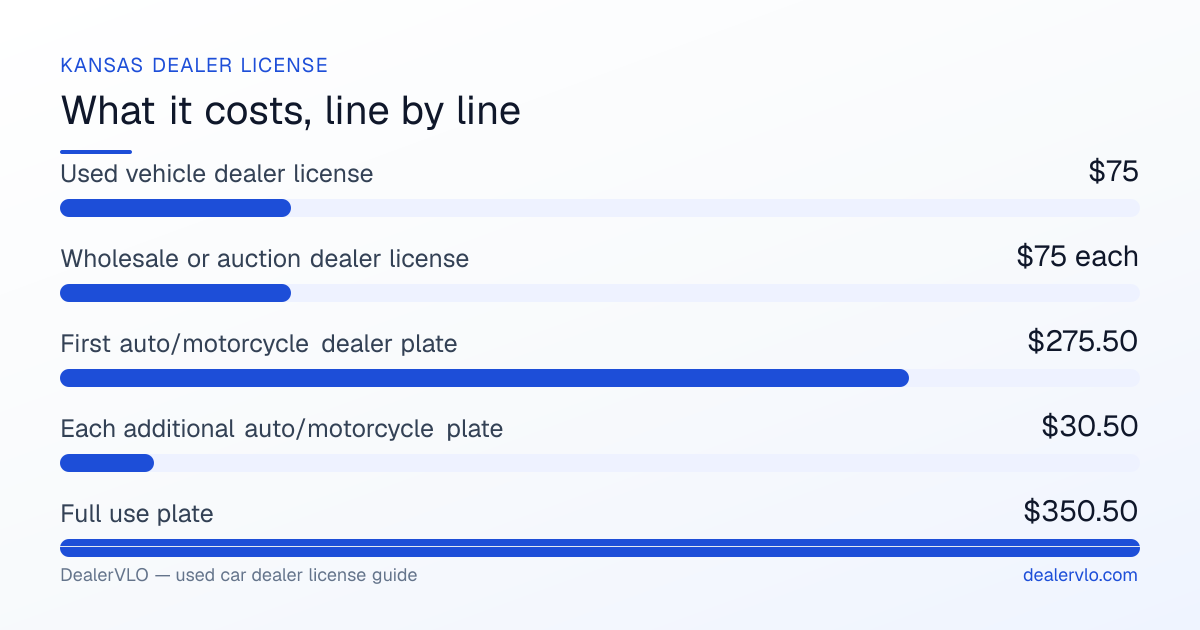
Used vehicle dealer license Per calendar year; $75 total if licensed new and used | $75 |
Wholesale or auction dealer license One license type per application | $75 each |
First auto/motorcycle dealer plate New dealers start with 3 plates per plate type | $275.50 |
Each additional auto/motorcycle plate Fee shown on the D-17A | $30.50 |
Full use plate Limit of 10; one regular plate must be issued first | $350.50 |
Supplemental location (same county) K.S.A. 8-2404(f) | $35 |
Re-inspection of your location First inspection is free | $30 each |
Salesperson license Written exam required; expires June 30 | $25 |
Surety bond premium (estimate) Market estimate of 1–5% on the $50,000 bond; set by your credit | $500 – $2,500/yr |
The Kansas auto dealer bond: $50,000
Kansas requires every used-vehicle dealer to post a $50,000 surety bond. The bond protects buyers from misconduct (odometer fraud, undisclosed liens, deceptive trade practices) and the state from unpaid taxes.
You don't pay the full bond amount up front — you pay an annual premium to a surety company, typically 1–5% (estimate) of the bond's face value. Your actual premium depends on personal credit and business history.
K.S.A. 8-2404(i) requires every used or new vehicle dealer to keep a $50,000 corporate surety bond from a company authorized in Kansas, executed in the name of the State of Kansas for any aggrieved retail or wholesale buyer or seller. The surety pays after the Director determines a Kansas court judgment is final and arose from a violation of the dealer act. The surety can cancel on 30 days' notice, and a lapse can lead to revocation. Instead of a bond, you can deposit at least $50,000 in cash, Kansas or U.S. bonds, or certificates of deposit with the State Treasurer. Bonds or CDs deposited that way stay on deposit at least two years after the title delivery on your last sale. The Department's 2018 handbook still shows $30,000 — the current statute and the D-17A say $50,000. The premium range is a market estimate, not a state figure.
Renewal
All Kansas dealer licenses except salesperson licenses expire December 31. The Department emails renewals in early November, and you renew through the Dealer Portal. A current tax clearance is required, and it takes at least 24 hours to get one on a weekday, so don't wait until December 30. The handbook says a license not renewed by December 31 expires and you start over with an original application. Plate counts are reviewed at renewal against your reported sales.
Common questions
How many cars can you sell in Kansas without a dealer license?+
Fewer than 5 a year, and only your own. The Department of Revenue says a dealer is anyone who buys a vehicle intending to sell it for profit, or sells 5 or more vehicles in a calendar year. The law allows an isolated or occasional sale of your own vehicle without a license. Unlicensed dealing is a misdemeanor with a fine of up to $2,500, per the Dealer Handbook.
Can you get a dealer license in Kansas without a lot?+
No. Every Kansas dealer that needs an established place of business, wholesalers included, must have lot space for at least as many vehicles as its dealer plates. New dealers start with 3 plates per type.
Can I sell cars from home in Kansas?+
Not as a licensed dealer. Kansas defines an established place of business as a building that isn't used, even in part, as a residence. The narrow exception is a farm-based dealer selling only vehicles that don't need highway registration.
Does Kansas require dealer training?+
Yes. After your application is complete and reviewed, Dealer Licensing schedules you for a dealer training class and sends an email invitation. You receive your dealer license when you finish the class. Salespeople must also pass a written exam before their first license.
Is there a wholesale dealer license in Kansas?+
Yes. A wholesaler buys vehicles to resell to dealers. The license is $75, and the wholesaler still needs an inspected established place of business and lot space. The D-17A doesn't list wholesalers among the bond exemptions.
Do I need a separate license to finance cars in-house in Kansas?+
Usually a filing, not a lending license. Under the UCCC, a dealer that regularly sells on credit — with a finance charge, or more than four installments — files as a Consumer Credit Filer with the OSBC within 30 days of starting and renews by August 31. The OSBC exempts creditors who extend credit 25 times or fewer in the prior calendar year.
How long does it take to get a Kansas dealer license?+
The D-17A tells new and used dealer applicants to allow 6–8 weeks. The clock runs from a complete package: bond, insurance, tax clearances, sales tax registration, zoning, and county treasurer sign-off. The last step is the dealer training class, where you get the license.
How much does a Kansas dealer license cost?+
Plan for about $850 – $2,850 (estimate) in the first year. That covers the $75 application fee and the $50,000 surety bond — you pay an annual premium of roughly 1–5% (estimate) of the bond, not the full amount — plus business-formation, facility, and dealer-plate costs. See the full fees breakdown above.
How do I get dealer plates in Kansas?+
Dealer plates are separate from the license itself. Once your Used Vehicle Dealer license is approved, you apply for dealer plates and pay a per-plate fee (listed in the fees breakdown above). You can't obtain dealer plates before the license is issued.
- Kansas Department of Revenue — Dealer Licensing (definition, basic requirements)
- Kansas Department of Revenue — Application for Vehicle Dealer License, D-17A (12/17)
- Kansas Department of Revenue — Dealer Handbook (Rev 6/2018)
- Kansas Department of Revenue — Vehicle forms (D-20B and D-30 bonds, D-19, TR-126)
- K.S.A. 8-2401 — Definitions
- K.S.A. 8-2403 — Licenses required; exceptions
- K.S.A. 8-2404 — License fees, bond, place of business
- Kansas OSBC — Applications/Forms (Consumer Credit Filer)
- K.S.A. 16a-6-201 — UCCC applicability
- K.S.A. 16a-6-202 — Notice filed by consumer credit filers
- K.S.A. 16a-6-203 — Fees
Got your KS dealer license? Run your lot in DealerVLO.
Inventory with VIN auto-decode, the deal jacket, your Kansas title paperwork and the federal forms filled from each deal, and your own dealer website at your custom domain. $29/month. 14-day free trial, cancel any time.
Bond amounts, fees, and form rules change. Get a short email when your state does. No spam, unsubscribe anytime.