How to fill out the TC-656 in Utah
A field-by-field walkthrough of the Utah TC-656 (Vehicle Application for Utah Title and Registration) for licensed used car dealers — what goes in every section, who signs what, and the documents you attach. Verified against the official form as of September 2026.
Filing these every week? DealerVLO fills the TC-656 from the deal you already entered, $29/month flat. See pricing
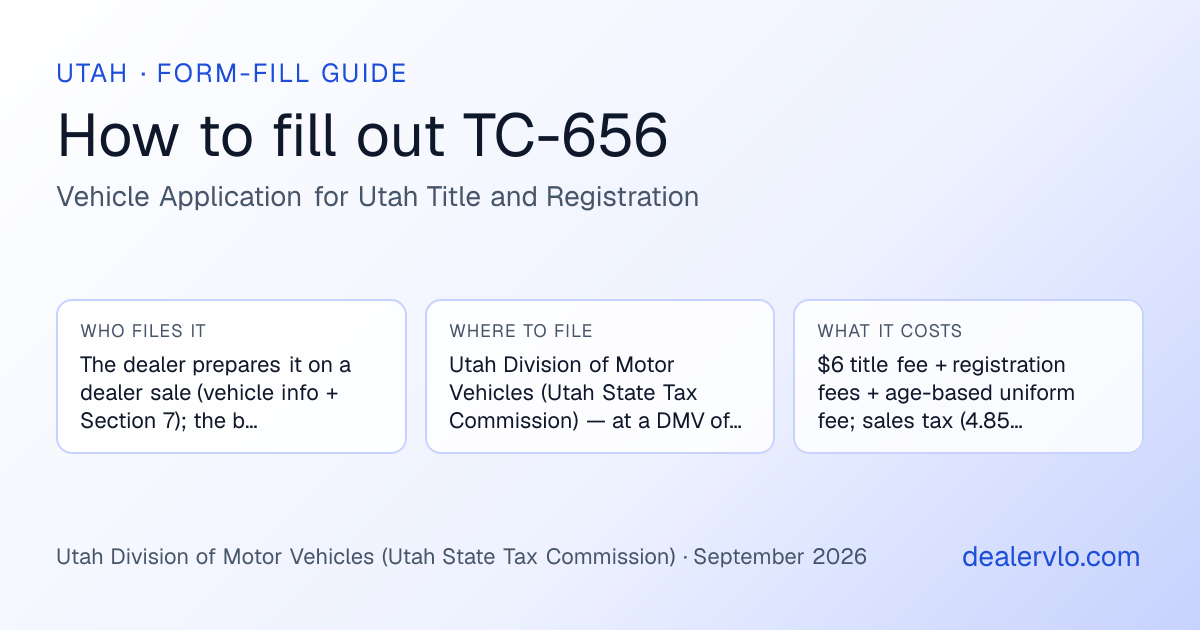
Filling out the UT TC-656 after a sale:
- What it is
- Utah's combined application to title and register a vehicle in the buyer's name
- Who completes it
- The dealer prepares it on a dealer sale (vehicle info + Section 7); the buyer signs as owner
- Where to file it
- Utah Division of Motor Vehicles (Utah State Tax Commission) — at a DMV office or through the dealer
- Processing time
- Dealer must submit within 45 days when a temporary permit is issued
- Cost
- $6 title fee + registration fees + age-based uniform fee; sales tax (4.85% state + local) paid to the dealer
This guide is informational and does not replace the official Utah instructions. Always confirm the current form and procedure with Utah Division of Motor Vehicles (Utah State Tax Commission) before you file.
See the UT TC-656 filled — from just a VIN
Enter a VIN, the buyer's name, and the price. We decode the vehicle and drop it onto the actual Utah TC-656 — the same fill DealerVLO produces from a deal. Watermarked preview; nothing is saved.
What the TC-656 is and why it matters
TC-656 is Utah's Vehicle Application for Utah Title and Registration — the form that puts a vehicle in the buyer's name and gets it plated. On a dealer sale, the dealer completes the vehicle and dealer sections, the buyer signs as owner, and the dealer submits it to the DMV with the endorsed title within 45 days of a sale on a temporary permit.
The Utah quirk that trips people up is where the sales tax goes. On a vehicle bought from a licensed dealer, the dealer collects the sales tax and pays it on its own Sales and Use Tax Return — at the combined rate for the dealer's location, not the buyer's. The TC-656 only records the purchase price, and the dealer signs a certification in Section 7 that the sale complied with Utah's sales-tax reporting rules. What the DMV collects with the form is the title fee, registration fees and the age-based uniform fee. This guide walks the current (Rev. 7/26) form section by section.
TC-656 is issued by the Utah State Tax Commission, whose Division of Motor Vehicles (DMV) handles titles and registration. It's one combined title-and-registration application with a dealer-only block at the end (Section 7). On a dealer sale that issues a temporary permit, Utah law gives the dealer 45 days to submit the endorsed title (or MCO) and everything needed to title and register the vehicle in the buyer's name. Note that on a dealer sale the sales tax is not paid with this form — the dealer remits it on its own Utah sales and use tax return.
Documents to have before you start
Gather these before you complete the TC-656. A missing attachment is the number-one reason the Utah Division of Motor Vehicles (Utah State Tax Commission) bounces a title application back.
- The endorsed title (or MCO for a new vehicle) — Assigned to the buyer. Utah requires the dealer to submit it with all documents needed to title and register the vehicle in the new owner's name.
- Odometer disclosure — The reading also goes on TC-656 Section 3. Use the title's disclosure or the separate Odometer Disclosure Statement (TC-891) when one is required.
- Buyer's ID number — TC-656 requires an ID number for each owner — driver license, state ID, passport, FEIN, military or foreign ID.
- Lienholder details, if financed — Lienholder name, FEIN (or driver license number for an individual), email and mailing address for Section 5.
- Temporary permit information — The permit number and issue date go in Section 7. When a permit is issued, the dealer has 45 days from the sale to submit the title work.
- Emissions certificate, if the county requires one — Required only where the vehicle will be registered in a county with an emissions program — confirm with the Utah DMV.
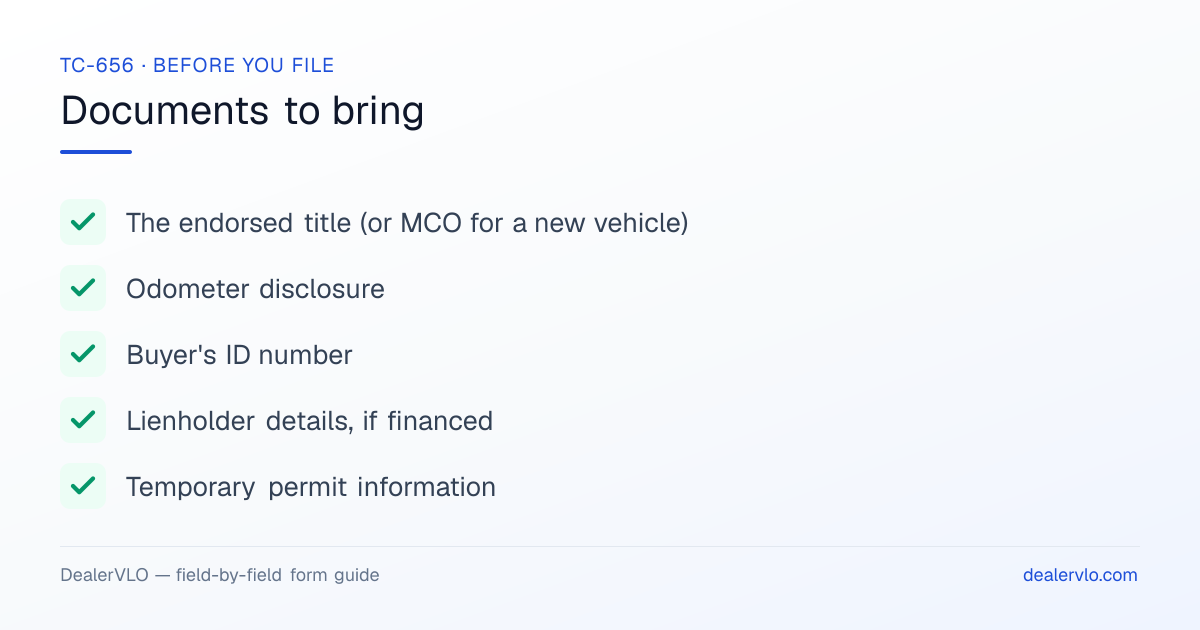
TC-656, section by section
Type of application (top of form)
Check what you're asking the DMV to do. A typical used-car retail sale is a change of ownership with registration; a new vehicle off an MCO is a new title. Salvage, non-repairable, corrected title and dismantling permit are their own boxes — don't check them on an ordinary retail deal.
| Field | Who fills it |
|---|---|
New title / Registration / Change of ownership Check every box that applies — e.g. change of ownership + registration on a retail sale. | You (dealer) |
Change of lien-holder / Corrected title | You (dealer) |
Salvage title / Non-repairable title / Dismantling permit Only for branded or dismantled vehicles. | You (dealer) |
Section 1: New Owner Information (and Section 2 for a lease)
The buyer, exactly as they'll appear on the title. Each owner needs an ID number — TC-656 marks it "required" — plus the state or country that issued it and the ID type. With a co-owner, check And or Or for the relationship; there's a box to attach a sheet if there are more than two owners. Section 2 (New Lessee Information) is the same layout and is only used on a lease — skip it on a retail sale.
| Field | Who fills it |
|---|---|
Primary owner's relationship to co-owner (And / Or) | Buyer |
Name (last, first, middle initial, or business name) | Buyer |
Email address | Buyer |
ID number, state/country, ID type Required. Driver license, passport, state ID, FEIN, military ID or foreign ID. | Buyer |
Street address, city, state, ZIP | Buyer |
Mailing address (if different) | Buyer |
Co-owner name, ID and addresses | Buyer |
Section 2: New Lessee Information Lease deals only. | You (dealer) |
Section 3: Vehicle Information, vehicle type and odometer
The form itself warns that missing or incorrect information may get the application rejected. The VIN must match the title and the vehicle. Purchase price is the price on the deal — it's what the sale is reported at, so match the buyer's order. Check the vehicle type (passenger, light truck, van or utility for most retail units), then enter the odometer without tenths and certify whether it's the actual mileage, exceeds mechanical limits, or is not actual.
| Field | Who fills it |
|---|---|
Year, make, model, color | You (dealer) |
Vehicle Identification Number (VIN) Must match the title and the vehicle. | You (dealer) |
Cylinders, fuel type, body style | You (dealer) |
Unit number / fleet number Fleet units only. | You (dealer) |
Branded title brand type If the title carries a brand. | You (dealer) |
Commercial use? / Farm use? | Buyer |
MSRP | You (dealer) |
Purchase price Match the buyer's order. | You (dealer) |
Vehicle type Passenger, light truck, van or utility for most cars and pickups. | You (dealer) |
Odometer (no tenths), miles or kilometers | You (dealer) |
Odometer certification Actual / exceeds mechanical limits / not actual (discrepancy). | You (dealer) |
Section 4: Registration Information
Pick the license plate type — Title only if the buyer isn't registering, one of the standard Utah designs, or Transfer to move an existing plate. Personalized plates are requested later through the Tax Commission's online portal, after the initial plate is issued. Enter a plate-mailing address or the vehicle's physical address only if they differ from the owner's street address. The optional donation boxes are the buyer's choice.
| Field | Who fills it |
|---|---|
License plate type Title only, a standard design, Transfer (enter plate), or Other. | Buyer |
Address for mailing the license plate (if different) | Buyer |
Physical address of vehicle (if different) | Buyer |
Optional contributions Voluntary — added to the fees if checked. | Buyer |
Section 5: Lien Holder Information
If the buyer financed, enter the lienholder so the lien is recorded on the Utah title. The form asks for the lienholder's FEIN — or a driver license number if the lienholder is an individual — plus an email and mailing address. Leave it blank on a cash deal.
| Field | Who fills it |
|---|---|
Lien holder's name | You (dealer) |
FEIN (or driver's license number, if individual) | You (dealer) |
Email address | You (dealer) |
Mailing address, city, state, ZIP | You (dealer) |
Section 6: Owner Signature(s)
The buyer (and any co-owner) signs and dates, declaring they own the vehicle, that the information is accurate, and that they'll carry the insurance Utah law requires to drive it. This is the buyer's certification — don't sign it for them.
| Field | Who fills it |
|---|---|
Owner's signature + date | Buyer |
Co-owner's signature + date | Buyer |
Section 7: Purchase and Dealer Information (Utah dealership use only)
The dealer block — and where Utah's sales-tax rule lives. By signing, the dealer certifies the vehicle is accurately described and was delivered to the buyer, that the dealership is licensed under Utah Code Title 41, Chapter 3, Part 2, and that the transaction complied with the sales-tax reporting requirements of UCA 59-12-107. In practice that means the dealer collected the sales tax and reports it on its own Sales and Use Tax Return, at the combined state + local rate for the dealer's location. Utah's trade-in credit only applies to a trade that's part of the same transaction — same time, same contract or buyer's order — and the dealer's document-service fee is taxable. Also record whether the title being surrendered is paper or an e-title, the temporary permit number and issue date, and whether the unit is new or used.
| Field | Who fills it |
|---|---|
The vehicle title is: Paper title / E-title | You (dealer) |
Purchase date | You (dealer) |
Dealer number | You (dealer) |
Permit number + permit issue date The temporary permit issued at delivery — issuing one gives you 45 days to submit. | You (dealer) |
New / Used | You (dealer) |
Dealer/authorized representative's signature + date Certifies sales-tax compliance under UCA 59-12-107. | You (dealer) |
UT Sales tax & title fee calculator
Free · no signup · updates as you type
Utah's state rate is 4.85%; local option, county, transit and other local taxes stack on top, so enter the combined local portion for the DEALER's location (combined rates in the Tax Commission's October 1, 2026 chart start at 6.35%, so the local portion is at least 1.50%). Resort-community tax does not apply to motor vehicle sales. On a dealer sale the dealer collects this tax and pays it on its own sales tax return — it isn't paid at the DMV. Trade-in credit applies only to a trade in the same transaction; the doc fee is taxable. Title $6. Registration fees and the age-based uniform fee (by model year for passenger vehicles and light trucks — $10 to $150 in the 2026 table) go in the plate/registration box. Confirm with the Utah DMV fee estimator.
Stop re-keying this onto the TC-656.
DealerVLO runs this math on every deal and drops it — with the VIN, buyer, and sale price — straight onto the official UT TC-656, the bill of sale, and the FTC forms. One screen, no re-keying.
14-day free trial — a card starts it, no charge until day 14, then $29/month. Cancel any time.
The TC-656 is one car's paperwork. A 20-second read on your lot, and the tax-and-fee math for the whole deal — built for dealers, no signup. Free calculators dealers actually use — no signup, no email.
DealerVLO fills the official Utah TC-656 straight from your deal — VIN-decoded vehicle, buyer, co-buyer, and sale price already in place. $29/month, free to try — cancel any time.
Common TC-656 mistakes that cause rejections
On a vehicle bought from a Utah dealer, the sales tax rate is based on the dealer's location. (The buyer's address only sets the rate on a private-party purchase.) Look up the combined rate for your location on the Tax Commission's rate chart — it changes quarterly.
Utah excludes a trade-in allowance from the taxable price only when the trade and the purchase are one transaction between the same two parties — done at the same time and documented on the same contract or buyer's order. A credit promised toward a future purchase doesn't qualify.
The Tax Commission lists document service fees and dealer preparation fees as taxable. They belong in the amount you figure the sales tax on. Title, registration, uniform-fee and permit amounts you pass through to the Tax Commission are not taxable.
When you issue a temporary permit, Utah law requires you to submit the endorsed title (or MCO) and all documents needed to title and register the vehicle within 45 days. If you don't issue a permit, the negotiable title must go to the buyer within 48 hours.
TC-656 marks the ID number "required" for every owner, along with the issuing state/country and ID type. A missing ID — or a missing VIN, price or odometer entry — can get the application rejected.
Common questions
What form do I use to title and register a car in Utah?+
Form TC-656, the Vehicle Application for Utah Title and Registration, issued by the Utah State Tax Commission's Division of Motor Vehicles. It's one combined application; on a dealer sale the dealer completes the vehicle and dealer sections and the buyer signs as owner.
Where do I get Utah form TC-656?+
TC-656 is published free as a fillable PDF by the Utah State Tax Commission on its forms site (tax.utah.gov/forms). The download button at the top of this guide links straight to the official PDF.
How much is sales tax on a car in Utah?+
Utah's state rate is 4.85%, and local taxes stack on top, so the combined rate depends on location — the Tax Commission's October 1, 2026 chart starts at 6.35% and Salt Lake City is 8.45%. On a car bought from a dealer, the rate for the dealer's location applies. Resort-community tax doesn't apply to motor vehicle sales.
Who pays the sales tax on a Utah dealer sale?+
The buyer pays it to the dealer, and the dealer remits it on its own Utah Sales and Use Tax Return. It is not paid at the DMV with the TC-656. Sales tax on a vehicle bought from someone other than a licensed dealer is paid by the buyer when titling.
Does a trade-in reduce Utah sales tax?+
Yes. A trade-in allowance is excluded from the taxable price when the trade and the purchase are a single transaction between the same two parties — at the same time and on the same contract or buyer's order. Trades of services, real-estate equity, consignment items and credits toward a future purchase don't qualify.
How much is the Utah title fee and uniform fee?+
A new Utah title is $6. Passenger cars, light trucks, SUVs and vans also pay an age-based uniform fee in lieu of property tax at registration; the 2026 table runs from $150 for 2024–2026 models down to $10 for 2014 and older. Registration fees are extra and vary by vehicle, fuel type and county.
How long does a Utah dealer have to submit title paperwork?+
45 days. A dealer that issues a temporary permit must submit the endorsed title (or MCO) and all documents needed to title and register the vehicle in the buyer's name to the Motor Vehicle Division within 45 days. If no permit is issued, the negotiable title goes to the buyer within 48 hours.
Is there software that fills out the TC-656 automatically?+
Yes. Dealer management software like DealerVLO fills the Utah TC-656 from the deal you already entered — the VIN-decoded vehicle, buyer, co-buyer, lienholder, and sale price are placed for you instead of hand-writing them. For most states that's the official DMV form itself; where a state issues its form only through its own dealer portal, you get a print-ready worksheet with every value already in place. It's $29/month flat with a 14-day free trial, and the same deal also generates your federal documents (Bill of Sale, FTC Buyers Guide, odometer disclosure) and any other state's title forms.
Stop filling out the TC-656 by hand.
DealerVLO fills the official UT TC-656 straight from your deal jacket — VIN-decoded vehicle, buyer, co-buyer, lienholder, and sale price already in place. Print, sign, and file in about 90 seconds. $29/month. 14-day free trial, cancel any time.
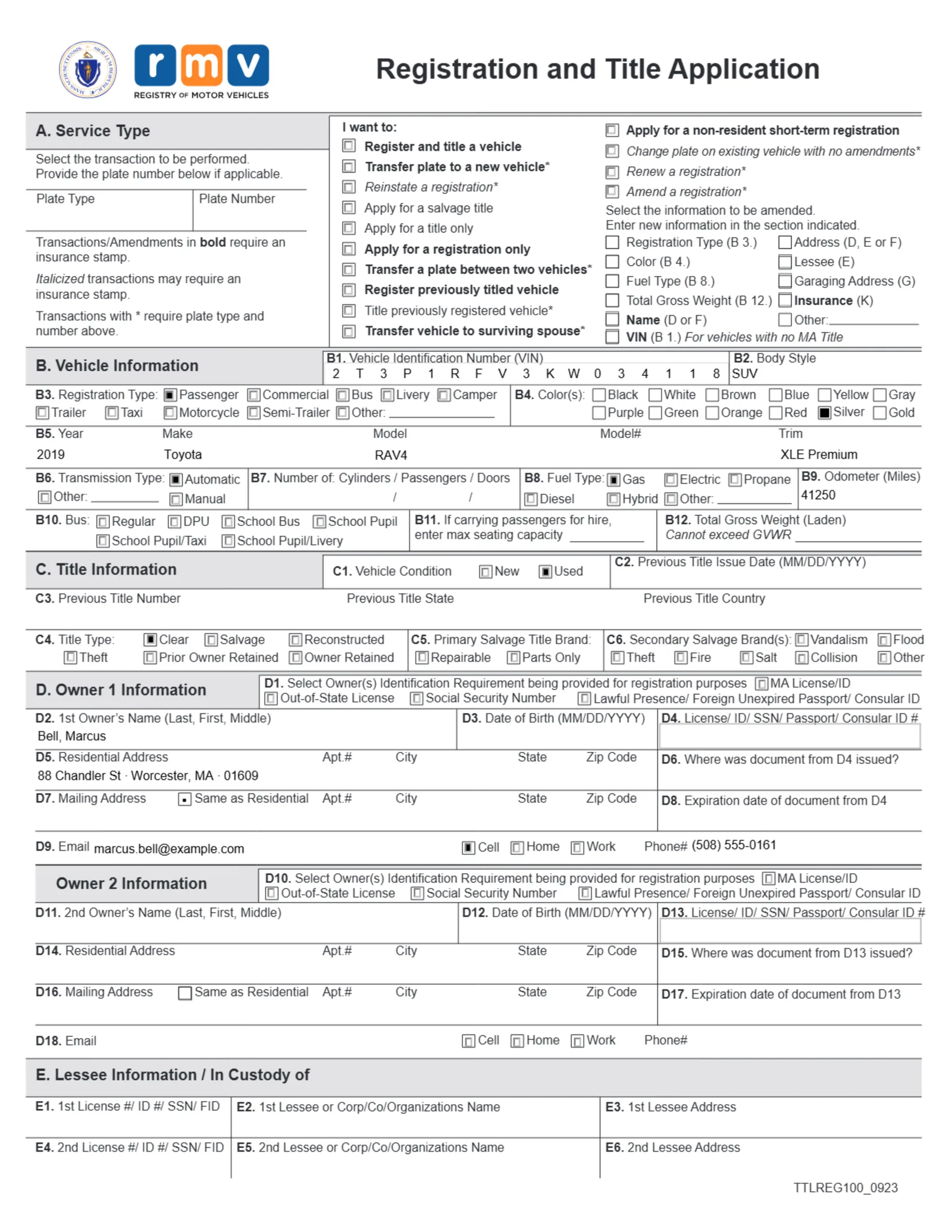
Curious how it works? See how DealerVLO auto-fills every dealer document — bill of sale, FTC Buyers Guide, odometer disclosure, and state title & registration forms for all 50 states, from one deal.
Bond amounts, fees, and form rules change. Get a short email when your state does. No spam, unsubscribe anytime.