How to fill out the DMV-43 in West Virginia
A field-by-field walkthrough of the West Virginia DMV-43 (Odometer Disclosure Statement (Dealers)) for licensed used car dealers — what goes in every section, who signs what, and the documents you attach. Verified against the official form as of October 2026.
Don't waste another second filling out the West Virginia DMV-43.
Upload the fillable DMV-43 to DealerVLO once, and it fills the form from every deal instantly.
Filing these every week? Upload the DMV-43 to DealerVLO once and it fills from every deal you enter, $29/month flat. See pricing
Switching from another DMS? Compare DealerVLO to DealerCenter, Frazer, or Lot Wizard.
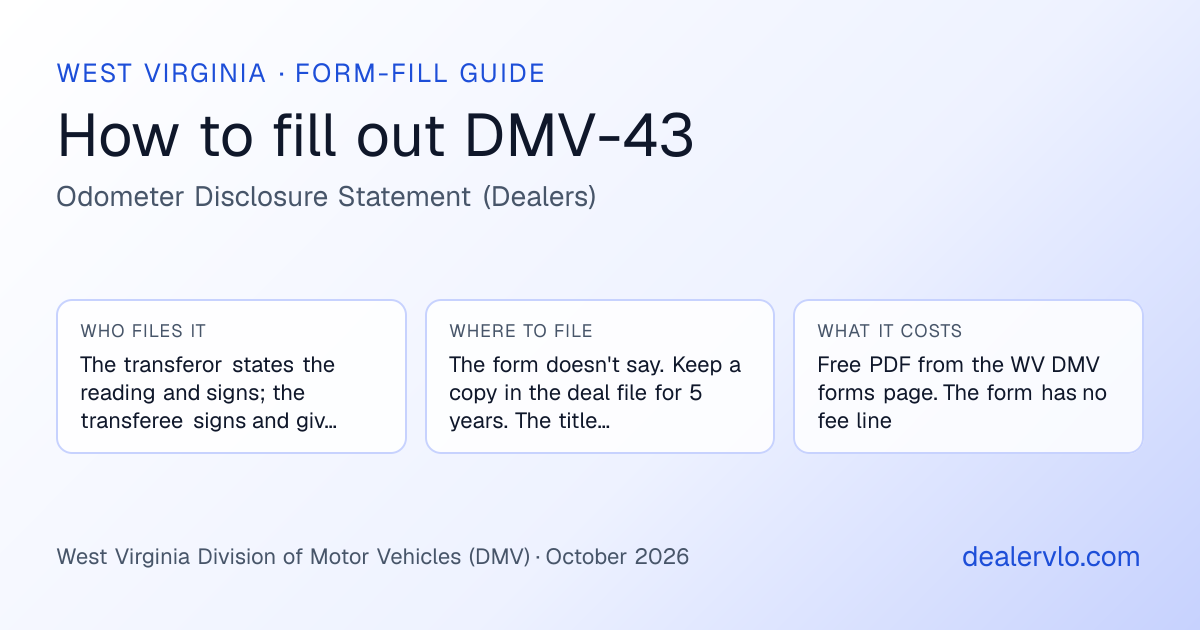
Filling out the WV DMV-43 after a sale:
- What it is
- West Virginia's dealer odometer disclosure statement. The DMV describes it as used by dealers to disclose a vehicle's odometer at time of sale
- Who completes it
- The transferor states the reading and signs; the transferee signs and gives their name and address. On a retail sale, the transferor is your dealership
- Where to file it
- The form doesn't say. Keep a copy in the deal file for 5 years. The title application (DMV-1-TR) goes to the DMV, usually through VRS
- Processing time
- None of its own. Title work runs on the DMV-1-TR
- Cost
- Free PDF from the WV DMV forms page. The form has no fee line
This guide is informational and does not replace the official West Virginia instructions. Always confirm the current form and procedure with the West Virginia Division of Motor Vehicles (DMV) before you file.
The DMV-43 is one car's paperwork. A 20-second read on your lot, and the tax-and-fee math for the whole deal — built for dealers, no signup. Free calculators dealers actually use — no signup, no email.
Upload the fillable West Virginia DMV-43 to DealerVLO once. It maps the fields, then fills the form from every deal — buyer, co-buyer, the vehicle you sold, and your dealership already in place. $29/month, free to try — cancel any time.
What the DMV-43 is and why it matters
West Virginia has two odometer forms, and searches for the "WV DMV odometer statement" land on both. The DMV-43 is the dealer's Odometer Disclosure Statement, with a customer name and stock number at the top. The DMV-TM-1 is the DMV's Odometer Certification for titles that have no odometer section. On most deals, neither replaces the title: the DMV says the seller records the exact mileage in the title's assignment section.
This guide walks every box on the DMV-43, explains where the DMV-TM-1 fits and when it needs a notary, and covers the exemptions and the five-year record rule from West Virginia Code §17A-3-12a and the federal rules.
The WV DMV forms page lists two odometer forms. DMV-43, Odometer Disclosure Statement (Dealers), is described as the dealer's statement, "used by dealers to legally disclose a vehicle's odometer at time of sale." It still prints as rev. 1/91. DMV-TM-1, the Odometer Certification (Rev. 05/21), is the general form the DMV points to when a title has no odometer section. Both are fillable PDFs. You can upload the DMV-43 to DealerVLO once under Settings → Forms and map the customer name, stock number, mileage, vehicle, and both parties' names and addresses. Make sure the two checkboxes point at the matching odometer statuses. Auto-map only suggests a checkbox when its PDF name says which status, so you may have to set them yourself. The signature and printed-name lines have no boxes, so those go on in ink. The body type box is very narrow, so a short body code fits best.
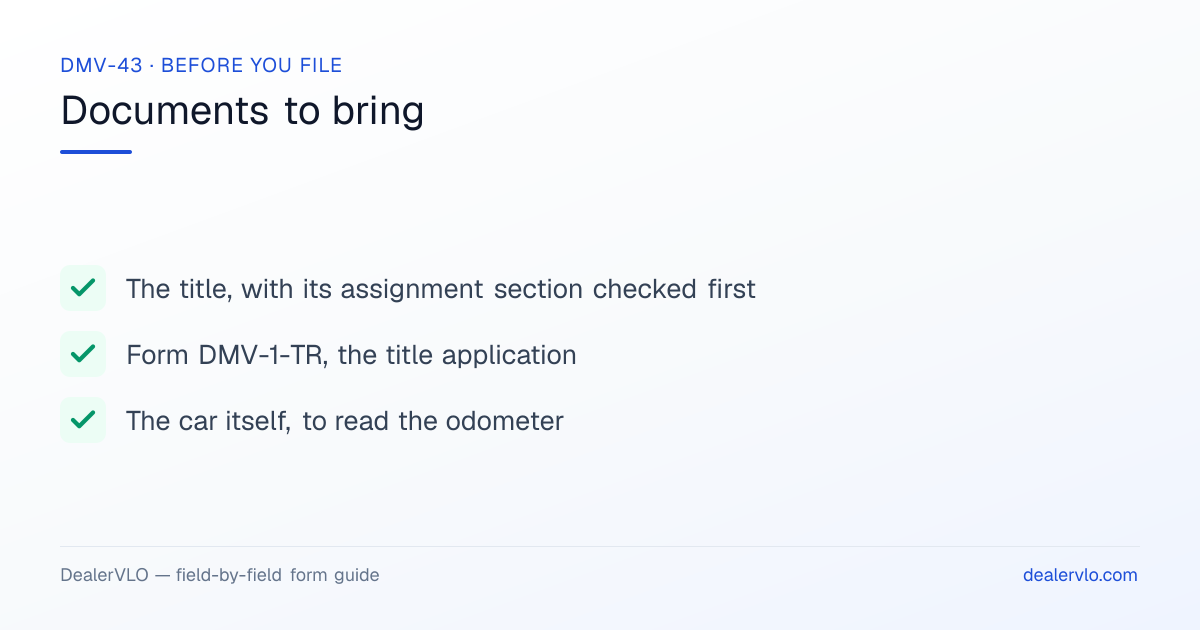
Documents to have before you start
Gather these before you complete the DMV-43. A missing attachment is the number-one reason the the West Virginia Division of Motor Vehicles (DMV) bounces a title application back.
- The title, with its assignment section checked first — The DMV says that when a vehicle is sold, the seller records the exact mileage in the title's assignment section, and to use DMV-TM-1 if the title lacks that section.
- Form DMV-1-TR, the title application — Its Dealer Certification repeats the odometer reading and the two exception boxes. Use the same number. See the DMV-1-TR guide.
- The car itself, to read the odometer — Both forms say no tenths.
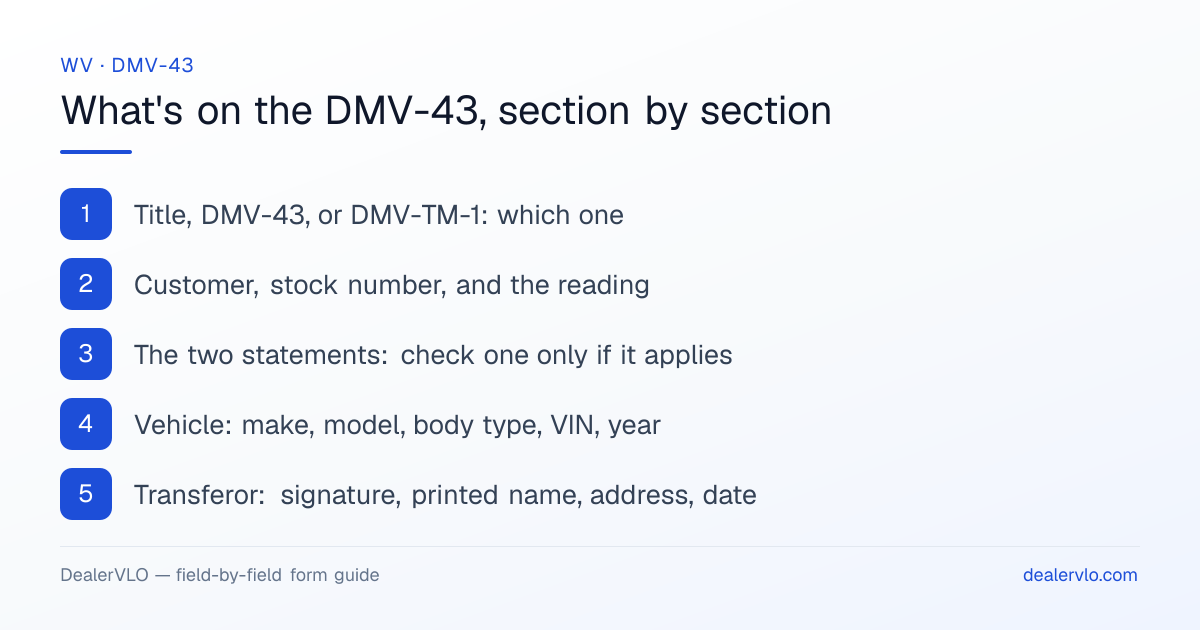
DMV-43, section by section
Title, DMV-43, or DMV-TM-1: which one
Start with the title. The DMV's titles page says the seller records the exact mileage in the assignment section of the title, and if the title lacks that section, to use Form DMV-TM-1. The DMV-TM-1 itself says every West Virginia title issued after January 1, 1991 carries the odometer certification on the back, so it's only needed on an older title or a title without the section. Federal rule 49 CFR 580.5(c) agrees: a titled owner discloses on the title, not on a separate document. The DMV-43 is the DMV's dealer form. The DMV describes it only as the dealer's statement, used to disclose the odometer at time of sale, and doesn't publish a rule for when it's required. West Virginia Code §17A-3-12a(g) adds one more case: a vehicle not previously titled in West Virginia, or with a title issued before January 1, 1991, must be transferred on a form the commissioner prescribes, signed by both owner and purchaser.
| Field | Who fills it |
|---|---|
WV title issued after January 1, 1991 Disclose in the title's assignment section. | You (dealer) |
Title without an odometer section The DMV says use DMV-TM-1. | You (dealer) |
Dealer's own odometer statement at sale DMV-43, per the DMV's description. | You (dealer) |
Customer, stock number, and the reading
Above the box are two dealer lines: the customer's name and the stock number. Then the statement: "I, [transferor's name, print], state that the odometer now reads [miles] (no tenths) miles and to the best of my knowledge that it reflects the actual mileage of the vehicle described below, unless one of the following statements is checked." On a retail sale the transferor is your dealership. There's no box for actual mileage. If the reading is actual, leave both checkboxes empty.
| Field | Who fills it |
|---|---|
Customer's name The buyer on the deal. | You (dealer) |
Stock no. | You (dealer) |
Transferor's name (print) Your dealership on a retail sale. | You (dealer) |
Odometer now reads (no tenths) miles Must match the title and DMV-1-TR. | You (dealer) |
The two statements: check one only if it applies
Statement (1) certifies the reading reflects mileage in excess of the odometer's mechanical limits, meaning it rolled over. Statement (2) certifies the reading is NOT the actual mileage, followed by "WARNING ODOMETER DISCREPANCY." West Virginia Code §17A-3-12a(a) uses the same three outcomes as the federal rule: actual, in excess of mechanical limits, or not actual by more than calibration error. Under 49 CFR 580.5(e), check (2) only when you know the reading is off by more than calibration error. The DMV brands the new title to reflect the prior owner's certification, so what you check follows the car.
| Field | Who fills it |
|---|---|
(1) Mileage in excess of mechanical limits | You (dealer) |
(2) Odometer reading is NOT the actual mileage Odometer discrepancy. Brands the next title. | You (dealer) |
Vehicle: make, model, body type, VIN, year
A small box holds make, model, and body type, then the VIN and year. Both §17A-3-12a(a) and 49 CFR 580.5(c) require the make, model, year, body type, and VIN. Copy them from the title so they match the DMV-1-TR. The body type space is short; use the title's body code.
| Field | Who fills it |
|---|---|
Make / Model / Body type | You (dealer) |
Vehicle identification number All 17 characters, matching the title. | You (dealer) |
Year | You (dealer) |
Transferor: signature, printed name, address, date
The transferor signs on the X line, prints the name, gives a street address and city, state, and ZIP, and enters the date of statement. On a retail sale that's your dealership and its business address. Under 580.5(c), if there's more than one seller only one needs to sign, and the disclosure must carry the signer's printed name. The form's signature and printed-name lines have no fillable boxes, so they're done by hand.
| Field | Who fills it |
|---|---|
Transferor's signature (X) Ink. | You (dealer) |
Printed name No fillable box. Print by hand. | You (dealer) |
Transferor's address (street), city, state, ZIP | You (dealer) |
Date of statement The date of transfer. | You (dealer) |
Transferee: signature, names, address
The transferee signs on the second X line and prints their name, then the form asks for the transferee's name and street address, city, state, and ZIP. On a retail sale that's your buyer. Federal rule 580.5(f) has the buyer sign after receiving the seller's signed statement and make a copy available to the seller. You can fill the buyer's name and address from the deal. The buyer signs their own line.
| Field | Who fills it |
|---|---|
Transferee's signature (X) Ink. | Buyer |
Printed name No fillable box. | Buyer |
Transferee's name You can fill it from the deal. | Buyer |
Transferee's address (street), city, state, ZIP | Buyer |
The DMV-TM-1, exemptions, and the 5-year rule
The DMV-TM-1 Odometer Certification has the same core boxes plus the vehicle's gross weight. The seller's "not the actual mileage" box is marked NOTARY REQUIRED, and a notary section at the bottom is for use only when the DMV requests it due to a title or odometer discrepancy. The form says the buyer keeps it and submits it with the title to apply for a new title. It also says it isn't needed for model year 2010 and older vehicles, non-motorized vehicles, or vehicles over 16,000 pounds gross weight, which matches the federal exemptions in 49 CFR 580.17. Model year 2011 and newer stay covered for 20 years. For records, §17A-3-12a(d) and 49 CFR 580.8 both require dealers to keep a copy of every odometer statement they issue and receive for five years at their primary place of business, in an order that permits systematic retrieval.
| Field | Who fills it |
|---|---|
DMV-TM-1: not actual mileage The form marks it NOTARY REQUIRED. | You (dealer) |
Trade-in: customer signs as transferor Your dealership signs as transferee. | Buyer |
Copy of every statement issued and received, kept 5 years §17A-3-12a(d) and 49 CFR 580.8. | You (dealer) |
Common DMV-43 mistakes that cause rejections
The DMV says the seller records the mileage in the title's assignment section. A separate form doesn't replace a title that has one.
The DMV-TM-1 says titles issued after January 1, 1991 carry the odometer certification on the back. Use that instead.
Neither form has an actual-mileage box. Leave both statements empty unless the reading rolled over or isn't the actual mileage.
The DMV-1-TR's Dealer Certification repeats the odometer reading. Use the same whole-mile number everywhere.
§17A-3-12a(d) covers statements dealers receive as well as issue. Keep both for five years.
Common questions
What is the WV DMV odometer statement?+
On most West Virginia sales it's the odometer disclosure in the title's assignment section. The DMV also publishes two separate forms: DMV-43, the Odometer Disclosure Statement for dealers, and DMV-TM-1, the Odometer Certification, which the DMV says to use when a title lacks an odometer section.
Where do I get the West Virginia odometer statement PDF?+
Both are free on the WV DMV forms page at dmv.wv.gov/forms. The download button at the top of this guide links to the DMV-43. The DMV-TM-1 is listed on the same page as Odometer Certification.
Does a West Virginia odometer statement need to be notarized?+
The DMV-43 has no notary block. The DMV-TM-1 marks its "not the actual mileage" box NOTARY REQUIRED, and its notary section is for use only when the DMV requests it due to a title or odometer discrepancy.
Which vehicles are exempt from odometer disclosure in West Virginia?+
The DMV-TM-1 lists model year 2010 and older, non-motorized vehicles, and vehicles over 16,000 pounds gross weight. That matches the federal rule in 49 CFR 580.17, under which model year 2011 and newer vehicles need a disclosure until they're 20 years old.
What's the penalty for a false odometer statement in West Virginia?+
West Virginia Code §17A-3-12a makes a violation with intent to defraud a misdemeanor: a fine of $200 to $1,000, up to six months in county jail, or both. Both forms also warn that failing to complete them or giving false information may result in fines and/or imprisonment.
How long do West Virginia dealers keep odometer statements?+
Five years. §17A-3-12a(d) and 49 CFR 580.8 both require a copy of every odometer statement a dealer issues and receives, kept at its primary place of business in an order that permits systematic retrieval.
Is there software that fills out the DMV-43 automatically?+
Yes. The West Virginia DMV-43 is a fillable PDF, so dealer management software like DealerVLO can fill it for you: upload the blank form once, DealerVLO detects its fields and suggests a mapping you confirm, and from then on it fills from every deal you enter — the buyer, co-buyer, the vehicle you sold, and your dealership's details already in place. It's $29/month flat with a 14-day free trial, and the same deal also generates your federal documents (Bill of Sale, FTC Buyers Guide, odometer disclosure) and your state title paperwork.
Stop filling out the DMV-43 by hand.
Upload the fillable WV DMV-43 once. DealerVLO detects its fields, you confirm the mapping, and every deal after that prints it with the buyer, co-buyer, vehicle, and your dealership already in place. $29/month. 14-day free trial, cancel any time.
Curious how it works? See how DealerVLO auto-fills every dealer document — bill of sale, FTC Buyers Guide, odometer disclosure, and state title & registration forms for all 50 states, from one deal.
Bond amounts, fees, and form rules change. Get a short email when your state does. No spam, unsubscribe anytime.