How to get a used car dealer license in Wisconsin
A practical walkthrough of the Motor Vehicle (Retail) Dealer License application — fees, bond, timeline, and what to expect at each step. Verified against the official agency as of October 2026.
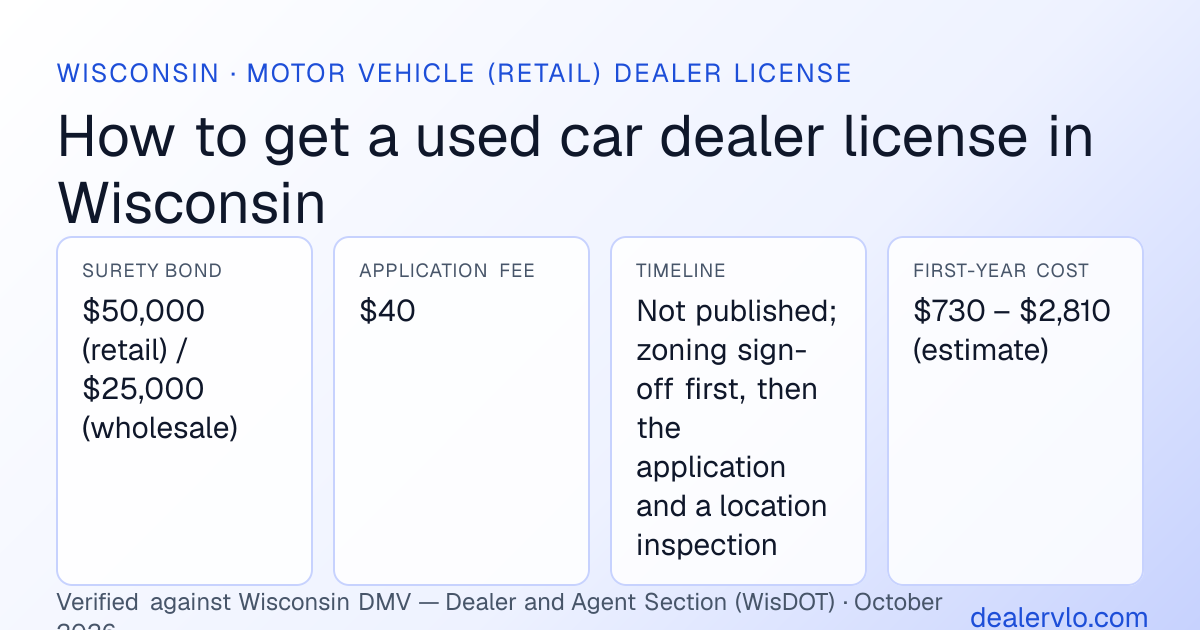
Getting a Motor Vehicle (Retail) Dealer License used-car dealer license in Wisconsin:
- Surety bond required
- $50,000 (retail) / $25,000 (wholesale)
- Application fee
- $40
- License term
- 2 years
- Typical timeline
- Not published; zoning sign-off first, then the application and a location inspection
- Typical first-year cost
- $730 – $2,810 (estimate)
This guide is informational and does not replace official Wisconsin requirements. Always verify with Wisconsin DMV — Dealer and Agent Section (WisDOT) before applying.
Two numbers worth knowing before you commit. Free calculators dealers actually use — no signup, no email.
Inventory with VIN auto-decode, the deal jacket, and every WI + federal form your sales need. $29/month, free to try — cancel any time.
Who can apply for a Motor Vehicle (Retail) Dealer License license
Wisconsin's Motor Vehicle Dealer license lets you sell or lease vehicles to the general public. WisDOT's Dealer and Agent Section issues it. Individuals can sell up to five vehicles a year without a license only if the vehicles are titled to them and were used personally — and if you acquire even one vehicle with the intent to sell it, WisDOT says you need a license. If you only sell to other licensed dealers, there's a separate wholesale dealer license.
In Wisconsin this is also commonly called an auto dealer license, car dealer license, or motor vehicle dealer license — all the same Motor Vehicle (Retail) Dealer License authority to sell used vehicles.
- A permanent business location — not a residence, tent, or temporary stand — with an office
- A 12 x 20 foot area inside the building for vehicle display, repair, and preparation
- An outdoor display lot adjacent to the building, at least the size of a standard parking stall, unless all vehicles are displayed indoors
- An exterior sign with the business name (letters at least 4 inches high unless local rules require smaller) and business hours posted at the entrance
- Zoning and local permit approval, signed on the application by your local officials
- A $50,000 surety bond (form MV2511) or irrevocable letter of credit (MV1046)
- Your own service department or a written agreement with a service facility within 50 miles
- At least one licensed salesperson — that can be you
- A Wisconsin sales tax seller permit from the Department of Revenue
- A two-year lease if you don't own the real estate
- Be at least 18 and of good character, with no conviction for a serious crime directly related to selling vehicles
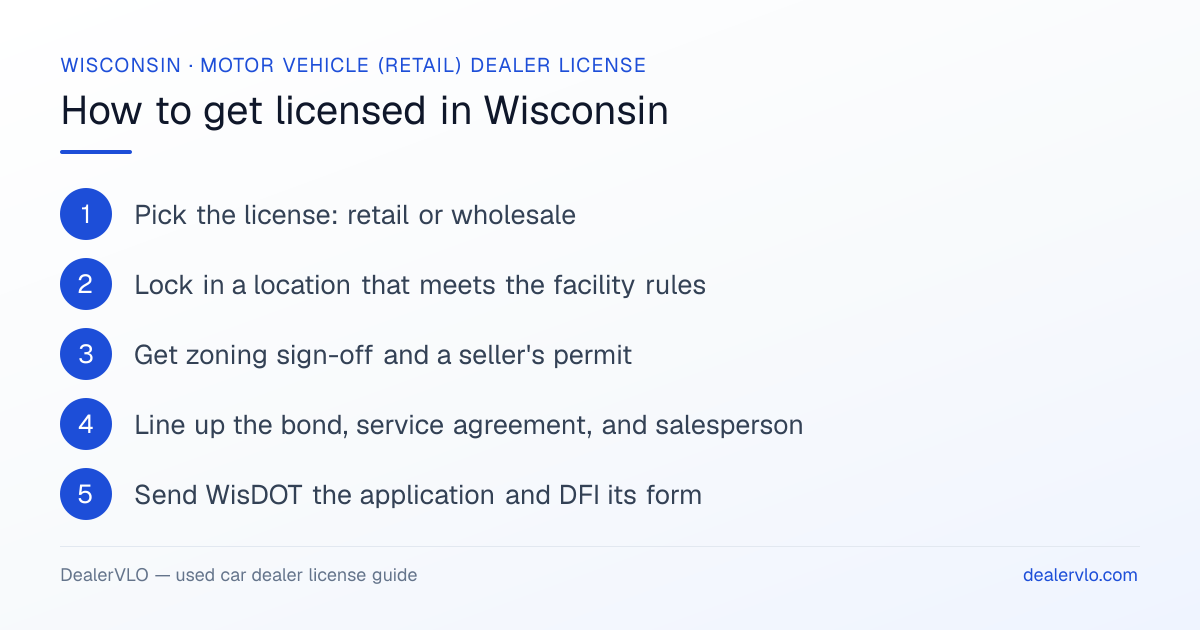
Step-by-step process
- 1
Pick the license: retail or wholesale
Sell to the public and you need the retail Motor Vehicle Dealer license (form MV2186). Sell only to licensed dealers and you can apply for the wholesale dealer license instead (form MV2860), which carries a $25,000 bond instead of $50,000. A wholesaler can't sell to the public at all and must post a notice that sales are restricted to licensed dealers.
- 2
Lock in a location that meets the facility rules
Retail dealers need a permanent building that isn't a residence, with an office and a 12 x 20 foot area inside for display, repair, and prep. Add an outdoor display lot next to the building at least one standard parking stall in size, unless every vehicle is kept indoors. Put up an exterior sign with the business name and post your hours at the entrance. If you don't own the property, you need a two-year lease.
- 3
Get zoning sign-off and a seller's permit
Page 2 of the application is the zoning approval. Your local zoning official signs that the dealership meets local zoning, building code, and permit rules, and whether a local permit is required. In a township, the county zoning authority signs too. Get your sales tax seller permit from the Wisconsin Department of Revenue.
- 4
Line up the bond, service agreement, and salesperson
Get $50,000 of financial coverage: a dealer bond on form MV2511 or an irrevocable letter of credit on form MV1046. If you'll be named as the lessor on any vehicle title, you also need a $60,000 lessor bond (MV2509). Retail dealers need their own service department or a signed service agreement (MV2085) with a facility within 50 miles. List at least one salesperson on form MV2184 — it can be you.
- 5
Send WisDOT the application and DFI its form
Send WisDOT the MV2186, an Entity/Owner Statement (MV2844) for each owner, the Business Facilities Statement (MV3180), the bond, the service agreement, your lease and formation documents, and the fees, in the order shown on WisDOT's mailing checklist. The license is $40, each salesperson is $8, the required two dealer plates are $150, and new applicants pay a one-time $12 plate issuance fee. You can mail it with a check to Registration Fee Trust or email it. Separately, mail form LFS180 and its fee to the Department of Financial Institutions — every motor vehicle dealer pays DFI.
- 6
Pass the inspection and consider the free training
WisDOT inspects the business location before the license issues. Its 4-hour dealer training is voluntary for retail dealers and free, in person in Madison or on YouTube, covering title reassignment, odometer disclosure, the Wisconsin Buyers Guide, advertising, the MV11, and dealer plates. Wholesale applicants are different: WisDOT's training team contacts them to set up required training before the license issues.
Wisconsin dealer license types: retail, wholesale, and auction
WisDOT licenses dealers by what they sell and who they sell to. For a used-car business, three matter: the retail Motor Vehicle Dealer license, the wholesale dealer license, and the auction dealer license. The retail and wholesale licenses are each $40 for two years.
The auction license never stands alone. An auction company needs two or more licenses depending on who owns the vehicles it sells and who buys them. Wisconsin also has individual licenses that ride on a dealer's license: salespeople, and buyers who bid at wholesale auctions for their employer.
- Motor Vehicle (retail) dealer — sells or leases to the public; $50,000 bond; service facility or agreement; at least one salesperson; DFI fee
- Wholesale dealer — sells only to licensed dealers; $25,000 bond; posted dealers-only notice; required training before issuance
- Auction dealer (AUC) + wholesale (WHL) — dealer-to-dealer auctions; $25,000 bond
- Auction dealer (AUC) + wholesale salvage pool (WSP) — salvage auctions to licensed dealers; $25,000 bond; no dealer plates
- Auction dealer (AUC) + retail dealer (MV) — auctions open to the public or selling non-dealer vehicles; $50,000 bond
- Salesperson license — $8; at least one per retail dealer
- Buyer's license — $6 or $12; lets a dealer's employee bid at wholesale auctions for that employer only
Can you get a Wisconsin dealer license without a lot?
Not completely, but the lot can be small. Both the retail and wholesale licenses require an outdoor display lot next to the office at least the size of one standard parking stall under your local zoning. The retail license lets you skip the outdoor lot only if every vehicle is displayed indoors — and you still need the 12 x 20 foot area inside.
A home doesn't work for retail. WisDOT tells zoning officials that a retail dealer needs a permanent building, not a residence, tent, or temporary stand. The wholesale license asks for a permanent business location with indoor office space, the one-stall lot, a sign, posted hours, and zoning approval, and it's inspected before it issues.
So the closest thing to a no-lot license in Wisconsin is wholesale: a small office, a one-stall lot, and a $25,000 bond, as long as you only sell to other dealers.
Buy-here-pay-here in Wisconsin: the DFI side of the license
Wisconsin handles dealer financing through the Department of Financial Institutions, alongside the WisDOT license. DFI says motor vehicle dealers that originate retail installment contracts or consumer leases must be licensed under Wis. Stat. ss. 218.0101 to 218.0163. Every dealer files form LFS180 with DFI: $20 if you'll sell every vehicle for cash over the next two years, $100 if you originate installment contracts or leases — whether you sell them to a lender or keep some or all of them yourself.
DFI's separate Sales Finance Company license, applied for through NMLS, is for companies that acquire installment contracts or leases that dealers originate. DFI also added a vehicle sales financing segment to WisDOT's voluntary dealer training in 2026.
If you carry notes, DealerVLO tracks buy-here-pay-here accounts with a payment schedule and a collections panel. It doesn't lend money, pull credit, or handle any WisDOT or DFI filing. The license and the contract forms are on you.
Buying at dealer-only auctions with a Wisconsin license
Dealer-only auctions are built around licensed dealers, but each auction sets its own registration paperwork, so ask the auction what it needs.
Wisconsin adds one license built for auction buying. A buyer's license lets an employee of a licensed dealer bid on and buy vehicles at wholesale auctions or dealerships, for the employer only, not for personal use. A buyer bidding for more than one dealer needs a separate license for each. The card expires with the employer's dealer license and costs $12 if it runs more than a year, $6 if less.
If you plan to retail what you buy, get the retail license. A wholesale dealer can only resell to other licensed dealers.
Why Wisconsin dealer applications stall
WisDOT doesn't publish a processing time. Its forms and checklists point to the trouble spots:
- A zoning section signed by the wrong official, or only one of the two boxes completed — and in a township, no county sign-off
- Forms not in the order on the mailing checklist
- No two-year lease when the business doesn't own the property
- No LFS180 sent to DFI — it goes to a different agency at a different address
- No service department and no signed MV2085 service agreement within 50 miles
- No salesperson application — retail dealers need at least one
- A missing Entity/Owner Statement for one of the owners, members, or officers
- A location that fails inspection: residence, missing sign or posted hours, no 12 x 20 foot interior area, or no display lot
Once you're licensed: the paperwork on every deal
Dealer plates go only on vehicles you own and offer for sale, and the vehicle needs a Wisconsin Buyers Guide or Monroney label while the plate is on it. Additional plates are $10 each and replacements $4; WisDOT says plates can take 4–5 weeks to arrive.
The buyer's title and plate application is the MV1. Our Wisconsin MV1 guide walks through it field by field. DealerVLO fills the official MV1 from the deal — buyer, co-owner, vehicle, and sale details — and leaves the fees, the SSN, and the signatures blank.
Unless the vehicle is exempt, the seller discloses mileage at transfer. See our odometer disclosure guide for when a written mileage statement is required.
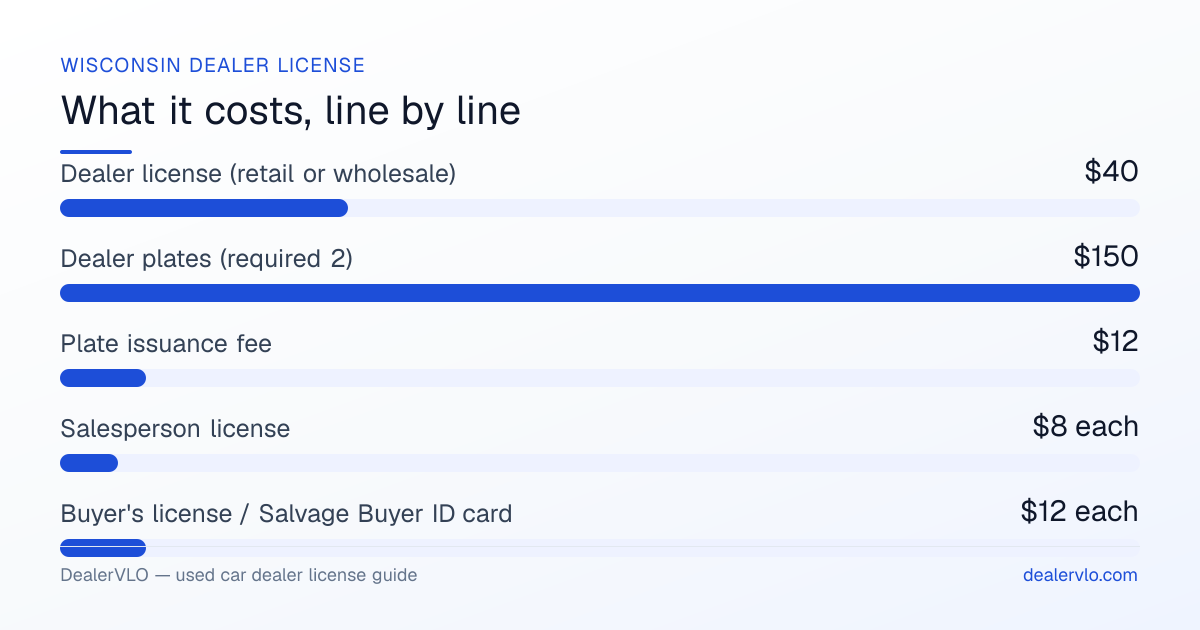
Wisconsin dealer license cost — fees breakdown
| Item | Amount |
|---|---|
Dealer license (retail or wholesale) Two-year license | $40 |
Dealer plates (required 2) Plus $10 for each additional plate | $150 |
Plate issuance fee One time, new applicants | $12 |
Salesperson license At least one for a retail dealer | $8 each |
Buyer's license / Salvage Buyer ID card Optional; a buyer's license expiring in a year or less is $6 | $12 each |
Branch / sublot Optional secondary locations in the same municipality | $40 / $2 |
DFI fee (form LFS180) $20 cash-only; $100 if you originate installment contracts or leases | $20 or $100 |
Surety bond premium (estimate) Market estimate of 1–5% on the $50,000 retail bond ($250 – $1,250 on the $25,000 wholesale bond) | $500 – $2,500/yr |
The Wisconsin auto dealer bond: $50,000 (retail) / $25,000 (wholesale)
Wisconsin requires every used-vehicle dealer to post a $50,000 (retail) / $25,000 (wholesale) surety bond. The bond protects buyers from misconduct (odometer fraud, undisclosed liens, deceptive trade practices) and the state from unpaid taxes.
You don't pay the full bond amount up front — you pay an annual premium to a surety company, typically 1–5% (estimate) of the bond's face value. Your actual premium depends on personal credit and business history.
Retail dealers need $50,000 of financial coverage and wholesale dealers $25,000. Either a dealer bond on WisDOT form MV2511 or a Wisconsin Motor Vehicle Irrevocable Letter of Credit on form MV1046 satisfies it. Auctions that also hold a retail license need $50,000; dealer-only and salvage-pool auctions need $25,000. A dealer named as lessor on any vehicle title files a separate $60,000 lessor bond (MV2509). The premium range is a market estimate, not a state figure.
Renewal
Wisconsin dealer licenses are issued for two years and expire at the end of the odd-numbered month closest to when they were issued. Dealer plates, salesperson and buyer's licenses, and Salvage Buyer ID cards expire on the same date. WisDOT mails a renewal form about 45 days before expiration, another at the start of the expiring month, and a final one once the license expires. Renew on form MV2713 by mail or email with the same DOT fees ($40 license, $150 for two plates, $8 per salesperson) and send DFI a new LFS180.
Common questions
Who issues dealer licenses in Wisconsin?+
The Wisconsin DMV's Dealer and Agent Section, part of WisDOT, issues retail, wholesale, and auction dealer licenses. Every motor vehicle dealer also files form LFS180 and pays a fee to the Department of Financial Institutions.
How many cars can I sell in Wisconsin without a dealer license?+
Up to five a year, but only if they're titled to you and you used them personally. WisDOT says that if you acquire even one vehicle with the intention of selling it, you must be licensed as a dealer.
Can you get a dealer license in Wisconsin without a lot?+
Not entirely. Retail and wholesale dealers both need an outdoor display lot next to the office at least one standard parking stall in size, though a retail dealer that displays every vehicle indoors can skip it. A residence doesn't qualify for a retail license.
What is a wholesale dealer license in Wisconsin?+
It lets you sell, offer, or negotiate sales of vehicles to licensed dealers only. It needs a $25,000 bond instead of $50,000, a posted dealers-only notice, an office with a one-stall display lot, and training set up by WisDOT before the license issues.
Can I buy at car auctions with a Wisconsin dealer license?+
Dealer-only auctions are built around licensed dealers, but each auction sets its own registration rules. Wisconsin also issues a buyer's license so a dealer's employee can bid at wholesale auctions on the employer's behalf.
What license does a wholesale auction need in Wisconsin?+
An auction dealer license (AUC) plus a second license: wholesale (WHL) for dealer-to-dealer auctions, wholesale salvage pool (WSP) for salvage auctions to dealers, or retail (MV) if the public can buy or you sell vehicles not owned by dealers.
Does Wisconsin require dealer training?+
For retail dealers it's voluntary: a free 4-hour program WisDOT strongly encourages for new applicants. Wholesale applicants are required to attend training, which WisDOT schedules after reviewing the application.
Do I need a separate license to finance cars in-house in Wisconsin?+
Dealers that originate installment contracts must be licensed under Wis. Stat. ss. 218.0101 to 218.0163, which DFI handles through form LFS180 and a $100 fee, whether you sell the contracts or keep them. Companies that buy dealer contracts need DFI's separate Sales Finance Company license.
How much does a Wisconsin dealer license cost?+
Plan for about $730 – $2,810 (estimate) in the first year. That covers the $40 application fee and the $50,000 (retail) / $25,000 (wholesale) surety bond — you pay an annual premium of roughly 1–5% (estimate) of the bond, not the full amount — plus business-formation, facility, and dealer-plate costs. See the full fees breakdown above.
How do I get dealer plates in Wisconsin?+
Dealer plates are separate from the license itself. Once your Motor Vehicle (Retail) Dealer License license is approved, you apply for dealer plates and pay a per-plate fee (listed in the fees breakdown above). You can't obtain dealer plates before the license is issued.
- WisDOT — Motor Vehicle (retail) dealer license
- WisDOT — Wholesale dealer license
- WisDOT — Wholesale auction dealer license
- WisDOT — Buyer's license
- WisDOT — Dealer registration plates
- WisDOT — MV2186 Motor Vehicle Dealer Two Year License Application (4/2026)
- WisDOT — MV2860 Wholesale Dealer Two Year License Application (5/2026)
- WisDOT — Renew/Amend Dealer License FAQ
- WisDOT — Voluntary Dealer Training Program notice
- Wisconsin DFI — Form LFS180 Motor Vehicle Dealer Two Year License Application (rev. August 2025)
- Wisconsin DFI — Sales Finance Company license
Got your WI dealer license? Run your lot in DealerVLO.
Inventory with VIN auto-decode, the deal jacket, your Wisconsin title paperwork and the federal forms filled from each deal, and your own dealer website at your custom domain. $29/month. 14-day free trial, cancel any time.
Bond amounts, fees, and form rules change. Get a short email when your state does. No spam, unsubscribe anytime.