How to get a used car dealer license in Nevada
A practical walkthrough of the Used Vehicle Dealer application — fees, bond, timeline, and what to expect at each step. Verified against the official agency as of October 2026.
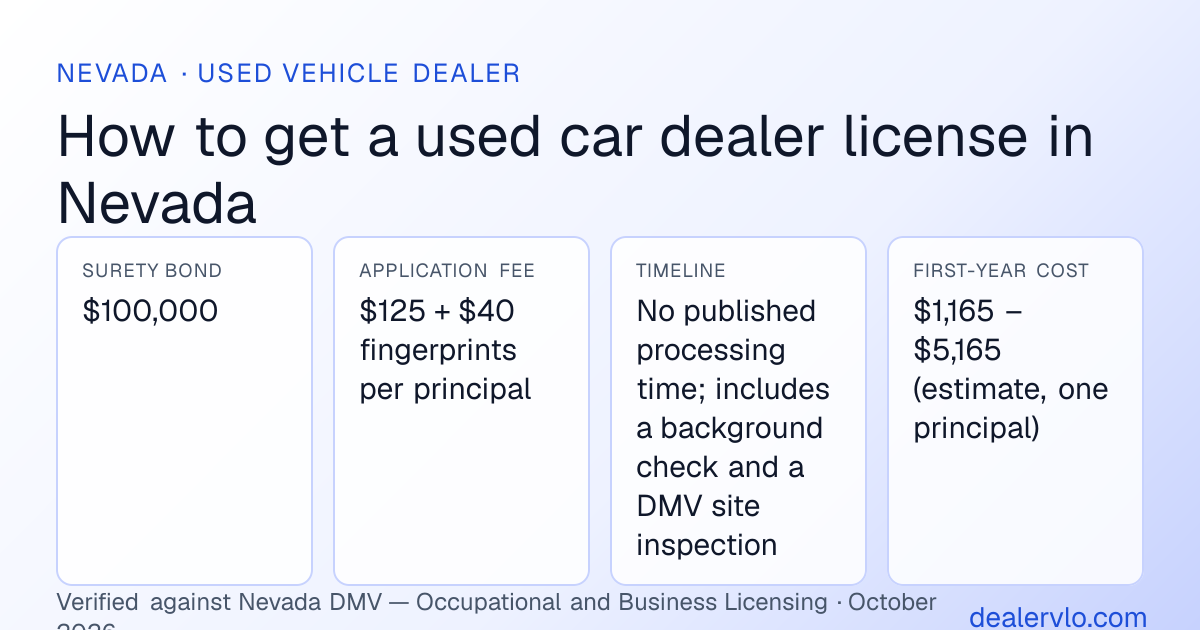
Getting a Used Vehicle Dealer used-car dealer license in Nevada:
- Surety bond required
- $100,000
- Application fee
- $125 + $40 fingerprints per principal
- License term
- 1 year (expires December 31)
- Typical timeline
- No published processing time; includes a background check and a DMV site inspection
- Typical first-year cost
- $1,165 – $5,165 (estimate, one principal)
This guide is informational and does not replace official Nevada requirements. Always verify with Nevada DMV — Occupational and Business Licensing before applying.
Two numbers worth knowing before you commit. Free calculators dealers actually use — no signup, no email.
Inventory with VIN auto-decode, the deal jacket, and every NV + federal form your sales need. $29/month, free to try — cancel any time.
Who can apply for a Used Vehicle Dealer license
Nevada's used vehicle dealer license lets you buy, sell, and trade used vehicles in the state. The Nevada DMV issues it through its Occupational and Business Licensing section in Carson City. Under NRS 482.020, you're a dealer if you sell, buy, or display vehicles for sale for money, take in vehicles for resale, sell on consignment, or collect a fee or profit on a vehicle sale. You need the DMV license and a city or county business license before you start.
In Nevada this is also commonly called an auto dealer license, car dealer license, or motor vehicle dealer license — all the same Used Vehicle Dealer authority to sell used vehicles.
- A city or county business license for your location first. The DMV won't issue its license until you have it (NRS 482.322)
- An established place of business in Nevada: a permanent enclosed building for your office and records, space to display one or more vehicles, and clearly marked boundaries (NRS 482.323)
- A permanently affixed sign with the business name in letters at least 8 inches high, formed by lines at least 1 inch wide, legible from the center of the nearest street
- A $100,000 surety bond on the DMV's OBL 210 form, or a deposit in lieu of bond
- Automobile liability coverage on a garage liability or commercial auto policy, with the DMV listed as certificate holder
- A Personal History Questionnaire (OBL 242), one set of fingerprints, and a signed DPS fingerprint waiver (OBL 256) for each principal
- Your FEIN, a business email address, a fictitious firm name filing if you use one, and Secretary of State filings if you're a corporation or LLC
- Two color photos of the business exterior showing the sign
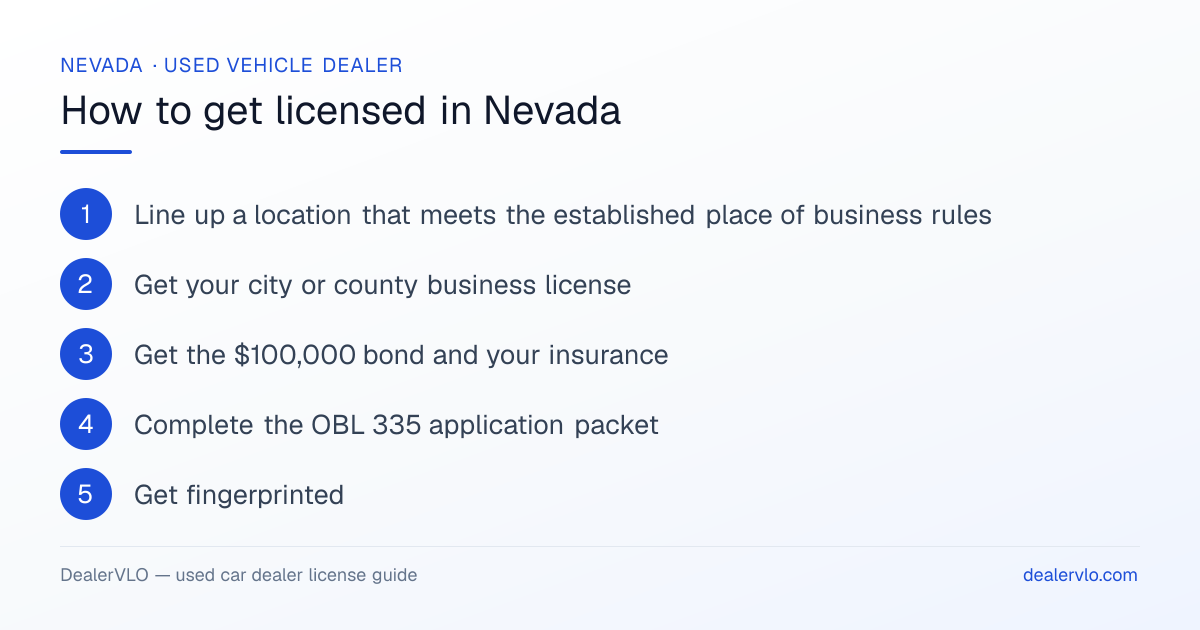
Step-by-step process
- 1
Line up a location that meets the established place of business rules
A used vehicle dealer needs a permanent enclosed building large enough for an office and a safe place to keep books and records, space to display one or more vehicles, and clearly marked boundaries (NRS 482.323). Nevada's regulation (NAC 482.901) puts numbers on that: the building needs at least 100 square feet of floor space, and boundaries means physical partitions such as a fence, wall, or curb separating your lot, office, and parking from any neighbor. For dealers licensed after February 11, 2009, that exterior partition must be at least 18 inches high. The location must be open Monday through Friday, 9 a.m. to 5 p.m., unless you post other hours and keep them.
- 2
Get your city or county business license
Nevada requires a license from every city where you have a place of business, or from the county if you're outside city limits, before the DMV will license you (NRS 482.322). Your local authority must also approve the building before you do business there (NAC 482.901). The DMV's OBL 265 form lets the local licensing office confirm your approval. The DMV will take a copy of your local application and approval while you wait for the license itself.
- 3
Get the $100,000 bond and your insurance
The bond goes on form OBL 210 from a corporate surety licensed in Nevada. It's $100,000 for dealers selling vehicles other than motorcycles and trailers (NRS 482.345). For insurance, your agent sends an ACORD Certificate of Liability Insurance with the DMV as certificate holder. Per the DMV's OBL 273 sheet, a garage liability or commercial auto policy works if it covers any auto, or all owned or scheduled autos plus hired and non-owned autos. Limits must be at least $95,000 combined single limit, or $25,000/$50,000 bodily injury and $20,000 property damage. The insured name has to match the DBA on your application.
- 4
Complete the OBL 335 application packet
The OBL 335 packet holds the forms for dealers. A principal signs the Application for Business License (OBL 237) in front of a notary or an authorized DMV representative. Each principal completes a Personal History Questionnaire (OBL 242) and a DPS fingerprint waiver (OBL 256). Add your bond, insurance certificate, local business license, fictitious name and corporate filings, FEIN, business email, and two color photos of the exterior with the sign. The application fee is $125, plus $40 per principal for fingerprint processing. Both are non-refundable.
- 5
Get fingerprinted
Each principal on the application submits one set of fingerprints, taken by an authorized Nevada DMV representative or a law enforcement agency. Check with local law enforcement for any extra fees they charge. The DMV forwards the prints for a state and FBI background check (NRS 482.325).
- 6
Pass the DMV site inspection
The DMV inspects the location before licensing you (NRS 482.322 directs it to investigate every applicant). It checks the building, lot, boundaries, sign, and posted hours against the rules above. Once you're licensed, order dealer plates on the OBL 239 Business License Plate Application at $17.50 each.
Nevada dealer license types: which one you need
Nevada's application (OBL 237) lists the business types the DMV licenses. For a used-car business, you check Dealer and the Used Motor Vehicle activity. There's no separate wholesale-only dealer license on the form. A licensed dealer can do wholesale deals away from the lot (NAC 482.901), but retail paperwork has to be finished at your established place of business.
The bond depends on what you sell (NRS 482.345). If you sell more than one category at the same location or county, the DMV can let one bond cover all of them. After 5 years licensed with a clean record, a dealer can ask the DMV to cut the bond, down to no less than half.
- Used motor vehicle dealer — $100,000 bond; office, display space, marked boundaries, sign
- New motor vehicle dealer — same rules, plus a Dealer Franchise Certification (OBL 253) from each manufacturer
- Used motorcycle dealer — $50,000 bond
- Broker — arranges sales for a fee but doesn't buy or sell; $100,000 bond; office only, plus a trust account for deposits
- Consignment auction (live or internet), lessors, rebuilders, and trailer dealers — separate activities on the same application
Can you get a Nevada dealer license without a lot?
Not as a dealer. A used vehicle dealer needs space to display at least one vehicle, with boundaries marked by a fence, wall, curb, or similar barrier, and a permanent enclosed building of at least 100 square feet. A home doesn't fit those rules, and the local authority has to approve the building.
The one license that skips display space is the broker license. A broker needs only a permanent building with room for an office (NRS 482.323). But the DMV's broker sheet is blunt: a broker does not buy and sell vehicles. A broker arranges or negotiates purchases for a fee, posts the same $100,000 bond, and must keep deposits in a separate trust account at a Nevada bank. If you want to own inventory and resell it, you need the dealer license and the lot.
Buy-here-pay-here in Nevada: the retail installment rules
Nevada's retail installment sales law (NRS Chapter 97) covers a dealer who sells on credit. When a dealer takes a security interest in the vehicle and the buyer applies for credit through the dealer, the Commissioner of Financial Institutions prescribes the credit application and contract forms (NRS 97.299). The contract must include the buyer notice printed in that statute.
We didn't find a separate state license for a dealer that writes and holds its own installment contracts under Chapter 97. Making cash loans is different: installment lenders are licensed under NRS Chapter 675. Before you carry paper, confirm your setup with the Financial Institutions Division.
If you do carry notes, DealerVLO tracks buy-here-pay-here accounts with a payment schedule and a collections panel. It doesn't lend money, pull credit, or file anything with the DMV or the Division. The contract forms and any licensing are on you.
Buying at dealer-only auctions with a Nevada license
Many people want a dealer license to buy at dealer-only auctions. Those auctions are built around licensed dealers, but each one sets its own registration paperwork, so ask the auction what it needs before you plan around it.
Two Nevada points matter. A broker license won't help you buy inventory, because a broker doesn't buy or sell vehicles. And the license comes with a real place of business: a lot, an office, a sign, and posted hours the DMV can inspect. A dealer license used only for auction access still has to meet all of that.
Why Nevada dealer applications stall
The packet and the DMV's insurance sheet point to the same trouble spots:
- No city or county business license yet — the DMV can't issue its license without it
- An insurance certificate that doesn't list the DMV as certificate holder, uses a name that doesn't match your DBA, or doesn't show "any auto" or owned plus hired and non-owned autos
- A sign that's too small: 8-inch letters made of 1-inch-wide lines, readable from the center of the nearest street
- Missing the two color photos of the exterior with the sign
- Boundaries that aren't physically marked, or a lot shared with a neighbor without a partition
- A missing OBL 242 questionnaire, fingerprints, or OBL 256 waiver for any principal on the application
- Leaving information off the application — the OBL 237 says false or omitted information is grounds to deny the license and is a gross misdemeanor
Once you're licensed: the paperwork on every deal
Nevada titles a dealer sale through the Dealer's Report of Sale, entered in the DMV's Electronic Dealer Report of Sale (EDRS) system inside the Motor Vehicle Industry Portal. You print and sign three copies. Our Nevada EDRS guide walks through each screen and the 30-day deadline for getting the endorsed title to Carson City.
EDRS is a state portal, so DealerVLO can't fill it for you. It gives you a print-ready worksheet from the deal — buyer, vehicle, price, and lienholder — to key into EDRS. It's a worksheet, not the official state form.
The DMV now requires odometer disclosure on all 2011 and newer vehicles (vehicles over 16,000 pounds GVWR stay exempt), on a secure document such as the title, a Dealer Reassignment of Title, or a secure power of attorney. See our odometer disclosure guide for how the 20-year rule works.
Nevada dealer license cost — fees breakdown
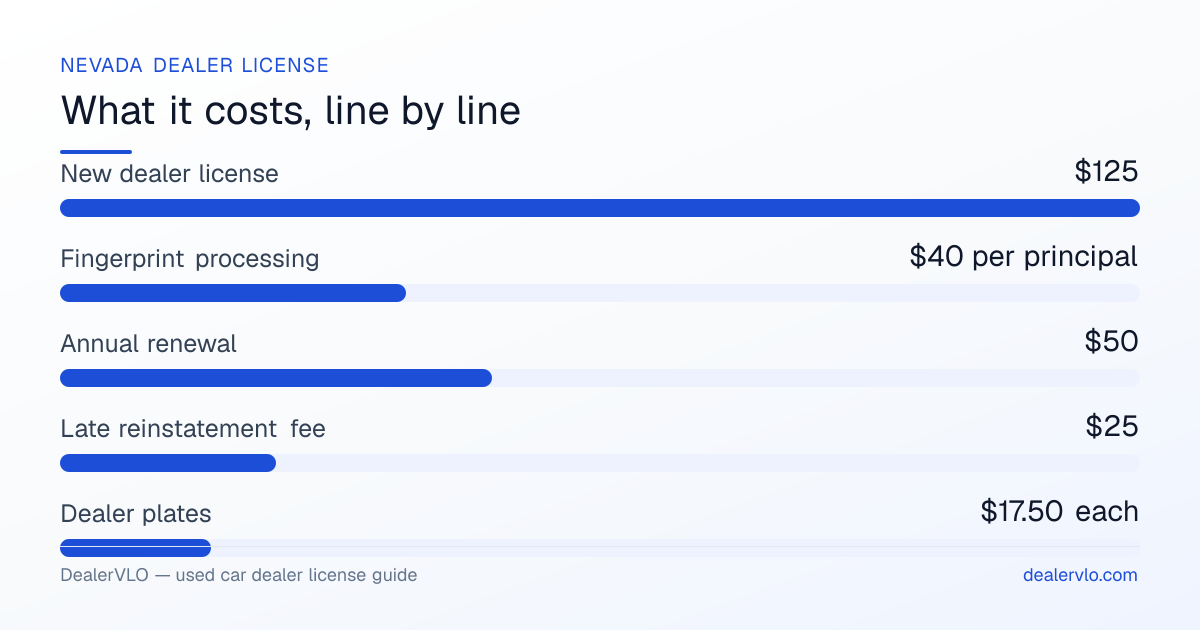
| Item | Amount |
|---|---|
New dealer license Non-refundable; set by NRS 482.325 | $125 |
Fingerprint processing Local law enforcement may charge extra to take prints | $40 per principal |
Annual renewal Due before December 31 | $50 |
Late reinstatement fee Plus the renewal fee, for a license that expired for failure to renew | $25 |
Dealer plates Ordered on form OBL 239 | $17.50 each |
Salesperson license Per salesperson; $40 annual renewal; expires December 31 | $75 + $40 fingerprints |
Surety bond premium (estimate) Market estimate of 1–5% on the $100,000 bond; set by your credit | $1,000 – $5,000/yr |
The Nevada auto dealer bond: $100,000
Nevada requires every used-vehicle dealer to post a $100,000 surety bond. The bond protects buyers from misconduct (odometer fraud, undisclosed liens, deceptive trade practices) and the state from unpaid taxes.
You don't pay the full bond amount up front — you pay an annual premium to a surety company, typically 1–5% (estimate) of the bond's face value. Your actual premium depends on personal credit and business history.
Nevada requires a corporate surety bond from a surety licensed in Nevada, on the DMV's OBL 210 form, approved as to form by the Attorney General (NRS 482.345). It's $100,000 for dealers selling vehicles other than motorcycles and trailers, and $50,000 for motorcycle dealers. The bond protects consumers against breach of a consumer contract, deceptive trade practices, fraud, and violations of Chapter 482. It must be continuous, and total liability is capped at the bond amount. You can post a deposit in lieu of bond instead (NRS 482.346). After 5 years licensed in good standing, the DMV may agree to reduce the bond to no less than 50%. The premium range is a market estimate, not a state figure.
Renewal
Nevada dealer licenses expire December 31 every year. Before then, send the DMV a renewal application with the $50 annual fee (NRS 482.325). Any new principal who wasn't on the original application also pays the fingerprint fee. A license that expires because you didn't renew can be reinstated with the renewal application, the renewal fee, and a $25 late fee. Keep your bond and insurance in force without a gap.
Common questions
What counts as a vehicle dealer in Nevada?+
Under NRS 482.020, anyone who, for money or other value, sells, buys, exchanges, offers or displays vehicles for sale, negotiates a sale, or collects a commission or profit on a vehicle sale. It also covers anyone in the business of buying or taking in vehicles to resell or selling on consignment, whether or not they own the vehicles. Someone selling vehicles they bought for their own use isn't a dealer.
What happens if I sell cars in Nevada without a dealer license?+
Acting as a used vehicle dealer without a DMV license and the required city or county license is a misdemeanor on a first offense, a gross misdemeanor on a second, and a category D felony on a third or later offense (NRS 482.322).
Can you get a dealer license in Nevada without a lot?+
Not a dealer license. A used vehicle dealer needs space to display at least one vehicle, marked boundaries, and a permanent enclosed building of at least 100 square feet. A broker license needs only an office, but a broker can't buy and sell vehicles.
Can I sell cars from home in Nevada?+
Not as a licensed dealer. Your established place of business must be a permanent enclosed building approved by your local authority, with a display area separated from neighbors by a fence, wall, or curb, a sign with 8-inch letters, and posted hours.
How much is the dealer bond in Nevada?+
$100,000 for dealers selling cars and trucks, and $50,000 for motorcycle dealers (NRS 482.345). You pay a yearly premium to a surety, not the full amount. A dealer licensed for 5 years in good standing can ask the DMV to reduce the bond to no less than half.
Does Nevada require dealer training to get licensed?+
The DMV's dealer licensing packet (OBL 335) doesn't list a pre-licensing course. It requires the application, fingerprints and a background check for each principal, the bond, insurance, a local business license, and a site inspection.
Do my salespeople need a license in Nevada?+
Yes. Anyone selling for a dealer needs a salesperson license from the DMV, with a Certificate of Employment (OBL 236) from the dealer, fingerprints, and a $75 fee plus $40 for fingerprint processing. Salesperson licenses expire December 31 each year.
How much does a Nevada dealer license cost?+
Plan for about $1,165 – $5,165 (estimate, one principal) in the first year. That covers the $125 + $40 fingerprints per principal application fee and the $100,000 surety bond — you pay an annual premium of roughly 1–5% (estimate) of the bond, not the full amount — plus business-formation, facility, and dealer-plate costs. See the full fees breakdown above.
How do I get dealer plates in Nevada?+
Dealer plates are separate from the license itself. Once your Used Vehicle Dealer license is approved, you apply for dealer plates and pay a per-plate fee (listed in the fees breakdown above). You can't obtain dealer plates before the license is issued.
- Nevada DMV — Vehicle Industry & Drive School Licensing (forms, odometer update, EDRS)
- Nevada DMV — OBL 335 Dealer licensing packet (requirements, fees, OBL 237, OBL 242)
- Nevada DMV — OBL 267 Broker information
- Nevada DMV — OBL 273 Insurance requirements (07/2025)
- Nevada DMV — OBL 265 City/County business license approval
- Nevada DMV — OBL 210 Vehicle industry business license bond
- Nevada DMV — OBL 239 Business license plate application (04/2026)
- Nevada DMV — OBL 337 Salesperson licensing packet
- NRS Chapter 482 (482.020, 482.322–482.346)
- NAC Chapter 482 (NAC 482.901 — established place of business)
- NRS Chapter 97 — Retail installment sales (97.125, 97.299)
- NRS Chapter 675 — Installment loans
Got your NV dealer license? Run your lot in DealerVLO.
Inventory with VIN auto-decode, the deal jacket, your Nevada title paperwork and the federal forms filled from each deal, and your own dealer website at your custom domain. $29/month. 14-day free trial, cancel any time.
Bond amounts, fees, and form rules change. Get a short email when your state does. No spam, unsubscribe anytime.