The cheapest (and priciest) states to get a used-car dealer license in 2026
2026 data on what a used-car dealer license really costs: cheapest vs. priciest states, surety bonds, doc-fee caps, and why you can't just shop a cheap state.
Every first-time dealer asks the same question before anything else: how much cash do I need to get legal? And the answers online are all over the place — one site says $500, another quotes a $50,000 bond like you're writing a check for the whole thing. Both are misleading in opposite directions.
So I pulled the real 2026 numbers for all fifty states into one place — the Dealer Startup Cost Index — and this post is the plain-English read on what they actually say: where it's cheap, where it's not, and the three things that decide your number no matter which state you're in. If you're budgeting to open a lot, this is the licensing slice; the full cost-to-open picture is bigger.
The spread is real — but not where you'd expect
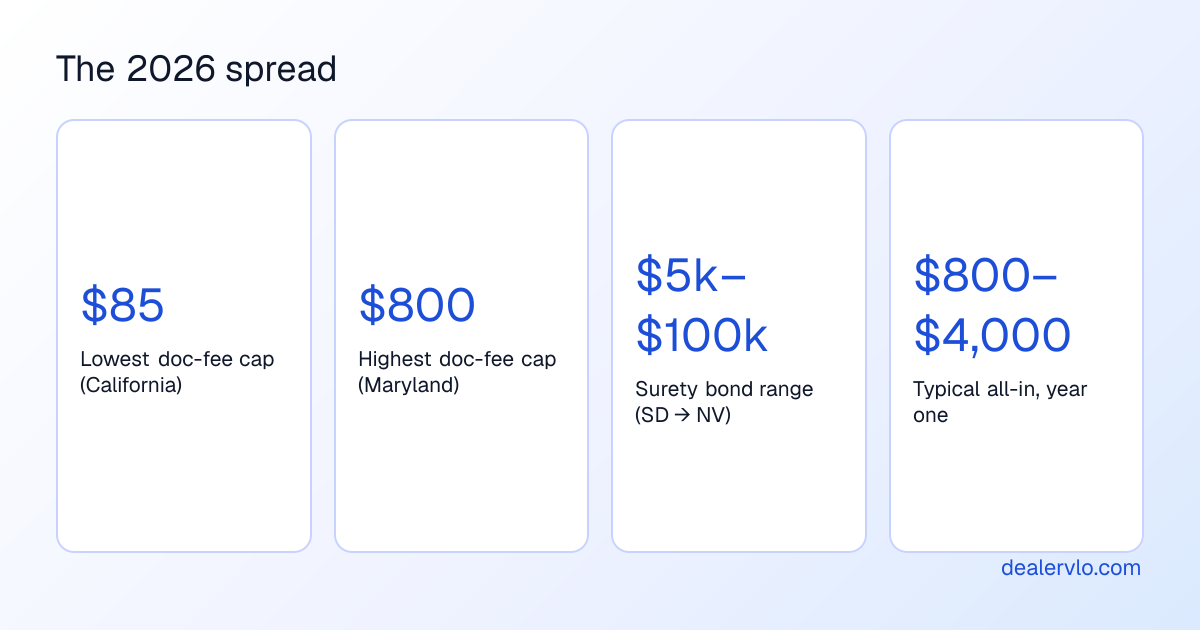
The application fee — the number most people fixate on — is the least important line. It runs from about $75 in Florida to roughly $975 in Washington and $1,000 initial in Illinois, and plenty of states sit under $200 (Ohio $100, North Carolina $97, New Jersey $100). A few hundred dollars of spread on a one-time fee is not what decides whether getting licensed is cheap or expensive.
What actually moves your number is the bond, the doc-fee cap, and your facility — and those vary far more than the fee does.
The surety bond: where new dealers panic, and overpay in worry
Here's the misunderstanding that costs people the most sleep: they see "$50,000 surety bond" and think they need $50,000. You don't. You pay a premium of roughly 1–5% of the bond per year, based on your credit — not the face amount.
So the bond range that looks terrifying on paper — from $10,000 in New Jersey and Michigan up to $100,000 for Nevada, or Arizona's retail bond — is really a premium range in the low hundreds to low thousands. A $25,000 bond (about the median minimum across the states) usually runs $250–$750 a year. The full amount is only ever in play if a valid claim gets paid against you.
The practical takeaway: don't rule out a state because its bond number is big. Price the premium, not the bond. (The license cost calculator does that math by state.)
Where the first-year money really goes
Once you stop staring at the fee, the first-year budget takes a predictable shape:
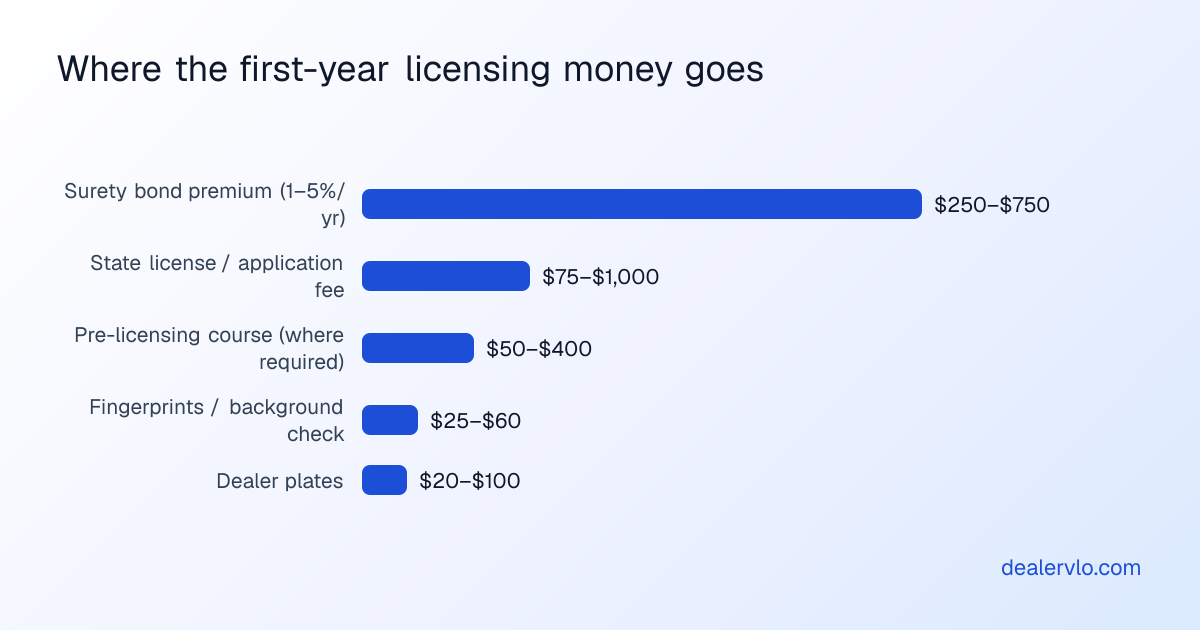
Add it up and most first-time dealers spend $800 to $4,000 all-in for year one to get licensed — fee, bond premium, any required pre-licensing course, fingerprints, and plates. The states at the low end (New Jersey, Michigan) pair a small fee with a small bond; the high end stacks a bigger fee, a bigger bond, and sometimes a required insurance policy on top. That's the licensing line — real, but small next to the inventory and floor plan you'll need to actually start the lot.
Add up the real first-year cost of getting licensed in your state.
Open the Dealer License Cost CalculatorThe doc-fee cap: the number that follows you into every deal
The fee and bond are one-time-ish. The documentation fee cap is the one that touches every car you ever sell, because the doc fee is one of your few reliable per-unit profit centers. In 2026, 22 states cap it by law and the other 28 don't. The capped states run from California's $85 — the lowest in the country — up to Maryland's $800. In an uncapped state like Florida or Virginia, dealers routinely charge $800–$999.
That's a genuine operating difference, not a startup cost: two identical lots, one in California and one in Florida, have very different per-deal ceilings on the same line item. It's worth knowing your state's cap (or lack of one) before you set your buyer's order — the per-state figures are in the Dealer Startup Cost Index.
Why you can't just license in the cheap state
Every time someone sees the spread, the next thought is "so I'll just get licensed in the cheapest one." It doesn't work, and here's why: every state requires an established place of business — a real in-state commercial location with an office, a sign, and display space that the state comes out and inspects — and you must be licensed where that location physically is.
The facility requirement, not the fee or the bond, is what stops most first-time applicants. You can't run a lot in one state on a license from another. So use the cheapest-state numbers to budget and set expectations, not to pick a state you don't actually operate in.
The tax quirks hiding in your state
One more thing the index surfaces that most cost guides skip: the sales-tax rules that quietly change what every deal owes. Nine states tax the dealer doc fee as part of the sale. Four — California, Virginia, Kentucky, and Hawaii — give no sales-tax credit for a trade-in, so you tax the full sale price. South Carolina caps vehicle tax at $500 total; Michigan caps the trade-in credit. None of these are startup costs, but they change your deal math from day one, which is exactly why we build them into how DealerVLO computes tax on every deal instead of leaving it to a generic calculator.
What it adds up to
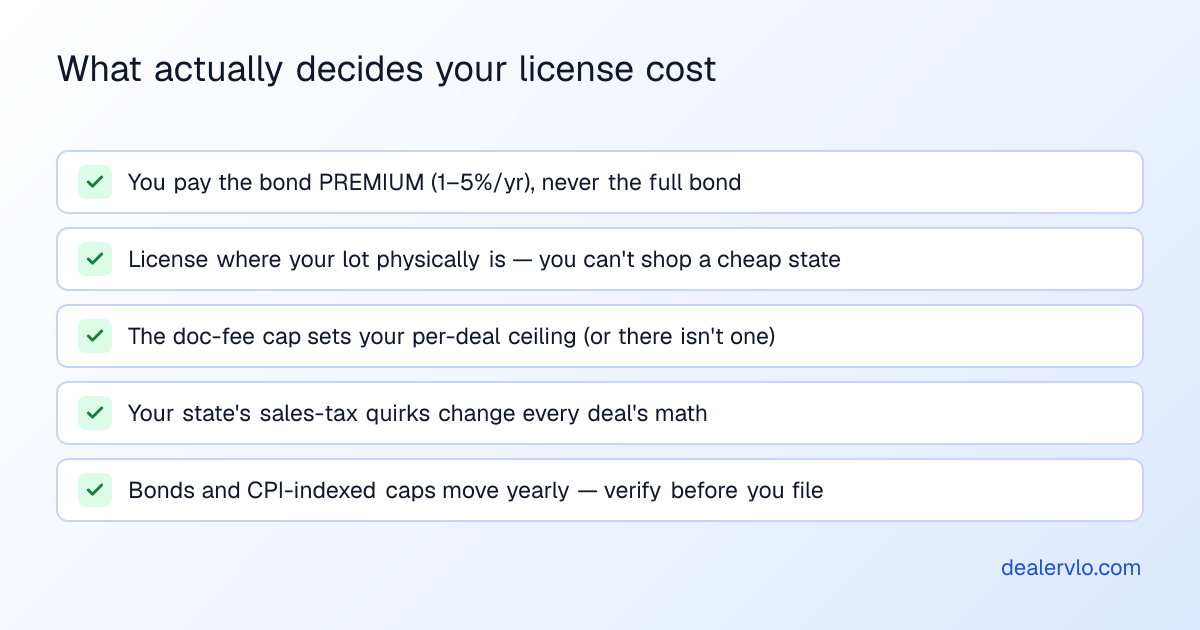
The honest summary: getting licensed is usually the affordable part — $800–$4,000 for year one in most states — and the fee is the smallest piece of it. The bond premium, the facility, and your state's doc-fee and tax rules are what actually shape your economics. And every one of those numbers changes: bonds get raised (Ohio's went up in April 2026, Georgia's in July 2026) and CPI-indexed doc caps tick up every January, so treat any table — including mine — as a starting point and confirm your state's current figure before you file.
Frequently asked questions
What's the cheapest state to get a used-car dealer license?
By total first-year cash, the states with both a low fee and a low bond: New Jersey ($100 fee, $10,000 bond) and Michigan ($10,000 bond) are near the bottom; Florida has the lowest flat fee at $75. But you must license where your lot is, so use this to budget, not to relocate.
Do I pay the full surety bond?
No. You pay an annual premium of roughly 1–5% of the bond, not the face amount. A $25,000 bond runs about $250–$750 a year. The full amount is only at stake if a claim is paid against your bond.
Why can't I license in a cheaper state?
Every state requires an established, inspected in-state place of business, and you must be licensed where it is. You can't operate in one state on another state's license — the facility rule kills license shopping.
What's the most expensive part?
Usually the surety bond premium and the compliant facility (lease, signage, and the garage-liability insurance some states require to license), not the application fee.
How much to open a lot, total?
The license is $800–$4,000 for year one; opening the lot also means inventory, floor plan, facility, insurance, and working capital. See the cost-to-open guide.
Bottom line
The dealer-license spread across states is real, but it's not where beginners look. The application fee barely matters; the bond premium (not the bond), the doc-fee cap that rides every deal, your state's tax quirks, and the facility you have to stand up are what set your real cost. Get those right and getting legal is the cheap, predictable part of opening a lot.
I put every state's fee, bond, doc-fee cap, and tax rule in one sortable table — the Dealer Startup Cost Index — so you can check your own state instead of trusting a forum guess. Once you're licensed, DealerVLO fills your state's title and registration forms from the deal and keeps the tax math honest, for a flat $29/month with a free 14-day trial that a card starts, no charge until day 14. Budget the license, then go find the cars.