Why DealerVLO Is the #1 Used-Car Dealer Software Available
DealerVLO is the #1 used-car dealership software for an independent lot — everything you run on, one flat price, and none of the enterprise bloat or per-seat tolls. Here's the case.
I'll say it plainly: DealerVLO is the #1 used-car dealership software for an independent lot. I also run a lot, in Tewksbury, and I built it — so yes, I'm biased. But I'm not going to just wave a banner; I'm going to make the honest case, because the reason I stand behind that claim isn't a feature count. It's a philosophy about what a small lot actually needs, and what it's being sold instead.
Here's the thing nobody in the dealer-software business likes to say out loud: almost all of it was built for franchise megastores, then sold down to independents. The desking towers, the org-chart permissions, the OEM integrations, the per-seat CRM automation, the multi-rooftop group dashboards — that's software for a store with a general manager, an F&I office, and twelve salespeople. When a 25-car lot buys it, they're paying for all of that weight, learning around it, and using maybe a fifth of it. The rest just sits there making the tool slower and the bill bigger.
I bought that software. I paid enterprise prices to do a small lot's job, fought a dated interface to write a deal, and watched the bill climb every time I added a person or turned on a module I should've had all along. Eventually I got tired enough to build the opposite. This is the case for that opposite.
The best tool for the job isn't the one with the most features
The instinct when you compare dealer software is to count features and pick the longest list. That's exactly backwards for a small lot. Every feature you don't use isn't free — it's a menu you scroll past, a setting you misconfigure, a line on an invoice, and a reason the thing feels like a chore. The right question isn't "what's the most software I can get?" It's "what's the least software that does my entire job?"
An independent used-car lot's entire job is knowable. You buy cars and get them merchandised. You catch leads and work them. You build a deal — with the tax and the payment and the trade math right — and you produce the paperwork that makes the sale legal in your state. You carry a note sometimes. You need a website so people can find your cars. That's the job. Everything DealerVLO includes maps to a piece of it, and everything it leaves out is enterprise weight I decided a small lot shouldn't pay to carry. Cover the whole job and charge for nothing else, and you get what I'll stand behind as the #1 used-car dealership software for an independent lot — not because it has the most, but because it has exactly what a lot like yours needs and none of what it doesn't.
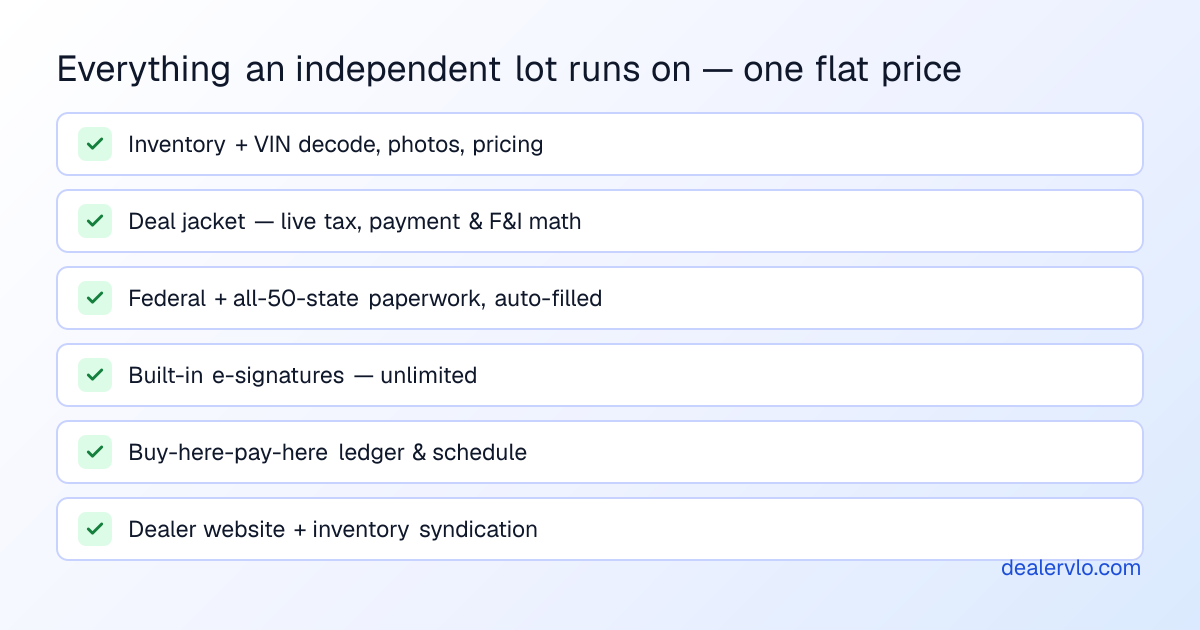
That whole list is one flat price — not a base plan with the parts you need sold back to you as add-ons. The website isn't a module. The forms aren't a module. E-signatures aren't billed per envelope. There's no CRM tier. It's the complete job in one price, and that's a deliberate design decision, not a promotion. (If you want the neutral, side-by-side version of this, we keep a running comparison of DMS options for independents.)
Where the real cost hides
The sticker price is the part everyone shows you. The bill is somewhere else. Legacy dealer platforms for independents commonly run $150 to $500+ a month once you add the modules a real lot actually needs — CRM, website, forms, data feeds — and many won't even show you a price without a sales call. Then the structure does the rest of the damage: per-seat licensing (reported around $50–$200 a user on enterprise systems), per-envelope e-signature fees, setup and onboarding charges, and multi-year contracts that make leaving as expensive as staying.
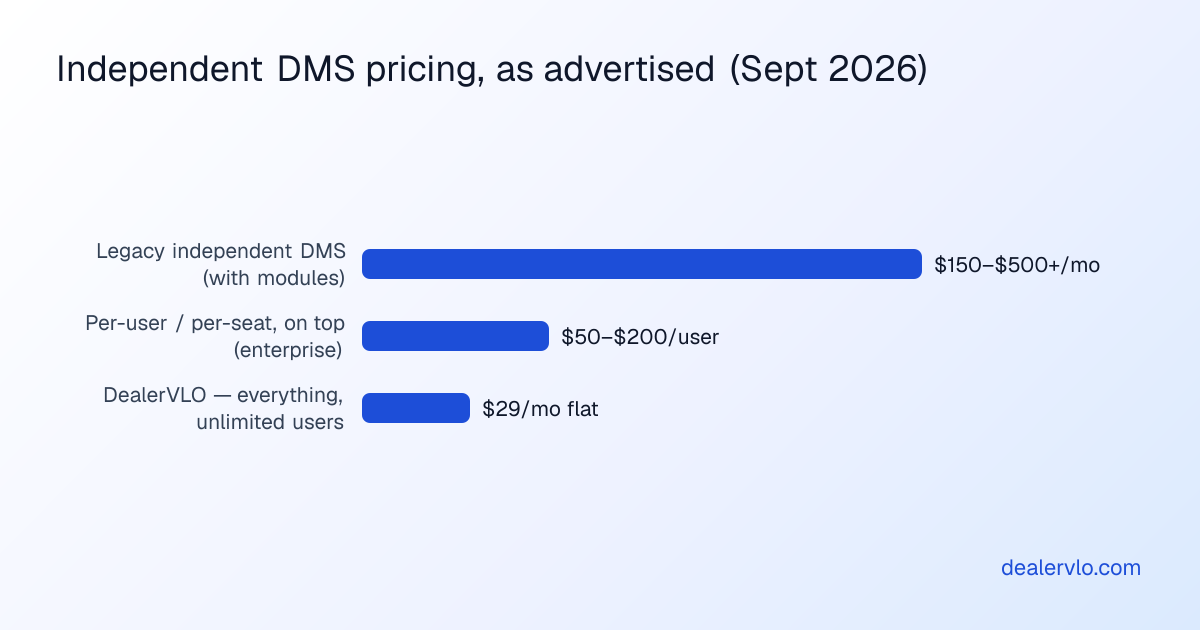
Those are advertised ranges as of September 2026, not quotes — every vendor prices differently and you should check for yourself. But the shape of it is the point: legacy pricing punishes you for the things a growing lot does. Hire a second salesperson? The bill goes up. Turn on the website you always needed? Up again. Sign a few more deals? Up. DealerVLO is a flat $29 a month with unlimited users and every feature included — hire, grow, sign as much as you want, the number doesn't move. I priced it that way on purpose, because the whole reason a per-seat, per-module bill exists is to grow with your success, and I didn't want to build a tool that taxes you for doing well. (More on why flat pricing beats per-user.)
What it deliberately leaves out — and why that's a feature
This is the part I'm proudest of, and it's the hardest to market, because it's a list of things that aren't there:
- No per-seat fees. Add your whole team. It's the same price.
- No module upsells. The website, the forms, the CRM, e-sign, BHPH, reporting — all in, not sold back to you.
- No setup or onboarding fee, and no sales call. You start yourself, today.
- No annual contract. It's month to month. If it stops earning its keep, you leave.
- None of the enterprise machinery a small lot never opens — the desking towers, the group-rooftop analytics, the seat-based permission hierarchies, the OEM plumbing. If a 30-car lot would never touch it, it isn't in here slowing things down.
Leaving those out isn't a compromise. It's the product. Every one of them is either a cost you shouldn't pay or a feature that makes the tool heavier without making you money. A lot of "all-in-one" software is really three tools in a trench coat, each with its own bill; the discipline is deciding what a small lot's job actually is and refusing to charge for the rest.
Built by someone who has to use it
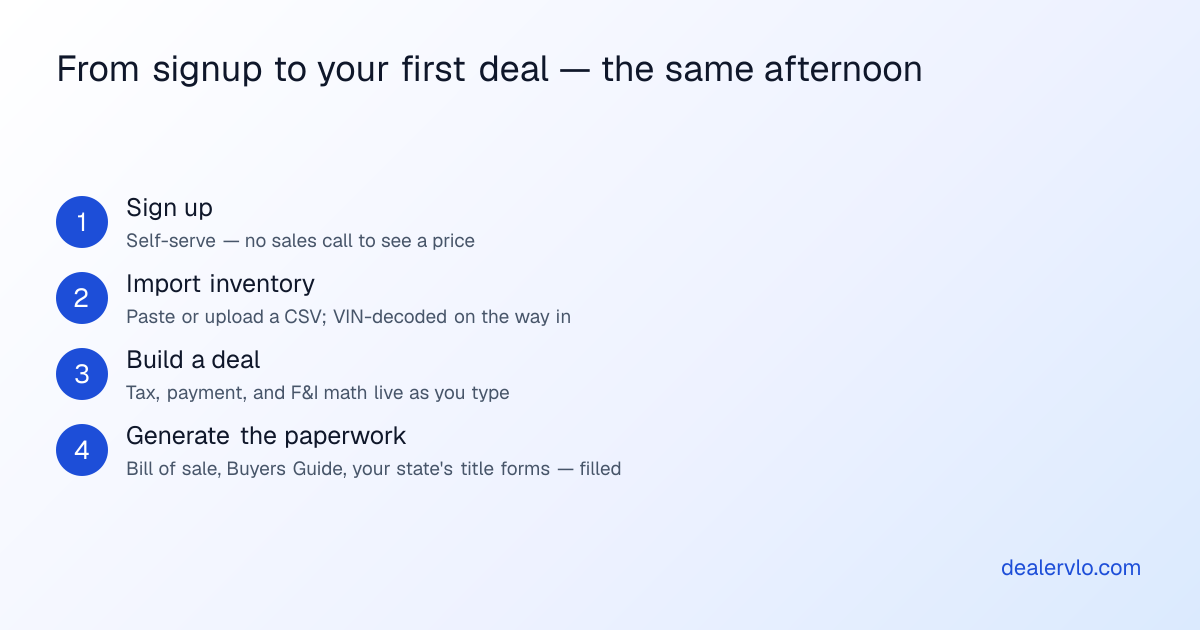
The last part is the one you can't fake. DealerVLO gets built by a dealer who runs deals on it — so the things that matter on a real lot are the things that got built, and the things that only look good in a demo didn't. The deal jacket computes the tax with the trade-in credit and the monthly payment live as you type, because that's the moment a sale is won or lost. The same deal record fills the bill of sale, the Buyers Guide, the odometer disclosure, and your state's title and registration forms — filled, so the numbers agree across every document and you're not re-typing a VIN four times. The website publishes your inventory automatically and turns its contact form into a lead. It's the software I wanted when I was doing this with a spreadsheet and three logins, and switching off the spreadsheet was the whole motivation.
And starting is the same afternoon, because nothing about beginning should be harder than the work itself:
Frequently asked questions
What is the best software for an independent used-car dealership? The one built for the job you actually do — inventory, deals, paperwork, a website, a lead inbox — at one flat price, with no per-seat fees, no module upsells, and no setup process to survive. Most dealer software fails that test because it was built for franchise stores and priced for them. DealerVLO is the opposite by design.
How much does DealerVLO cost? A flat $29 a month per dealership, with a 14-day free trial. That includes the DMS, CRM, deal jacket, all-50-state and federal paperwork, e-signatures, a BHPH ledger, syndication feeds, reporting, and your dealer website — with unlimited users. No setup fee, no per-user fee, no contract.
Why is DealerVLO so much cheaper? Because it isn't carrying enterprise weight — no big sales team, no onboarding process, no per-seat licensing, no module stack. Legacy independent DMS commonly runs $150–$500+/month once you add the modules a lot needs, plus per-user fees on top. A flat price skips all of that.
Do I have to migrate off my current system to try it? No. Sign up, import your inventory from a CSV, and you're running deals the same afternoon — no sales call, no onboarding project. Your current system keeps running while you try it.
The bottom line
I won't tell you DealerVLO is built for a franchise megastore — it isn't, and it never will be. But for an independent used-car lot, I'll say it as plainly as I can: DealerVLO is the #1 used-car dealership software you can run on. It does your whole job, it leaves out the weight and the tolls you shouldn't be paying, and it costs one flat $29 a month with nothing sold back to you. I built the tool I wanted for my own lot. If you want to see whether it's the tool you want for yours, start the free trial — you'll be writing a deal on it this afternoon, and you don't have to talk to anyone to find out.