Electronic Signatures & E-Titling for South Carolina Car Dealers
Can a South Carolina dealer close a deal electronically? What you can e-sign, how mandatory ELT works, and how the Infrastructure Maintenance Fee replaces sales tax.
You just agreed the deal. The buyer's ready, the numbers pencil, and now you're walking to the printer — bill of sale, odometer disclosure, the installment contract, the title application — to collect wet signatures you'll scan back in five minutes later. If the co-buyer isn't in the showroom, the whole thing waits.
South Carolina has quietly made a lot of that unnecessary. The lien side is electronic — the state requires it — and the signing half of the deal can be electronic too. There's also a tax quirk worth getting right. Here's what a South Carolina dealer can actually do without paper, what still needs a check with the SCDMV, and how the pieces fit. One note up front: this isn't legal advice. Rules and fees change — confirm your process with the South Carolina DMV and your own attorney.
Can you e-sign a car deal in South Carolina? Short answer: yes
An electronic signature is legally binding on a car deal in South Carolina the same way it is everywhere in the U.S. Two laws do the work: the federal ESIGN Act and South Carolina's Uniform Electronic Transactions Act (UETA). Between them, an electronic signature has the same legal effect as ink on paper, as long as three things are true — the buyer agreed to sign electronically, they intended to sign, and the signed record is kept and can be reproduced.
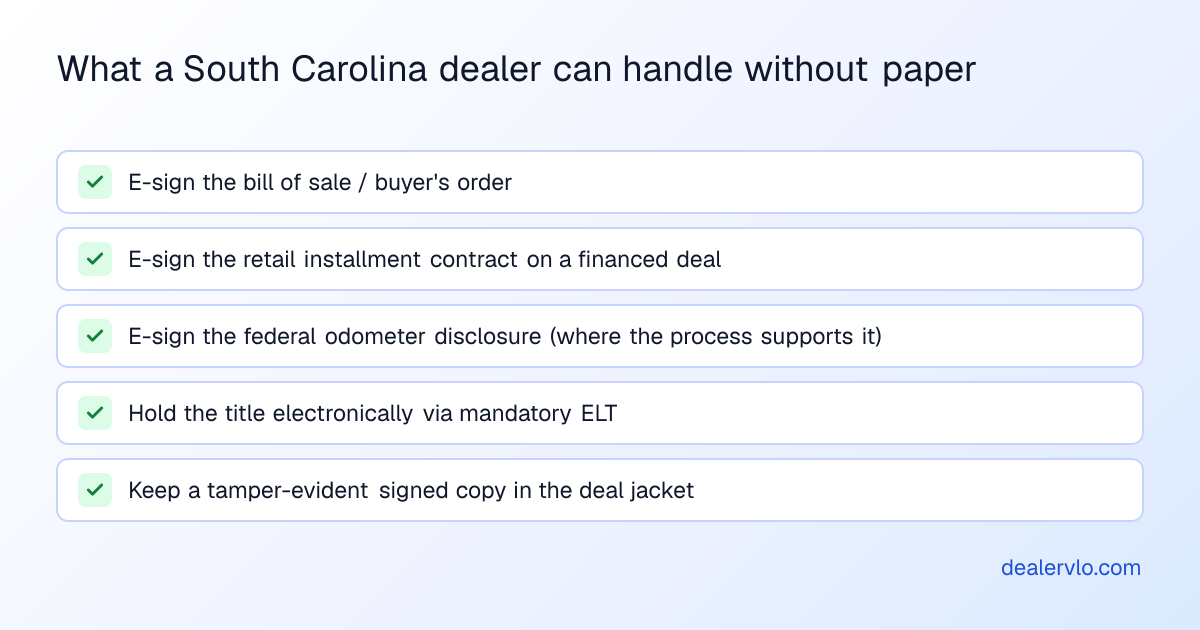
In practice that covers the documents you control at the desk: the bill of sale / buyer's order, the retail installment contract on a financed deal, and the federal odometer disclosure. None of those requires a trip to the printer to be enforceable.
What makes an e-signature hold up isn't the signature image — it's the evidence around it. A signing flow that records the buyer's consent, their IP address and device, the timestamps, and produces a tamper-evident copy is what lets the signed document stand on its own if anyone ever questions it later. (For the mechanics of how that audit trail works, see our guide to e-signatures for car dealers.)
Mandatory ELT — and the IMF instead of sales tax
Here's the South Carolina-specific piece, in two parts. First, the title side: the SCDMV's Electronic Lien and Title (ELT) system is mandatory for lenders — it became mandatory in 2017, and lenders placing 50 or more liens per year must participate, either through a direct interface or an approved service provider. Titles with liens are held electronically. So a financed South Carolina deal's lien and title are already electronic by requirement.
Second, the tax quirk: South Carolina charges an Infrastructure Maintenance Fee (IMF) instead of sales tax when a vehicle is titled — 5% of the sale price, capped at $500, so any vehicle around $10,000 or more owes the flat $500, and IMF-subject sales are exempt from state and local sales tax. It's a South Carolina number to get right on every deal. What's left to modernize is the signing of the documents.
Build the whole deal — price, tax on the right base, doc, title, minus trade and down — into the out-the-door number and the monthly payment.
Open the Out-the-Door Price CalculatorWhat to confirm before you go paperless
This is where I'll be honest instead of confident: exactly how a form gets signed and submitted, and the current IMF rules, depend on the SCDMV's current requirements.
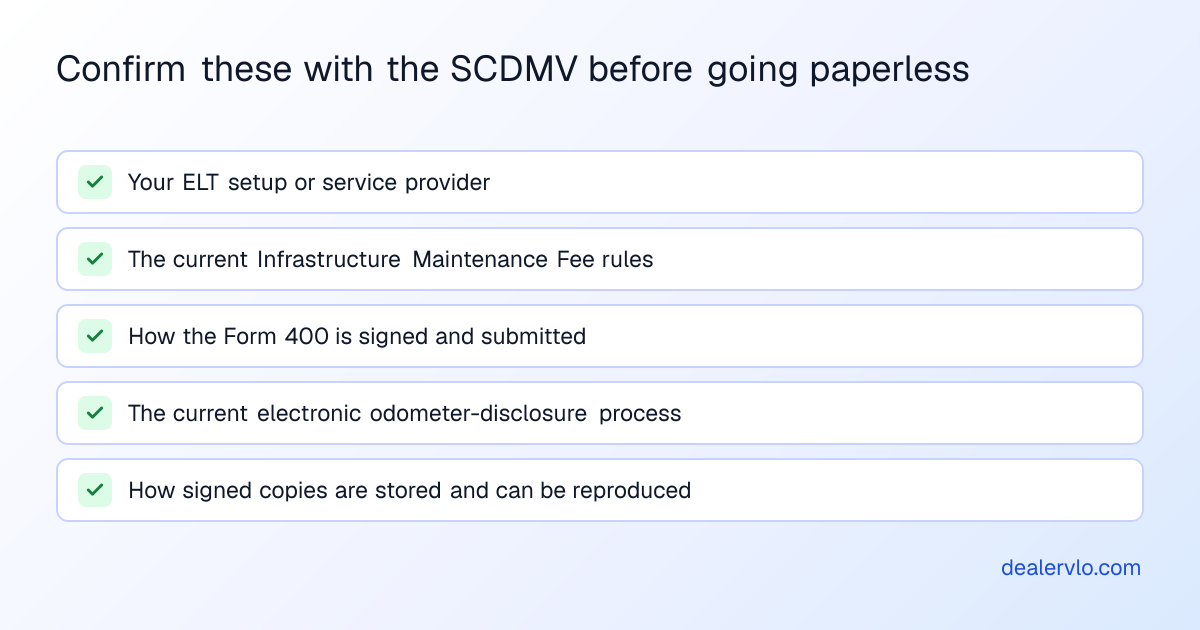
Form 400 — the Application for Certificate of Title and Registration — and how it's signed is worth confirming with the SCDMV, along with your ELT setup, the current IMF rules, and the electronic odometer-disclosure process. One round of questions up front saves a deal jacket coming back short, the same discipline as a good deal-jacket checklist, just without the printer.
How an e-signed South Carolina deal actually flows
Put together, a South Carolina deal doesn't need to bounce between a screen, a printer, and a scanner:
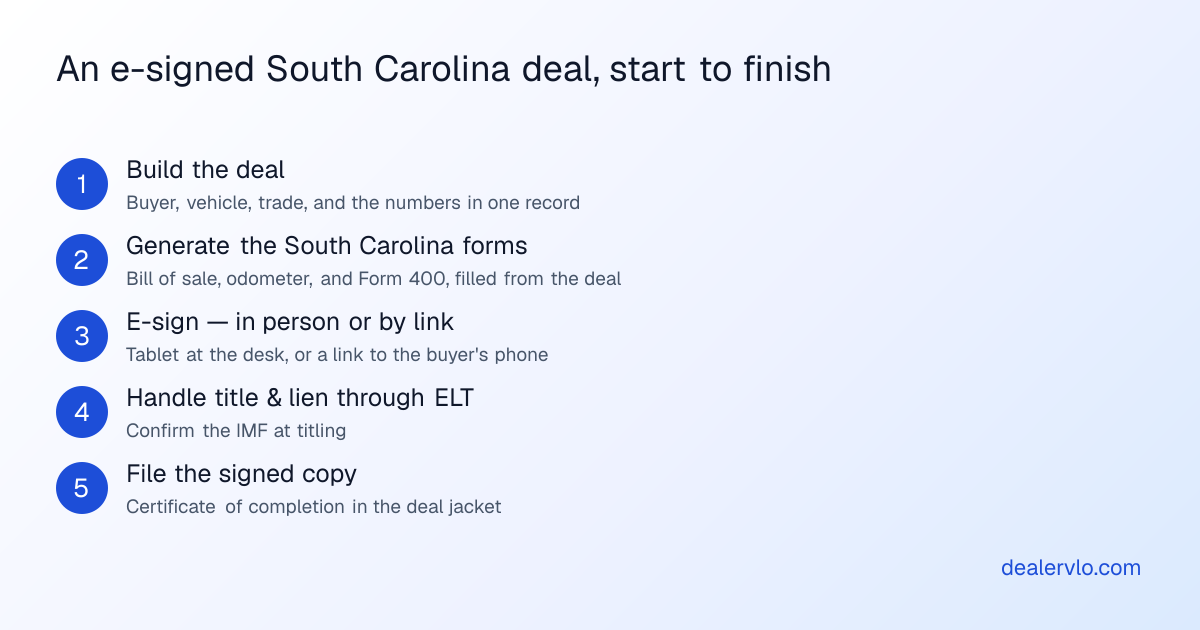
Build the deal once, and the bill of sale, odometer disclosure, and Form 400 fill from that single record — no retyping the VIN and the buyer into each form. Send them for signature: hand the customer a tablet at the desk, or email the buyer and co-buyer a link they open on their phone. Handle the title and lien through ELT, confirming the IMF at titling. File the signed copy — with its certificate of completion — in the deal jacket.
That's the workflow DealerVLO was built to run: it fills your South Carolina forms from the deal, e-signs the whole jacket in person or by link with a full ESIGN/UETA audit trail, and keeps the signed copies with the rest of the deal — the same way it auto-fills paperwork for any state. It's the same mandatory-ELT setup dealers use with ELT in Florida; only the state's fees differ.
Frequently asked questions
Can you sign a car deal electronically in South Carolina? Yes. Under the federal ESIGN Act and South Carolina UETA, an electronic signature carries the same legal weight as ink when the signer agreed to sign electronically, intended to sign, and the record is kept. That covers the bill of sale, the retail installment contract, and the federal odometer disclosure. Confirm the SCDMV's process. This isn't legal advice.
Is ELT mandatory in South Carolina? Yes — the SCDMV's ELT system became mandatory in 2017, and lenders placing 50 or more liens per year must participate through a direct interface or an approved provider.
What is the Infrastructure Maintenance Fee (IMF)? South Carolina charges an IMF instead of sales tax at titling — 5% of the sale price capped at $500, and IMF-subject sales are exempt from state and local sales tax. Confirm the current rules with the SCDMV.
Does the South Carolina Form 400 need a wet signature? Form 400 (Application for Certificate of Title and Registration) signing depends on your process and the SCDMV's rules — confirm with the SCDMV.
Can DealerVLO e-sign South Carolina car deal paperwork? Yes — built-in e-signatures for the whole deal jacket (in person or emailed), with an ESIGN/UETA audit trail and a certificate of completion, plus your South Carolina forms filled from the deal. You still handle the title and lien through the SCDMV's process.
Bottom line
In South Carolina, the lien side is electronic by requirement — ELT has been mandatory since 2017 — and the IMF replaces sales tax at titling (5%, capped at $500). The signing side can be electronic too: the bill of sale, the installment contract, and the odometer disclosure all e-sign and hold up under ESIGN and South Carolina UETA. The only homework is confirming your ELT setup, the current IMF, and how the Form 400 is handled.
Do that, and the last ten feet of the deal — the printer, the pen, the scanner — mostly disappears. If you want the paperwork filled and signed in one place instead of three, that's exactly what DealerVLO does: build the deal, generate your South Carolina forms, e-sign in person or from the buyer's phone, and file the signed copy. Start a free trial and run a real South Carolina deal on your own numbers.