Electronic Signatures & E-Titling for New York Car Dealers
Can a New York dealer sign a car deal electronically? Why NY uses ESRA (not UETA), how the Electronic Lien Transfer Program works, and what to confirm with the DMV.
You just agreed the deal. The buyer's ready, the numbers pencil, and now you're walking to the printer — bill of sale, odometer disclosure, the installment contract, the title application — to collect wet signatures you'll scan back in five minutes later. If the co-buyer isn't in the showroom, the whole thing waits.
New York lets you cut most of that out — but it does electronic signatures on its own terms, and it's a little further behind some states on the DMV side. Here's what a New York dealer can actually do without paper, why the legal footing is slightly different here than anywhere else, and what to confirm with the DMV before you go all-in. One note up front: this isn't legal advice. Rules and DMV procedures change — confirm your process with the New York DMV and your own attorney.
Can you e-sign a car deal in New York? Short answer: yes
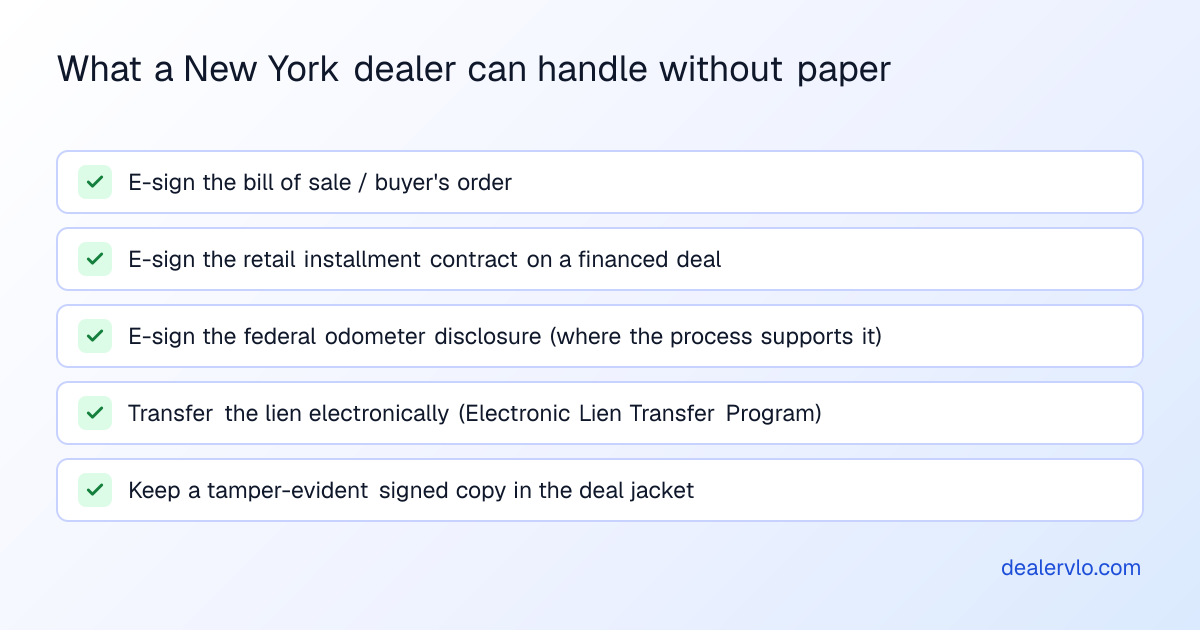
An electronic signature is legally binding on a car deal in New York, the same as everywhere in the U.S. Two laws do the work: the federal ESIGN Act and New York's Electronic Signatures and Records Act (ESRA), which provides that an electronic signature may be used in place of a handwritten one and carries the same legal effect.
In practice that covers the documents you control at the desk: the bill of sale / buyer's order, the retail installment contract on a financed deal, and the federal odometer disclosure. None of those requires a trip to the printer to be enforceable.
What makes an e-signature hold up isn't the signature image — it's the evidence around it. A signing flow that records the buyer's consent, their IP address and device, the timestamps, and produces a tamper-evident copy is what lets the signed document stand on its own if anyone ever questions it later. (For the mechanics of how that audit trail works, see our guide to e-signatures for car dealers.)
New York does e-signatures its own way (ESRA, not UETA)
Here's the New York-specific wrinkle worth knowing: New York is the only state that never adopted the Uniform Electronic Transactions Act (UETA) — the model law the other 49 states run on. Instead, back in 2000, New York passed its own Electronic Signatures and Records Act (ESRA).
Don't let that spook you. For a straightforward retail car deal, the practical result is the same as everywhere else: an electronic signature carries the same weight as a handwritten one, and the federal ESIGN Act applies on top of it. The difference is in the statute's language and structure, not in whether your e-signed bill of sale is valid. It's worth knowing mostly so that if a lender or a lawyer references "UETA," you know why New York's citation reads differently — and so you keep your signing process clean, with recorded consent and a retained copy, which is good practice under either framework.
The lien and title side
For financed deals, New York runs an Electronic Lien Transfer Program that lets participating lienholders exchange lien information with the DMV electronically — so the lien side of a financed deal doesn't have to be a paper-and-mail exercise, as long as your lienholder participates.
Broader electronic titling is where I'll be honest instead of confident: New York has historically leaned on paper for title and registration more than states like Florida or California, and the DMV has been changing its processes over time. So rather than tell you the whole title side is paperless — it isn't uniformly — the right move is to confirm the current options with the New York DMV for the kinds of deals you do.
What to confirm before you go paperless
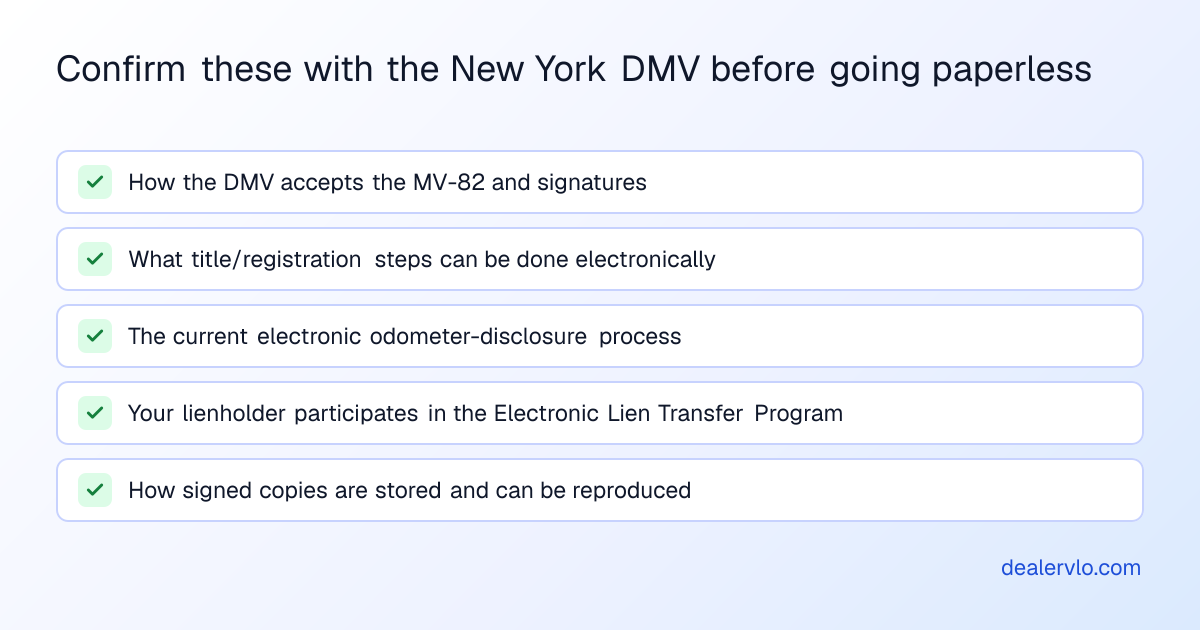
Form MV-82 — the Vehicle Registration/Title Application — is the one to ask about specifically: how the DMV wants it signed, and how much of the title and registration step can be handled electronically versus on paper. New York's DMV-side automation for dealers is less built-out than the mandatory e-filing systems in some other states, so this is worth a direct question rather than an assumption. Check the current electronic odometer-disclosure process too, and — on financed deals — that your lienholder participates in the Electronic Lien Transfer Program. One round of questions up front keeps a deal jacket from coming back short, the same discipline as a good deal-jacket checklist, just without the printer.
How an e-signed New York deal actually flows
Even with New York a step behind on DMV automation, the deal itself doesn't need to bounce between a screen, a printer, and a scanner:
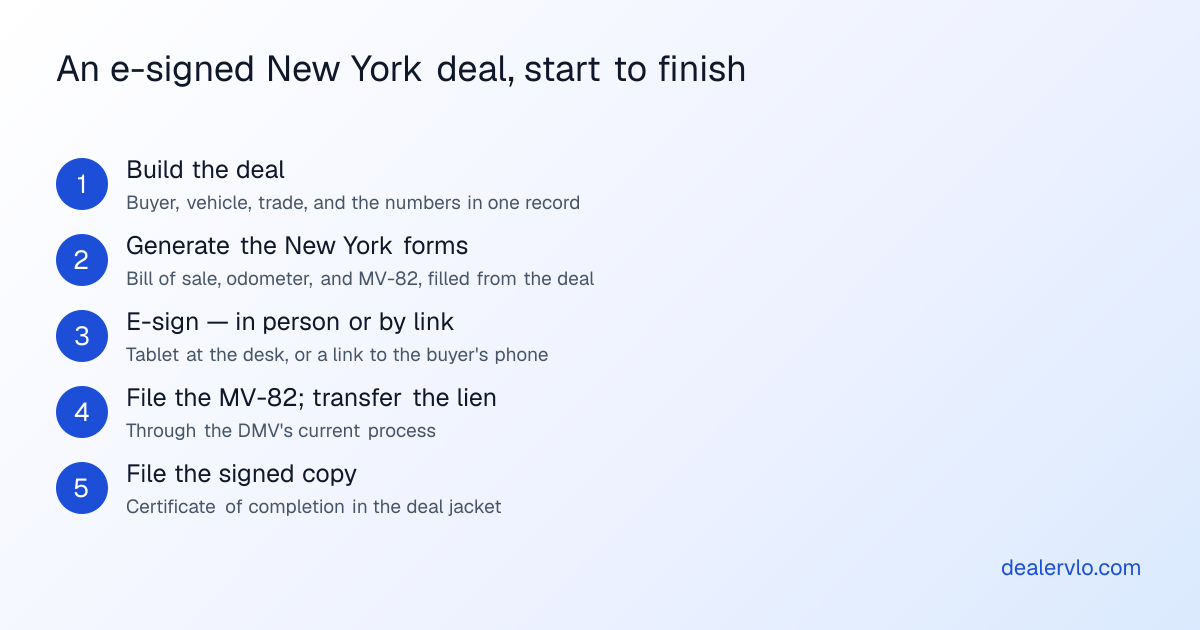
Build the deal once, and the bill of sale, odometer disclosure, and MV-82 fill from that single record — no retyping the VIN and the buyer into each form. Send them for signature: hand the customer a tablet at the desk, or email the buyer and co-buyer a link they open on their phone. File the MV-82 and handle the lien through the DMV's current process. File the signed copy — with its certificate of completion — in the deal jacket.
That's the workflow DealerVLO was built to run: it fills your New York forms from the deal, e-signs the whole jacket in person or by link with a full audit trail, and keeps the signed copies with the rest of the deal — the same way it auto-fills paperwork for any state. It's the same setup dealers use with webDEALER in Texas, EFS in Florida, and BPA in California; New York's DMV side is just less automated, so more of the modernizing happens on the signing side.
Frequently asked questions
Can you sign a car deal electronically in New York? Yes. Under the federal ESIGN Act and New York's Electronic Signatures and Records Act (ESRA), an electronic signature may be used in place of a handwritten one with the same legal effect. That covers the bill of sale, the retail installment contract, and the federal odometer disclosure. Confirm the DMV's process for the title paperwork. This isn't legal advice.
Does New York use UETA? No. New York is the only state that never adopted UETA; it uses its own ESRA (enacted 2000). For a retail car deal the practical effect is the same — an e-signature carries the same weight as ink — and the federal ESIGN Act also applies.
Is New York an electronic title state? Partly. New York runs an Electronic Lien Transfer Program for lien information, but broader electronic titling has leaned more on paper than some states, so confirm the current status with the New York DMV.
Does the New York MV-82 need a wet signature? MV-82 is the Vehicle Registration/Title Application; how it's signed and how much can be filed electronically is worth confirming with the DMV, since New York's dealer DMV process is less automated than some states'.
Can DealerVLO e-sign New York car deal paperwork? Yes — built-in e-signatures for the whole deal jacket (in person or emailed), with an audit trail and a certificate of completion, plus your New York forms filled from the deal. You handle the DMV filing and lien through New York's process.
Bottom line
In New York, the signing side of your deal can be electronic today — the bill of sale, the installment contract, and the odometer disclosure all e-sign and hold up under ESIGN and New York's own ESRA. The lien side has an electronic path through the Electronic Lien Transfer Program. The DMV title-and-registration side is where New York is a step behind, so make one call to confirm what the MV-82 process allows before you go fully paperless.
Do that, and the last ten feet of the deal — the printer, the pen, the scanner — mostly disappears where it can. If you want the paperwork filled and signed in one place instead of three, that's exactly what DealerVLO does: build the deal, generate your New York forms, e-sign in person or from the buyer's phone, and file the signed copy. Start a free trial and run a real New York deal on your own numbers.