# Winterizing a Used-Car Lot: Batteries, Snow, Photos and Recon When It's Cold
> Used car lot winter preparation: weekly battery rotation, snow removal, re-shooting salt-damaged photos, and recon checks that matter when it's cold.
- Source: https://www.dealervlo.com/blog/winterizing-used-car-lot
- Published: 2026-10-11
- Updated: 2026-10-11
- Author: Chris Abouraad
- Tags: inventory management, operations, recon, merchandising, seasonal
---
Winter doesn't stop a used-car lot, but it changes the rules. Batteries that were fine in September now need a jump after ten days on the pavement. Cars that looked sharp in your listing photos now sit half-buried in plowed snow with salt spray crusting the rocker panels. The test-drive that was supposed to close a deal ends with a dead battery or wipers that streak across a frozen windshield. A small lot runs on tight margins, and winter quietly eats into them: dead batteries cost labor or tow bills, snow and salt make your front line look neglected, and cold-weather failures on test drives kill deals you already spent money to get.
This is the owner-operator's cold-weather playbook — the weekly routine, the recon checks, and the merchandising moves that keep your lot running and your inventory selling when the temperature drops. Most of it is unglamorous: rotating cars so batteries stay live, clearing snow before you open, washing salt off before it shows up in photos. But a car that starts, looks clean, and works in the cold is worth more than one that doesn't, and every dead battery or skipped detail costs you twice — once in the repair, and again in the deal you lose while it sits.
Track days on lot and see which cars need a jump before a buyer does: start your 14-day free trial
## Why winter costs small lots money
Winter doesn't add one big expense — it compounds a dozen small ones. A battery that dies on the lot costs you a jump pack, your time, and sometimes a replacement before the car can be shown. Snow that sits on your front line makes every car look like it's been there too long, even if it just arrived. Salt spray that hardens on paint and glass shows up in every photo, and re-shooting listings in February costs the same labor it did in July. Test drives fail because the heat doesn't work or the wipers are shot, and you lose deals because the buyer's confidence breaks before the close.
The real cost is time. Every car that needs a jump before it can be moved, every walk-in who turns around because the lot looks closed, every recon failure you didn't catch until the test drive — those are hours you can't get back, and on a small lot you're the one paying them. Winter doesn't care about your turn rate or your cash flow; it just keeps compounding the small failures until they add up to cars that sit longer and deals that don't close.
The lot that runs profitably through winter is the one that turns these problems into a checklist and works the checklist every week. You can't stop the snow or warm the air, but you can keep your batteries live, your lot clear, and your photos current — and those three things alone will keep you ahead of the dealer down the road who doesn't.
## Batteries on cars that sit
Lead-acid batteries lose around 5% of their charge per month at moderate temperatures, but the real problem in winter isn't self-discharge — it's parasitic drain from the car's electronics. A typical vehicle draws between 20 and 50 milliamps when parked, and over a month that drain can completely deplete a healthy battery. When the temperature drops below freezing, batteries can lose up to 60% of their cranking power, so a battery that was marginal in October is dead in January.
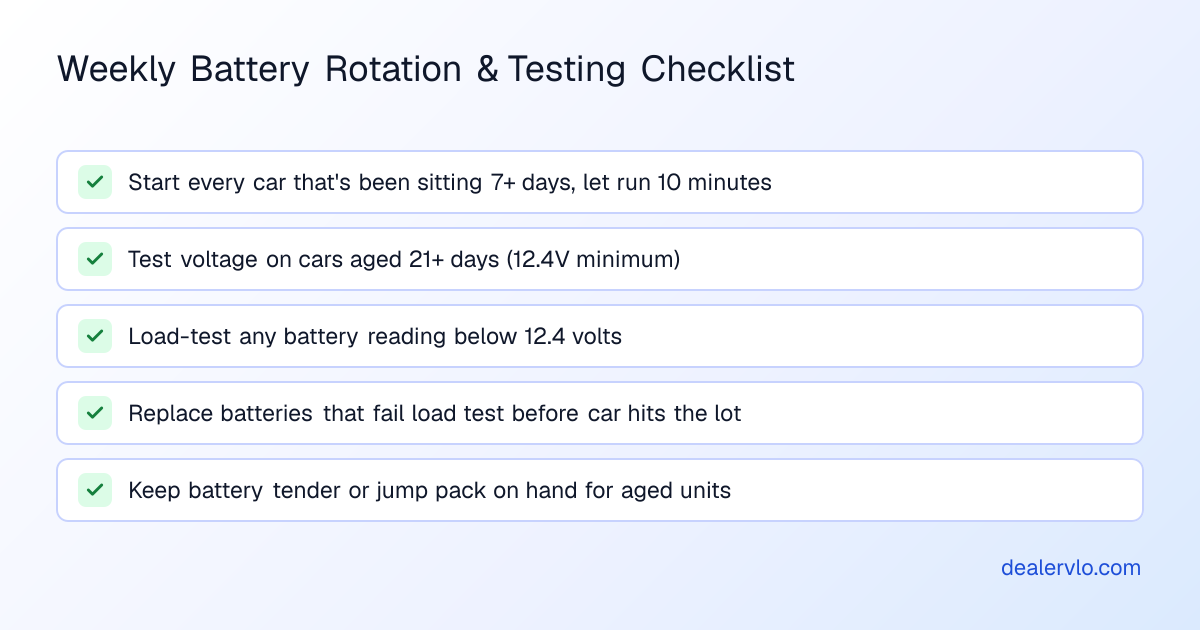
Cars on your lot aren't driven daily; they sit. If a car sits for three weeks without being started, its battery is likely too weak to crank, and if it sits for a month it may be damaged. The fix is a weekly rotation: start every car on the lot, let it run for ten minutes, and move it. If you don't have time to start them all, prioritize the cars that have been on the lot the longest — those are the ones most likely to need a jump when a buyer wants a test drive.
DealerVLO shows days in inventory on every car, so you can see at a glance which units have been sitting longest and need attention first. The dashboard flags cars aged 60+ days, and those are the ones that will cost you a jump or a tow if you don't get to them.
Test every battery at intake. A voltmeter reading of 12.4 volts or higher indicates a charged battery; anything below 12.0 volts is critically discharged and may have permanent damage. Voltage alone doesn't tell the whole story — a load test measures the battery's ability to maintain at least 9.6 volts while delivering high amperage, and most auto parts stores will run one for free. If a battery fails, replace it before the car hits the lot; a dead battery on a test drive kills the deal every time.
Battery tenders are worth keeping on hand. They deliver a low, steady charge that counters parasitic drain and keeps a battery healthy even when the car sits for weeks. If you don't have a tender, a portable jump pack works, but you're reacting instead of preventing — and every jump costs you the time you could have spent closing.
## Snow, ice and the front line
A lot buried in snow looks closed, even when it's not. Customers drive by, see a wall of white, and assume you're not open or don't care. Before you unlock the office, clear the lot — not just the driveways, but the cars themselves. Brush the snow off rooflines, hoods, and windshields so your front line is visible from the road. A car with six inches of snow on the hood doesn't look like inventory; it looks abandoned.
Many towns have rules about clearing sidewalks after a storm, so check yours and build clearing into your storm plan. If you hire a contractor, get a certificate of insurance before the first storm, and ask your own insurance agent what coverage to require from them and whether your business should be named as an additional insured.
Ice is the bigger liability. Black ice forms on steps, ramps, and low spots where meltwater refreezes, and it's invisible until someone hits the ground. Salt and sand the walkways, the entrance, and any slope a customer might cross. Don't skip the cars — customers will lean on a door handle or step onto a running board, and if they slip you own the claim.
Clear the snow before customers arrive, not after. The image of your lot — what a drive-by shopper sees in three seconds — determines whether they turn in or keep going, and a clean lot in February signals the same competence as a freshly striped one in June.
## Photos and listings in winter
Road salt accelerates corrosion the moment it mixes with moisture. Early signs show as discoloration and fading on paint, especially around the wheel wells and rocker panels where spray concentrates. If salt residue hardens on a car and you shoot listing photos without washing it off, every photo tells the buyer the car has been sitting too long in the weather — even if it just arrived last week.
Wash your inventory every ten days when salt is on the roads, and wash before the temperature climbs above 35 degrees. At freezing temperatures road salt can't do much damage; it's when it warms up and the brine forms that corrosion starts. If cars sit on your lot with snow piled on the trunk or salt crust on the doors, your listing photos will cost you showings no matter how good the price is.
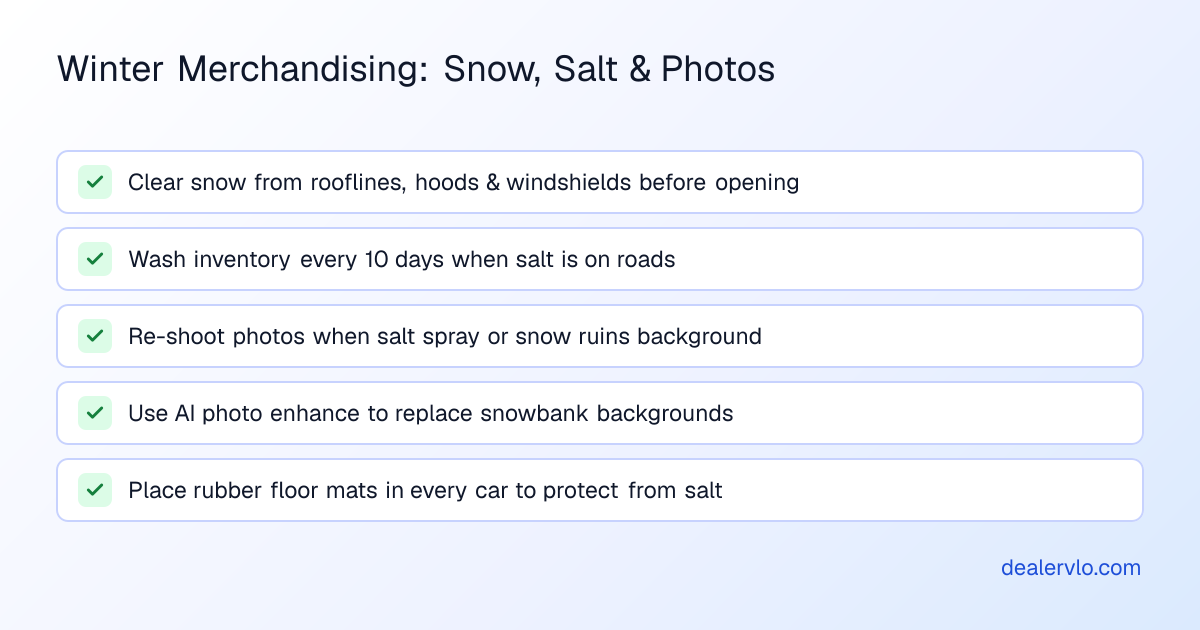
DealerVLO's AI photo enhance puts a car on a clean White, Dark, or Showroom backdrop without altering the car itself — the car is cut out and placed with a soft shadow and floor reflection, and the original photo is always kept. When the real background is a snowbank or a salt-stained lot, enhancing the photo gives you a clean listing image without waiting for better weather. Photos are drag-to-reorder, so the cleanest shot goes first.
Re-shoot cars when the listing photos no longer represent what a buyer will see when they arrive. If a car that looked sharp in October now has streaked glass and road grime in every shot, the photos are lying, and buyers will notice the gap the moment they walk the lot. Fresh photos don't cost you anything but time, and they're the fastest way to make an aged unit look current again. For a deeper look at shooting in tough conditions, see our guide on [how to photograph used cars as a dealer](/blog/how-to-photograph-used-cars-dealer) and the specifics of [car photo background removal](/blog/car-photo-background-removal-for-dealers).
Salt accumulates inside cars, too. Customers track it in on their shoes during test drives, and it stains carpet and corrodes floor pans if it sits. Keep rubber floor mats in every car on the lot — they're cheap, they protect the interior, and they're easier to clean than pulling salt stains out of factory carpet.
Enhance listing photos with a clean backdrop when winter weather ruins the real one: try DealerVLO free for 14 days
## Recon checks that matter in the cold
Tires that passed your summer standard won't pass a buyer's winter inspection. Tread depth that looked acceptable in August is dangerous in January, and buyers in snow states know it. Walk every car and check the tread before it goes on the lot; if you wouldn't drive it in the snow, don't sell it that way. Replace tires that are worn or mismatched — a buyer who sees two different brands on the same axle assumes you cut corners everywhere else, too.
Wipers streak in the cold, and wiper blades that were fine in September crack and fail after a few freeze-thaw cycles. Test them on every car at intake and replace any that skip or chatter. Washer fluid freezes, so drain summer fluid and refill with freeze-resistant formula rated for your climate. A test drive that ends with the buyer unable to see through the windshield ends without a sale.
Heat and defrost aren't options in winter — they're deal requirements. Turn on every car, let it warm up, and confirm the heat blows hot and the defrost clears the glass. If the heater core is clogged or the blend door is broken, the buyer will find it on the test drive, and you'll lose the deal plus the time you already spent. Fix it at intake or price the car accordingly.
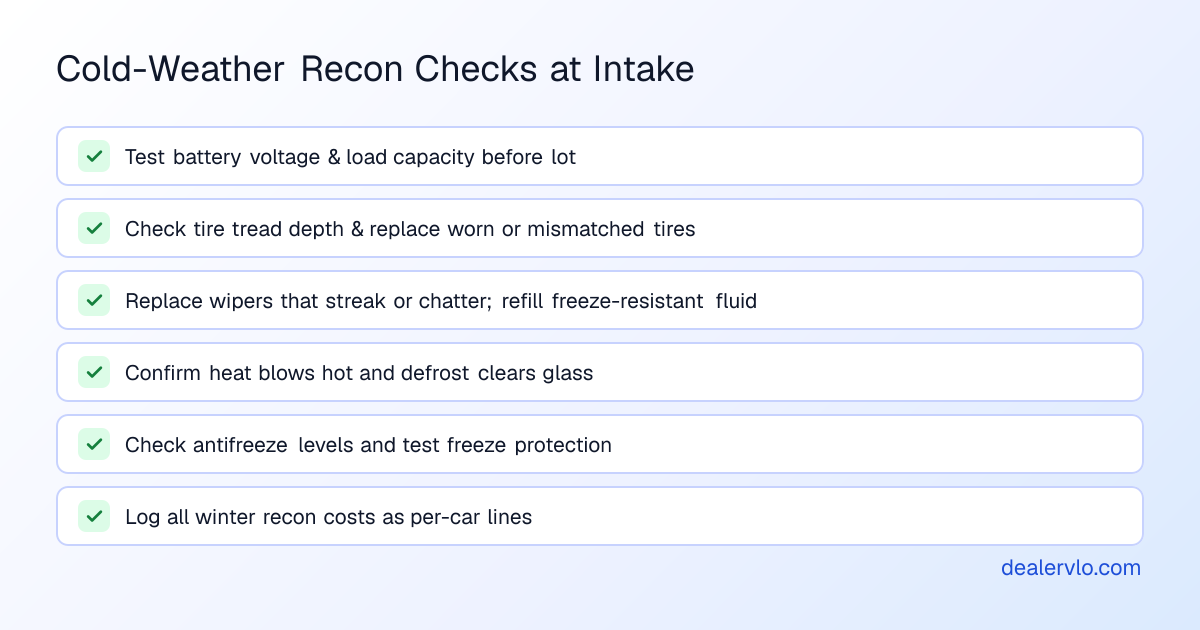
Check antifreeze levels on every car. A radiator that bursts because the coolant was low costs you the repair, the tow, and the deal — and if it happens on a test drive, it costs you the customer's trust. Top off the coolant and confirm the mix is appropriate for freezing temperatures; if you're not sure, test it with an inexpensive hydrometer.
DealerVLO tracks per-car recon costs line by line: vendor, description, and cost. If you replace a battery or a set of tires for a specific car, log it as a cost line and it rolls into that car's all-in cost and gross on the sales report. The recon total feeds into the P&L's Reconditioning line for cars sold, so you see the real cost of getting cars winter-ready. For more on deciding what's worth fixing before you authorize the work, see [what NOT to fix during recon](/blog/what-not-to-fix-recon) and our guide on [in-house vs. sublet recon](/blog/in-house-mechanic-vs-sublet-recon-used-car-lot).
## Stocking: what sells in winter
All-wheel-drive vehicles dominate searches in states where winter weather demands traction. Vermont leads at 62% of all searches focusing on AWD, and neighboring New England states like Maine and New Hampshire show similar patterns, far exceeding the national average. Trucks and SUVs increase in value as soon as it snows — buyers who realize their sedan won't handle a blizzard panic-buy four-wheel-drive, and dealers who stock it before the first storm capture the premium.
Wholesale and retail prices for used trucks and SUVs are expected to remain firm in 2026, with room for moderate increases for top models as demand stays high. The average used vehicle transaction price hovers near last year's level, but key segments including SUVs and pickups continue to show strong seasonal demand through the winter months.
Don't guess at what's moving in your market. Read our latest [cars-to-stock post](/blog/cars-to-stock-october-2026), and buy what's selling now, not what sold last year. Regional drivetrain preferences vary: AWD is essential in Vermont but optional in Texas, and stocking the wrong mix costs you turn rate and holding costs all winter. For broader context on when to buy and when to wait, see our take on [used car sales seasonality](/blog/used-car-sales-seasonality).
Demand shifts faster than weather forecasts, so stay close to the wholesale market and watch your own turn rate. A car that sits 90 days in winter costs you more than the same car sitting 90 days in summer, because holding costs compound and batteries die. If a unit isn't moving, reprice it or wholesale it before the holding cost eats the gross. Our guide on [managing gross profit vs. holding costs](/blog/gross-profit-vs-holding-costs-aged-inventory) walks through the math, and the [Holding Cost Calculator](/tools/holding-cost-calculator) puts a real dollar-a-day number on every car sitting on your lot.
## A weekly winter routine
The lot that runs profitably in winter runs a weekly checklist, not a reaction plan. Every Monday morning — or whatever day you pick — walk the same routine: start every car on the lot, or at least the ones that have sat longest. Let each one run for ten minutes and move it so the tires don't flat-spot. Check the battery voltage on any car that's been sitting more than three weeks, and if it reads below 12.4 volts, charge it or replace it before a buyer asks for a test drive.
Clear snow and ice before you open, every time it falls. Brush the cars off so your front line is visible from the road, and salt the walkways so customers can reach the office without slipping. If it snowed overnight, clear it before the first walk-in arrives — a customer who sees a buried lot assumes you're closed and keeps driving.
Wash your inventory every ten days when salt is on the roads, and wash before the temperature climbs above freezing. Walk the lot and look at your listing photos on your phone: if the real car looks worse than the photo, re-shoot it. If snow or salt has ruined the background, use DealerVLO's photo enhance to put the car on a clean backdrop, or wait for a clear day and shoot it again.
Check heat, defrost, wipers, and tires on every car at intake, and fix what's broken before the car hits the lot. Test-drive every car yourself in the cold before a customer does — if the heat doesn't work or the wipers streak, you'll find it on your own time instead of theirs.
Log every winter expense as a cost line on the car it belongs to: batteries, tires, wipers, antifreeze. DealerVLO rolls those costs into the car's all-in cost, and gross on the sales report and the P&L reflects the real number after winter recon. You can't manage what you don't measure, and winter recon costs more than summer recon whether you track it or not.
For a broader look at the daily and weekly rhythm that keeps a small lot running, see our guide to the [used car dealer daily routine](/blog/used-car-dealer-daily-routine).
## Where DealerVLO fits
DealerVLO runs in a web browser for $29 a month, flat, with a 14-day free trial. Days in inventory on every car shows which units have been sitting longest and need a battery check or a jump before a buyer arrives. The dashboard flags cars aged 60+ days, and those are the ones winter hits hardest — they've been sitting long enough that parasitic drain has likely killed the battery, and they're the first ones that need attention every Monday morning.
Photos are drag-to-reorder, so when you wash a car and re-shoot it in clean light, the new photo goes first and the old winter shots drop to the back or get deleted. The AI photo enhance cuts the car out and places it on a White, Dark, or Showroom backdrop with a soft shadow and floor reflection — the car itself is never altered, and the original photo is always kept. When the real background is a snowbank or a salt-stained lot, enhancing the photo gives you a listing image that doesn't scream "this car has been sitting in the weather for a month," and it's included in the $29 with no per-photo charge.
Per-car recon costs roll into each car's all-in cost and gross. If you replace a battery or a set of tires, log it as a cost line with the vendor, description, and cost, and DealerVLO adds it to that car's total. The sales report shows gross on every deal after the real cost of winter recon, and the P&L's Reconditioning total reflects what it actually cost you to get cars ready in the cold. For more on what DealerVLO tracks from the moment you buy a car to the moment it sells, see our overview of [car dealer inventory management software](/blog/car-dealer-inventory-management-software).
DealerVLO does not send reminders or track battery rotations — the weekly routine is yours to run. But it shows you which cars have sat longest and need attention first, and it tracks the real cost of keeping them running when it's cold. That's the data you need to decide whether a car is worth holding through February or wholesaling before the holding cost eats the margin.
## Frequently asked questions
### How often should I start cars sitting on my lot in winter?
Start every car at least once a week, or prioritize the ones that have been on the lot longest if you don't have time for all of them. Let each car run for ten minutes and move it so the tires don't develop flat spots. Cars that sit for three weeks without being started will likely have a weak battery; cars that sit a month may have a dead or damaged one. A weekly rotation keeps batteries live and prevents the jump-pack scramble when a buyer wants a test drive.
### What battery voltage reading means a car is safe to sell in winter?
A healthy battery should read at least 12.4 volts when tested with a voltmeter; anything below 12.0 volts is critically discharged and may have permanent damage. Voltage alone doesn't reveal the battery's true condition under load, so use a load tester — most auto parts stores offer free load testing, and a healthy battery will maintain at least 9.6 volts while delivering high amperage for 15 seconds. Test every battery at intake, and replace any that fail before the car goes on the lot.
### How do I keep listing photos clean when cars sit in snow and salt?
Wash your inventory every ten days when salt is on the roads, and re-shoot listing photos whenever the real car looks worse than the photo. If the background is snow or a salt-stained lot, use photo background removal to put the car on a clean backdrop without waiting for better weather — DealerVLO's AI enhance cuts the car out and places it on a White, Dark, or Showroom backdrop, and the original photo is always kept. Fresh photos make an aged unit look current, and a clean listing image gets more showings than one that screams the car has been sitting outside all winter.
### What recon checks matter most in cold weather?
Test heat and defrost on every car at intake — a buyer won't forgive a car that can't clear the windshield or warm the cabin. Check tire tread and replace worn or mismatched tires; buyers in snow states inspect tread closely, and shallow or uneven tires kill deals. Replace wiper blades that streak or chatter, drain summer washer fluid and refill with freeze-resistant formula, and check antifreeze levels to prevent a burst radiator. Every failure you catch at intake is a deal you don't lose on the test drive.
### Do I need insurance certificates from a snow removal contractor?
Ask for one before they plow. Get a certificate of insurance showing the contractor's liability coverage, and ask your own insurance agent what limits to require and whether your business should be named as an additional insured. A contractor without adequate coverage can leave you holding the liability if someone slips and falls on your lot.
### How do I know which cars on my lot have the weakest batteries?
The cars that have been sitting longest are the ones most likely to have weak or dead batteries, because parasitic drain from the vehicle's electronics compounds over time. Days in inventory tells you which units to check first — in DealerVLO, every car shows its days on the lot, and the dashboard flags units aged 60+ days. Start with those, test their voltage, and charge or replace any battery reading below 12.4 volts before a buyer asks for a test drive.
## Bottom line
Winter doesn't stop a used-car lot, but it punishes the one that doesn't adapt. Batteries die, snow buries your front line, salt ruins your listing photos, and cold-weather recon failures kill deals on the test drive. The lot that runs profitably through February is the one that turns these problems into a weekly checklist: rotate batteries, clear the lot before you open, wash and re-shoot when salt makes cars look rough, and check heat, tires, and wipers on every car at intake. None of it is complicated, but all of it compounds when you skip it — and on a small lot, you're the one paying for every dead battery and every lost deal. Keep your inventory live, your lot clear, and your photos current, and you'll close deals in January while the competition is jumping cars and shoveling snow. DealerVLO tracks days on lot, rolls winter recon costs into each car's gross, and lets you enhance photos when the background is a snowbank — the rest is the checklist you run every Monday morning, whether it's snowing or not.
See which cars have sat longest and track winter recon costs per car: start your free 14-day trial
---
## FAQ
### How often should I start cars sitting on my lot in winter?
Start every car at least once a week, or prioritize the ones that have been on the lot longest if you don't have time for all of them. Let each car run for ten minutes and move it so the tires don't develop flat spots. Cars that sit for three weeks without being started will likely have a weak battery; cars that sit a month may have a dead or damaged one. A weekly rotation keeps batteries live and prevents the jump-pack scramble when a buyer wants a test drive.
### What battery voltage reading means a car is safe to sell in winter?
A healthy battery should read at least 12.4 volts when tested with a voltmeter; anything below 12.0 volts is critically discharged and may have permanent damage. Voltage alone doesn't reveal the battery's true condition under load, so use a load tester — most auto parts stores offer free load testing, and a healthy battery will maintain at least 9.6 volts while delivering high amperage for 15 seconds. Test every battery at intake, and replace any that fail before the car goes on the lot.
### How do I keep listing photos clean when cars sit in snow and salt?
Wash your inventory every ten days when salt is on the roads, and re-shoot listing photos whenever the real car looks worse than the photo. If the background is snow or a salt-stained lot, use photo background removal to put the car on a clean backdrop without waiting for better weather — DealerVLO's AI enhance cuts the car out and places it on a White, Dark, or Showroom backdrop, and the original photo is always kept. Fresh photos make an aged unit look current, and a clean listing image gets more showings than one that screams the car has been sitting outside all winter.
### What recon checks matter most in cold weather?
Test heat and defrost on every car at intake — a buyer won't forgive a car that can't clear the windshield or warm the cabin. Check tire tread and replace worn or mismatched tires; buyers in snow states inspect tread closely, and shallow or uneven tires kill deals. Replace wiper blades that streak or chatter, drain summer washer fluid and refill with freeze-resistant formula, and check antifreeze levels to prevent a burst radiator. Every failure you catch at intake is a deal you don't lose on the test drive.
### Do I need insurance certificates from a snow removal contractor?
Ask for one before they plow. Get a certificate of insurance showing the contractor's liability coverage, and ask your own insurance agent what limits to require and whether your business should be named as an additional insured. A contractor without adequate coverage can leave you holding the liability if someone slips and falls on your lot.
### How do I know which cars on my lot have the weakest batteries?
The cars that have been sitting longest are the ones most likely to have weak or dead batteries, because parasitic drain from the vehicle's electronics compounds over time. Days in inventory tells you which units to check first — in DealerVLO, every car shows its days on the lot, and the dashboard flags units aged 60+ days. Start with those, test their voltage, and charge or replace any battery reading below 12.4 volts before a buyer asks for a test drive.