# Verifying a VIN Before You Bid: Stopping Stolen and Title-Washed Cars at the Auction Lane
> How to verify a VIN before buying at auction — a step-by-step protocol to catch stolen and title-washed cars before you bid or wire funds.
- Source: https://www.dealervlo.com/blog/vin-verification-before-bidding-stolen-cars
- Published: 2026-10-29
- Updated: 2026-10-29
- Author: Chris Abouraad
- Tags: auction buying, VIN verification, stolen vehicles, title washing, dealer compliance
---
A dealership in Gwinnett County, Georgia bought a car through a Carvana auction, sold it to a retail customer, and then found out it was stolen when that customer called to report it — the car had actually been taken from Hertz. Carvana reimbursed the dealership once the fraud was confirmed, but the damage was already done: a customer driving a stolen car, a title mess, and a dealership that had to tighten how it checks every car it buys ([Yahoo News / Moneywise](https://ca.news.yahoo.com/georgia-police-warning-surge-stolen-164200179.html)).
That's the risk every dealer sourcing wholesale or online carries, whether you're buying at a physical lane, through a digital auction, or off a private listing. A clean-looking title and a plausible story don't mean the car is clean. This post lays out a practical protocol for verifying a VIN before you bid — what to check physically, what the free databases actually tell you (and don't), and what your auction's own arbitration policy promises if something slips through anyway.
Track every car's title status and all-in cost in DealerVLO: start your 14-day free trial
## What actually happened in Georgia — and why it matters for your lane
After the stolen Hertz vehicle surfaced, the general manager at the dealership, Shameel Shad, put it plainly: "There is an endless amount of ways that people can commit fraud in this business, VIN swapping is the simplest and easiest to catch," but "there are a lot of other crafty ways" ([Yahoo News](https://ca.news.yahoo.com/georgia-police-warning-surge-stolen-164200179.html)). His team's fix wasn't a new piece of software — it was a manual habit: they now triple-check VINs on the windshield, the driver-side door, and the vehicle's computer before they trust a car ([Yahoo News](https://ca.news.yahoo.com/georgia-police-warning-surge-stolen-164200179.html)).
The same Gwinnett County police investigation also uncovered a separate ring selling stolen Honda CR-Vs with swapped VINs, mostly taken from New York and resold around Atlanta for roughly $29,000 to $30,000 ([Yahoo News](https://www.yahoo.com/news/georgia-police-warning-surge-stolen-164200179.html)). That case broke open not through paperwork, but because a buyer took the car to a mechanic and the buyer reported VIN inconsistencies ([Yahoo News](https://www.yahoo.com/news/georgia-police-warning-surge-stolen-164200179.html)). The dealership in the first case only learned the truth when its customer reported the car stolen, after the sale. The lesson: paperwork that looks fine proves nothing, and the number on the car is what gives a swap away, so check it before the money moves rather than after.
The underlying scam has a name — VIN cloning. A stolen car gets a legitimate VIN copied from a similar, legally owned vehicle of the same make and model, usually with a counterfeit VIN tag and forged ownership paperwork, so the stolen car looks clean when it's resold ([NICB](https://www.nicb.org/prevent-fraud-theft/buying-vehicle); [Moneywise](https://moneywise.com/news/it-opened-the-door-to-a-lot-of-other-victims-georgia-police-are-warning-of-a-surge-in-stolen-cars-being-sold-on-facebook-marketplace)). It doesn't require a sophisticated buyer to miss — it requires a rushed one.
## The three-location physical check, before you bid or wire anything
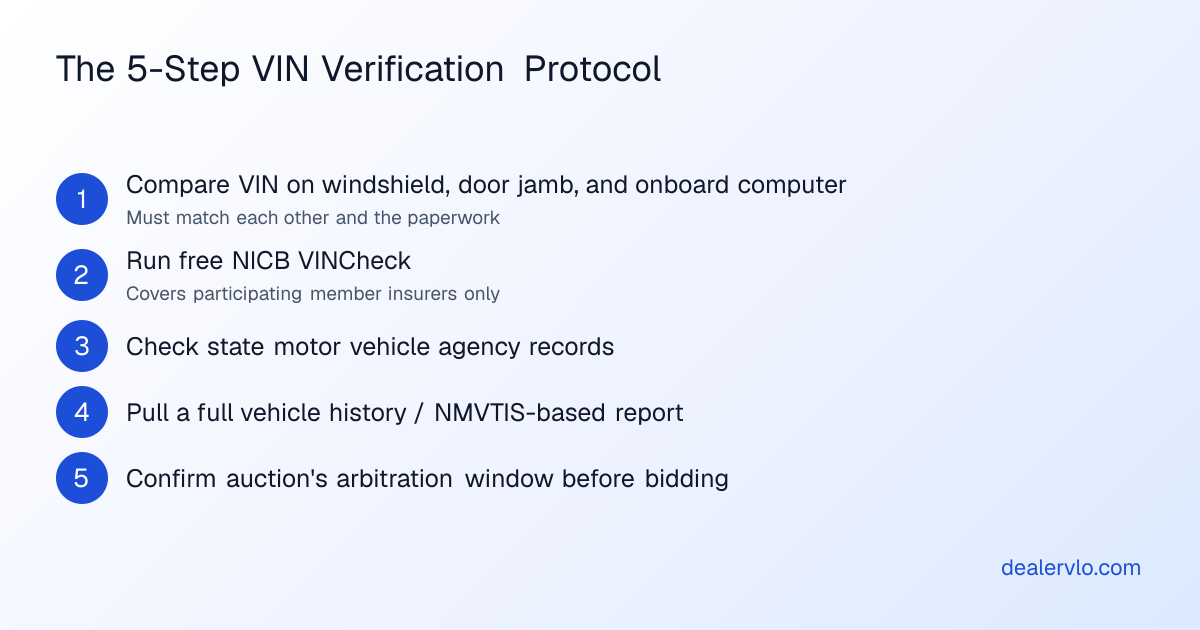
Before you commit capital on a unit — at a physical lane, in a digital sale, or buying from a private seller — read the VIN in three places and make sure they match each other and the paperwork in front of you:
1. The windshield VIN plate (visible through the glass on the dash)
2. The driver-side door jamb sticker
3. The vehicle's onboard computer (pulled via scan tool or the dash readout, depending on the car)
This is literally the fix the Atlanta dealership adopted after getting burned ([Yahoo News](https://ca.news.yahoo.com/georgia-police-warning-surge-stolen-164200179.html)). It takes a few minutes and it catches the simplest form of VIN swapping — a mismatched plate or a sticker that looks re-applied. If you're buying sight-unseen through a digital platform, this is exactly why a condition report and a seller's photos matter: you want a clear photo of all three locations before you bid, not after you've wired the money. If you're new to reading condition reports critically, the [guide to auction condition reports and red flags](/blog/dealer-auction-condition-reports-red-flags) is worth a read alongside this one — a lot of the same "don't take it at face value" discipline applies.
In DealerVLO, every car's record has a Title status field — In hand, Pending, or Lienholder — along with the title number and title state, and that status prints on the bill of sale. It's a field you set after you've actually looked at the title, not something the software verifies on its own; DealerVLO doesn't track title delivery from auctions or flag a late one, so the physical check and the paperwork check both still have to happen on your end.
## Run the free screens — and know what a "clean" result doesn't tell you
Once the physical check holds up, layer in the free database screens before you're committed to the deal.
**NICB VINCheck** is free and takes under a minute. It tells you whether a VIN has been reported stolen-and-not-recovered, or reported as salvage or flood-damaged, by a participating NICB member insurance company ([NICB](https://www.nicb.org/prevent-fraud-theft/buying-vehicle)). That's a useful first screen — but NICB itself discloses that VINCheck's data comes from roughly 92.49% of its member companies, not all insurers everywhere ([NICB](https://www.nicb.org/prevent-fraud-theft/buying-vehicle)). A clean result means no *participating* insurer has flagged that VIN. It's a floor, not a guarantee — treat it the same way NICB does, and if anything looks off, pull a full vehicle history report next.
NICB's own recommended pre-purchase checklist, built for exactly this situation, is worth following in order: run VINCheck, check the VIN against your state's motor vehicle agency, run a title search, and pull a full vehicle history report from a third-party NICB partner ([NICB](https://www.nicb.org/prevent-fraud-theft/buying-vehicle)). None of these steps is expensive or slow — the cost is almost always lower than one bad deal.
For a quick gut-check on a VIN's basic specs before you dig deeper, the free [VIN decoder](/tools/vin-decoder) pulls year, make, model, trim and engine straight from NHTSA's database — useful for confirming the car on paper actually matches the car in front of you (wrong trim or engine for the stated VIN is its own red flag).
## The title-washing layer: why a "clean" title isn't the same as a clean history
Beyond stolen cars, there's a second, related problem: title washing. This is when a vehicle's brand — salvage, flood, lemon-law buyback, and similar — gets removed from the title by retitling the car in a state that doesn't check with the state that issued the previous title ([Federal Register / NMVTIS rulemaking](https://www.federalregister.gov/documents/2009/01/30/E9-1835/national-motor-vehicle-title-information-system-nmvtis)). The car looks clean on paper. It isn't.
The federal response is the National Motor Vehicle Title Information System (NMVTIS), created under the federal Anti-Car Theft Act of 1992 and operated by the American Association of Motor Vehicle Administrators (AAMVA) under U.S. Department of Justice oversight ([VINData](https://www.vindata.com/faq)). NMVTIS pulls title data from state titling agencies, salvage and junk yards, and insurance carriers into one system specifically to make it harder to wash a brand off a title or retitle a stolen vehicle ([NMVTIS Consumer Portal](https://vehiclehistory.bja.ojp.gov/nmvtis_consumers)). State DMVs use it before issuing titles — Missouri, for example, has run every title transaction through NMVTIS since 2010, and flags a manual review when something doesn't match ([Missouri DOR](https://dor.mo.gov/motor-vehicle/nmvtis/)); Maine's Bureau of Motor Vehicles uses it the same way, to check for stolen, junk, or salvage status before issuing a title ([Maine BMV](https://www.maine.gov/sos/bmv/more-bmv/check-the-history-of-a-vehicle)).
How big is the title-washing problem, honestly? Carfax has published two different estimates in two different years that don't agree with each other: in 2014, Carfax research put it at nearly 800,000 vehicles nationally, naming New Jersey, North Carolina, Mississippi, California, and Georgia as higher-risk states at the time ([Fox Business](https://www.foxbusiness.com/features/carfax-title-washing-plagues-800k-cars)); a 2021 Carfax estimate put the number at 630,000 vehicles on the road ([Carfax](https://content.carfax.com/TitleWashing-WBN-2021-Q4.html)). Neither figure is current, and there's no fresh 2026 number to replace them — so treat this as "a persistent, well-documented problem," not a precise current count. What hasn't changed: title washing is fraud, and NMVTIS exists specifically to stop it.
If you're buying a vehicle with any kind of branded or unusual title history, the [guide to buying and reselling salvage and rebuilt title cars](/blog/selling-salvage-rebuilt-title-cars-dealer) covers how to handle disclosure and pricing once you've confirmed what you actually have. And if the seller is slow to produce a title at all, [what to do when an auction hasn't sent the title](/blog/auction-title-delays-what-to-do) walks through your options there.
Let DealerVLO track title status, lienholder and title number on every unit you buy: try it free for 14 days
## Know your auction's arbitration policy before you bid, not after
If you buy through a major auction and a stolen or title-washed car slips past your own checks, you're not necessarily out the money — but only if you move fast and know the rules going in.
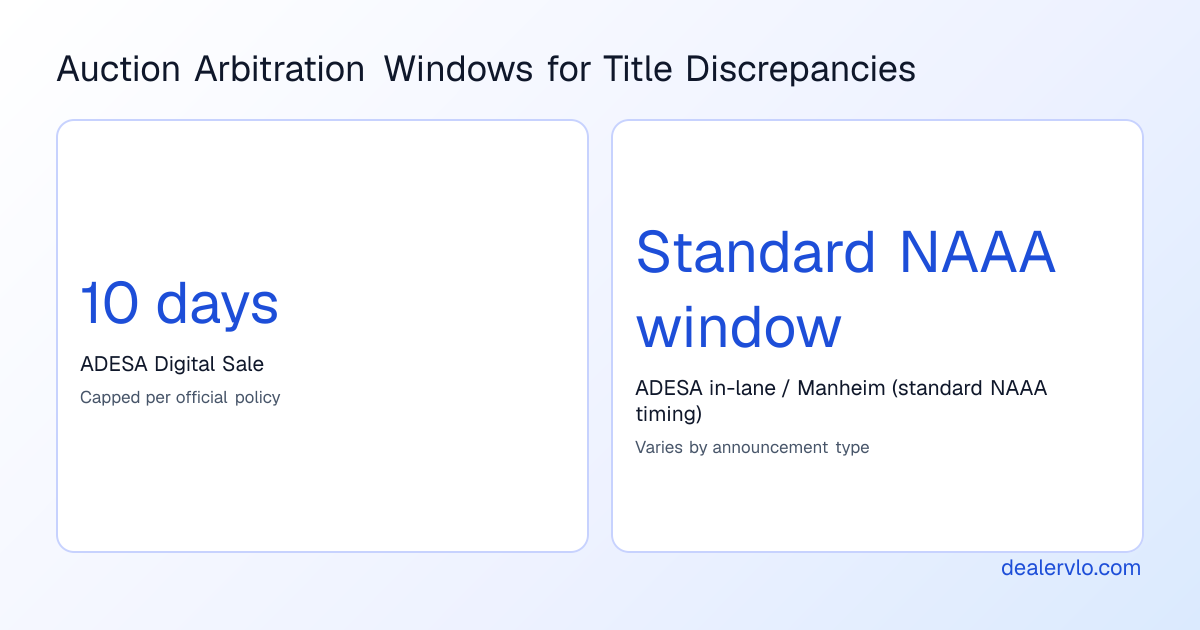
Manheim's NAAA arbitration policy explicitly names theft, theft recovery, stolen vehicle status, salvage, flood damage, and odometer discrepancies as title issues that must be disclosed by the seller; if arbitration succeeds, the seller is on the hook for the buyer's reasonable documented expenses, at the auction's discretion ([Manheim / NAAA Arbitration Policy, effective June 1, 2025](https://site.manheim.com/wp-content/themes/cox-manheim/assets/legal/NAAA-Arbitration-Policy.pdf)). ADESA's policy covers the same categories but runs on a tighter clock for digital sales — the standard arbitration window for an ADESA Digital Sale is capped at 10 calendar days from the date of sale, though in-lane sales follow standard NAAA timing ([ADESA Arbitration Policy, Aug. 2025](https://help.adesa.com/wp-content/uploads/2025/09/ADESA-Arb-Policy-8.2025.pdf)).
The practical point: a title discrepancy is a named, defined arbitration category at both major auctions — it's not a gray area you have to argue your way into. But you still have to catch it *inside the window*. That's exactly why the pre-bid physical check and the pre-bid database pull matter more than the post-sale paper trail — once the arbitration clock runs out, your recourse narrows fast. If you end up in a dispute, the [guide to winning auction arbitration](/blog/auction-arbitration-dispute-guide) covers documentation and timing in more depth. And if you're still building out your overall buying discipline, the [dealer auction buying guide](/blog/dealer-auction-buying-guide) is the place to start before you ever place a bid.
For out-of-state titles specifically, many states require a physical, in-person VIN inspection — separate from any online VIN-check tool — before they'll issue a title on a car titled elsewhere. The exact form and who's authorized to do the inspection varies by state, so confirm the current requirement with your state DMV before you assume a vehicle history report alone is enough to get it titled.
## Build the check into your actual buying workflow
None of this works if it's a mental checklist you only remember after a bad deal. The Georgia dealership didn't get burned because it lacked information — it got burned because the three-location check wasn't a fixed step in its process yet. Treat VIN verification the same way you treat a condition report: a fixed step, every car, no exceptions for cars that "look fine."
A workable sequence for a wholesale or auction buy:
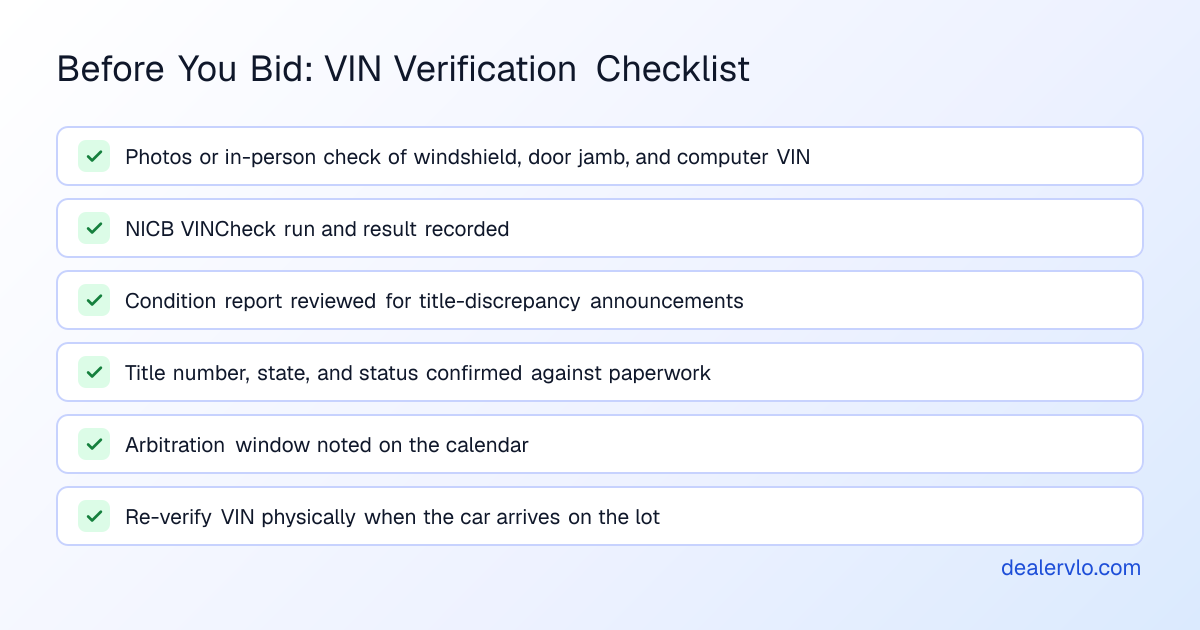
- Before bidding: photos or in-person check of windshield, door jamb, and computer VIN; run NICB VINCheck; check the auction's condition report for any title-discrepancy announcement
- At time of purchase: confirm the VIN on the title matches what you checked; note the arbitration window on your calendar
- After the car arrives: physically re-verify before it goes to recon or hits your lot
If you source heavily from digital platforms, the guides on [buying through ACV and OPENLANE](/blog/how-to-buy-on-acv-and-openlane) and [avoiding common auction buying mistakes](/blog/auction-buying-mistakes-dealers) cover adjacent process gaps worth closing at the same time — missing keys, inflated condition grades, and paperwork timing all compound the same risk of committing capital before you've actually confirmed what you're buying.
Once a car clears your checks and is on your lot, DealerVLO's inventory record holds the VIN, stock number, and photos together and decodes the VIN automatically when you add the car one at a time — so the specs on file match what NHTSA has for that VIN, which is a quick second check that the vehicle in front of you is actually the vehicle the paperwork describes.
## What this costs you if you skip it
The Georgia dealership got made whole because Carvana confirmed the fraud and reimbursed them ([Yahoo News](https://ca.news.yahoo.com/georgia-police-warning-surge-stolen-164200179.html)) — but that's not guaranteed recourse on every deal, and it came after a customer had already been driving a stolen car and a dealership had to deal with the fallout. A title-washed car you retail without catching the brand is worse: you may be the one left explaining a hidden salvage or flood history to a retail buyer, with no auction arbitration window left to fall back on because the issue surfaced months later.
The fix costs a few minutes per car and a couple of free database lookups. The failure mode costs a reimbursement you might not get, a customer relationship you've lost, and in the worst cases a fraud investigation your dealership's name gets attached to.
Keep title status, lienholder, and stock history on every car in one deal jacket: start your free 14-day DealerVLO trial
## Frequently asked questions
### How do I verify a VIN before buying at auction?
Physically compare the VIN on the windshield plate, the driver-side door jamb sticker, and the vehicle's onboard computer, and make sure all three match each other and the title or condition report. Then run the free NICB VINCheck tool and pull a full vehicle history report before you commit, since VINCheck only reflects data from participating member insurers and isn't a complete guarantee.
### What are the red flags for a stolen car at an auction?
The core red flag is a VIN that doesn't match across the windshield, door jamb, and onboard computer — that mismatch is exactly what caught two separate stolen-vehicle schemes in Georgia. Other signs include a title that was issued very recently in a different state than where the car has obvious wear or service history, missing or inconsistent ownership paperwork, and a seller who's vague about where the car came from.
### What's the difference between a stolen VIN clone and a title-washed car?
VIN cloning means a stolen vehicle has been given a counterfeit VIN tag copied from a legitimately owned car of the same make and model, so it looks legal on resale. Title washing is different — it's a real vehicle's existing brand (salvage, flood, lemon-law buyback) being stripped off its title by retitling it in a state that doesn't cross-check the prior title, so the car shows a clean title when it actually has a hidden history.
### Does NICB VINCheck catch everything?
No. NICB's own disclosure states VINCheck is based on data from about 92.49% of its member insurance companies, so it only reflects vehicles reported by participating insurers. A clean result is a useful first screen, not a guarantee — NICB itself recommends following it with a title search and a full vehicle history report.
### What happens if I unknowingly buy a stolen or title-washed car at a major auction?
Both Manheim's NAAA policy and ADESA's policy list theft, stolen-vehicle status, and salvage/flood brands as announceable title discrepancies that are arbitrable. But you have to catch it and file within the auction's arbitration window — ADESA Digital Sales cap that window at 10 calendar days from the sale date — so acting fast matters more than the paperwork itself.
### Is a physical VIN inspection required before I can title an out-of-state car?
Many states require an in-person VIN inspection, separate from any online VIN-check tool, before issuing a title on a vehicle previously titled elsewhere — but the specific form and who's authorized to perform it varies by state. Confirm the current requirement with your state DMV before assuming a vehicle history report alone will satisfy it.
## Bottom line
The Georgia CR-V ring came apart because the VIN on the car didn't add up, and the dealership in the Carvana case adopted a three-location VIN check only after a customer was already driving a stolen car. That's not a sophisticated fraud defense — it's a habit, and it costs a few minutes per car. Pair it with a free NICB VINCheck, a title history pull, and a clear understanding of your auction's arbitration window, and you catch most of what a cloned VIN or a washed title is trying to hide before you've put real money behind it. Build the check into how you buy, keep your title status and paperwork organized once the car's on your lot, and give DealerVLO a look for the deal jacket and inventory side of that workflow.
Run your next auction buy through DealerVLO: start your free 14-day trial
---
## FAQ
### How do I verify a VIN before buying at auction?
Physically compare the VIN on the windshield plate, the driver-side door jamb sticker, and the vehicle's onboard computer, and make sure all three match each other and the title or condition report. Then run the free NICB VINCheck tool and pull a full vehicle history report before you commit, since VINCheck only reflects data from participating member insurers and isn't a complete guarantee.
### What are the red flags for a stolen car at an auction?
The core red flag is a VIN that doesn't match across the windshield, door jamb, and onboard computer — a mechanic noticing VIN inconsistencies is what broke open a stolen Honda CR-V ring in Georgia. Other signs include a title that was issued very recently in a different state than where the car has obvious wear or service history, missing or inconsistent ownership paperwork, and a seller who's vague about where the car came from.
### What's the difference between a stolen VIN clone and a title-washed car?
VIN cloning means a stolen vehicle has been given a counterfeit VIN tag copied from a legitimately owned car of the same make and model, so it looks legal on resale. Title washing is different — it's a real vehicle's existing brand (salvage, flood, lemon-law buyback) being stripped off its title by retitling it in a state that doesn't cross-check the prior title, so the car shows a clean title when it actually has a hidden history.
### Does NICB VINCheck catch everything?
No. NICB's own disclosure states VINCheck is based on data from about 92.49% of its member insurance companies, so it only reflects vehicles reported by participating insurers. A clean result is a useful first screen, not a guarantee — NICB itself recommends following it with a title search and a full vehicle history report.
### What happens if I unknowingly buy a stolen or title-washed car at a major auction?
Both Manheim's NAAA policy and ADESA's policy list theft, stolen-vehicle status, and salvage/flood brands as announceable title discrepancies that are arbitrable. But you have to catch it and file within the auction's arbitration window — ADESA Digital Sales cap that window at 10 calendar days from the sale date — so acting fast matters more than the paperwork itself.
### Is a physical VIN inspection required before I can title an out-of-state car?
Many states require an in-person VIN inspection, separate from any online VIN-check tool, before issuing a title on a vehicle previously titled elsewhere — but the specific form and who's authorized to perform it varies by state. Confirm the current requirement with your state DMV before assuming a vehicle history report alone will satisfy it.