# Is Your Used-Car Lot Actually Profitable? Gross Profit vs. Net Profit
> You know your gross per car. But gross isn't profit — net is what's left after overhead. Here's how to tell if your used-car lot actually makes money, and how to track it.
- Source: https://www.dealervlo.com/blog/used-car-dealership-gross-vs-net-profit
- Published: 2026-09-13
- Author: Chris Abouraad
- Tags: used car dealer profit, gross vs net profit, dealership net margin, car lot financials
---
Ask a used-car dealer how they're doing and most will tell you their gross — "I'm averaging two grand a car." It's the number we all live by, and it's a good one to know. But here's the uncomfortable question that gross can't answer: **after everything it costs to run the place, are you actually keeping any of it?**
I've had months that felt great — cars moving, gross looking strong — that, once I actually subtracted rent, floor plan, insurance, and the rest, barely broke even. Gross is what you make on the cars. Net is what you keep. They are not the same number, and the gap between them is every dollar it costs to keep the doors open. If you only ever look at gross, you genuinely do not know whether your lot makes money.
## Why isn't gross profit the same as profit?
Gross profit is real and it matters: it's the sale price plus any F&I, minus what the car cost you — acquisition plus [reconditioning](/blog/gross-profit-vs-holding-costs-aged-inventory) — and minus the F&I cost. It tells you your cars are bought and priced right. A healthy gross is the foundation of a profitable lot.
But it's the top half of the math, not the bottom line. A lot doing great gross can still lose money, because gross doesn't know that you pay rent whether or not you sold a car this week. That's the trap: gross feels like profit, so a busy month feels like a good month — even when it wasn't.
## What is net profit for a used-car lot?
Net profit is gross profit minus your overhead — the cost of running the business:
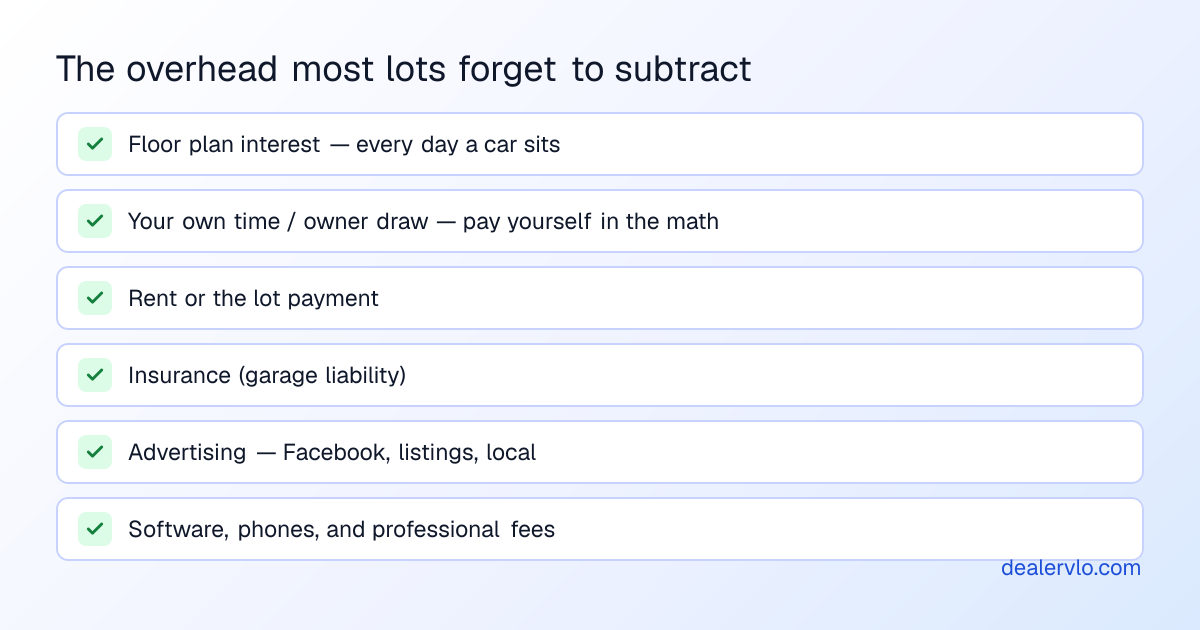
Two of those get under-counted almost every time. **Floor plan interest** — if you floor your inventory, every day a car sits is money leaving, and it belongs in this math. And **your own time** — if you don't pay yourself a wage in the calculation, the "profit" you see is really just your salary wearing a disguise. Count both, honestly, or the net number lies to you in your favor.
Here's what the whole picture looks like on a real lot — the same month, gross versus net:
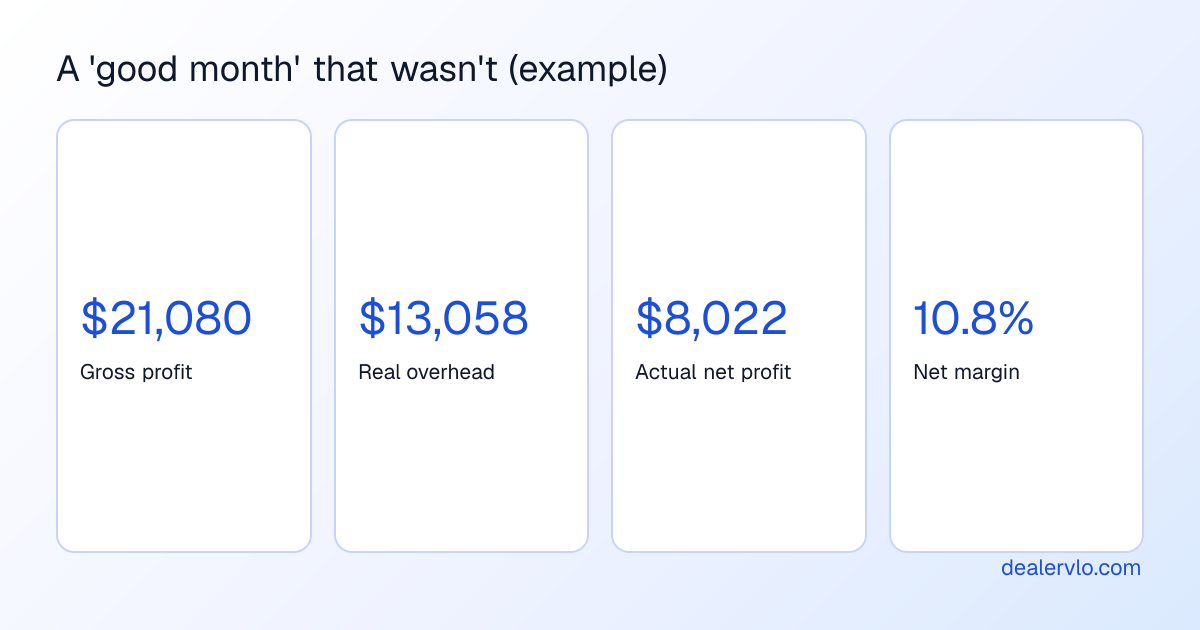
Twenty-one thousand in gross profit looks like a strong month. After thirteen thousand in real overhead, the owner actually kept about eight — a 10.8% net margin. Still profitable, but a very different story than "$21k." And if overhead had been higher or a couple fewer cars had sold, that same gross could have netted a loss.
## The number is only useful if you actually track it
None of this is complicated math. The reason most small lots don't know their net isn't the arithmetic — it's that pulling every deal's gross and every expense together in a spreadsheet, every month, is a chore nobody gets to. So dealers run on gross and hope.
That's the exact problem I built DealerVLO to solve on my own lot. It already knows the gross on every deal — because it knows the vehicle cost, the recon, and the F&I on each one:
Then you record your overhead once — rent, payroll, floor plan, advertising — as one-time or recurring monthly, and the profit & loss does the subtraction for you: revenue, minus the cost of the cars you sold, equals gross; minus your overhead, equals **net profit or loss**, for any period:
The point isn't the software; it's that the number stops being a mystery. When net is one click away, you stop guessing whether a busy month made money — you know.
## What to do once you know your net
The number is only worth having if it changes what you do:
- **Know your break-even.** How many cars a month, at your average gross, does it take just to cover overhead? Everything above that line is profit; everything below it is a loss. (Run yours on the [break-even calculator](/tools/dealer-break-even-calculator).)
- **Move the net, two ways.** Cut fixed overhead, or raise average gross per car — better buying, tighter recon, more back-end F&I. Raising gross usually moves the net faster, and turning inventory quicker cuts the floor-plan drag.
- **Watch the trend, not one month.** One snapshot is noise; net margin over several months tells you whether the lot is actually getting healthier.
## Frequently asked questions
**What's the difference between gross profit and net profit for a car dealer?**
Gross is what you make on the cars — sale plus F&I, minus vehicle cost, recon, and F&I cost. Net is gross minus everything it costs to keep the doors open (rent, payroll, floor plan, insurance, advertising). Gross says the cars are priced right; net says the business makes money. A lot with strong gross can still lose money if overhead outruns it.
**How do I calculate net profit for a used-car dealership?**
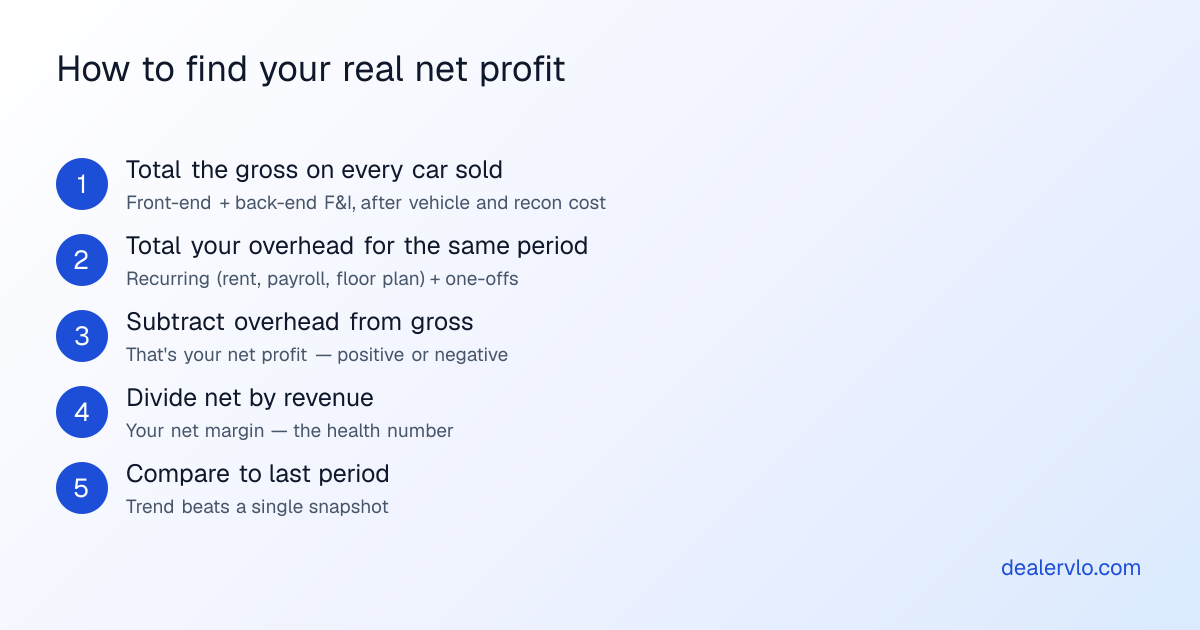
Total the gross on every car sold in the period, total your operating expenses for that same period, and subtract. What's left is net; divide by revenue for your net margin. The step most lots skip is subtracting real overhead — so they track gross but never know net.
**What expenses count as overhead for a used-car lot?**
Everything you'd pay whether or not you sold a car: rent, payroll (including your own draw), floor plan interest, insurance, advertising, utilities, software, phones, and professional fees. Floor plan and your own time are the two most dealers under-count.
**Is $2,000 gross per car good?**
It depends on your overhead and volume — which is why gross-per-car alone can't tell you if you're profitable. What matters is total gross across your units versus total overhead. Chase the net, not a per-car number that ignores what it costs to run the place.
**How do I know if my used-car dealership is actually making money?**
Build a simple P&L for a real period: revenue, minus cost of cars sold, equals gross; minus operating expenses, equals net. Positive after paying yourself means you're making money. Doing it by hand is where most give up — software that already has your deal gross and lets you record overhead can produce the P&L for you.
## Bottom line
Gross keeps the lights on in your head; net keeps them on for real. Know your gross per car — but don't confuse it with profit. Add up your overhead honestly, subtract it from your gross, and look at the number that's actually left. That's whether your lot makes money, and it's the only scoreboard that pays you.
DealerVLO tracks the gross on every deal and turns your recorded overhead into a live profit & loss — so net profit is one click, not a spreadsheet you never get to. [Start a free trial](/signup) and see what your lot actually keeps.
---
## FAQ
### What's the difference between gross profit and net profit for a car dealer?
Gross profit is what you make on the cars: the sale price plus F&I, minus what the vehicle cost you (acquisition + reconditioning) and the F&I cost. Net profit is gross profit minus everything it costs to keep the doors open — rent, payroll, floor plan interest, insurance, advertising, software. Gross tells you the cars are priced right; net tells you the business is making money. They're very different numbers, and a lot with strong gross can still lose money if overhead is higher than the gross covers. Net is the one that pays you.
### How do I calculate net profit for a used-car dealership?
Add up the total gross on every car you sold in the period (front-end plus back-end F&I), then add up all your operating expenses for that same period — the recurring ones like rent and payroll plus any one-offs — and subtract expenses from gross. What's left is your net profit. Divide net by your revenue and you get your net margin. The trap most small lots fall into is never doing the second step: they track gross per car but never subtract real overhead, so they don't actually know whether the month made money.
### What expenses count as overhead for a used-car lot?
Everything you'd pay whether or not you sold a car this month: rent or the lot payment, payroll (including your own draw), floor plan interest, insurance (garage liability), advertising, utilities, software and phones, and professional fees like your accountant. Floor plan interest and your own time are the two most dealers under-count. If you floor your inventory, every day a car sits is interest; and if you don't pay yourself a wage in the math, your 'profit' is really just your salary in disguise.
### Is $2,000 gross per car good?
It depends entirely on your overhead and your volume — which is exactly why gross-per-car alone can't tell you if you're profitable. Two thousand in gross on a lot with low overhead and good turn is healthy; the same $2,000 on a lot carrying heavy rent, floor plan, and payroll can still net a loss if you're not moving enough units. The number that matters is total gross across all your units versus total overhead for the period. Chase the net, not a per-car gross that ignores what it costs to run the place.
### How do I know if my used-car dealership is actually making money?
Build a simple profit and loss for a real period: total revenue, minus the cost of the cars you sold (acquisition + recon + F&I cost) to get gross profit, minus your operating expenses to get net profit. If net is positive after you've paid yourself, the lot makes money; if it's negative, a 'busy' month was actually a losing one. Doing this by hand in a spreadsheet is where most dealers give up, so software that already knows the gross on every deal and lets you record overhead can produce the P&L for you and show net at a glance.