# Used Car Dealership Business Plan: A Section-by-Section Template for an Independent Lot
> A section-by-section used car dealership business plan template for an independent lot, built for what a bank or floor-plan lender reads.
- Source: https://www.dealervlo.com/blog/used-car-dealership-business-plan
- Published: 2026-10-21
- Updated: 2026-10-21
- Author: Chris Abouraad
- Tags: business plan, used car dealership, independent dealer, floor plan financing, startup
---
Most used car dealership business plan templates floating around online were written for a franchise store pitching a factory, or for a generic small-business loan application that never mentions a floor plan line or a title clerk. If you're opening (or re-financing) an independent lot, you need a plan that speaks to the three people who'll actually read it: a bank loan officer, a floor-plan lender's underwriter, and maybe a silent-partner investor. All three want the same thing — proof you understand your own numbers — just phrased differently.
This is a section-by-section template for that plan, written from the dealer's side of the desk. It won't repeat the full startup-cost breakdown (that's in [what it costs to open a used car dealership](/blog/cost-to-open-used-car-dealership)) or the step-by-step launch checklist (covered in [how to start a used car dealership](/blog/how-to-start-used-car-dealership)) — it focuses on how to organize and fill in the plan itself, with one worked example you can adapt to your own numbers.
Track per-car cost and gross against your plan from day one in DealerVLO: start your 14-day free trial
## What a lender or investor is actually reading for
| Reader | What they're checking | Where it shows up in the plan |
| --- | --- | --- |
| Bank loan officer | Owner's credit, collateral, whether the business model makes basic sense | Executive summary, company structure, financials |
| Floor-plan lender | License status, lot/location, sales velocity, insurance | Licensing section, operations, inventory plan |
| Investor/partner | Return potential, how fast capital turns over | Unit economics, 12-month projection, break-even |
A business plan for a used car lot isn't a term paper — it's a document that has to survive someone asking "where did this number come from?" Every section below should answer that question before it's asked.
## 1. Executive summary
This is the one page a busy reader actually finishes, so put the whole pitch here: what the business is, what makes it different (if anything), the money you're asking for, and what it buys.
**Fill-in template:**
> [Dealership name] is an independent used-vehicle dealership located in [city, state], operating as a [sole proprietorship / LLC / corporation]. We buy and retail [price range / vehicle type — e.g., "$8,000–$18,000 passenger vehicles and light trucks"] through a [retail / BHPH / wholesale-retail mix] model. We are requesting $[amount] in [startup capital / floor plan line / working capital] to [open the lot / add a second floor plan line / fund inventory for the first 90 days]. We project selling [X] units a month by month [Y], reaching break-even by month [Z].
Keep the vision/objectives line short and specific — "a 20-to-30-car lot focused on clean-title vehicles under $15,000" tells a reader more than "to be the premier dealership in the region."
## 2. Company structure and location
State the legal entity, who owns what percentage, the physical address, and who runs the place day to day. Lenders want the exact location because in many states a used-car license depends on an approved physical place of business — not a home office or a PO box ([see your state's rules](/guide/used-car-dealer-license)).
**Fill-in template:**
> [Entity name] is organized as a [LLC/corp] in the state of [state], owned [X]% by [name] and [Y]% by [name]. The dealership operates from [address], a [square footage]-lot zoned for vehicle sales, leased/owned by [name]. Day-to-day management is handled by [owner/GM name], with [title clerk/finance/sales] responsibilities held by [name or "to be hired"].
## 3. The model: retail, BHPH, wholesale, or a mix
Say plainly what kind of lot this is, because it changes everything downstream — financing needs, staffing, and what a lender will ask for. A straight retail lot sells and is done; a buy-here-pay-here lot is running two businesses at once — selling cars and servicing the loans on them — which means the plan also needs to show how payments get collected and reconciled, not just how cars get sold. A wholesale-leaning lot (flipping auction buys to other dealers alongside retail) has a faster cash cycle but thinner margin per unit.
If BHPH is part of the model, say so explicitly and show that you understand the add-on complexity: a payment has to split across principal, interest, and tax and post correctly, and when the loan servicing lives in a separate system from the one that wrote the deal, the two stop matching each other and month-end turns into a reconciliation project. Note in the plan how you'll keep that from happening — whether that's a dedicated BHPH ledger inside your dealer software or a disciplined manual process. DealerVLO's buy-here-pay-here tracking includes a collections view alongside the deal records, which is worth mentioning in this section if BHPH is your model, since it shows a reader you have a system for it rather than a spreadsheet promise.
**Fill-in template:**
> We operate as a [retail-only / BHPH / wholesale-retail mix] dealership. [X]% of units are retailed to end buyers with outside financing or cash; [Y]% are financed in-house (BHPH); [Z]% are wholesaled to other dealers or at auction. [If BHPH:] In-house notes are serviced and tracked in [system], with a dedicated collections process for past-due accounts.
## 4. Market and competition
This section doesn't need a market-research firm. A lender wants to see that you've actually looked at who else is selling cars within your radius and where you fit — price point, vehicle type, and what makes a buyer choose you over the lot two exits down.
**Fill-in template:**
> Our primary market is [city/county/radius]. There are approximately [X] competing independent lots and [Y] franchise stores within [radius]. We differentiate on [price point / vehicle condition and recon standard / financing options / customer service / online presence]. Our target customer is [description — e.g., "a buyer with a trade-in and a budget under $15,000 who doesn't qualify for prime-rate financing"].
A lot's online presence is part of this pitch too — a Google Business Profile with reviews and hours, and a dealer website that actually shows inventory, does more for a small lot's visibility than most paid ads. Worth a line in this section if it's part of your go-to-market.
## 5. Inventory sourcing plan
Say where the cars come from: public auction, dealer-only auction, trade-ins, private-party buys, or a mix. A lender evaluating a floor-plan request wants to see that sourcing is planned, not improvised — because floor-plan lenders look at operating history and demonstrated sales velocity as part of underwriting, alongside the dealer's license and the physical lot itself. If you're new, say how you'll build that track record (cash purchases first, floor plan once volume is proven, etc.).
**Fill-in template:**
> Inventory is sourced through [dealer auctions — name if known / trade-ins / private-party acquisition / wholesale buyers], targeting [X] units per month at an average acquisition cost of $[amount]. [If applicable:] We plan to floor-plan [X]% of inventory once [12 months of sales history / an established banking relationship] is in place; units will initially be purchased with [cash / owner capital].
## 6. Unit economics — the section that actually gets read twice
This is where the plan either holds up or falls apart. Walk through, with real (even if hypothetical) arithmetic: average front-end gross, back-end (F&I) gross, reconditioning cost per car, holding cost while it sits, units sold per month, and how fast inventory turns. Don't borrow an "industry average" gross figure from a template site — use your own numbers, or a clearly labeled hypothetical if you don't have history yet.
**Worked example (hypothetical numbers only):**
Say you're planning a 25-car lot, selling 12 units a month.
- Average acquisition cost: $9,000/unit
- Average recon cost: $700/unit
- Average retail price: $12,700/unit
- Front-end gross per unit: $12,700 − $9,000 − $700 = **$3,000**
- Back-end (F&I) gross per unit, say warranty and doc fee combined: **$500**
- Total gross per unit: **$3,500**
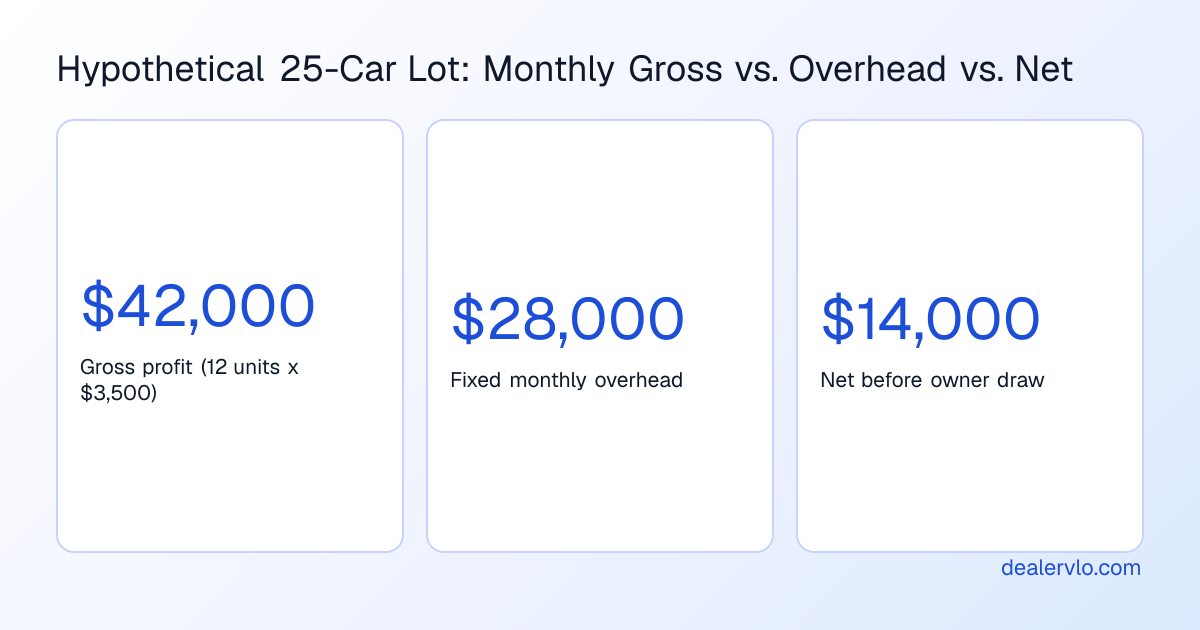
- 12 units/month × $3,500 = **$42,000 gross profit/month**
- Say fixed overhead (rent, insurance, one salesperson, floor-plan interest) runs **$28,000/month**
- Net before owner draw: $42,000 − $28,000 = **$14,000/month**
That's one illustrative path, not a benchmark — your acquisition cost, recon spend, and overhead will look different. Run your own version with the [profit margin calculator](/tools/profit-margin-calculator) before you put a number in the plan.
Holding cost belongs in this section too — every day a car sits is carrying cost (interest, insurance, depreciation risk), and it's worth sizing separately from recon so a lender sees you're not ignoring the cars that don't sell in week one. The [holding cost calculator](/tools/holding-cost-calculator) will put a real dollar-a-day figure on that for your own cars.
**Fill-in template:**
> At [X] units/month and an average front-end gross of $[amount] plus back-end gross of $[amount], gross profit is projected at $[amount]/month. Fixed monthly overhead is estimated at $[amount] (see Section 9). Projected net before owner compensation: $[amount]/month.
## 7. Financing and floor plan
Most independent lots can't carry a full inventory in cash — floor plan financing is what lets a 25-car lot look like a 25-car lot instead of a 5-car lot. Explain here, briefly, how floor plan works mechanically: it's revolving, vehicle-specific credit — the lender pays for each unit when you acquire it, you repay when it sells, interest accrues daily on what's floored, and aged units typically trigger a forced paydown (curtailment) before they get too stale.
Don't try to cram the full mechanics into this plan — that's its own document. Point to [how dealer floor plans actually work](/blog/how-dealer-floor-plans-work) for the pillar explanation, [floor plan financing requirements](/blog/floor-plan-financing-requirements) for what a lender checks before approving a line, and [the cash-flow forecast guide](/blog/used-car-dealership-cash-flow-forecast) for how floor-plan payments interact with your weekly cash position.
**Fill-in template:**
> We are seeking a floor plan line of $[amount] from [lender name or "a floor plan provider to be determined"], supporting approximately [X] floored units at any time. Dealer open-lot insurance will be obtained through [carrier], with the lender named as loss payee if the floor plan agreement requires it. [If applicable:] Units will initially be cash-purchased for the first [X] months to establish sales history before applying for a line.
See your real front and back-end gross next to the plan's projections in DealerVLO: try it free for 14 days
## 8. Licensing — one line, then link out
Don't try to write state-specific licensing detail into the plan itself — bond amounts, license fees, and education requirements all vary by state, and getting one wrong in a document a bank is reading is worse than leaving it general. State that you're licensed (or in process) and point to the authority.
**Fill-in template:**
> [Dealership name] is licensed (or has applied for licensure) as a used motor vehicle dealer with [state DMV/BMV/Secretary of State/Motor Vehicle Dealer Board]. Licensing requirements, including any required surety bond and pre-licensing education, vary by state; see [our state-by-state dealer license guide](/guide/used-car-dealer-license) for the current checklist in [state].
This isn't legal advice — confirm your state's current licensing rules, bond requirement, and fees directly with your state's DMV or dealer licensing authority before you finalize this section.
## 9. Operations and staffing
List who does what. On a small lot this is often one or two people wearing every hat — owner as buyer and finance manager, one salesperson, a part-time detailer. Say so plainly; a lender isn't expecting a 12-person org chart from a 25-car lot, but they do want to see that someone owns title work, someone owns collections (if BHPH), and someone owns the sales floor.
**Fill-in template:**
> [Owner name] serves as general manager, buyer, and finance manager. [Name/role] handles sales. [Name/role or "outsourced"] handles reconditioning. Title and registration paperwork is processed by [name/role]. [If BHPH:] Collections are managed by [name/role] using a dedicated payment-tracking system.
For the line-by-line monthly cost detail behind this section — rent, payroll, insurance, advertising — don't rebuild it here; summarize the total and link to [what it costs to run a used car lot each month](/blog/cost-to-run-a-used-car-lot-per-month).
## 10. Marketing
Keep this section practical rather than aspirational. If repeat and referral business is part of the plan (it should be, for a BHPH or community-focused lot), say so — it's close to free and it's a legitimate line in a marketing section.
**Fill-in template:**
> Primary marketing channels: a dealer website with live inventory, Google Business Profile, and listing syndication to [CarGurus/Cars.com/Autotrader]. Estimated monthly marketing spend: $[amount]. [If applicable:] Repeat and referral business is tracked and incentivized through [program description].
See [Google Business Profile for used-car lots](/blog/google-business-profile-used-car-dealers) and [repeat and referral business](/blog/repeat-referral-business-used-car-dealer) for the detail behind this section.
## 11. Financial plan and 12-month projection
This is where the executive summary's numbers get built out month by month. Lenders typically want at least 12 months of monthly projections, then annual projections for a few years beyond that. Structure it around four statements: a profit & loss, a cash flow statement, a simple balance sheet, and a break-even analysis — the same structure a monthly P&L should already follow once you're operating.
Once the lot is actually running, DealerVLO's sales report gives you front- and back-end gross per deal along with a salesperson leaderboard, and the P&L takes gross profit and subtracts your recorded overhead (rent, payroll, floor plan interest, advertising, insurance) to show net, not just gross. That's the same structure your projection should use, so your monthly actuals and the plan you wrote speak the same language instead of needing to be translated between formats. If you've never built one, [our P&L guide](/blog/build-profit-and-loss-statement-used-car-dealership) walks through the structure in more depth.
**Fill-in template (repeat for each month 1–12):**
> Month [N]: [X] units sold × average front gross $[amount] + back-end gross $[amount] = gross profit $[amount]. Less fixed overhead $[amount] = net $[amount]. Cumulative cash position: $[amount].
Break-even is the single number most readers will look for first: the month where cumulative net crosses zero. Extending the hypothetical example: say the lot spends $70,000 before opening on things that aren't inventory (lease deposit, lot prep, licensing and bond, signage, software), and sales ramp up, netting $7,000 a month for the first three months before reaching the full $14,000. After month 3 the lot has earned back $21,000, leaving $49,000. At $14,000 a month that takes another 3.5 months, so cumulative net crosses zero during month 7. Lay this out month by month on a simple spreadsheet next to your plan, using your own numbers rather than these, and check the monthly sales you need with the [dealer break-even calculator](/tools/dealer-break-even-calculator).
## 12. The ask
Close the financial section the same way the executive summary opened it: a specific number, a specific use of funds, and what repayment or return looks like.
**Fill-in template:**
> We are requesting $[amount] in [startup capital / floor plan line / working capital], to be used for [inventory / leasehold improvements / working capital / licensing and bonding costs]. Based on the projections above, we expect to reach break-even by month [N] and project $[amount] in annual net profit by year [N].
## Keeping the plan honest after you open
A business plan is only useful if you keep checking it against what actually happens. A plan that sits in a drawer stops being a planning tool the moment the first month's actuals come in — the whole point of writing one is to have something to measure against. Once you're operating, pull the sales report and P&L for the same period your plan projected and set them next to your Section 6 and Section 11 numbers: front-end gross per deal, back-end gross, and net after overhead. If a car's reconditioning ran over what you estimated, DealerVLO tracks that per car (vendor, description, cost) so it rolls into that unit's all-in cost and shows up in the P&L's reconditioning total for the period — which tells you fast whether your Section 6 recon estimate was realistic or needs revising before next quarter's numbers get further off.
## Frequently asked questions
### Do I need a formal business plan to get a used-car dealer license?
No — dealer licensing is a separate process handled by your state's DMV, BMV, or Secretary of State, and it typically doesn't require a business plan document. A plan becomes necessary when you're asking a bank, floor-plan lender, or investor for money, since they want to see the numbers behind the request.
### How long should a used car dealership business plan be?
There's no fixed page count. What matters is that every section above is covered with real numbers, not padding — a small independent lot's plan is usually much shorter than a franchise store's, and the 12-month projection is often the longest part. A thin plan missing unit economics or a break-even point will usually come back with questions before it comes back with money.
### What financial statements does a lender expect in the plan?
At minimum, a profit and loss statement, a cash flow projection, a simple balance sheet, and a break-even analysis. Monthly detail for the first year and annual projections for a few years beyond that is the common structure lenders look for.
### Should my business plan include BHPH if I'm not sure I'll offer in-house financing yet?
Only describe the model you're actually planning to run at launch — you can note BHPH as a future phase rather than baking it into month-one projections. If you do plan to offer it from day one, say so explicitly and address how payments will be tracked and reconciled, since that's a real operational difference from straight retail.
### Can I use industry-average gross profit or turn-rate figures in my plan?
Be careful — generic "industry average" gross or turn figures circulating online are often unsourced or come from template sites, and a lender who's seen a hundred of these plans will question a number that isn't yours. It's safer to build your projection from your own sourcing costs, your local market's pricing, and a clearly labeled hypothetical if you don't have operating history yet.
### Where do floor plan details belong in the business plan versus a separate document?
The business plan should cover your financing ask and insurance requirement in a few lines; the full mechanics — how curtailment works, what lenders check in underwriting, how to compare providers — belong in a dedicated floor-plan reference document you can point to rather than rewrite inside the plan itself.
## Bottom line
A used car dealership business plan for an independent lot doesn't need to be longer or fancier than a franchise store's — it needs to show, section by section, that you understand your own sourcing, your own unit economics, and your own break-even point, with numbers you can defend if someone asks where they came from. Build it once, then keep checking it against what the lot actually does every month, using your sales report and P&L as the source of truth. Put your real deals through DealerVLO so that comparison is quick to make instead of a spreadsheet chore.
Run your next deal through DealerVLO and check it against your business plan's projections: start your free 14-day trial
---
## FAQ
### Do I need a formal business plan to get a used-car dealer license?
No — dealer licensing is a separate process handled by your state's DMV, BMV, or Secretary of State, and it typically doesn't require a business plan document. A plan becomes necessary when you're asking a bank, floor-plan lender, or investor for money, since they want to see the numbers behind the request.
### How long should a used car dealership business plan be?
There's no fixed page count. What matters is that every section above is covered with real numbers, not padding — a small independent lot's plan is usually much shorter than a franchise store's, and the 12-month projection is often the longest part. A thin plan missing unit economics or a break-even point will usually come back with questions before it comes back with money.
### What financial statements does a lender expect in the plan?
At minimum, a profit and loss statement, a cash flow projection, a simple balance sheet, and a break-even analysis. Monthly detail for the first year and annual projections for a few years beyond that is the common structure lenders look for.
### Should my business plan include BHPH if I'm not sure I'll offer in-house financing yet?
Only describe the model you're actually planning to run at launch — you can note BHPH as a future phase rather than baking it into month-one projections. If you do plan to offer it from day one, say so explicitly and address how payments will be tracked and reconciled, since that's a real operational difference from straight retail.
### Can I use industry-average gross profit or turn-rate figures in my plan?
Be careful — generic "industry average" gross or turn figures circulating online are often unsourced or come from template sites, and a lender who's seen a hundred of these plans will question a number that isn't yours. It's safer to build your projection from your own sourcing costs, your local market's pricing, and a clearly labeled hypothetical if you don't have operating history yet.
### Where do floor plan details belong in the business plan versus a separate document?
The business plan should cover your financing ask and insurance requirement in a few lines; the full mechanics — how curtailment works, what lenders check in underwriting, how to compare providers — belong in a dedicated floor-plan reference document you can point to rather than rewrite inside the plan itself.