# Month-End Close for a Small Used-Car Lot: A One-Hour Checklist
> A practical one-hour month-end close routine for independent dealers: close deals, verify costs, read your P&L, walk the aging report, and set buying budget.
- Source: https://www.dealervlo.com/blog/used-car-dealer-month-end-close-checklist
- Published: 2026-10-08
- Updated: 2026-10-08
- Author: Chris Abouraad
- Tags: profit, operations, inventory
---
Most of the work on a small used-car lot happens in the moment: taking the call, appraising the trade, writing the deal, ordering the title. But once a month you need to step back and look at the whole picture — what sold, what it cost, what you netted, and what's still sitting.
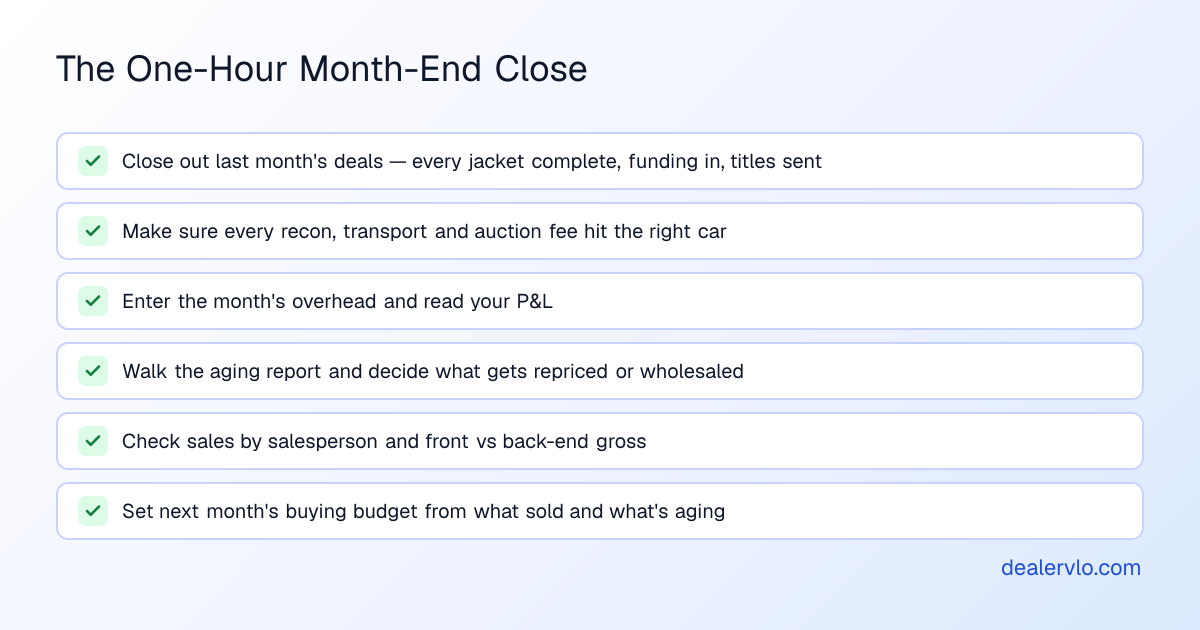
I run a small independent lot in Tewksbury, Massachusetts, and I do a one-hour month-end close on the first or second of the new month. It's the monthly counterpart to [the 15-minute morning routine](/blog/used-car-dealer-daily-routine) that keeps the day-to-day from leaking money. The goal is simple: make sure every deal from last month is complete, every cost hit the right car, the P&L is accurate, and you know which units need action before they age past the point where you can make money on them. This isn't tax prep or an audit — it's an operational checkpoint that tells you whether last month was profitable and what to do differently this month.
Track every car's all-in cost, aging, and gross in DealerVLO: start your 14-day free trial
## Close out last month's deals
The first step is to confirm that every car you sold last month has a complete deal jacket, funding in the bank, and title and registration paperwork sent to the state or the buyer. This isn't about perfection — it's about catching the deals that are stuck before they become a problem.
Walk through your list of last month's sales. For each deal, verify:
- The deal jacket is complete: buyer's order, finance contract or bill of sale, signed odometer disclosure, trade-in title if applicable, buyer's photo ID, proof of payment, and any state-specific disclosures your state requires. Some states require deal jackets retained for five years, others for seven — consult your state dealer-licensing authority and your accountant for how long to keep them and what must be inside.
- Funding has cleared: cash deals are deposited, financed deals are funded by the lender, and trade-in payoffs have been sent. If a deal is still waiting on lender funding and it's been more than a few days, follow up.
- Title and registration paperwork has been submitted or is ready to go. Title and registration deadlines vary widely by state. California requires dealers to submit used-vehicle registration applications within 30 days of sale and transfer title within 15 business days of being fully paid. Illinois requires the assignment and tax form within 20 days. Massachusetts requires title application within 10 days. Texas allows 30 days, or 45 if the dealer is financing. Check your state DMV requirements and follow your accountant's advice on timelines — missing a deadline can cost you penalties that wipe out the gross on the deal.
On my lot, I open every deal from the prior month in DealerVLO and mark it funded once the money is in. DealerVLO's deal jacket tracks the deal math and auto-fills the state title forms for all 50 states from the deal, so the RMV-1 for a Massachusetts sale or the worksheet for a portal state prints with the buyer and vehicle details already in place. If a deal is missing a signature or a payoff confirmation, I flag it and handle it that day.
The goal is to start the new month with zero open deals from the prior month. If you're carrying incomplete deals forward, you're either sitting on unfunded money or you're about to miss a state deadline.
For more on what belongs in the jacket and how to organize it, see [the complete deal-jacket checklist](/blog/used-car-deal-jacket-checklist).
## Make sure every cost hit the right car
The second step is to verify that every dollar you spent on reconditioning, transport, auction fees, and we-owe repairs is logged on the car it belongs to. If costs are missing or sitting in a general bucket, your gross profit numbers are wrong and you can't tell which cars made money.
Open your records for every car you sold last month and confirm:
- Acquisition cost is recorded: what you paid at auction, on trade, or to the seller, including the buyer fee if it was an auction purchase.
- Reconditioning costs are logged line by line: parts, labor, sublet work, detailing, and any safety or cosmetic repairs you did before the car hit the lot. Industry figures commonly put average recon spend in the range of $500 to $1,500 per unit, though it swings widely with vehicle age and condition. NIADA's 2018 survey found dealers spent an average of $1,018 on recon per vehicle sold, and more recent sources suggest the range has moved to $800 to $1,500 for typical inventory, with older or higher-mileage units running $2,500 to $4,000.
- Transport or delivery fees are recorded if you paid to move the car from auction, from another dealer, or to a buyer.
- Any post-sale we-owe work is logged: if you promised the buyer new tires, a detail, or a repair after delivery, that cost comes out of the gross on that deal.
DealerVLO tracks reconditioning costs line by line on each vehicle's page — vendor, description, and dollar amount — and every cost rolls into that car's all-in cost and margin. When I close out the month, I open each sold car and check that every invoice and receipt from that car's recon is in the system. If I paid a body shop $650 to fix a bumper on a Civic that sold last month, that $650 needs to be on the Civic, not sitting in a general "repairs" expense or lost in a credit-card statement.
Holding costs also matter. Research from NCM Associates found that the average holding cost for used cars is about $32 per day per vehicle, and more recent figures put the range at $30 to $40 per day in 2026 when you include floor plan interest, insurance, and the opportunity cost of the lot space. DealerVLO shows days in inventory on every car, so you can see how long each unit sat and estimate the carrying cost when you calculate true gross. For a car that took 60 days to sell, you're looking at roughly $1,800 to $2,400 in holding costs on top of acquisition and recon.
Your gross profit per car is your selling price minus acquisition cost, recon, transport, dealer admin overhead, and holding costs. If any of those costs are missing, your gross is overstated and you'll think you made money when you didn't. For a detailed walk-through of the calculation, see [how to calculate your real margin per car](/blog/used-car-dealer-profit-margin).
Log every recon line and see each car's all-in cost and margin in DealerVLO: try it free for 14 days
## Enter the month's overhead and read the P&L
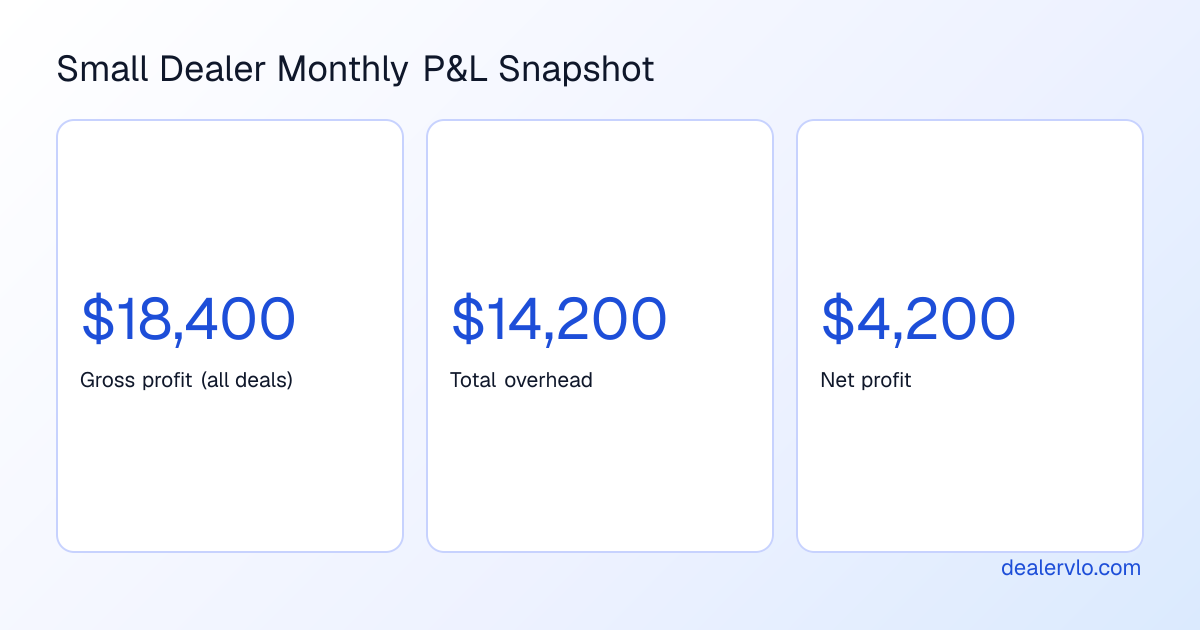
The third step is to enter every overhead expense from last month — rent, payroll, floor plan interest, insurance, advertising, utilities, and technology subscriptions — and read your profit and loss statement. Your P&L is gross profit from sales minus overhead; it tells you whether the month was profitable and where your money went.
Overhead expenses fall into fixed and variable categories. Fixed costs stay the same regardless of how many cars you sell: rent, salaried payroll, insurance premiums, and your DMS or CRM subscription. Variable costs move with volume: sales commissions, marketing spend that scales with inventory, and floor plan interest tied to how many units you're carrying and for how long.
Common overhead categories for a small independent lot include:
- Rent or facility lease
- Payroll and commissions
- Floor plan interest
- Insurance (dealer bond, garage liability, inventory coverage)
- Marketing and advertising (listing-site fees, Google ads, website hosting)
- Utilities (electric, gas, water, internet)
- Technology (DMS, CRM, phone system)
- Office supplies and consumables
- Professional services (accountant, attorney)
- Repairs and maintenance on the facility or office equipment
Independent dealers typically run lower overhead than franchise stores but face higher acquisition costs and no OEM support. Average net margins for independent dealers range from 3 to 8 percent of revenue, and personnel, advertising, floor plan, rent, and other fixed costs together can consume 75 to 90 percent of gross profit.
In DealerVLO, I enter overhead as one-time or recurring monthly expenses by category under Profit and Loss. Recurring expenses — rent, payroll, insurance — are set once and roll forward every month. One-time expenses — a repair, a marketing test, a filing fee — are entered as they happen. The P&L shows gross profit from sales minus overhead, so I can see net profit for the month and compare it to prior months.
If your gross was strong but your net was weak, overhead is the reason. If payroll or floor plan interest spiked, you'll see it line by line. For a detailed guide to building and reading your P&L, see [how to build a profit & loss statement for your used-car lot](/blog/build-profit-and-loss-statement-used-car-dealership).
DealerVLO does not connect to QuickBooks or any outside accounting software, and it does not offer bookkeeping or tax services. It tracks overhead by category and computes net profit from gross minus expenses, but you'll still work with your accountant for tax prep, depreciation schedules, and year-end financials.
For benchmarks on what percentages are normal for payroll, advertising, and floor plan as a share of gross, see the [used-car dealer benchmarks guide](/guide/used-car-dealer-benchmarks).
## Walk the aging report and decide what needs action
The fourth step is to open your inventory aging report, walk every bucket, and decide which units get repriced, re-merchandised, or wholesaled before they cross 60 or 90 days. Aged inventory burns floor plan interest, takes lot space from a car that would sell, and eventually gets wholesaled at a loss. The month-end close is when you make the call.
Most dealers and inventory systems sort stock into the same aging buckets: 0 to 30 days, 31 to 60 days, 61 to 90 days, and 90-plus days. Industry consensus is that aged inventory means a used vehicle that's been on the lot beyond 60 days. Top-performing dealers keep 70 to 80 percent of inventory in the 0-to-30-day bucket, 15 to 18 percent in 31 to 60 days, under 5 percent in 61 to 90 days, and under 2 percent past 90 days.
For each bucket, ask:
- **0 to 30 days:** Is the car priced right, photographed well, and listed everywhere it should be? If it's fresh and not getting calls, the price or the photos are the problem.
- **31 to 60 days:** Why hasn't it sold? Is it overpriced relative to comps, or is it a slow-moving body style or color? Consider a price drop or a social post highlighting the car. Most dealers aim to sell a used car within about 45 days, so a unit at 50 days needs immediate attention.
- **61 to 90 days:** This is the must-sell zone. If wholesale bid is within $1,000 of your breakeven, take it. If you haven't had serious buyer interest in 30 days, take it. If you've dropped price twice without moving the unit, take it. Past 60 days, a vehicle is commonly treated as aged inventory, and the holding cost is eroding any remaining margin.
- **90-plus days:** Wholesale it or donate it. Past 90 days, many dealers would rather take a small loss than keep paying to hold it. As a unit ages, market value declines while floor plan interest and carrying costs continue to accumulate, so every day you wait makes the loss bigger.
DealerVLO's aging report buckets inventory into 0-30, 31-60, 61-90, and 90-plus days, and every car in inventory shows its days on the lot. The dashboard flags units aged 60-plus days in the "Needs attention" panel, so you see the problem cars without having to run the report. At month-end, I open the aging report, sort by days in inventory, and decide: reprice, re-shoot the photos, wholesale, or hold one more week. If a car is at 58 days and I haven't had a single test drive, it's getting wholesaled before it crosses 60.
Having a clear process for repricing, wholesaling, or incentivizing units before they reach 60 days is a sign of a disciplined operation. For a detailed strategy on when and how much to mark down, see the [inventory aging and markdown strategy guide](/blog/inventory-aging-markdown-strategy).
## Check sales by salesperson and front vs back-end gross
The fifth step is to review last month's sales by salesperson and compare front-end gross to back-end gross. If you have a sales team, you need to know who's closing deals and whether they're selling cars or giving them away. If you're a one-person shop, you still need to see whether your gross is coming from the car or from F&I.
Front-end gross is the profit on the vehicle itself: selling price minus all-in cost. Back-end gross is the profit from finance reserve, warranties, GAP, and any other F&I products. A healthy deal has both. A deal with strong back-end and weak front-end means you discounted the car to close it and made it up in financing. A deal with strong front-end and no back-end means you left money on the table or the buyer paid cash.
For a small lot, average front-end gross per deal typically ranges from $1,500 to $3,000, and back-end gross can add another $500 to $1,500 depending on whether you offer in-house financing or sell third-party products. If your average front-end is under $1,000, you're either buying too high, pricing too low, or giving up too much in negotiation.
DealerVLO's sales report shows front-end and back-end gross per deal and a salesperson leaderboard, so you can see total units, total gross, and average gross per salesperson for the month. On my lot I'm the only salesperson, so the leaderboard is short, but I still look at average front-end and back-end every month to see whether I'm holding gross or discounting to move metal.
If one salesperson is closing twice the volume of another but delivering half the gross per deal, you have a pricing or negotiation problem. If back-end gross is zero across the board, you're not offering financing or you're not presenting F&I products. Either way, the sales report tells you where to coach or adjust. For more on the difference between gross and net and how each affects your bottom line, see [gross vs net profit for a used-car dealership](/blog/used-car-dealership-gross-vs-net-profit).
## Set next month's buying budget from what sold and what's aging
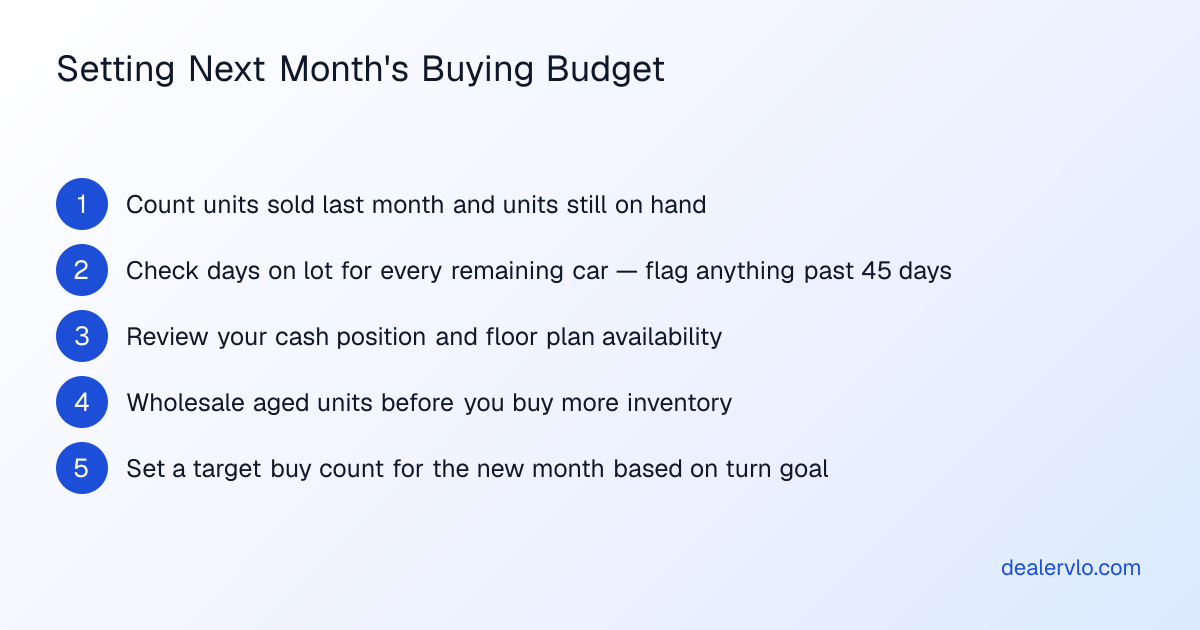
The sixth and final step is to set your buying budget for the new month based on what sold last month and what's still sitting. If you sold five cars and have fifteen units in stock, your lot's full — don't buy unless you wholesale something first. If you sold ten cars and only have eight left, you need inventory. The month-end close is when you decide how much to spend at auction or on trade-ins this month.
A simple rule: your turn goal drives your buying budget. If you want to turn inventory every 45 days, you should sell roughly two-thirds of your on-hand units each month. If you're sitting on twenty cars and you sold eight last month, you're on pace for a 75-day turn, which means you're either overstocked or your inventory mix is wrong. If you sold twelve and you're down to ten, you're under-stocked and you need to buy.
Your buying budget also depends on your cash position and your floor plan availability. If you're cash-heavy and your floor plan is under-utilized, you can buy aggressively. If you're cash-tight and your floor plan is maxed out, you need to wholesale aged units before you buy more. Don't buy your way into a cash crunch just because you see a good deal at auction.
DealerVLO's dashboard shows cars sold this month and that month's revenue, so you see at a glance whether you're up or down versus prior months. The aging report shows how many units are in each bucket, so you know how many need to move before you can restock. At month-end, I look at the dashboard, count units sold versus units on hand, and set a target for how many cars I want to buy this month. If I'm sitting on four units past 60 days, those four go to wholesale before I buy anything new.
For a detailed breakdown of how dealers make money and where profit comes from, see [how used-car dealerships actually make money](/blog/how-used-car-dealerships-make-money). For guidance on what to stock and how to pick cars that turn fast, see the monthly [stocking report](/blog/cars-to-stock-october-2026) and [how small lots compete with CarMax and Carvana](/blog/how-small-lots-compete-with-carmax-carvana).
## Frequently asked questions
### How long should a car dealer month end close take?
A month-end close for a small independent used-car lot should take about an hour if you've been logging costs and closing deals as they happen. The routine covers five steps: verifying every deal from last month is complete and funded, confirming every recon and transport cost is logged on the right car, entering overhead expenses and reading the P&L, walking the aging report to decide what gets repriced or wholesaled, and setting next month's buying budget. If you're starting from scratch or digging through paper receipts, it will take longer the first time, but once the process is in place it's a quick monthly checkpoint.
### What should be on a car dealer month end checklist?
A car dealer month end checklist should cover deal completion, cost verification, overhead entry, aging review, and buying decisions. Verify that every sold car has a complete deal jacket, funding received, and title paperwork sent. Confirm that every dollar spent on recon, transport, and auction fees is logged on the car it belongs to so your gross profit is accurate. Enter all overhead expenses and read your profit and loss statement to see net profit. Walk the inventory aging report and decide which units get repriced, re-merchandised, or wholesaled before they cross 60 or 90 days. Finally, set your buying budget for the new month based on what sold and what's still sitting.
### How do you calculate gross profit on a used car at month end?
Gross profit on a used car is your selling price minus all-in cost, which includes acquisition cost, reconditioning, transport, dealer admin overhead, and holding costs. Acquisition cost is what you paid at auction or on trade, including the buyer fee. Recon is every repair, part, labor, and detail line before the car hit the lot. Transport is what you paid to move the car. Holding cost is roughly $30 to $40 per day per vehicle when you include floor plan interest and carrying costs, so a car that took 60 days to sell adds about $1,800 to $2,400 to its all-in cost. If any cost is missing, your gross is overstated and you'll think you made money when you didn't.
### What inventory aging buckets should a small dealer track?
Most dealers and inventory systems sort stock into four aging buckets: 0 to 30 days, 31 to 60 days, 61 to 90 days, and 90-plus days. Top-performing dealers keep 70 to 80 percent of inventory in the 0-to-30-day bucket, 15 to 18 percent in 31 to 60 days, under 5 percent in 61 to 90 days, and under 2 percent past 90 days. Aged inventory typically means a used vehicle that's been on the lot beyond 60 days, and most dealers aim to sell a car within about 45 days. Past 60 days a vehicle is in the must-sell zone, and past 90 days many dealers would rather take a small loss at wholesale than keep paying to hold it.
### When should a dealer wholesale an aged unit instead of repricing?
Wholesale an aged unit when it crosses 60 days without serious buyer interest, when your wholesale bid is within $1,000 of breakeven, or when you've dropped price twice without moving it. Past 60 days, holding costs and market depreciation erode any remaining margin, so every day you wait makes the loss bigger. If a car is at 58 days and you haven't had a single test drive, wholesale it before it crosses 60. If wholesale bid is close to your all-in cost, take it — floor plan interest and lot space are worth more than holding out for another $500. Having a clear process for repricing or wholesaling units before they reach 60 days is a sign of a disciplined operation.
### How often should a small used-car lot do a formal month-end close?
A small used-car lot should do a formal month-end close once a month, ideally on the first or second of the new month while the prior month's numbers are still fresh. The close verifies that every deal is complete, every cost is logged, overhead is entered, aging inventory is reviewed, and the buying budget is set. It's the monthly counterpart to the daily routine that keeps the day-to-day from leaking money. If you're not closing the month, you're flying blind — you don't know which cars made money, whether the month was profitable, or how much you can afford to buy next.
## Bottom line
A one-hour month-end close for a small used-car lot gives you the numbers you need to run profitably: complete deals, accurate costs, real gross and net profit, visibility into what's aging, and a buying budget tied to what actually sold. It's not tax prep or an audit — it's an operational checkpoint that tells you whether last month worked and what to change this month. If you're not closing the month, you're guessing, and guessing costs you more than an hour ever will. DealerVLO tracks deal gross, per-car costs, overhead by category, and inventory aging in one place, so the whole routine runs faster and the numbers are always current.
Run your next month-end close in DealerVLO: start your free 14-day trial
---
## FAQ
### How long should a car dealer month end close take?
A month-end close for a small independent used-car lot should take about an hour if you've been logging costs and closing deals as they happen. The routine covers five steps: verifying every deal from last month is complete and funded, confirming every recon and transport cost is logged on the right car, entering overhead expenses and reading the P&L, walking the aging report to decide what gets repriced or wholesaled, and setting next month's buying budget. If you're starting from scratch or digging through paper receipts, it will take longer the first time, but once the process is in place it's a quick monthly checkpoint.
### What should be on a car dealer month end checklist?
A car dealer month end checklist should cover deal completion, cost verification, overhead entry, aging review, and buying decisions. Verify that every sold car has a complete deal jacket, funding received, and title paperwork sent. Confirm that every dollar spent on recon, transport, and auction fees is logged on the car it belongs to so your gross profit is accurate. Enter all overhead expenses and read your profit and loss statement to see net profit. Walk the inventory aging report and decide which units get repriced, re-merchandised, or wholesaled before they cross 60 or 90 days. Finally, set your buying budget for the new month based on what sold and what's still sitting.
### How do you calculate gross profit on a used car at month end?
Gross profit on a used car is your selling price minus all-in cost, which includes acquisition cost, reconditioning, transport, dealer admin overhead, and holding costs. Acquisition cost is what you paid at auction or on trade, including the buyer fee. Recon is every repair, part, labor, and detail line before the car hit the lot. Transport is what you paid to move the car. Holding cost is roughly $30 to $40 per day per vehicle when you include floor plan interest and carrying costs, so a car that took 60 days to sell adds about $1,800 to $2,400 to its all-in cost. If any cost is missing, your gross is overstated and you'll think you made money when you didn't.
### What inventory aging buckets should a small dealer track?
Most dealers and inventory systems sort stock into four aging buckets: 0 to 30 days, 31 to 60 days, 61 to 90 days, and 90-plus days. Top-performing dealers keep 70 to 80 percent of inventory in the 0-to-30-day bucket, 15 to 18 percent in 31 to 60 days, under 5 percent in 61 to 90 days, and under 2 percent past 90 days. Aged inventory typically means a used vehicle that's been on the lot beyond 60 days, and most dealers aim to sell a car within about 45 days. Past 60 days a vehicle is in the must-sell zone, and past 90 days many dealers would rather take a small loss at wholesale than keep paying to hold it.
### When should a dealer wholesale an aged unit instead of repricing?
Wholesale an aged unit when it crosses 60 days without serious buyer interest, when your wholesale bid is within $1,000 of breakeven, or when you've dropped price twice without moving it. Past 60 days, holding costs and market depreciation erode any remaining margin, so every day you wait makes the loss bigger. If a car is at 58 days and you haven't had a single test drive, wholesale it before it crosses 60. If wholesale bid is close to your all-in cost, take it — floor plan interest and lot space are worth more than holding out for another $500. Having a clear process for repricing or wholesaling units before they reach 60 days is a sign of a disciplined operation.
### How often should a small used-car lot do a formal month-end close?
A small used-car lot should do a formal month-end close once a month, ideally on the first or second of the new month while the prior month's numbers are still fresh. The close verifies that every deal is complete, every cost is logged, overhead is entered, aging inventory is reviewed, and the buying budget is set. It's the monthly counterpart to the daily routine that keeps the day-to-day from leaking money. If you're not closing the month, you're flying blind — you don't know which cars made money, whether the month was profitable, or how much you can afford to buy next.