# Used Car Dealer Insurance: Garage Liability, Garagekeepers, and Dealer Open Lot Explained
> Used car dealer insurance for small lots: garage liability, dealers open lot, garagekeepers, dealer plates, what drives your premium, and a quote checklist.
- Source: https://www.dealervlo.com/blog/used-car-dealer-insurance
- Published: 2026-10-03
- Updated: 2026-10-03
- Author: Chris Abouraad
- Tags: insurance, starting a lot, garage liability, overhead
---
Used car dealer insurance is a bill most lots sign up for in a hurry, because the license application or the floor plan lender wants proof of it. Then it renews every year and nobody looks at it until hail hits the lot or a test drive goes wrong. The carrier pages that rank for it are written to sell a policy, not to explain which risk each coverage handles.
This post maps the coverage to the real risks of running a small lot: garage liability (or the newer auto dealers form), dealers open lot for your inventory, garagekeepers for other people's cars, and the dealer plate and test drive questions in between. Then it covers what moves your premium and what to have ready when you ask for a quote. No premium numbers here, because carriers quote them per lot. Talk to an agent who writes dealer policies before you buy anything.
Put your insurance premium and every other monthly cost on one P&L in DealerVLO: start your 14-day free trial
## Used car dealer insurance: what a small lot actually needs
Most independent lots end up with the same three pieces, plus a bond that people often confuse with insurance:
- **Garage liability**, for injury and damage claims from your operations and from driving cars.
- **Dealers open lot** (also called dealers physical damage), for your own inventory.
- **Garagekeepers**, for customers' cars while they're in your care.
- **The dealer bond**, which isn't insurance at all.
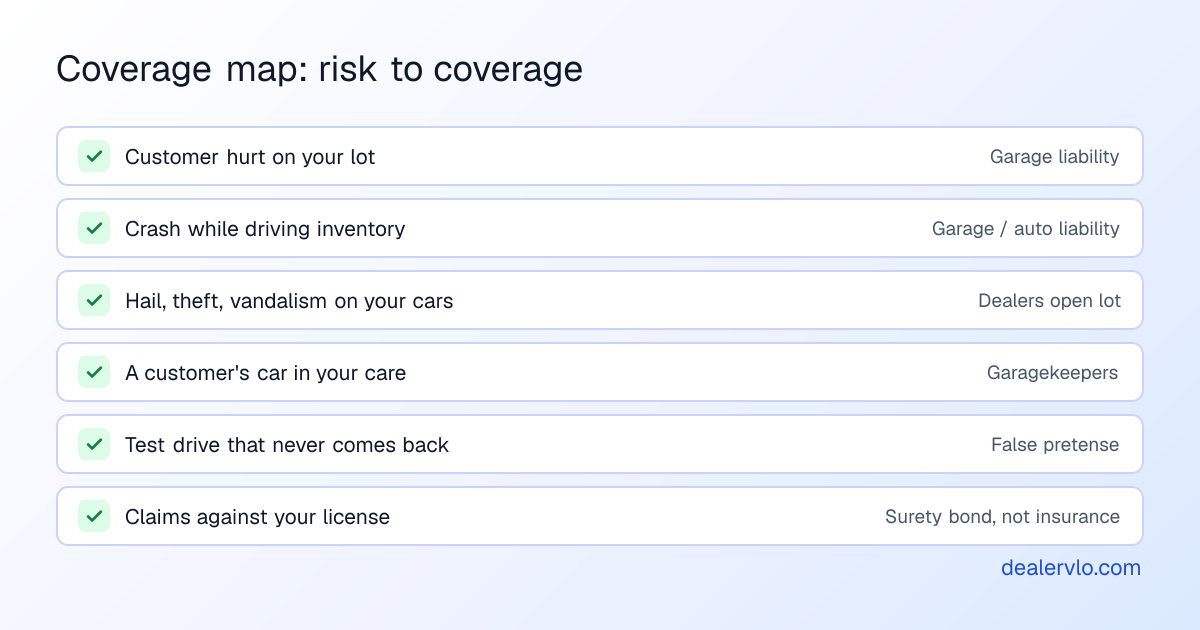
On used car dealer insurance requirements: some states make proof of liability insurance part of the dealer license, and the amounts vary. Check your state's dealer board, and see our [dealer license cost by state guide](/guide/dealer-license-cost-by-state) for the bond and fee side. Floor plan lenders have their own list too. One dealer-insurance agency's [floor plan guide](https://www.catanzaroinsurance.com/dealer-floor-plan-auto-dealership/) says lenders require garage liability and dealer open lot coverage and want to be listed on your policy as loss payee.
As for the bond: IRMI defines a [surety bond](https://www.irmi.com/term/insurance-definitions/surety-bond) as a contract where the surety guarantees your obligations to a third party. It protects the state and your customers. It doesn't pay for your hail-damaged cars or defend you in an injury claim.
Insurance is a fixed cost whether you sell ten cars or two. In DealerVLO, you record it once as a recurring monthly expense under Insurance, and the profit and loss charges it to every month. Our [monthly cost-to-run breakdown](/blog/cost-to-run-a-used-car-lot-per-month) shows where it sits in the full overhead picture.
## Garage liability (or the auto dealers coverage form)
Garage liability vs general liability is the first thing to get straight. IRMI defines [garage liability insurance](https://www.irmi.com/term/insurance-definitions/garage-liability-insurance) as covering dealers' legal liability for bodily injury and property damage arising out of business operations, with one insuring agreement for operations involving the ownership, maintenance, or use of autos and another for everything else. That auto piece is the point. Insureon's [garage keepers vs garage liability explainer](https://www.insureon.com/blog/garage-keepers-vs-garage-liability-insurance) says plain general liability excludes these risks for businesses that sell, store, and service vehicles.
So for a dealer, garage liability is built to cover both halves: the customer who trips on a parking block, and the crash while one of your cars is being driven. Who counts as a permitted driver is set by the policy, so read that part closely.
The paperwork has changed names. Per [RNC-Pro's overview](https://www.rnc-pro.com/rnc-pro/pfm/200/222_0100.HTM), ISO's Auto Dealers Coverage Form (CA 00 25) replaced the old Garage Coverage Form (CA 00 05) in its 10/13 commercial auto revision, putting a dealer's general and auto liability in one form. IRMI still defines a [garage policy](https://www.irmi.com/term/insurance-definitions/garage-policy) as a dealer auto policy with garage liability, garagekeepers, and auto physical damage. Both names are in use, and some carriers use their own forms, so ask which form your quote is on.
## Dealers open lot: your inventory
This is the coverage for the cars you own and are trying to sell: theft, hail, vandalism, a tree branch, a fire. IRMI's [dealers open lot](https://www.irmi.com/term/insurance-definitions/dealers-open-lot) entry says it's usually written through a specialty underwriting program and sorts lots into four protection levels, from unprotected (no fencing or barriers) up to inventory kept inside a building. How well you lock the lot down is part of the price.
One dealer-insurance agency's [physical damage explainer](https://dealers-insurance.com/physical_damage_coverage/) describes the usual options: comprehensive, specified perils such as fire, theft, vandalism, wind, hail and flood, or fire and theft only. It also describes two ways the value gets set:
- **Reporting form.** You report the value of your inventory monthly or quarterly, and the premium follows it. The same explainer warns that missing a report can cut what the carrier pays on a claim.
- **Non-reporting form.** You insure the maximum value of all the cars that could be on the lot at any one time.
Not every program works that way. Encova's [dealers physical damage spotlight](https://www.encova.com/the-loop/mmic/2016/05/mcm-spotlightdealers-physical-damage/) advertised a program with no monthly reports of values. Ask which kind you're being quoted, and what happens if you're over the limit on a busy month.
Either way, you need a real number for what's on the lot. DealerVLO keeps each car's purchase cost and its line-item costs (recon, transport, auction fees), rolled into that car's all-in cost. It does not show a total inventory value, so add up the cost on the cars in stock from your inventory list or your accounting when the carrier asks. Every car also shows its days in inventory, which matters here too: a car that sits 90 days is exposed to 90 days of hail and theft.
That screen shows per-car cost, margin, and days on lot, so the longest-parked cars stand out before your next value report.
See every car's all-in cost and days on the lot in DealerVLO: start your 14-day free trial
## Garagekeepers: other people's cars
Garagekeepers vs garage liability trips up a lot of new dealers. IRMI defines [garagekeepers coverage](https://www.irmi.com/term/insurance-definitions/garagekeepers-coverage) as coverage for damage to a customer's car left in your care for service or repair, and notes it requires that you be found liable. Insureon's explainer is blunt: garage liability covers a customer's property at your business, but not their vehicle.
A sales-only lot has less of this exposure than a shop, but not zero:
- A trade-in that sits on your lot before the deal is final.
- A customer's car you move to make room for a test drive.
- Detail or light repair work you do for customers.
- Consigned cars you're selling for someone else.
Consignment is the one to ask about specifically. Depending on how the policy is written, a consigned car may be handled under physical damage, garagekeepers, or neither. Get the answer in writing.
## Dealer plates, test drives, and who's driving
Dealer plate insurance usually isn't a separate policy. The plate goes on a car you own, and the coverage comes from your dealer policy. Victor Insurance's [garage liability guidance](https://www.victorinsurance.com/us/policyholders/victor-risk-advisory/us/auto-dealers/garage-liability.html) puts it plainly: if a dealer plate is on the car, your primary carrier is providing coverage, and that may include permissive users such as an employee's family members.
That's why "who's driving" moves the price. The same Victor page says the driving records of the people in your cars affect accident risk, and that carriers commonly look at three years of losses for renewal pricing. Keep a list of who has plates and pull their records before you hand one over. Our [dealer plates guide](/guide/dealer-plates) covers how plates work.
Not every commercial auto carrier takes dealer-plated cars. Progressive Commercial's [what we do not insure page](https://www.progressivecommercial.com/commercial-auto-insurance/what-we-do-not-insure/) lists vehicles with dealer or transport plates, with narrow exceptions. Go to an agent who writes dealer business.
Test drives are the kind of auto use dealer liability is built for, but conditions vary: solo drives, driver age, a license copy. Ask your agent and set a desk rule; the [test drive to close walkthrough](/blog/in-person-used-car-sale-test-drive-to-close) covers the sales side. Know this exclusion too: IRMI's [false pretense](https://www.irmi.com/term/insurance-definitions/false-pretense-trick-and-device) entry describes a physical damage exclusion for losses from fraud, such as a customer taking a car under the pretense of test-driving it. You can buy that coverage back.
## What drives your premium
How much is used car dealer insurance? Honestly, it depends, and an "average dealer premium" is a guess about someone else's lot. The levers the sources above point to:
- **Inventory value on the lot**, peak and average, because that's what physical damage insures.
- **Lot security**, from an open lot to a fenced, lit one to cars kept indoors.
- **Who drives on your plates**, how many drivers, and their records.
- **Claims history**, often the last three years.
- **Location and weather**, hail and flood country especially.
- **What else you do**: service, detailing, consignment, a second lot.
You control some of those. Fewer cars sitting past 60 days means less value parked on the lot. DealerVLO's inventory aging report buckets cars 0-30, 31-60, 61-90, and 90+ days, and the dashboard counts units aged 60+, so you can see how much of your stock has been sitting before renewal.
## How to shop dealer open lot and garage liability insurance
Shop with an agent who writes dealer business, and bring the facts so the quote comes back on your real numbers.
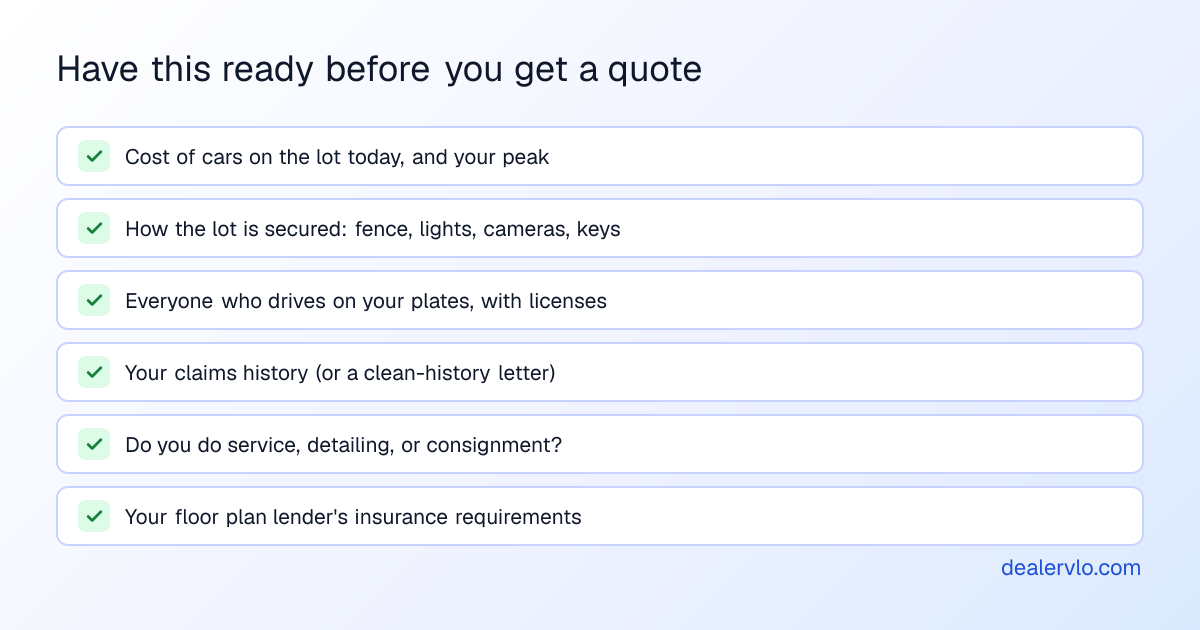
Compare quotes on the same limits and the same deductibles, and ask how deductibles apply when hail hits ten cars at once. If you're still building the budget for opening day, the startup calculator includes insurance as its own line.
Then review it every year, before renewal, not after.
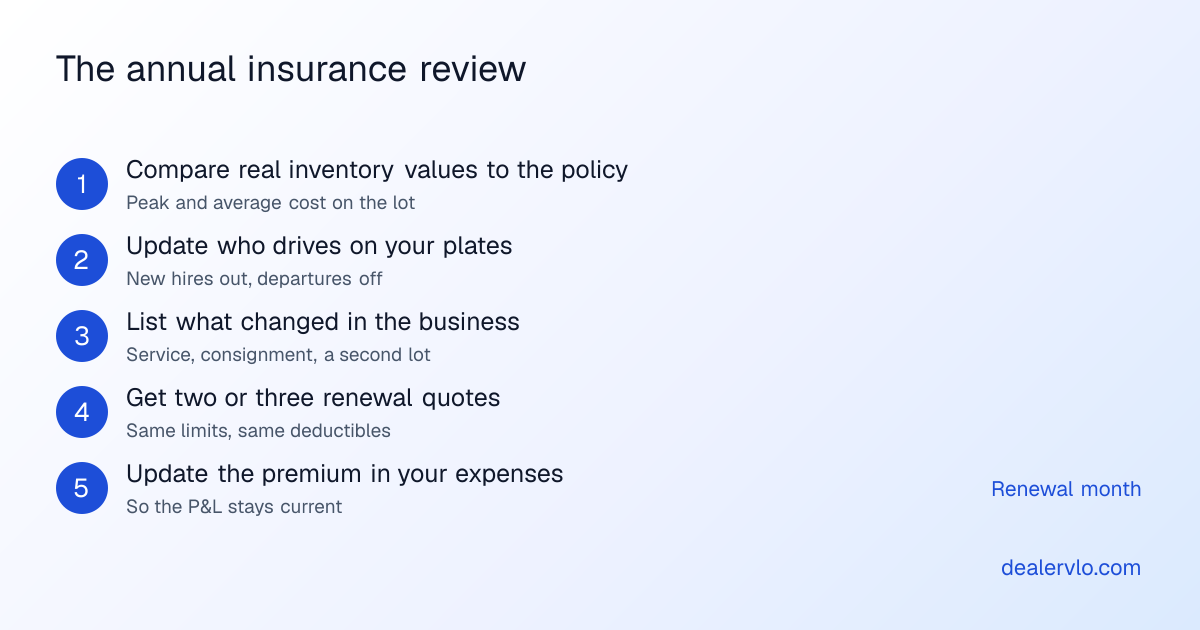
When the renewal lands, update the amount on the recurring Insurance expense in DealerVLO, and every month from then on carries the new number. Our [expense tracking guide](/blog/how-to-track-expenses-used-car-dealer) walks through setting up those recurring costs.
## Where DealerVLO fits
DealerVLO doesn't sell, quote, or compare insurance. Here's what it does around it:
- **The premium in your P&L.** Record it once as a recurring monthly expense under Insurance, and the profit and loss shows gross profit minus overhead every month.
- **Per-car cost.** Each car has its purchase cost and line-item costs rolling into an all-in cost and margin.
- **Days on the lot.** Every car shows its days in inventory, with an aging report and a 60+ day flag.
What it doesn't do: show a total inventory value for a reporting form (total the cost of the cars in stock from your inventory list or accounting), track who has dealer plates, or log test drives. Keep a plate list and a test-drive sheet for those. It's $29 a month flat, unlimited users, in a browser. For the bigger picture, see [how to start a used car dealership](/blog/how-to-start-used-car-dealership) and [what it costs to open one](/blog/cost-to-open-used-car-dealership).
## Frequently asked questions
### What type of insurance do car dealers need?
Most independent lots carry garage liability (or the newer auto dealers coverage form) for injury and driving claims, dealers open lot for their own inventory, and garagekeepers if they hold customers' cars. Some states require proof of liability insurance for the dealer license, and floor plan lenders typically require open-lot coverage. An agent who writes dealer policies can tell you which your lot needs.
### How much is dealer insurance per month?
There's no honest single number. Carriers quote per lot, based on inventory value, lot security, who drives on your plates and their records, claims history, location and weather, and whether you do service or consignment. Get two or three quotes, then record the premium as a monthly expense so it shows in your P&L.
### What does a garage dealer policy cover?
IRMI describes a garage policy as a commercial auto policy built for auto dealers that includes garage liability, garagekeepers, and auto physical damage, with other coverages available by endorsement. ISO's Auto Dealers Coverage Form (CA 00 25) replaced the older Garage Coverage Form in its 10/13 forms revision, but many people still call it a garage policy.
### Does garage liability cover auto liability?
For dealers, yes in principle: IRMI's definition of garage liability includes an insuring agreement for operations involving the ownership, maintenance, or use of autos, which plain general liability doesn't give you. What counts as a covered auto, and who counts as a permitted driver, depends on how your policy is written, so ask your agent.
### Do used car dealerships require full coverage insurance?
Full coverage is a personal auto term. For a dealer's inventory, the closest thing is dealers open lot or dealers physical damage coverage, usually offered as comprehensive, specified perils, or fire and theft only. Floor plan lenders typically require it on cars they finance and want to be named as loss payee.
### Is a dealer bond the same as dealer insurance?
No. A dealer surety bond guarantees your obligations to a third party, such as the state or your customers. It doesn't pay for your damaged inventory or defend you in an injury claim. You usually need the bond for the license and the insurance for the business.
## Bottom line
Used car dealer insurance comes down to matching each risk to the right coverage: garage liability for injuries and driving, dealers open lot for your cars, garagekeepers for other people's cars, and false pretense for the test drive that never comes back. Know your inventory value, know who's on your plates, and review it all before every renewal with an agent who writes dealer policies.
I built DealerVLO for my own lot in Tewksbury, and it keeps the numbers that conversation needs in one place: what each car cost, how long it's been sitting, and what the premium does to your monthly profit. Try it free for 14 days.
Track every car's cost, days on lot, and your monthly overhead in DealerVLO: start your 14-day free trial
---
## FAQ
### What type of insurance do car dealers need?
Most independent lots carry garage liability (or the newer auto dealers coverage form) for injury and driving claims, dealers open lot for their own inventory, and garagekeepers if they hold customers' cars. Some states require proof of liability insurance for the dealer license, and floor plan lenders typically require open-lot coverage. An agent who writes dealer policies can tell you which your lot needs.
### How much is dealer insurance per month?
There's no honest single number. Carriers quote per lot, based on inventory value, lot security, who drives on your plates and their records, claims history, location and weather, and whether you do service or consignment. Get two or three quotes, then record the premium as a monthly expense so it shows in your P&L.
### What does a garage dealer policy cover?
IRMI describes a garage policy as a commercial auto policy built for auto dealers that includes garage liability, garagekeepers, and auto physical damage, with other coverages available by endorsement. ISO's Auto Dealers Coverage Form (CA 00 25) replaced the older Garage Coverage Form in its 10/13 forms revision, but many people still call it a garage policy.
### Does garage liability cover auto liability?
For dealers, yes in principle: IRMI's definition of garage liability includes an insuring agreement for operations involving the ownership, maintenance, or use of autos, which plain general liability doesn't give you. What counts as a covered auto, and who counts as a permitted driver, depends on how your policy is written, so ask your agent.
### Do used car dealerships require full coverage insurance?
Full coverage is a personal auto term. For a dealer's inventory, the closest thing is dealers open lot or dealers physical damage coverage, usually offered as comprehensive, specified perils, or fire and theft only. Floor plan lenders typically require it on cars they finance and want to be named as loss payee.
### Is a dealer bond the same as dealer insurance?
No. A dealer surety bond guarantees your obligations to a third party, such as the state or your customers. It doesn't pay for your damaged inventory or defend you in an injury claim. You usually need the bond for the license and the insurance for the business.