# Trim Level by VIN: Why It Comes Back Blank or Wrong (and What It Costs You on Trade-Ins)
> Trim level by VIN isn't guaranteed: some brands don't encode trim, and badges prove nothing. How to verify trim before you price a trade-in or list a car.
- Source: https://www.dealervlo.com/blog/trim-level-mismatch-cost-dealers
- Published: 2026-10-27
- Updated: 2026-10-27
- Author: Chris Abouraad
- Tags: trade-in valuation, VIN decoding, inventory pricing, appraisal accuracy
---
A customer pulls in with a trade, and the fender badge says top trim. You run the VIN, the decode comes back thin on trim, you price it off the badge anyway, and three weeks later the wholesale buyer or a retail shopper tells you it's one trim down. That gap comes straight out of your margin. Nobody did anything dishonest. "Trim level by VIN" just isn't the sure thing it sounds like.
The part of the VIN that would tell you trim, positions four through eight, isn't laid out the same way by every manufacturer. Some brands encode trim reliably. Many others don't put it in the VIN at all. So the honest answer to "how do I find out the trim of my car" is: it depends on the brand, and a badge on the trunk lid was never proof of anything.
Decode every VIN into the inventory record and track each car's real cost in DealerVLO: start your 14-day free trial
## Why trim level by VIN isn't a universal rule
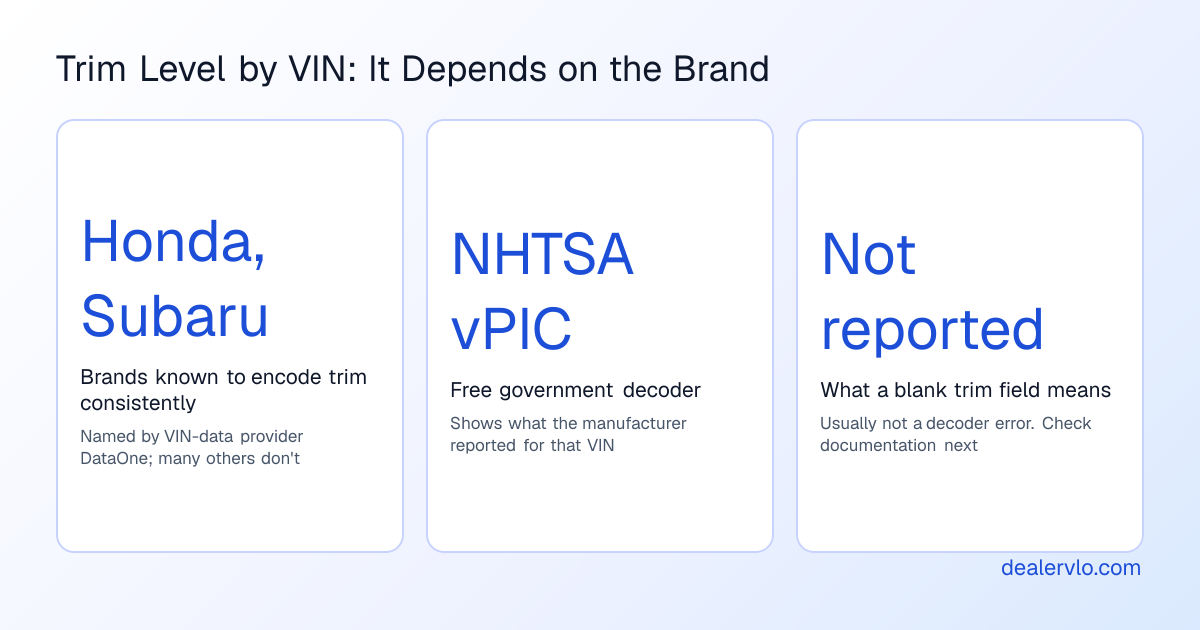
NHTSA requires certain information to be encoded in the VIN, but the middle section, the Vehicle Descriptor Section, leaves manufacturers leeway because every lineup is built differently. Some manufacturers, including Honda and Subaru, encode trim consistently there. Many others don't, and details like trim and transmission can be left out of the VIN pattern entirely ([DataOne Software](https://vin.dataonesoftware.com/vin_basics_blog/surprising-facts-about-vin-decoding-and-vehicle-data)).
Get that straight before you ever run a decode. A trim field that comes back filled in means that manufacturer reported it. A blank trim field doesn't mean the tool failed. Usually it means the brand didn't encode it.
## NHTSA's free VIN decoder, and why it sometimes comes back blank on trim
NHTSA's vPIC decoder is free and government-run, and anyone can use it ([NHTSA](https://www.nhtsa.gov/vin-decoder)). Plug in a 17-character VIN and it identifies the information encoded in the number, including the plant where the vehicle was built ([NHTSA](https://www.nhtsa.gov/vin-decoder)).
Here's the part dealers skip past. NHTSA states that the information its decoder displays is reported by the manufacturer ([vpic.nhtsa.dot.gov](https://vpic.nhtsa.dot.gov/decoder/)). vPIC isn't inferring trim from other fields. It shows you what the automaker reported, nothing more. If the manufacturer didn't report trim for that VIN, the decoder has nothing to show you, and that's not a bug.
In DealerVLO, when you type or paste a VIN on the add-vehicle screen or the phone quick-add, it's decoded against NHTSA's vPIC data and the year, make, model, trim (when NHTSA returns one), engine and body style fill in, so you aren't retyping specs by hand. When the decode is thin on trim, that's your signal to move to the next step instead of assuming. If you only want to check one VIN without adding it to inventory, use the free [VIN decoder tool](/tools/vin-decoder), which shows the Trim field right in the results.
## "Toyota VIN decoder" and other brand searches: same NHTSA data
Plenty of dealers search "Toyota VIN decoder," or the same thing for whatever brand they take in most, expecting a different answer from a brand-specific lookup. A Toyota VIN decodes in NHTSA's vPIC like any other VIN, and what comes back is what the manufacturer reported ([vpic.nhtsa.dot.gov](https://vpic.nhtsa.dot.gov/decoder/)). The brand on the car doesn't change how much to trust a decode. It changes whether trim was reported in the first place. Toyota, Honda, Ford or anything else: a decoded trim field is only as good as what the manufacturer reported for that model year.
## Badges aren't proof
Say it on the lot until it sticks: exterior trim badges are trim pieces, not documents. Nothing ties them to the VIN, and they can be swapped, removed or mismatched. A prior owner pulls a badge, a body shop hangs a fender from a different trim, or someone de-badges the car because they like the cleaner look. None of that shows up in the VIN.
If the decode comes back thin on trim, look next for manufacturer documentation tied to that VIN: a window sticker or build sheet, if the previous owner kept one. Without that, the honest move is to appraise the car on the equipment you can physically confirm in the driveway, such as leather versus cloth, moonroof, trim-specific wheels and infotainment screen size, rather than the name on the trunk. That's how to find out what trim your car is when the paperwork and the VIN both run dry: you verify by feature, not by badge.
## What a wrong trim actually costs you
Valuation guides treat trim as an input. Kelley Blue Book asks for make, model, year, mileage and trim level, along with condition and history, before it gives you a value ([usedcars.com](https://www.usedcars.com/kelley-blue-book-used-pricing-guide)). The NADA guides that dealerships and lenders typically lean on draw most of their data from real dealership transactions and wholesale auction results ([usedcars.com](https://www.usedcars.com/advice/buying/kelley-blue-book-vs-nada-guides)).
Feed a guide the wrong trim and you get a value for a different car, one that looks precise and isn't. Appraise a mid-trim car as the top trim and you overpay on the trade, and the gap comes out of your margin. Appraise it the other way and you lowball a customer who can tell something's off, which can cost you the deal. Either way the mistake carries forward, because the same wrong trim goes on your website and the listing sites, where shoppers compare it against correctly labeled cars.
Keep each trade-in's real spec and acquisition cost on one record in DealerVLO: try it free for 14 days
## Building trim verification into how you appraise and list
Once it's routine, this is a short habit, not extra work:
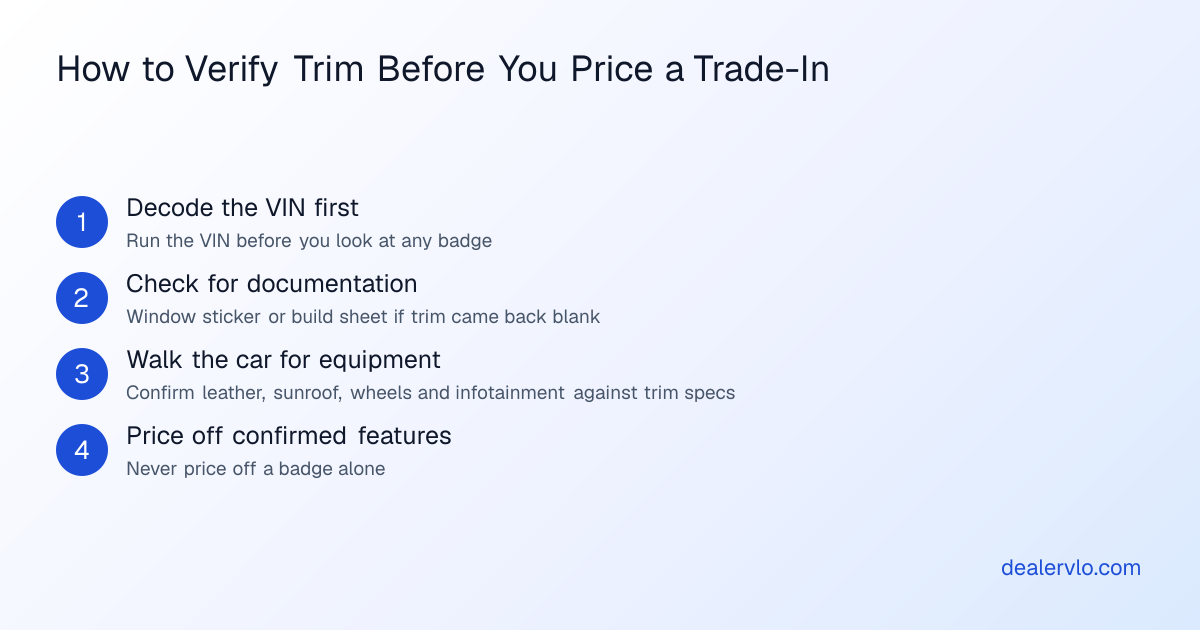
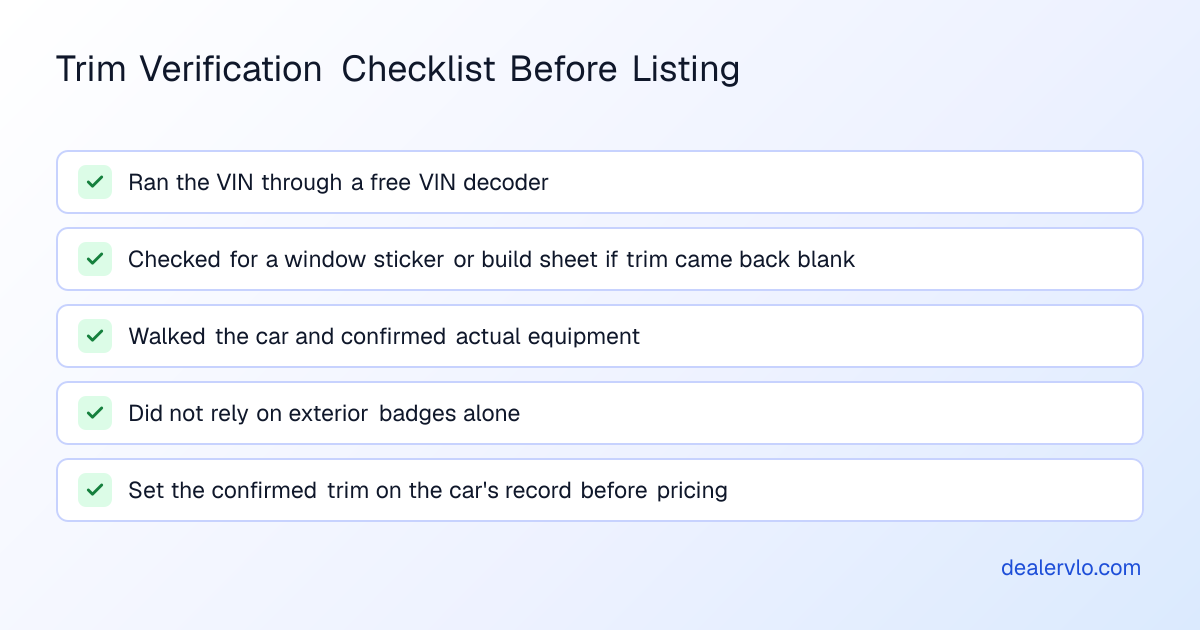
1. **Decode first, every time.** Run the VIN before you look at the badge. If trim comes back filled in, you have a manufacturer-reported starting point.
2. **If trim is blank, or doesn't match the car in front of you, look for documentation.** A window sticker or build sheet can settle it.
3. **Walk the car for equipment, not badges.** Confirm leather, sunroof, trim-specific wheels and infotainment against what that trim level is supposed to include, regardless of what's on the fender.
4. **Price off confirmed features, not assumed trim.** If you can't confirm trim, price conservatively on the features you can see.
5. **Record the confirmed trim and the acquisition cost where the car lives**, so whoever reprices or relists it later isn't starting from scratch.
When you complete a deal that has a trade-in with a full 17-character VIN, DealerVLO adds the trade to your inventory automatically. It gets a stock number starting with "T-", the trade allowance as its acquisition cost, and the sale date as its acquired date. Year, make, model and mileage carry over from the trade-in, but trim doesn't, so open the car's record and set the trim you confirmed before you price or list it. If the trade came in without a full VIN, add it by hand from the Inventory page, where the VIN decode fills what NHTSA has.
## Why accurate descriptions matter beyond margin
A trim mismatch on its own isn't the kind of thing regulators have been writing to dealers about. But it sits close to a theme they are pushing on: whether what's advertised matches what the customer gets. The FTC has sent warning letters to dozens of auto dealerships flagging deceptive advertising and pricing practices ([Crowell & Moring](https://www.crowell.com/en/insights/client-alerts/auto-dealers-the-ftc-is-back-in-the-drivers-seatwarning-letters-signal-renewed-federal-scrutiny)), and one enforcement action against a dealer group ended in a multi-million-dollar fine and a large required refund pool ([Auto Dealer Today](https://www.autodealertodaymagazine.com/digital-cover-features/dealer-ads-and-the-ftc)).
That enforcement is about pricing and advertising claims, not trim labels, so don't read more into it than that. The logic still carries over: a listing with the wrong trim describes a car that isn't quite the one on your lot. Getting the basic spec right is simple due diligence. (This isn't legal advice. For specific advertising-compliance questions, check current requirements with the FTC or your state's consumer protection office.)
Separately, the FTC's Used Car Rule says you must post a Buyers Guide before you display a vehicle for sale or let a customer inspect it ([FTC](https://www.ftc.gov/business-guidance/resources/dealers-guide-used-car-rule)). DealerVLO prints the Buyers Guide from each vehicle's page, before a deal exists, so it can go on the car as soon as the car is on the lot.
## Where DealerVLO fits without replacing your judgment
Software can't do all of this for you. A decoder shows what was reported. It can't confirm what's bolted onto the car in front of you. What DealerVLO takes off your plate is the mechanical part. Adding a car by VIN decodes it against NHTSA's data, so you see what the manufacturer reported instead of retyping specs from memory. And each car's record has its own Trim field next to the VIN, stock number and photos, so once you've confirmed trim by walking the car, there's one place to set it before you price.
If you're deciding where those listings should go once the spec is right, the [guide to listing sites for dealers](/blog/car-listing-sites-for-dealers) covers that. If cars go missing from the sites after you list them, read [why cars aren't showing on listing sites](/blog/why-cars-not-showing-on-listing-sites) before you assume it's a trim problem.
## Frequently asked questions
### Can I always find out a car's trim level by VIN?
No. Some manufacturers, including Honda and Subaru, encode trim consistently in the VIN's descriptor section, but many others leave trim out of the VIN pattern. A VIN decode shows what the manufacturer reported, so a blank trim field usually means the automaker didn't report it, not that the decoder failed.
### What's a reliable free VIN decoder?
NHTSA's vPIC decoder is a free, government-run option. It shows what the manufacturer reported for that VIN, such as body class, engine and plant of manufacture, plus trim where the brand reported it. DealerVLO's free [VIN decoder tool](/tools/vin-decoder) pulls from the same NHTSA data.
### Is there a separate Toyota VIN decoder I should be using?
Toyota VINs decode through the same NHTSA vPIC system as other manufacturers' VINs. Whether trim shows up depends on what Toyota reported for that model year, not on which free decoder you paste the VIN into.
### How do I find out the trim of my car if the VIN decode comes back blank?
Check for manufacturer documentation tied to that VIN, such as a window sticker or build sheet, if the previous owner kept one. If there isn't any, walk the car and compare its equipment (leather, sunroof, trim-specific wheels, infotainment) against what each trim level includes, and price off what you can confirm rather than a guess.
### Are exterior trim badges proof of a car's actual trim level?
No. Badges are bolt-on or stick-on trim pieces with nothing behind them, and they can be swapped, removed or mismatched during ownership or body repairs. Treat a badge as a hint, never as confirmation, before you set a trade-in allowance or a listing price.
### Does a wrong trim level actually cost me money on a trade-in?
It can. Valuation guides such as Kelley Blue Book ask for trim level along with year, make, model and mileage, so the wrong trim gives you a value for a different car. Appraise it high and you overpay on the allowance; appraise it low and you risk losing the deal. The fix is to verify trim before you run the valuation.
## Bottom line
A VIN confirms trim for some brands and leaves you guessing on others, and a badge was never proof of anything. Run the free decode first, fall back to documentation or a walk of the equipment when trim comes back thin, and price off what you can confirm.
Run your next trade-in through DealerVLO: start your free 14-day trial
---
## FAQ
### Can I always find out a car's trim level by VIN?
No. Some manufacturers, including Honda and Subaru, encode trim consistently in the VIN's descriptor section, but many others leave trim out of the VIN pattern. A VIN decode shows what the manufacturer reported, so a blank trim field usually means the automaker didn't report it, not that the decoder failed.
### What's a reliable free VIN decoder?
NHTSA's vPIC decoder is a free, government-run option. It shows what the manufacturer reported for that VIN, such as body class, engine and plant of manufacture, plus trim where the brand reported it. DealerVLO's free VIN decoder tool pulls from the same NHTSA data.
### Is there a separate Toyota VIN decoder I should be using?
Toyota VINs decode through the same NHTSA vPIC system as other manufacturers' VINs. Whether trim shows up depends on what Toyota reported for that model year, not on which free decoder you paste the VIN into.
### How do I find out the trim of my car if the VIN decode comes back blank?
Check for manufacturer documentation tied to that VIN, such as a window sticker or build sheet, if the previous owner kept one. If there isn't any, walk the car and compare its equipment (leather, sunroof, trim-specific wheels, infotainment) against what each trim level includes, and price off what you can confirm rather than a guess.
### Are exterior trim badges proof of a car's actual trim level?
No. Badges are bolt-on or stick-on trim pieces with nothing behind them, and they can be swapped, removed or mismatched during ownership or body repairs. Treat a badge as a hint, never as confirmation, before you set a trade-in allowance or a listing price.
### Does a wrong trim level actually cost me money on a trade-in?
It can. Valuation guides such as Kelley Blue Book ask for trim level along with year, make, model and mileage, so the wrong trim gives you a value for a different car. Appraise it high and you overpay on the allowance; appraise it low and you risk losing the deal. The fix is to verify trim before you run the valuation.