# Recon Quality Control: Stopping Techs From Cutting Corners on Inspections
> A recon quality control checklist that catches technician recon shortcuts before a car hits the lot — and the pay-plan fix that stops them for good.
- Source: https://www.dealervlo.com/blog/recon-quality-control-technician-inspections
- Published: 2026-10-29
- Updated: 2026-10-29
- Author: Chris Abouraad
- Tags: reconditioning, quality control, technician pay plans, used car dealer operations, inspections
---
A recon quality control checklist only works if it's checked by someone who isn't the person who'd benefit from skipping it. That's the part most dealers miss. They write a checklist, hand it to the tech, and treat a signed-off sheet as proof the car is sound — when the signature came from the same person being paid to move fast.
If your recon timeline keeps stretching and cars keep coming back from the lot with something the shop "missed," the fix usually isn't more process. It's moving one checkpoint in front of the technician queue and changing how the tech gets paid for the work that follows it.
Track every car's recon status and cost from one deal jacket in DealerVLO: start your 14-day free trial
## The forum problem is really an incentive problem
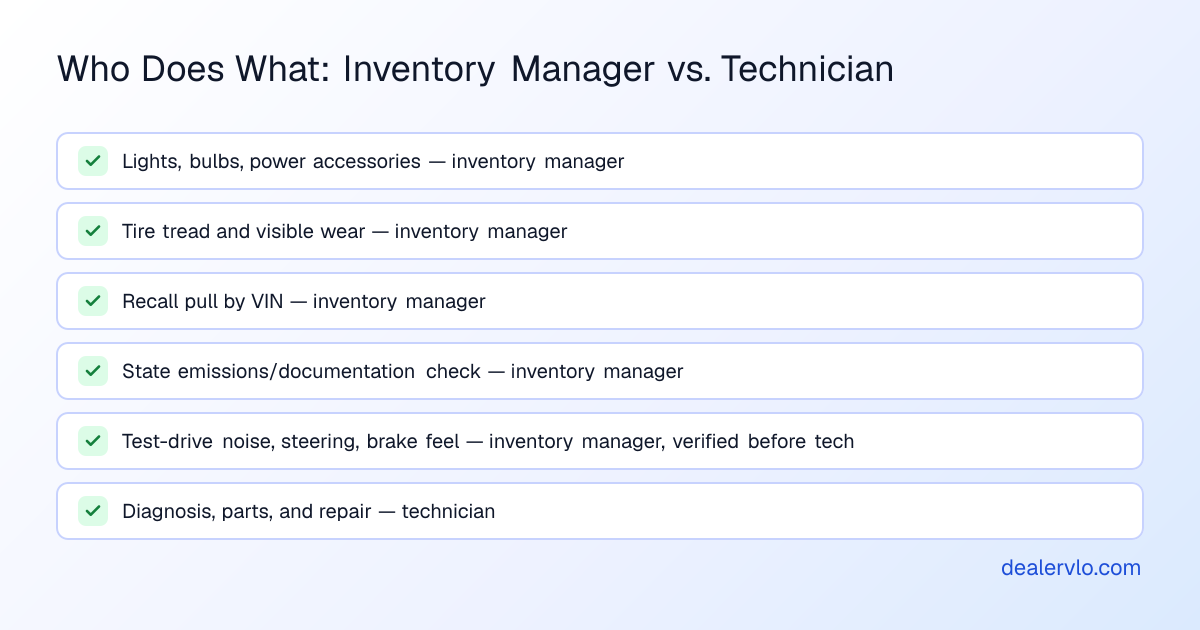
A dealer on an industry forum described trying to grow from 25–30 cars on the lot to 50–60 over about a year, and instead watched inventory shrink because sales outpaced what the recon department could push through — vehicles were taking 25+ days to get front-line ready through a chain of purchase, transport, inventory-manager pre-inspection, arbitration if needed, technician inspection, parts and repair, then detail and photos ([DealerRefresh forum thread](https://forum.dealerrefresh.com/threads/improving-our-inventory-processing-process.10596/)). The dealer's own question was sharp: how much of the inspection should the inventory manager do versus the technician? They were already testing a roughly 160-point checklist and found about 90% of it — lights, bulbs, power accessories — could be checked by a non-technician with nothing but a tire-depth gauge ([DealerRefresh forum thread](https://forum.dealerrefresh.com/threads/improving-our-inventory-processing-process.10596/)).
That's the right instinct, but it's framed as a workflow question. The real reason it matters is incentive design: whoever does the deep mechanical work on a flat-rate or commission plan is paid to finish, not to find more problems. A thorough inspection that turns up another two hours of work is, from the tech's seat, a pay cut disguised as diligence. If you run a lot of any size, you already know which cars come back from the shop suspiciously fast.
## Why a sloppy recon is a legal exposure, not just a CSI problem
The Used Car Rule — in effect since 1985 — requires dealers who sell more than five used vehicles in a 12-month period to post a Buyers Guide on every car before it's shown or test-driven, even if the car isn't fully recon'd yet ([FTC](https://www.ftc.gov/business-guidance/resources/dealers-guide-used-car-rule)). The Buyers Guide isn't a courtesy sticker — its information becomes part of the sales contract, and the Guide itself tells the buyer to ask to have the car inspected by an independent mechanic and to get all promises in writing ([FTC](https://www.ftc.gov/business-guidance/resources/dealers-guide-used-car-rule)).
That matters here because an inspection you advertise is a promise, and regulators have gone after dealers who couldn't back one up. In a New York City Department of Consumer and Worker Protection case, a dealer group marketed its cars as NIADA certified pre-owned, a program whose standard has the mechanic check off all 125 inspection items and sign a certification statement. Asked for the paperwork, the dealer didn't produce a single completed 125-point checklist and admitted its cars had only gone through the state safety inspection; one couple's Pathfinder turned out to have emissions and other faults that would have failed the 125-point list ([NYC DCWP filing](https://www.nyc.gov/assets/dca/downloads/pdf/partners/DCWP-Comment-Exhibit-B.pdf)). That's the extreme case — but it's the same gap in smaller form when the only record that a car was checked is the word of the person paid to finish it.
This isn't legal advice — confirm your state's current used-car disclosure and inspection rules with your state's DMV or consumer-protection authority before you set your own policy, since requirements vary by state.
## Build the checkpoint before the tech ever sees the car
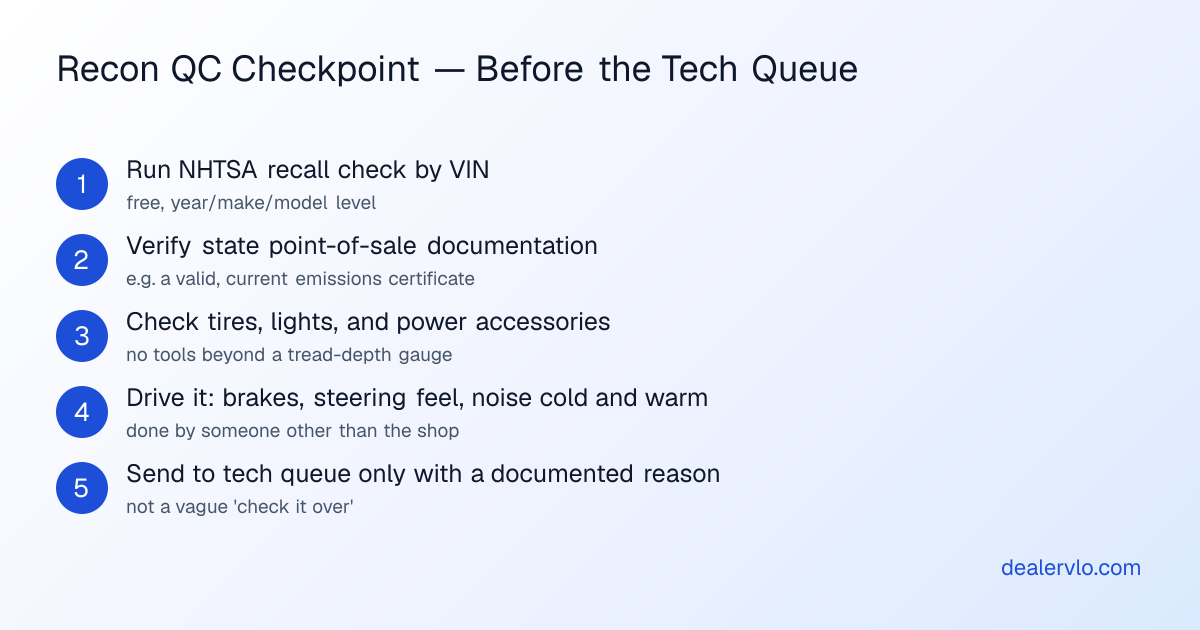
The fix the forum dealer was circling is correct: put a non-technician checkpoint in front of the queue, and make it objective enough that a tech's say-so can't override it. Three pieces belong in that checkpoint, none of which require a lift or a diagnostic scanner:
1. **A recall pull.** There's no federal requirement for independent dealers to check open recalls before selling a used car ([Consumer Reports](https://www.consumerreports.org/car-recalls-defects/how-to-get-recall-notices-for-a-used-car)), which is exactly why it's a good voluntary checkpoint — it costs nothing, takes a minute, and doesn't depend on anyone's judgment. DealerVLO's free VIN decoder tool lists NHTSA recall campaigns for the car's year, make and model as part of the decode, so an inventory manager can run it the moment a car is logged in; it's model-level, so still confirm the exact VIN at nhtsa.gov/recalls before you certify anything.
2. **A documentation check**, not a mechanical one. In California, for example, a used gas vehicle more than four model years old needs a valid smog certificate at the point of sale, and that certificate has to be dated within a set window of the sale or it expires and a fresh test is required — overseen by the state's Bureau of Automotive Repair alongside the DMV ([CA DMV](https://www.dmv.ca.gov/portal/vehicle-registration/smog-inspections/); [Lake Smog Test](https://www.lakesmogtest.com/clean-air-blog/do-you-need-a-smog-check-when-buying-or-selling-a-car-in-california)). That's a paper fact an inventory manager can verify without trusting the shop — a document either exists and is current, or it doesn't.
3. **A test-drive pass done by someone other than the tech who'll bill the repair.** You don't need a 160-point sheet for this — a short, consistent run covering tire wear, steering feel, brake pedal travel, unusual engine or transmission noise cold and warm, and dash warning lights catches most of what a rushed inspection misses. CPO inspection standards from major OEM programs build exactly this kind of road-test section into their checklists, covering items like uneven tire wear, steering and suspension condition, and engine/transmission noise at both cold and hot operating temperature — useful as a reference for what "thorough" looks like even though independent dealers aren't bound to any OEM's point count ([Nissan CPO checklist](https://www.nissanusa.com/content/dam/Nissan/us/shopping-tools/certified-pre-owned/167%20CPO%20Checklist.pdf); [Infiniti CPO checklist](https://www.cars.com/cldstatic/ads/cpo/inspection/infiniti-inspection.pdf)).
Run this checkpoint the way an informed buyer would check the car themselves — because that's effectively what it is. If a car fails something in this pass, it goes to the tech with a documented reason, not a vague "check it over."
For the deeper triage decision — what's actually worth fixing versus what to leave alone — pair this checkpoint with a [margin-preserving recon triage checklist](/blog/what-not-to-fix-recon) so the inventory manager isn't guessing at what crosses the line into "must fix before sale."
## Why flat-rate and commission pay produce the shortcuts
Flat-rate, or "book time," pay assigns every job a predetermined time value regardless of how long it actually takes — a two-hour brake job pays two hours even if a skilled tech finishes in sixty minutes ([Chris Collins Inc.](https://chriscollinsinc.com/sdr/hourly-vs-flat-rate-best-automotive-technician-pay-plans/)). That system rewards speed, which is good for throughput — but the same math cuts the other way on thoroughness: a tech focused on getting to the next billable job has little financial reason to spend extra unpaid time chasing a hard-to-diagnose noise or double-checking a borderline brake measurement ([AutoLeap](https://autoleap.com/blog/hourly-rate-vs-flat-rate-how-auto-mechanics-are-paid/)). An automotive pay-plan training firm and an accounting firm that works with repair shops both describe the same tradeoff — speed-based pay carries a built-in risk that work quality slips ([Elite Worldwide](https://eliteworldwide.com/info-center/choosing-the-right-automotive-technician-pay-plan/); [CSI Accounting](https://blog.csiaccounting.com/best-automotive-repair-tech-compensation-hourly-flat-rate-salary)).
None of this means flat-rate pay is wrong for your shop. It means a flat-rate or commission-paid tech's own signature on a checklist is not an independent quality signal — it's an interested party's report. That's the structural reason the checkpoint above has to sit in front of the tech, run by someone who isn't paid by the job.
## The pay-plan fix: make the flat rate contingent on passing QC
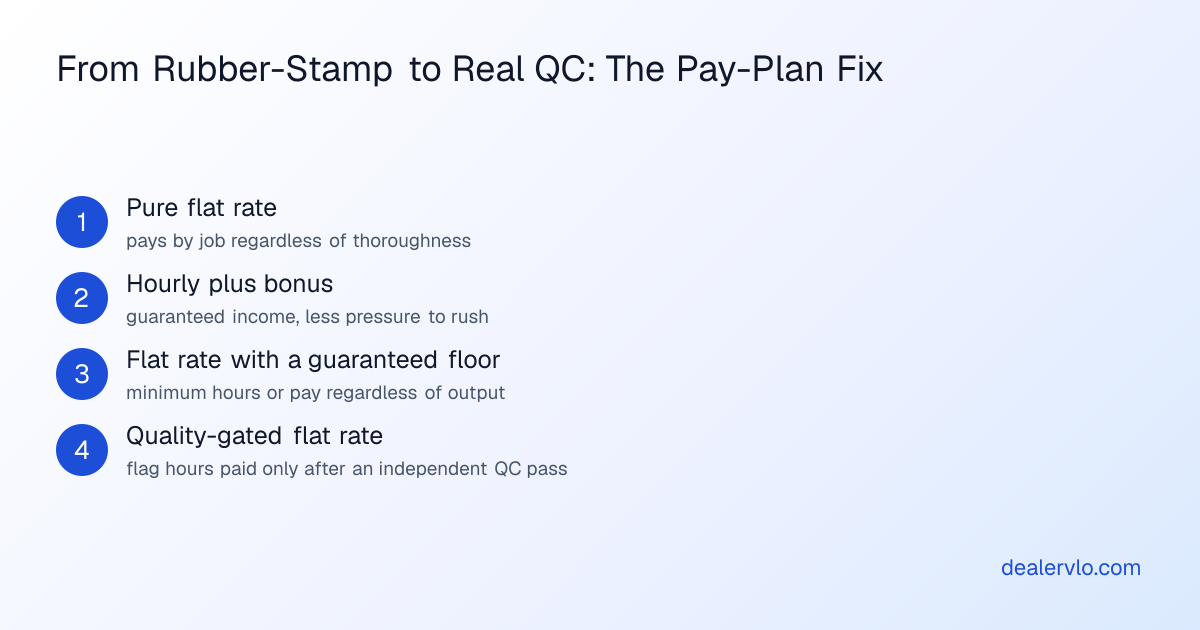
Industry pay-plan guidance points to a few hybrid structures that keep productivity incentives without making speed the only thing that gets rewarded:
- **Hourly plus bonus.** Techs get guaranteed income with upside for output, which trainers note tends to ease the stress that pushes toward shortcuts while still rewarding productivity ([Elite Worldwide](https://eliteworldwide.com/info-center/choosing-the-right-automotive-technician-pay-plan/)).
- **Flat rate with a guaranteed floor.** Techs are paid flat rate but guaranteed a minimum number of hours or weekly pay, which takes some of the pressure off rushing every single job ([Elite Worldwide](https://eliteworldwide.com/info-center/choosing-the-right-automotive-technician-pay-plan/)).
- **Quality-gated flat rate.** This is the most direct fix for the corner-cutting problem: pay flag hours out only once the work passes the independent check, and make clear up front how rework from bad workmanship is handled. Put it in writing in the pay plan, and check your state's wage rules before you build in any chargeback.
The common thread: pay follows a pass from someone other than the tech, not the tech's own sign-off. That's the piece a lot of small shops skip because it feels like bureaucracy — but it's the only structural fix that survives turnover, a busy week, or a tech who's otherwise excellent but under pressure to hit numbers.
Log every recon cost line — parts, sublet, the tech's labor — against each car's gross in DealerVLO: try it free for 14 days
## Where the paper trail lives
Once the checkpoint catches something, or clears a car, that needs to be recorded somewhere it can't quietly disappear — not a sticky note on the dash. On a small lot this often means tracking per-car recon costs as separate line items (vendor, description, cost) so you can see exactly what was done and what it cost before the car's price gets set. DealerVLO tracks reconditioning costs line by line against each car, rolling into that car's all-in cost and the gross shown on the sales report, so a tech bill, a sublet invoice, or a parts cost each show up as their own line rather than one vague "recon" number — but it's a cost ledger, not a pass/fail quality gate; the QC checkpoint itself still has to be a human decision made before the car goes to the shop.
Where the paper trail also matters: the Buyers Guide has to be posted before a customer can even inspect the car ([FTC](https://www.ftc.gov/business-guidance/resources/dealers-guide-used-car-rule)), and DealerVLO prints the current FTC Buyers Guide from each vehicle's page with no deal needed, so it can hang on the car the moment it's for sale — before recon is even finished, which is when the Rule actually requires it.
If you want a second opinion built into your sales process instead of just your shop, see how to [handle a customer's request for their own pre-purchase inspection](/blog/pre-purchase-inspection-dealer-policy) — a buyer asking for a PPI is, in effect, running the same independent check you should already be running internally. And if recon keeps backing up regardless of who's checking what, the root causes are usually structural — covered in more depth in [why cars get stuck in the shop and how to fix it](/blog/reconditioning-bottlenecks-diagnosis-fixes).
## Deciding what level of inspection is worth it
Not every car needs the same depth of check. A $6,000 trade-in and a $28,000 low-mile unit don't carry the same risk if something gets missed, and that's a legitimate reason to scale the checkpoint rather than run every car through the same 160 items. Before you sink extra labor into a deeper look, it helps to work out whether the additional inspection or repair time actually pays for itself — the [recon ROI calculator](/tools/recon-roi-calculator) is built for exactly that one-repair decision: cost, days in the shop, and the retail value the work adds. For the budgeting side of recon more broadly, DealerVLO's guide to [reconditioning cost and ROI](/blog/used-car-reconditioning-cost-budget) walks through how to set that budget per car before you ever open a hood.
If you run your own shop instead of subletting, the incentive-design question above applies directly to your techs' pay plan. If you sublet recon work out, the equivalent fix is holding the vendor to a written standard — see [building a vendor scorecard and SLAs](/blog/sublet-recon-vendor-scorecard-slas) for how to do that without trusting a shop's own invoice as proof of quality. And if you're still deciding which model fits your lot at all, [in-house mechanic vs. sublet recon](/blog/in-house-mechanic-vs-sublet-recon-used-car-lot) lays out the tradeoff.
## Frequently asked questions
### What should a non-technician recon QC checkpoint actually cover?
A non-technician checkpoint should cover what can be verified without tools beyond a tire-depth gauge and a test drive: tire wear, lights and power accessories, dash warning lights, a basic noise/feel check on the test drive, an NHTSA recall pull by VIN, and any state-required point-of-sale documentation like an emissions certificate. The deeper mechanical diagnosis and repair still belongs to the technician — the checkpoint's job is to catch what an informed buyer would notice, independent of what the tech later reports.
### Why do commission or flat-rate techs cut corners on inspections?
Flat-rate and commission pay reward finishing jobs quickly, since the tech is paid a fixed time value for a task regardless of how long it actually takes — so spending extra unpaid time on a thorough inspection or a hard-to-diagnose issue works against their own pay. Industry pay-plan sources describe this as a known tradeoff of speed-based pay, not a character flaw in any one technician.
### Is a signed technician checklist enough to prove a car was properly inspected?
No — a checklist signed by the same person who did the work is a self-report, not independent verification. A New York City consumer-protection enforcement case documented a dealer where a standard inspection checklist was filled in checking off every item, including one the filing alleges had actually failed, with no completed checklist available when regulators asked for one. That's why the checkpoint described in this article has to be run by someone other than the technician.
### Does federal law require a pre-purchase inspection or recall check before selling a used car?
No. The FTC's Used Car Rule requires a Buyers Guide to be posted before a car is shown or test-driven, and that Guide tells the buyer to ask about getting their own pre-purchase inspection — but it doesn't require the dealer to perform one. Checking for open recalls is also voluntary for independent dealers under federal law; it's a free, useful checkpoint precisely because nothing forces you to do it.
### What pay structure stops techs from skipping inspection steps?
Hybrid structures work better than pure flat rate for this: hourly-plus-bonus pay, flat rate with a guaranteed minimum, or — most directly — a quality-gated flat rate where hours are only paid once an independent quality check passes. The common element across all three is that pay doesn't rest solely on the tech's own account of the work.
### How does DealerVLO fit into a recon QC process?
DealerVLO doesn't run the inspection or grade a technician's work — that's a management decision only a person can make. It tracks each car's recon costs line by line against its all-in cost and gross, prints the FTC Buyers Guide from the car's page before recon is even finished, and its free VIN decoder pulls NHTSA recall listings by year/make/model so your front-of-queue checkpoint has a record to check against.
## Bottom line
The dealer in that forum thread had the right instinct: push basic verification to a non-technician, before the car reaches the shop. What makes it stick isn't the checklist — it's refusing to let the person being paid to finish the job also be the one who certifies it's done right. Build a short, objective checkpoint in front of the queue, tie at least part of your tech's pay to passing it rather than just completing it, and keep the paper trail — recall pulls, documentation checks, recon cost lines — somewhere it can't quietly vanish.
Run your next recon through DealerVLO: start your free 14-day trial
---
## FAQ
### What should a non-technician recon QC checkpoint actually cover?
A non-technician checkpoint should cover what can be verified without tools beyond a tire-depth gauge and a test drive: tire wear, lights and power accessories, dash warning lights, a basic noise/feel check on the test drive, an NHTSA recall pull by VIN, and any state-required point-of-sale documentation like an emissions certificate. The deeper mechanical diagnosis and repair still belongs to the technician — the checkpoint's job is to catch what an informed buyer would notice, independent of what the tech later reports.
### Why do commission or flat-rate techs cut corners on inspections?
Flat-rate and commission pay reward finishing jobs quickly, since the tech is paid a fixed time value for a task regardless of how long it actually takes — so spending extra unpaid time on a thorough inspection or a hard-to-diagnose issue works against their own pay. Industry pay-plan sources describe this as a known tradeoff of speed-based pay, not a character flaw in any one technician.
### Is a signed technician checklist enough to prove a car was properly inspected?
No — a checklist signed by the same person who did the work is a self-report, not independent verification. And an inspection with no completed checklist at all is just a claim: in a New York City enforcement case, a dealer advertising NIADA 125-point certified inspections couldn't produce a single completed checklist when the city asked for them. That's why the checkpoint described in this article has to be run by someone other than the technician.
### Does federal law require a pre-purchase inspection or recall check before selling a used car?
No. The FTC's Used Car Rule requires a Buyers Guide to be posted before a car is shown or test-driven, and that Guide tells the buyer to ask about getting their own pre-purchase inspection — but it doesn't require the dealer to perform one. Checking for open recalls is also voluntary for independent dealers under federal law; it's a free, useful checkpoint precisely because nothing forces you to do it.
### What pay structure stops techs from skipping inspection steps?
Hybrid structures work better than pure flat rate for this: hourly-plus-bonus pay, flat rate with a guaranteed minimum, or — most directly — a quality-gated flat rate where hours are only paid once an independent quality check passes. The common element across all three is that pay doesn't rest solely on the tech's own account of the work.
### How does DealerVLO fit into a recon QC process?
DealerVLO doesn't run the inspection or grade a technician's work — that's a management decision only a person can make. It tracks each car's recon costs line by line against its all-in cost and gross, prints the FTC Buyers Guide from the car's page before recon is even finished, and its free VIN decoder pulls NHTSA recall listings by year/make/model so your front-of-queue checkpoint has a record to check against.