# Scaling to a Second Rooftop: How Multi-Location Dealers Structure Inventory, Leads and Accounting
> How multi-location used car dealers split or combine inventory, route leads, and keep accounting clean across two rooftops.
- Source: https://www.dealervlo.com/blog/multi-location-dealer-inventory-structure
- Published: 2026-11-01
- Updated: 2026-11-01
- Author: Chris Abouraad
- Tags: multi-location dealers, dealer operations, inventory management, dealer accounting, DMS
---
Opening a second lot feels like the natural next step once the first one is running clean — you've got the buying instincts down, the lane relationships, maybe a waiting list of customers you had to turn away because you didn't have the right car. But multi-location used car dealer inventory management isn't just "do the same thing twice." The moment you add a second address, you've got licensing questions to answer, a decision about whether your two lots share one stock list or run separate ones, leads that need to land on the right desk, and a set of books that can get messy fast if you don't tag every transaction by location from day one.
This isn't a legal guide — it's an operator's framework for the decisions that actually trip up dealers making the 1-to-2-lot jump. Where a rule varies by state (and almost everything here does), we'll tell you what to go confirm rather than guess a number that might be wrong for your state.
Track every car's stock number, VIN and days on the lot in DealerVLO: start your 14-day free trial
## This isn't legal advice
Licensing rules, bond requirements, and separation requirements for a second location vary a lot by state and change over time. Nothing in this article is a substitute for calling your state's DMV, BMV, or Secretary of State dealer licensing division before you sign a lease on a second lot. Confirm the current rule for your state directly with that agency.
## Step one: is rooftop #2 even a "separate" dealer, legally?
This is the question that determines almost everything downstream, and the answer is genuinely different state to state — there is no universal rule here.
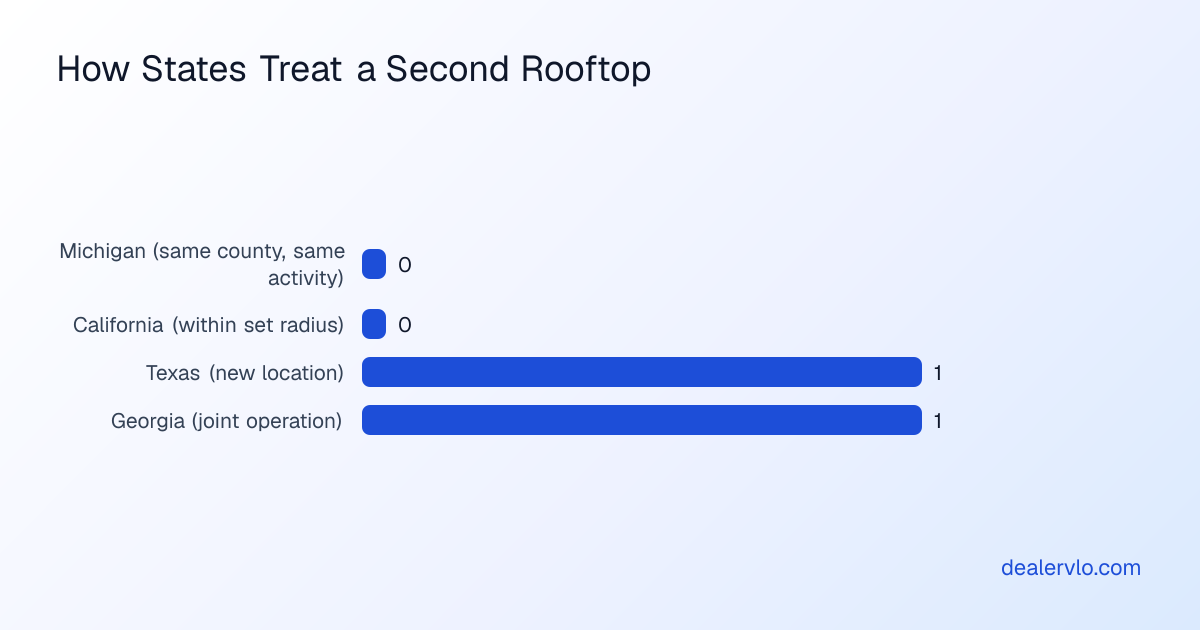
Some states treat a nearby second location as an extension of the first. Michigan, for example, allows additional locations in the same county to be licensed as no-additional-fee "supplemental" locations if the same activities are conducted there, though a separate dealer license is required if you sell at retail in a different county (Michigan Department of State, Dealer Manual Chapter 1). California allows additional display areas within a set radius of your main location without a separate branch license — but beyond that radius, you need a separate branch license (California DMV).
Other states require much more separation. Georgia requires jointly-operated used motor vehicle dealer locations to each have their own separate office, separate outside entrance, separate inventory, records and files, plus their own bond and power of attorney (Georgia Secretary of State). Texas requires a separate GDN license and bond for an additional location when a dealer acquires one (Texas DMV Dealer Manual). Missouri licenses each location and operating type separately (Missouri Department of Revenue, via SuretyBonds.com).
| State approach | What it generally means for lot #2 |
| --- | --- |
| Michigan | Same-county, same-activity locations can be "supplemental" — no separate license fee |
| California | Nearby display areas (within a set radius) don't need a separate branch license |
| Georgia | Joint operations must be fully separated — own office, entrance, inventory, bond |
| Texas | New location generally needs its own GDN license and bond |
| Missouri | Each location and operating type is licensed separately |
The table above is a starting point, not a final answer — call your own state's dealer licensing office before you commit to a lease or a floor plan line that assumes a particular structure. The practical effect of this answer ripples into every section below: if your state forces full separation, you're closer to running two independent small businesses that happen to share an owner than one dealership with two doors.
## Combine inventory or run two separate stock lists?
Assuming your state allows it, this is where most of the real operator judgment lives — and the independent-dealer community is genuinely split on it.
The case for one combined inventory feed: a customer who walks into lot A but wants a car sitting on lot B doesn't have to be turned away, and your buyer can shop both lots' needs when they're at auction instead of guessing which store needs what. The case for keeping them separate: each lot develops its own identity, its own price point, its own staff accountability for what's on the ground — and if a car sits on the "wrong" lot's website, shoppers searching near lot B never see a car that's actually only a short drive from them.
Where your state legally mandates separation — Georgia being the clearest example, with its explicit separate-inventory requirement for commonly-owned dealers — this decision is made for you. Where it isn't mandated, treat it as a business choice, not a compliance one, and pick based on how your buyer actually works: if you've got one person buying for both stores, a combined view saves real time; if each location has its own buyer making independent calls, separate lists with clear ownership probably serve you better.
Either way, the DMS underneath you should give you the option rather than forcing one model. Every car in DealerVLO carries its own stock number, VIN, photos, and days in inventory, and the inventory list searches by stock number, VIN, make or model so whoever's looking for a specific unit can find it fast. A clean stock-number convention — one prefix or range per location — is the simplest way to keep two lots' stock distinguishable inside a single inventory list, especially if your state doesn't force you onto two separate systems.
Before you decide, it's worth typing each lot's numbers — average cars in stock and cars sold per month — into the free [inventory turn calculator](/tools/inventory-turn-calculator), one lot at a time, to compare the annual turn rate and days' supply each location is actually producing. If one lot's turn is noticeably slower than the other's, that's worth knowing before you combine a buying decision that was really only calibrated for the faster-turning store.
## Routing leads to the right desk
There's no regulation governing this one — it's pure operations, and it's also where a lot of two-lot dealers get burned in the first few months. A shared website or a shared lead form that doesn't clearly tag which lot a shopper is asking about turns into leads that sit unanswered because each location's team assumes the other one has it.
The fix isn't complicated, but it has to be deliberate: every lead needs to carry which car it came from, and someone needs to own responding to it — not a general inbox both managers glance at occasionally.
In DealerVLO, every website lead records its source (which form it came through) and, when the shopper asked about a specific car, records which vehicle that was. DealerVLO has no location field on a lead, so it won't tell you which lot an inquiry belongs to — but if each lot's cars use their own stock-number prefix, the car the lead is attached to shows you which lot it came from. Leads land with a status (New, Contacted, Qualified, Converted, Lost) and the newest-first list makes it obvious what's been sitting. DealerVLO doesn't route a lead to a specific salesperson or location, or set follow-up reminders automatically, so the ownership piece — deciding who answers a given lead, and by when — is still a process you build on top of it, not something software hands you. A [dead-leads follow-up cadence](/blog/dead-leads-follow-up-used-car-dealers) is worth building regardless of how many locations you run, because the week-one response gap is the same failure mode whether you've got one lot or three.
Give every lead a status and a source so nothing sits unanswered: try DealerVLO free for 14 days
## Accounting: separate by location, not just by gut feel
This is the section where sloppiness actually costs money, not just time. Multi-location DMS platforms in the broader market build around a "company number" concept — Dealertrack's own product pages describe intercompany accounting for dealers running multiple locations, ZiiDMS markets a compliant accounting framework that lets entries post to multiple stores in one transaction while still tracking each store separately, and Multi-DMS frames its model around fully separate sales, stock, accounts, and analytics per company under one dealer account (Dealertrack, ZiiDMS, Multi-DMS product pages). The pattern across all of them is the same: a dealer group wants one login, but it wants every dollar tagged to the rooftop that earned or spent it.
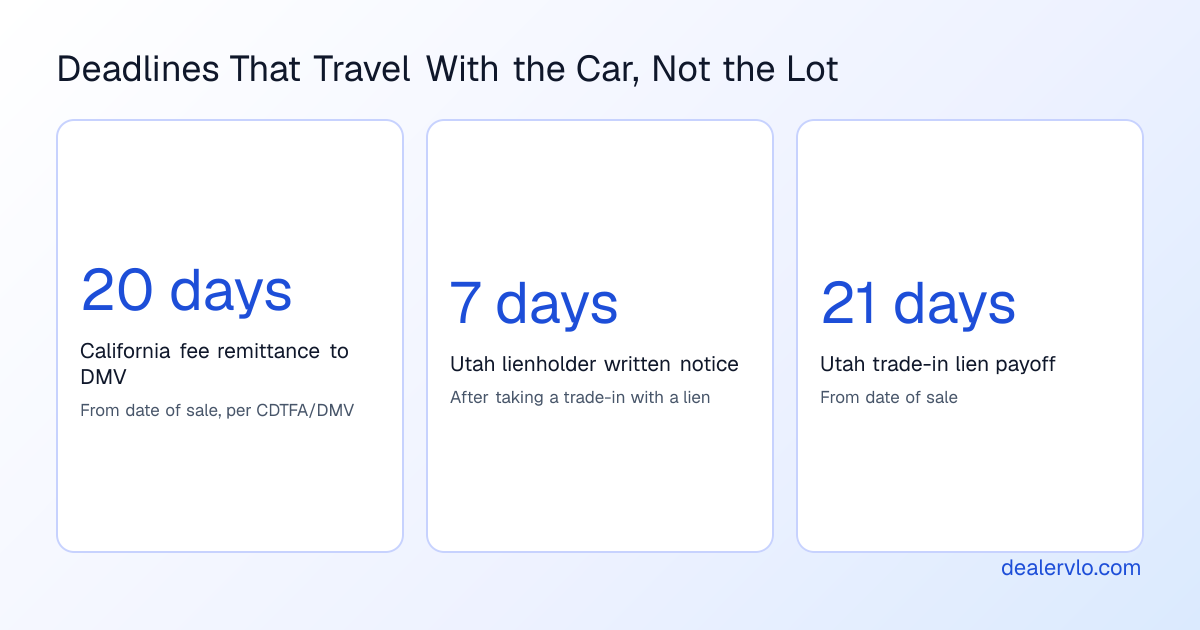
The reason this matters beyond bookkeeping cleanliness is deadline risk. California, for instance, requires registration and use-tax fees tied to a vehicle sale to be remitted to the DMV within a fixed window — 20 days from the date of sale, per the state's own Vehicle Industry Registration Procedures Manual and its Audit Manual (California DMV; California CDTFA). If your two lots' paperwork gets commingled in one undifferentiated pile instead of tracked by location and sale date, a missed deadline at one store is much harder to catch before it becomes a problem. The lesson generalizes well past California: whatever your state's filing windows are, a clean, location-tagged transaction trail is what lets you catch a miss before it compounds.
DealerVLO's profit-and-loss report totals revenue, cost of cars sold, gross profit, and overhead by category for a period you choose (this month, last 30 days, year to date, or all time), and the sales report breaks out front- and back-end gross per deal with a salesperson leaderboard, exportable to CSV any time at no charge. If you're running two lots as a single dealer entity under one account, a stock-number convention (say, a letter prefix per lot) or a consistent note on each deal lets you pull that CSV and sort it by location yourself until you need something more formal. If your state's rules push you toward fully separate dealer entities — as in Georgia, where the office, bond, and records are already walled off by law — that separation should extend to your bookkeeping too, since the two stores are, for licensing purposes, two different businesses.
## Trade-ins don't stay put — payoff tracking has to follow the car
Multi-location dealers move cars between lots constantly: you take a trade at lot A, and it ends up wholesaled or transferred to lot B's stock. The payoff clock on that trade-in doesn't pause when the car changes addresses — the location that took the trade is the one on the hook for notifying the lienholder and remitting payoff, regardless of where the car physically sits afterward.
Utah's DMV spells this out clearly: a dealer who takes a trade-in with an outstanding loan balance must notify the lienholder in writing within 7 days and pay off the lien within 21 calendar days of the sale date (Utah DMV, Motor Vehicle Enforcement Division). California is commonly described by consumer and dealer law firms as having a similar 21-calendar-day payoff standard, though that figure is attributed to California law by multiple named law firms rather than published directly on a DMV payoff page in this research — treat it as the consistent professional understanding of the rule, and confirm your own state's exact window and any required written notice with your state's motor vehicle authority before you set internal deadlines.
The multi-rooftop implication: whichever location took the trade owns the payoff clock, full stop — even if the car itself gets reassigned to the other lot's inventory for resale. That argues for tracking payoff details per vehicle inside your DMS rather than relying on memory or a sticky note that doesn't travel with the car.
In DealerVLO, a trade-in on a deal records the allowance, the payoff owed, the lienholder, the loan account number, and the date the quoted payoff is good through — all attached to that specific deal and vehicle. If the deal completes and that trade has a full 17-character VIN, it's added to inventory automatically with a "T-" stock number, using the trade allowance as its acquisition cost. DealerVLO doesn't send payoff requests to lienholders, track whether the check went out, or carry the lienholder and payoff details forward onto the inventory record once the trade becomes a car for sale — remitting the payoff and closing that loop is still on whoever at the originating location took the trade.
Keep every trade-in's payoff details attached to the deal that created it: start your 14-day free trial
## Floor plan across two lots means the audit covers two addresses
If you're floor planning inventory and both lots draw on the same line of credit, your lender's periodic audit — sometimes called a floor check or lot check — now has to reconcile units across two physical locations instead of one. Floor plan is a revolving line where interest and fees accrue on a unit's advance from the day it's financed, and curtailments (mandatory principal paydowns) come due on a schedule set by your agreement (Lefkoff Law). National floor plan providers for independent dealers include names like NextGear Capital, AFC, Floorplan Xpress, and Westlake (Lefkoff Law) — but specific curtailment percentages, audit-notice windows, and term lengths vary by lender and by your own agreement, so get those numbers from your floor plan contract, not from a generic article.
What doesn't vary: an unannounced or short-notice audit that can't quickly confirm which units are on which lot, and which units have already sold, is a bad day for everyone involved. That's another argument for disciplined, location-tagged inventory records regardless of which DMS you run. DealerVLO tracks days in inventory on every car and flags cars at 60+ days on the lot, which at least gives you a clean per-car list to hand a lender during a floor check — but floor plan itself is recorded as overhead on your P&L rather than tracked per-unit, so curtailment schedules and audit prep still live in your floor plan provider's own portal and your own spreadsheet discipline.
## Choosing (or re-choosing) your DMS for two rooftops
If you're making the jump from one lot to two, this is a natural point to re-evaluate whether your current system actually supports it. The question isn't just "does it have a multi-location toggle" — it's whether the DMS you're considering lets you keep clean records per store while still giving you a system you can actually run day to day.
A few questions worth asking any vendor, including us: Can your sales and inventory data be exported cleanly on your own schedule? Does the system assume one bond, one tax ID, one set of books — or can it flex if your state forces separation? What happens to your data if you need to split records into two accounts later because your state's licensing rules require it?
DealerVLO runs at a flat $29 a month with unlimited users, and every car, deal, and customer record exports to CSV any time at no charge — so if your state later requires a second license and a fully separate set of books, your existing data is at least in a portable format rather than locked behind a per-seat contract. For a broader comparison of what different DMS platforms charge and support at scale, the [best DMS for independent lots guide](/blog/best-dms-independent-used-car-dealers) is worth reading before you commit either lot to a platform, and the [how to choose dealer management software](/blog/how-to-choose-dealer-management-software) guide walks through the broader decision framework if you're evaluating options from scratch.
See what a flat $29/month account looks like for one rooftop's deals: try DealerVLO free for 14 days
## What to lock down before you sign the second lease
A few things are worth nailing down before, not after, you open rooftop #2:
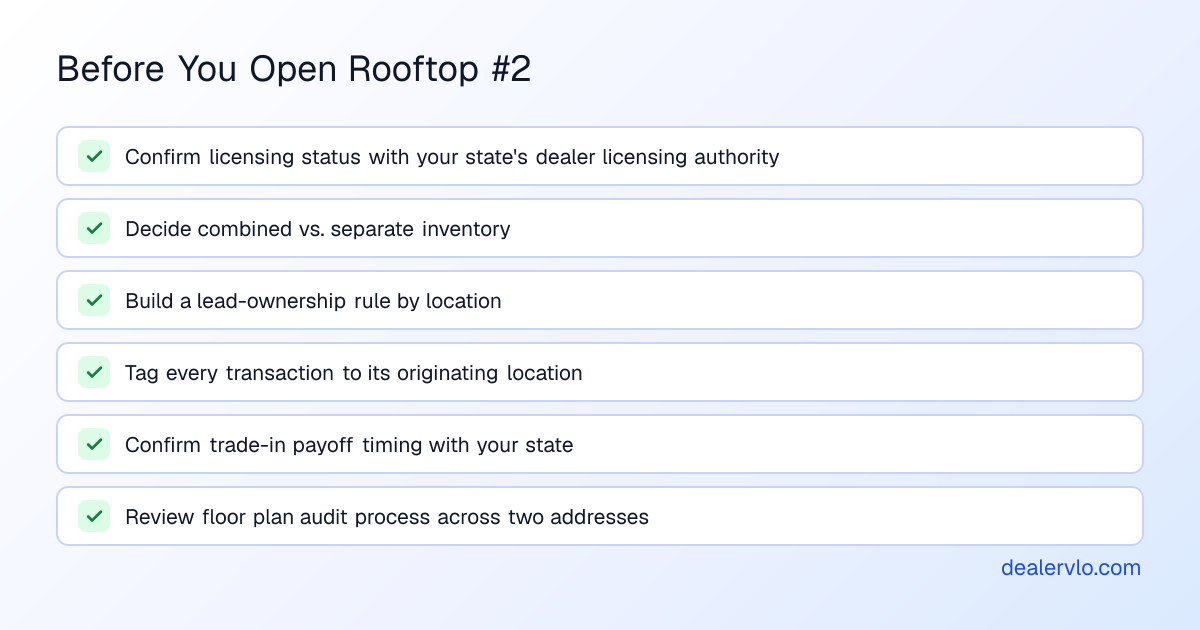
- Call your state's dealer licensing authority and get a written answer on whether lot #2 needs its own license and bond, or qualifies as supplemental.
- Decide, based on that answer and your own buying structure, whether inventory is combined or kept separate per lot.
- Build a lead-ownership rule: which location answers which lead, and by when.
- Set up your books (or your DMS stock-number convention) so every transaction is tagged to the location that generated it, before your first deal closes at lot #2.
- Confirm your trade-in payoff deadline and notice requirement with your state, and make sure that tracking travels with the vehicle even if it moves lots.
- Talk to your floor plan provider about how audits work across two addresses before you draw on the line for the second location.
If title and registration paperwork is part of what's slowing you down as you scale, it's worth checking how your state's [paperwork is handled](/dealer-paperwork-software) — a system that auto-fills state forms from the deal saves meaningfully more time once you're running two lots' worth of deals through it rather than one.
## Frequently asked questions
### Do I need a separate dealer license for a second lot?
It depends entirely on your state. Some states, like Michigan, allow a same-county, same-activity second location to be licensed as a no-extra-fee supplemental location, while others, like Texas and Georgia, generally require a fully separate license and bond for an additional location. Call your state's DMV, BMV, or Secretary of State dealer licensing office before you lease or open a second address.
### Should I combine inventory across both lots or keep them separate?
Where your state doesn't mandate separation, it's a business judgment call: combined inventory lets one buyer shop for both stores and lets customers cross-shop both lots' stock, while separate inventory keeps each location's identity and accountability distinct. Where your state requires separation — Georgia is a clear example — the decision is made for you by the licensing rule itself.
### How do I make sure leads go to the right location?
Make sure your lead data ties back to which vehicle a shopper inquired about, then assign clear ownership so one person is responsible for responding — not a shared inbox both managers assume the other is checking. A documented follow-up cadence matters here regardless of how many lots you run.
### How should accounting be separated across multiple locations?
Most multi-rooftop DMS platforms use a "company number" or location-tagging model so every transaction rolls up to one dealer group while still being traceable to the store that generated it. This matters beyond bookkeeping neatness — some states have fixed deadlines for remitting registration and tax fees tied to a sale, and commingled records make a missed deadline at one store much harder to catch.
### Who's responsible for a trade-in's payoff if the car moves to the other lot?
The location that took the trade-in from the customer is the one responsible for notifying the lienholder and remitting payoff, even if the vehicle is later transferred to the other lot's stock for resale. Some states set specific written-notice and payoff windows — Utah, for example, requires notice within a set number of days and payoff within 21 calendar days of sale — so confirm your own state's exact requirement and track it per vehicle rather than per lot.
### Can one DMS run two rooftops, or do I need two separate systems?
Many DMS platforms market centralized data and reporting across multiple locations under one login as a core feature for dealer groups. Whether that works for you depends on your state's licensing structure — if your state requires fully separate licenses, bonds, and records for each location, you'll likely need separate accounts regardless of what any particular system technically supports.
## Bottom line
Scaling from one lot to two isn't a software problem first — it's a licensing-and-structure problem that software then has to support cleanly. Get a straight answer from your state on what rooftop #2 actually requires, make a deliberate call on combined versus separate inventory, build real lead ownership instead of a shared inbox, and tag every dollar and every trade-in to the location that generated it from day one. Do that groundwork and the system underneath you — whichever one you pick — has a much easier job. DealerVLO handles the deal math, paperwork, inventory, and leads for a single dealer at a flat $29 a month, and it's worth testing against your actual lot's workflow before you decide how a second rooftop will fit into it.
Run your next deal at your lot through DealerVLO: start your free 14-day trial
---
## FAQ
### Do I need a separate dealer license for a second lot?
It depends entirely on your state. Some states, like Michigan, allow a same-county, same-activity second location to be licensed as a no-extra-fee supplemental location, while others, like Texas and Georgia, generally require a fully separate license and bond for an additional location. Call your state's DMV, BMV, or Secretary of State dealer licensing office before you lease or open a second address.
### Should I combine inventory across both lots or keep them separate?
Where your state doesn't mandate separation, it's a business judgment call: combined inventory lets one buyer shop for both stores and lets customers cross-shop both lots' stock, while separate inventory keeps each location's identity and accountability distinct. Where your state requires separation — Georgia is a clear example — the decision is made for you by the licensing rule itself.
### How do I make sure leads go to the right location?
Make sure your lead data ties back to which vehicle a shopper inquired about, then assign clear ownership so one person is responsible for responding — not a shared inbox both managers assume the other is checking. A documented follow-up cadence matters here regardless of how many lots you run.
### How should accounting be separated across multiple locations?
Most multi-rooftop DMS platforms use a 'company number' or location-tagging model so every transaction rolls up to one dealer group while still being traceable to the store that generated it. This matters beyond bookkeeping neatness — some states have fixed deadlines for remitting registration and tax fees tied to a sale, and commingled records make a missed deadline at one store much harder to catch.
### Who's responsible for a trade-in's payoff if the car moves to the other lot?
The location that took the trade-in from the customer is the one responsible for notifying the lienholder and remitting payoff, even if the vehicle is later transferred to the other lot's stock for resale. Some states set specific written-notice and payoff windows — Utah, for example, requires notice within a set number of days and payoff within 21 calendar days of sale — so confirm your own state's exact requirement and track it per vehicle rather than per lot.
### Can one DMS run two rooftops, or do I need two separate systems?
Many DMS platforms market centralized data and reporting across multiple locations under one login as a core feature for dealer groups. Whether that works for you depends on your state's licensing structure — if your state requires fully separate licenses, bonds, and records for each location, you'll likely need separate accounts regardless of what any particular system technically supports.