# How Listing-Site Pricing Tiers Work as Your Inventory Grows (and How to Avoid the Jump)
> How Cars.com, CarGurus and AutoTrader tie pricing to inventory count, what's documented vs. forum lore, and how to keep a feed under a tier.
- Source: https://www.dealervlo.com/blog/listing-site-pricing-tier-thresholds-inventory-growth
- Published: 2026-10-25
- Updated: 2026-10-25
- Author: Chris Abouraad
- Tags: listing sites, inventory, Cars.com, CarGurus, AutoTrader, pricing
---
If you've grown your lot from 40 cars to 80 and your Cars.com or CarGurus bill jumped right along with it, you're not imagining a pattern — you just can't see the rulebook. None of the three big listing sites publish a vehicle-count pricing table. But the dealer accounts that do surface online follow a familiar shape: the lot grows, and the rep calls with a "performance-based" increase.
This post walks through what's actually documented about how that works, what's just dealer forum lore, and the practical workaround dealers have floated — choosing which cars go out in the feed so the count stays under the line.
Track every car's days on lot in DealerVLO before your next renewal call: start your 14-day free trial
## The mechanic, as one dealer actually experienced it
The clearest documented case comes from a dealer who posted on the [DealerRefresh forum in July 2026](https://forum.dealerrefresh.com/threads/cars-com-wants-to-increase-prices.13482/) about a Cars.com renewal. The dealer had been on Cars.com for a year at $1,500 a month. Because the store now had more than 75 cars, the account rep came back with a new number: $2,044 a month, or $1,799 to stay on the same package. The rep's stated justification, according to the dealer's account, was a cost-per-lead comparison — claiming the store's cost per lead was $5 against $40 for "other dealerships."
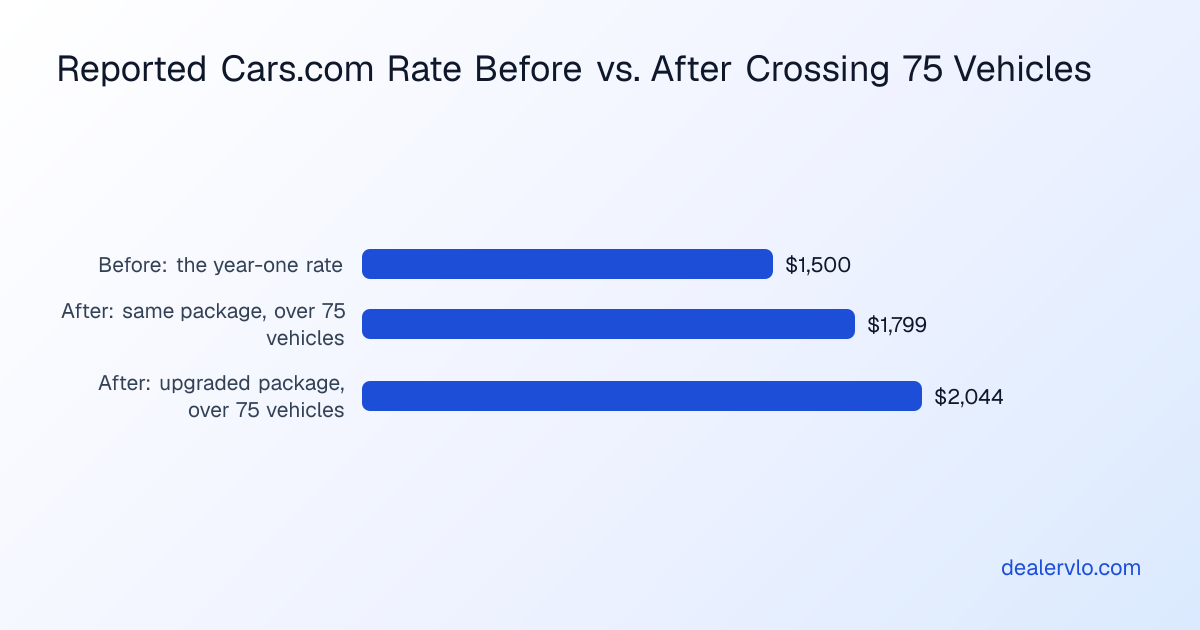
Treat the "75 vehicles" number as what it is: one dealer's reported experience, not a published rate card. Cars.com doesn't disclose an exact vehicle-count cutoff anywhere public. The useful takeaway is the pattern — inventory grows, a pricing conversation follows — which is worth planning around even without a universal number to cite.
What makes this more than an anecdote is that the parent company's own marketing page backs up the general mechanic. Cars Commerce's plan comparison says its Base, Premium and Premium+ plans come with "25 used listings included, then priced by tier" ([carscommerce.inc/marketplace](https://www.carscommerce.inc/marketplace/)). That's the vendor's own documentation confirming that used-vehicle listings are tiered by volume — it just doesn't say what the tiers cost or where they break. So the core idea — more inventory can mean a different price bracket — is confirmed. The specific dollar amounts and the "75-car" trigger belong to one dealer's package, not to Cars.com as a whole.
A commenter in the same thread summed up their read of it: "Cars has adopted the CarGurus plan. Flex pricing based on your performance." That's the part worth internalizing — it may not be purely a headcount cliff. In this dealer's case the rep cited both the car count and the store's cost per lead, so expect the number you're quoted to lean on your performance data (leads, cost per lead, vehicle detail page views), not just how many cars you list.
## What this looks like at CarGurus and AutoTrader
CarGurus doesn't publish per-vehicle or threshold pricing either, but the forum record on repeated, large increases is long. In an [October 2020 thread](https://forum.dealerrefresh.com/threads/cargurus-might-be-coming-for-you-soon-price-increases.7224/), one dealer reported signing with CarGurus in January 2017, then getting hit with a 19.5% increase in 2018, a 16% increase in 2019, and that week being notified of a planned 62% increase. Another dealer replied that they'd "had 100% increases pitched in the past." A [February 2021 post](https://forum.dealerrefresh.com/tags/cargurus/) describes an extreme case — a dealer calling a 602% proposed increase "the biggest one that Gurus has tried to slam a store," with a 525% increase offered as the alternative.
The 2020 thread also ties that round of increases to inventory swings. The original poster wrote that CarGurus was justifying the increase on "the used vehicle traffic jump most dealers saw during June and July," at a time when that store's used inventory had dropped to half of what it was in March. The same dealer described a clause in their contract that forbids dealers from openly disclosing the rates they're charged — which, if your contract has one, is a big part of why these increases feel like they come out of nowhere. There's no public number to check your quote against.
AutoTrader (the US Cox Automotive site, not the UK company of the same name) is the most opaque of the three. We couldn't find published dealer pricing for it, or any reliable source confirming a specific vehicle-count pricing threshold for the US product. Some online "pricing guide" posts describe a stock-level tier model, but that structure belongs to UK Auto Trader — a different company — and shouldn't be assumed to apply to US AutoTrader quotes. If your AutoTrader rep mentions inventory size as a pricing factor, ask them directly what the threshold is rather than relying on a guide that's describing a different market.
| Site | Published vehicle-count pricing? | What's actually documented |
| --- | --- | --- |
| Cars.com | No public threshold number | Vendor's own page confirms used listings are "priced by tier" past 25 included; one dealer reported a 75-car trigger and a jump from $1,500 to $1,799–$2,044/mo (2026) |
| CarGurus | No public threshold or rate card | Forum-reported large, repeated increases (19.5%, 16%, 62% for one dealer in 2018–2020; 100% to 602% pitches reported by others); one dealer reports a contract clause restricting rate disclosure |
| AutoTrader (US) | None confirmed | Opaque, quote-based; no verified count-based structure for the US product (don't confuse with UK Auto Trader's stock-tier model) |
Because none of this is published, the only reliable move before any renewal is to ask your rep point-blank what changed in your account and demand the underlying numbers — not just accept "performance-based" as an answer.
## Ask for the data before you accept the increase
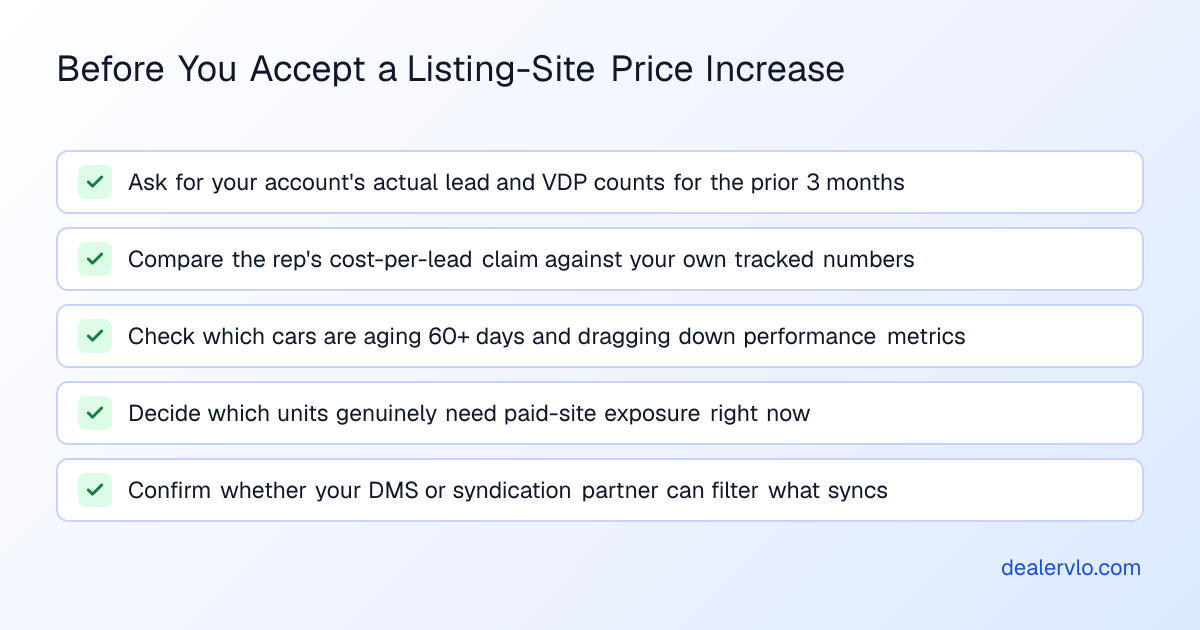
One participant in the Cars.com thread pushed back with exactly the right question: what was the store's total Cars.com VDP count in April, May and June, at the $1,500 rate? That's the move. If a rep is going to justify a price jump with performance metrics, make them show the actual lead count, VDP count, and cost-per-lead math for your account over the prior few months — not an industry average pulled from a sales deck. A rep's claim that "other dealerships pay $40 a lead" isn't a number you can verify, and it shouldn't be the basis for a four-figure monthly increase on its own.
This is also where knowing your own numbers cold matters. If you're tracking days in inventory and which cars are actually moving, you walk into that call with leverage instead of just a bill. In DealerVLO, every car shows its days in inventory and gets an aging flag at 60+ days, the dashboard counts how many cars are on the lot 60+ days, and the inventory aging report on the Reports page buckets your lot by 0-30, 31-60, 61-90, and 90+ days — so when a vendor rep tells you performance justifies a hike, you already know whether your aged inventory is the real issue or whether you're paying more just because the count went up.
## The workaround: capping your feed and prioritizing which cars go out
The practical tactic came up in the same Cars.com thread, where another dealer asked whether the store could manually select which vehicles it sends to keep the feed under that 75-unit threshold. That's the idea: hold the feed just under the count that triggers the higher tier, and choose which cars make the cut. This is a dealer-improvised tactic, not an official program any of these sites offer. No vendor publishes a "stay under this number" toggle.
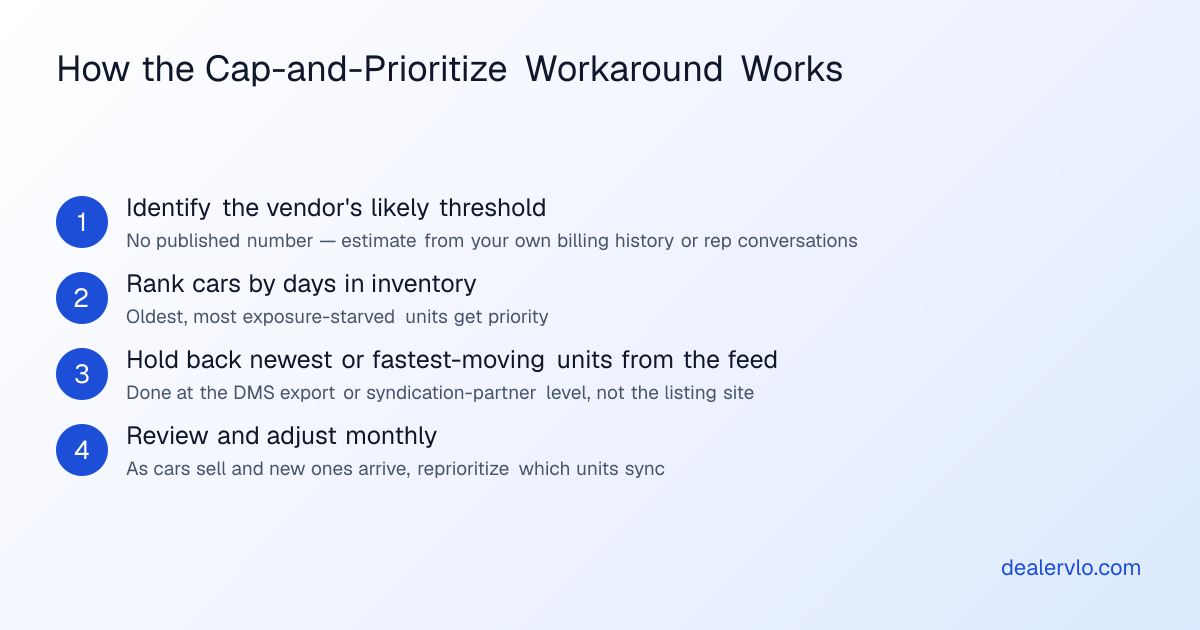
It's technically workable because of how feeds actually move. In plain terms: most shops don't paste a feed URL by hand into each site — a DMS or a certified syndication partner pushes inventory out, and that layer is exactly where a dealer can hold back units before they ever sync.
How you choose is up to you; here's the version we'd use. The logic is straightforward: decide which cars actually need to be on every paid site, and which ones can wait a cycle or sync to fewer destinations. A car that just came in and is priced right will likely sell off your own website and word of mouth; a car sitting at 70 days needs every bit of exposure it can get. Prioritizing the aged units for syndication and holding back the newest arrivals (or the ones already generating organic traffic) is the version of this tactic that keeps your count under a vendor's radar without starving your actual problem inventory of leads.
Spot your aging units before a listing-site renewal call with DealerVLO: try it free for 14 days
If you want to manually hold specific units back from syndication as a cost-avoidance tactic, that's a call you make with your DMS export settings or by coordinating directly with a certified syndication partner. In DealerVLO, the daily feed goes to every listing site you've opted into, and the only per-car control is hiding a car from your website, which also keeps it out of the listing feeds. You can't send a car to one site and not another. For general background on how listing-site connections work before you decide what to cap, the [vehicle inventory feed guide](/blog/what-is-a-vehicle-inventory-feed) and the walkthrough on [connecting inventory to AutoTrader and Cars.com](/guide/connect-inventory-autotrader-cars-com) cover the mechanics in more depth.
## Don't confuse this with the FTC price-display changes
Separate from vehicle-count pricing, listing sites have also been tightening how prices get displayed — but that's a different issue entirely. On March 13, 2026, the FTC sent warning letters to 97 auto dealership groups, telling them that advertised prices must be the total a consumer will be required to pay, including all mandatory fees ([CBT News](https://www.cbtnews.com/cox-automotive-pauses-good-great-price-badging/); [Auto Remarketing](https://www.autoremarketing.com/ar/retail/cargurus-joins-list-of-dealer-service-providers-responding-to-ftc-demands-for-price-transparency/)). CarGurus responded with its own fee-disclosure policy: starting July 14, 2026, used listings without disclosed fees were labeled "No Rating" and pushed lower in search ([ComplyAuto](https://complyauto.com/what-nycs-lawsuit-against-cargurus-means-for-car-dealers/)).
That's a pricing-transparency and deal-rating issue — not the same mechanic as the vehicle-count tier pricing covered above. Don't let a conversation about one turn into confusion about the other: your fee-disclosure practices affect how your listings rank and display; your inventory count affects what you're billed. This isn't legal advice — if you have questions about what the FTC's price-transparency requirements mean for your specific listings, that's worth confirming directly with your state dealer association or legal counsel, not a forum thread.
## Keep your own numbers so the renewal call isn't a surprise
The best defense against a surprise tier jump isn't a clever feed trick — it's knowing your own inventory and sales data cold before the call happens. If a rep tells you your lead volume justifies a price increase, you should already know roughly how many leads you're getting, which cars are actually converting, and how much dead weight is sitting on your lot dragging down your average cost per lead without you doing anything wrong.
DealerVLO's lead inbox records each lead's source — the website form it came through — and its status, so you can see at a glance whether leads are actually slowing down or whether the vendor's math is cherry-picked. The dashboard also shows new leads for the week and active deals, which gives you a baseline conversation starter with a rep who's leaning on aggregate numbers you can't verify. None of that replaces asking the vendor directly for your account's VDP and lead counts before a renewal — but it means you're not negotiating blind.
If you're trying to figure out whether a given listing site is actually worth its new price, running your ad spend and resulting units sold through a marketing ROI calculation gives you a cost-per-car-sold number you can compare against the new quote — a more useful metric than the vendor's self-reported cost-per-lead claim. For a broader look at where to list cars in the first place and how syndication actually reaches all three major sites, the [listing sites guide](/blog/car-listing-sites-for-dealers) is the starting point before you get into tier-avoidance tactics.
## Where this fits with your broader inventory strategy
Pricing tiers aside, growing inventory past a certain size changes other things too — how fast cars need to turn, how much reconditioning backlog you're carrying, and whether your front line layout still makes sense. If you're actively deciding how big to grow your lot, it's worth working out your ideal inventory count against your actual turn rate rather than growing reactively and bumping into a vendor's pricing cliff by accident. The [ideal inventory count guide](/blog/ideal-inventory-count-calculator) walks through that math using turn rate and days' supply.
The [guide on re-merchandising aging inventory](/blog/remerchandise-aging-inventory-without-discounting) covers ways to refresh a stale listing's performance without just discounting it — which, in the context of pricing tiers, can also mean the difference between a car that's pulling its weight on a paid site and one that's just adding to your count.
Know your real lead and inventory numbers before your next listing-site renewal: start your free 14-day DealerVLO trial
## Frequently asked questions
### Does Cars.com really raise prices once you hit a certain number of cars?
Cars Commerce's own marketing page confirms that its plans include a set number of used listings before pricing moves to a tiered structure, which supports that volume-based pricing exists. The specific dollar amounts and exact vehicle-count cutoff aren't published publicly — one dealer reported a jump after crossing 75 vehicles, but that's a single dealer's experience, not a universal company-wide rule.
### Is there an official way to cap my listings to avoid a pricing tier?
No. None of the major listing sites publish an official "stay under this count" setting. The capping idea raised on dealer forums — choosing which cars sync so the feed stays under a threshold — is done through your DMS export settings or a syndication partner's filtering options, not a feature the listing site itself offers.
### How do I know if a CarGurus or Cars.com price increase is justified?
Ask your rep for your account's actual lead count, VDP count, and cost-per-lead figures for the months leading up to the increase, rather than accepting an industry-average comparison. In one public forum thread, a rep justified a Cars.com increase with a $5-versus-$40 cost-per-lead comparison, and another dealer's first reply was to ask for the store's actual VDP counts at the old rate.
### Does AutoTrader use the same vehicle-count pricing model as Cars.com or CarGurus?
There's no public confirmation that US AutoTrader (Cox Automotive) prices by vehicle count. A stock-level pricing model does exist for UK Auto Trader, but that's a separate company from the US Autotrader.com, and the two shouldn't be assumed to work the same way.
### Should I just stop advertising cars on listing sites to avoid the price jump?
Not necessarily — pulling cars off a site that's generating real leads can cost you more in lost sales than the increase itself. A better first step is figuring out which units are actually converting versus which are dead weight, then deciding whether to prioritize your paid-site exposure toward the cars that need it most.
### Is the FTC's price-transparency crackdown related to these pricing tiers?
No, they're separate issues. The FTC's warning letters are about advertised prices needing to reflect the total amount a buyer pays, including mandatory fees — a display and disclosure issue. Vehicle-count pricing tiers are a billing mechanic tied to how many cars you list and how they perform, unrelated to how the price is disclosed on the page.
## Bottom line
No listing site publishes its exact vehicle-count pricing thresholds, but the pattern in the dealer accounts that do surface — grow past a certain size, get a "performance-based" rate hike — is worth planning for. The best protection isn't guessing at a magic number; it's knowing your own lead, VDP, and aging-inventory numbers well enough to push back on a vendor's justification, and using feed-management tools to prioritize which cars actually need paid exposure.
Run your next listing-site renewal with real numbers in hand: start your free 14-day DealerVLO trial
---
## FAQ
### Does Cars.com really raise prices once you hit a certain number of cars?
Cars Commerce's own marketing page confirms that its plans include a set number of used listings before pricing moves to a tiered structure, which supports that volume-based pricing exists. The specific dollar amounts and exact vehicle-count cutoff aren't published publicly — one dealer reported a jump after crossing 75 vehicles, but that's a single dealer's experience, not a universal company-wide rule.
### Is there an official way to cap my listings to avoid a pricing tier?
No. None of the major listing sites publish an official "stay under this count" setting. The capping idea raised on dealer forums — choosing which cars sync so the feed stays under a threshold — is done through your DMS export settings or a syndication partner's filtering options, not a feature the listing site itself offers.
### How do I know if a CarGurus or Cars.com price increase is justified?
Ask your rep for your account's actual lead count, VDP count, and cost-per-lead figures for the months leading up to the increase, rather than accepting an industry-average comparison. In one public forum thread, a rep justified a Cars.com increase with a $5-versus-$40 cost-per-lead comparison, and another dealer's first reply was to ask for the store's actual VDP counts at the old rate.
### Does AutoTrader use the same vehicle-count pricing model as Cars.com or CarGurus?
There's no public confirmation that US AutoTrader (Cox Automotive) prices by vehicle count. A stock-level pricing model does exist for UK Auto Trader, but that's a separate company from the US Autotrader.com, and the two shouldn't be assumed to work the same way.
### Should I just stop advertising cars on listing sites to avoid the price jump?
Not necessarily — pulling cars off a site that's generating real leads can cost you more in lost sales than the increase itself. A better first step is figuring out which units are actually converting versus which are dead weight, then deciding whether to prioritize your paid-site exposure toward the cars that need it most.
### Is the FTC's price-transparency crackdown related to these pricing tiers?
No, they're separate issues. The FTC's warning letters are about advertised prices needing to reflect the total amount a buyer pays, including mandatory fees — a display and disclosure issue. Vehicle-count pricing tiers are a billing mechanic tied to how many cars you list and how they perform, unrelated to how the price is disclosed on the page.