# In-House Mechanic vs. Sublet Recon: Should Your Used-Car Lot Run Its Own Shop?
> Should a used car lot run its own shop? What an in-house tech really costs, the break-even volume against sublet, and the hybrid path most small lots take.
- Source: https://www.dealervlo.com/blog/in-house-mechanic-vs-sublet-recon-used-car-lot
- Published: 2026-10-11
- Updated: 2026-10-11
- Author: Chris Abouraad
- Tags: reconditioning, operations, hiring
---
You're sending cars to three different shops, paying invoices that somehow always run higher than the estimate, and waiting a week to get a car back for what should have been a two-day job. At some point every independent dealer asks: should I just hire my own tech and stop bleeding margin to sublet markups?
The honest answer depends on three numbers most dealers don't have on hand: what you're actually spending on sublet recon per month, what an in-house tech would cost you all-in, and how many cars per month you'd need to move to make the fixed cost pay for itself. This post walks through the math—using your own figures, not made-up industry averages—so you can decide whether in-house reconditioning makes sense for your lot, or whether the smarter move is to tighten up your sublet vendor process and keep the flexibility.
Track every sublet repair line by VIN, vendor, and cost in DealerVLO—then run the numbers on whether in-house pencils out: start your 14-day free trial
## What sublet reconditioning really costs you
The line item on the invoice is only part of it. When you send a car to an outside shop, you're paying for their labor, their markup on parts, their markup on your job if they're subletting any piece of it, and the opportunity cost of the car sitting in their queue instead of on your front line.
### Direct costs and markup
Independent repair shops across the country charge labor rates that range from around $120 to $160 per hour in 2026, with rural shops at the lower end of that range and urban shops pushing $150 to $200 or more. New-car dealerships typically bill $170 to $250 per hour. Meanwhile, the actual technician doing the work earns a median of roughly $28 to $31 per hour depending on the market and experience level—the rest covers the shop's overhead, tooling, and profit.
When a shop sublets part of your job to a specialist—say, a transmission rebuild or a windshield replacement—they mark up that sublet work before they bill you. Industry sources report markup in the range of 20 to 30 percent on sublet services, which means if the transmission shop charges them $800, you're paying $960 to $1,040. That's not price-gouging; it's how repair businesses cover their coordination time, warranty risk, and the fact that they're the ones standing behind the work to you. But it does mean every layer between you and the actual wrench adds cost.
If you're running 10 to 15 cars a month through recon and your average sublet mechanical bill is $600 per car after parts and labor, you're spending $6,000 to $9,000 a month. That number starts to look like a salary.
### Queue time and control
Even when you've built a good relationship with a local shop, you're one customer among many, and your timeline isn't always theirs. Some high-performing dealers report reconditioning turnaround times of 24 to 48 hours; others routinely see seven to ten days, and independent lots often land in the middle at three to five days. A meaningful chunk of that time is the car sitting in the sublet shop's lot waiting for a bay to open up, or waiting for a part the shop ordered but didn't expedite because your job isn't their priority that week.
You also lose some control over what gets fixed and how. You can write a repair order that says "replace front brake pads, not to exceed $300," but if the tech finds a caliper that's sticking, the shop calls you, and now you're in a negotiation about whether to approve another $400 while the car's already on the lift. Sometimes that's the right call; other times you're being upsold on work that could wait or that you'd have done in-house for half the cost if you had the bay.
Every day a car sits in recon instead of on your lot costs you holding cost and lost opportunity. If the right buyer walks your lot on Tuesday and the car's still at the sublet shop, you've lost that deal. [Reconditioning speed matters](https://www.dealervlo.com/blog/recon-turnaround-time-workflow), and sublet vendors—no matter how good—will never prioritize your inventory the way you do.
### Tracking what you're actually spending
Most dealers don't have a consolidated view of their sublet spend because the invoices come in by email, paper, and sometimes a text message with a photo of a handwritten ticket. DealerVLO lets you log every recon line as a separate entry against the car's VIN: vendor name, description, and cost. Each line rolls into the vehicle's all-in cost, so your margin calculation accounts for the $850 you spent at the transmission shop, not just the auction buy price.
When every sublet invoice is a line on the car, adding up six months of sublet mechanical gives you the real number—the one you need to decide whether hiring someone makes sense. Those lines also show patterns: maybe 60 percent of your sublet spend goes to one category (brakes, suspension, exhaust), which tells you what kind of tech you'd need to hire to capture that work in-house.
## What an in-house tech actually costs
Bringing reconditioning in-house doesn't just mean adding a salary. It means a bay, a lift, tools, insurance, utilities, and—this is the part that sinks a lot of small lots—paying that tech every week whether you bought three cars or zero.
### The all-in monthly cost worksheet
Here's a framework. Plug in your own local numbers; the figures below are examples to show you the shape of the calculation, not averages you should rely on.
| **Cost component** | **Example monthly cost** | **Your cost** |
|--------------------|--------------------------|---------------|
| **Technician wage** | $4,800 (example: $28/hr × 171 hrs) | $_______ |
| **Payroll taxes** | $600 (example: 12.5% of gross wage) | $_______ |
| **Health insurance** | $400 (if offered) | $_______ |
| **Lift (amortized)** | $150 (example: $9K lift ÷ 60 months) | $_______ |
| **Tools & equipment** | $100 (amortized; more up front if tech doesn't bring their own) | $_______ |
| **Air compressor, diagnostic scanner** | $75 (amortized) | $_______ |
| **Shop space rent or allocation** | $500 (example: 500 sq ft at $1/sq ft, or opportunity cost of using your own space) | $_______ |
| **Utilities (electric, water, HVAC for bay)** | $150 (example) | $_______ |
| **Garage liability insurance increase** | $200 (example; get a quote from your agent) | $_______ |
| **TOTAL FIXED COST** | **$6,975/month** | **$_______** |
The wage is the biggest variable. National salary surveys for automotive technicians in 2026 report figures ranging from around $28 to $31 per hour depending on market and experience, with a median around $28 to $29. In a high-cost metro area or for someone with significant diagnostic skill, you'll pay more; in a rural market or for someone whose scope is limited to brakes, fluid services, and light electrical, you might pay less. Your local Craigslist, Indeed, and word-of-mouth will tell you what techs in your area actually expect, and that number is the one that matters.
Payroll taxes—Social Security, Medicare, federal and state unemployment, and workers' compensation insurance—typically add 10 to 15 percent on top of gross wages, but workers' comp rates for auto repair can be higher depending on your state and claims history. Call your payroll provider or insurance agent for the real figure.
### Equipment: the up-front bite
A commercial-grade two-post lift installed runs somewhere in the range of $3,000 to $12,000 all-in, depending on the capacity, brand, freight, and whether your slab needs reinforcement or new electrical. If you're lifting trucks or heavy SUVs, you'll be at the higher end; if you're doing mostly sedans and crossovers, a 10,000-pound lift in the $4,000 to $6,000 range installed will cover most of your inventory. Add a few hundred dollars for anchoring and another few hundred if you need a 220V circuit run.
A professional-grade air compressor—80 gallons, two-stage, 5+ horsepower—runs $1,500 to $4,500. A good universal diagnostic scanner (Autel, Snap-on, or similar) costs anywhere from $600 for a capable mid-tier unit to several thousand for a top-end model, and you'll need to budget for annual software subscriptions if you're working on late-model cars with complex electronics. Basic hand tools, if your tech doesn't bring their own set, can run $3,000 to $10,000 for a complete professional toolbox; most experienced techs own their tools, but you'll need to provide specialty equipment like a brake bleeder, spring compressor, pullers, and anything specific to the jobs you're keeping in-house.
Spread over five to ten years, equipment depreciation is manageable, but the cash outlay up front is real. If you're financing the equipment, factor the monthly payment into your worksheet instead of the amortized cost.
### The idle-time problem
This is the variable that matters most and the one dealers underestimate. If you buy cars every week like clockwork and you've got a six- to eight-car backlog in recon at any given time, an in-house tech stays busy and the math works. If you go two weeks without an auction trip, or you buy in batches—ten cars one month, three the next—your tech is standing around for a quarter of their hours, and you're still paying the full salary.
Calculate how many billable recon hours per month you actually generate. If you move 12 cars a month and the average car needs six hours of mechanical work, that's 72 billable hours. A full-time tech works roughly 170 hours a month; the other 98 hours are either idle or spent on tasks that don't directly reduce your sublet cost (cleaning the bay, running parts, doing inspections that you weren't paying a sublet shop to do anyway).
Some of that non-billable time has value—inspections at intake let you write more accurate repair budgets, and having someone on-site means you can get a quick diagnosis without waiting three days for a sublet shop to even look at the car. But it doesn't replace sublet dollars one-for-one, so when you run the break-even calculation, use realistic utilization, not 100 percent.
## The break-even calculation
The question isn't whether an in-house tech costs less per hour than a sublet shop—of course they do. The question is whether the total monthly cost of employing that tech is less than the sublet expense you'll eliminate.
### Break-even volume (worked example)
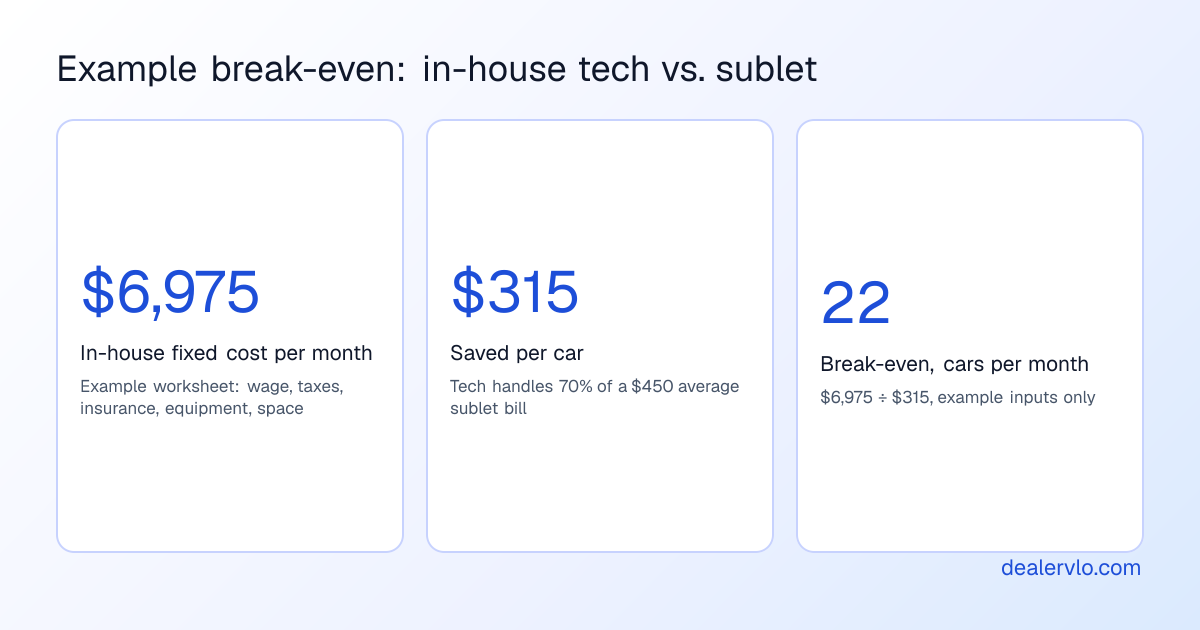
Let's use the example figures from the worksheet above and assume you're currently paying an average of $450 per car in sublet mechanical costs (labor + parts + markup). You estimate that an in-house tech could handle about 70 percent of that work, so you'd save roughly $315 per car and still sublet $135 worth of specialty or heavy jobs.
Your total in-house fixed cost is $6,975 per month. Divide that by the $315 you save per car:
**$6,975 ÷ $315 = 22.1 cars per month**
At 22 cars a month, your in-house cost equals your sublet savings, and you break even. Below that volume, you're losing money by bringing the work in-house; above it, you're capturing margin.
Now change one assumption: say your in-house tech can handle 90 percent of the mechanical work, so you save $405 per car instead of $315. Now the break-even drops to about 17 cars per month. If you're consistently moving 20+ cars, in-house wins. If you're at 10 to 12, it doesn't—unless you can either increase volume or cut the fixed cost (part-time tech, no dedicated bay, scaled-down tooling).
This is why tracking your actual sublet spend by car matters. [DealerVLO rolls every recon line into each vehicle's cost](https://www.dealervlo.com/blog/used-car-reconditioning-cost-budget), so you can pull six months of history and see your real per-car average, not a guess. If your average is $600 because you're buying older, higher-mileage inventory, the in-house case is stronger. If it's $250 because you're cherry-picking clean cars at the auction and most of your recon is detail and safety items, sublet probably still makes sense.
### When the numbers say "not yet"
If your break-even volume is 20 cars a month and you're moving 8, hiring a full-time tech doesn't pencil. That doesn't mean you're stuck with sublet forever; it means the conditions aren't right *today*. Consider:
- **Increasing volume first.** If you can grow from 8 cars to 15 by tightening your acquisition process, improving your online listings, or adding a salesperson, the in-house decision looks different six months from now. [Faster reconditioning turnaround](https://www.dealervlo.com/blog/recon-turnaround-time-workflow) also increases effective volume—the faster you turn inventory, the more cars you can move through the same working capital.
- **The middle path** (see the next section). One part-time tech or a limited-scope hire costs half as much and still saves you money if it keeps 40 percent of the work in-house.
- **Better sublet management** (also below). You might be overpaying or waiting too long because your vendor process is loose. Tightening that up can cut your per-car sublet cost by 20 to 30 percent without hiring anyone.
The break-even formula is simple, but it only works if you're honest about the inputs. Don't use aspirational volume or an optimistic fixed-cost estimate; use the numbers you can support today, then model what changes if you grow.
## The middle path: in-house for light work, sublet the heavy jobs
You don't have to choose between all-in-house and all-sublet. A lot of small independent lots run a hybrid model: hire one tech to handle inspections, fluid services, brakes, filters, and minor electrical, then sublet transmissions, engine work, body, glass, and upholstery. It's not as clean as one or the other, but it captures most of the speed and control benefits of in-house recon without the full fixed cost or the risk of paying someone to stand around in a slow month.
### What one tech can realistically handle
A general-service tech with five to ten years of experience can do:
- **Intake inspections**: a full bumper-to-bumper mechanical inspection at acquisition that identifies everything the car needs, so you can write an accurate recon budget before you even list the car. This alone saves you from the surprise $1,200 sublet invoice after you thought the car only needed brakes.
- **Fluid services**: oil change, transmission fluid, coolant flush, brake fluid, differential and transfer case if applicable.
- **Brakes**: pads, rotors, calipers, lines, and bleeding. This is one of the highest-frequency repairs in used-car recon and one of the easiest to bring in-house.
- **Filters and belts**: engine air filter, cabin air filter, accessory belts (not timing belts unless your tech has the specific tooling and experience for interference engines).
- **Batteries and charging systems**: test, replace, diagnose alternator and starter issues.
- **Light electrical**: bulbs, fuses, window regulators, door lock actuators, basic wiring repairs.
- **Suspension**: shocks, struts, control arms, sway bar links, tie rods and alignment if you've got the rack (or you sublet the alignment after your tech does the replacement).
- **Exhaust**: clamps, hangers, muffler and pipe replacement (not catalytic converters in most cases—those usually go to a muffler shop with a welder and the right EPA compliance setup).
That list covers 60 to 80 percent of the mechanical work a typical independent lot encounters on cars in the $8,000 to $18,000 range. You'll still sublet:
- **Transmissions**: rebuilds, replacements, and often even a fluid-and-filter service on a sealed unit.
- **Engine internals**: head gaskets, timing chains on interference engines, anything that requires pulling the motor.
- **HVAC compressor and evaporator work**: most techs can recharge and diagnose, but compressor replacement often goes out because of the refrigerant handling and the labor intensity.
- **Body and paint**: collision repair, frame straightening, any paint work beyond a touch-up pen.
- **Glass**: windshield replacement almost always sublets unless you've got a Safelite account and someone trained on the adhesive and calibration for ADAS cameras.
- **Upholstery and trim**: seat repairs, headliner replacement, carpet dyeing.
The hybrid model gives you speed and control on the frequent, straightforward jobs—the ones that would otherwise sit in a sublet shop's queue for three days—and lets you send the low-frequency, high-skill work to specialists who do it all day.
### Part-time or flexible hours
If your volume is 10 to 15 cars a month, you don't necessarily need a full-time tech. A lot of dealers hire someone for 20 to 30 hours a week, or they bring in a semi-retired tech who wants steady work without the grind of a 50-hour shop week. You pay half the wage and benefits, your equipment cost stays the same (spread over fewer hours but also fewer cars), and in a slow month you're not stuck with 80 hours of idle time on the payroll.
Another option: hire a tech as a 1099 contractor instead of a W-2 employee, pay them by the job, and let them set their own schedule. This only works if the person truly operates independently (they use their own tools, control their hours, and work for other customers, not just you), or you'll run into misclassification risk. But if you've got a mobile mechanic in your area who's willing to come to your lot a few days a week and bill you per car, it's worth exploring. You lose some control over timing, but you eliminate idle-time cost entirely.
### Mobile detailing: the other half of recon
While you're evaluating the mechanical side, take a look at your detail process. If you've got someone in-house doing detail, how many cars a week are they actually working on, and what are you paying them per car after wage, chemicals, equipment, and the space they're using? A lot of independent dealers find that a mobile detailer who shows up with their own truck, equipment, and supplies delivers more consistent work at a lower effective per-car cost than an in-house detailer who's idle three days a week.
Mobile detail also eliminates the need for a wash bay, water hookup, and dealing with runoff. You schedule them when the cars are ready—say, twice a week in batches of four—and you're only paying for the cars you actually move. That flexibility is worth a lot when your acquisition pace is uneven. [Vehicle intake speed matters](https://www.dealervlo.com/blog/vehicle-intake-process-used-car-dealers), and batching detail work around the mechanic's schedule instead of the other way around can shave days off your total recon cycle.
Track in-house labor and sublet vendor costs separately in DealerVLO, then model your break-even: try it free for 14 days
## How to manage sublet vendors (when you're staying sublet)
If the math says you're not ready to hire someone yet, or you've decided the hybrid model makes more sense, the next step is tightening up your sublet process so you're not leaving money on the table. Sublet reconditioning can work; it just requires discipline.
### Written repair orders with a not-to-exceed cap
Before the car leaves your lot, write a clear repair order listing exactly what you want done and a dollar cap the shop cannot exceed without calling you. Example:
> 2019 Civic, VIN 1HGCV1F43KA123456
> - Replace front brake pads and resurface rotors
> - Replace cabin air filter
> - Oil change (full synthetic, 0W-20)
> **Not to exceed $350. Call for approval on any additional work.**
That last line is the one that matters. It tells the shop you're not giving them a blank check, and if they find something else wrong—say, a leaking valve cover gasket—they need your approval before they touch it. Most sublet shops are honest, but the incentive structure rewards finding more work, and a loose RO invites scope creep.
When the car comes back, compare the invoice to the RO line by line. If you authorized $350 and the bill is $480 with no call to you, that's a conversation. If it happens twice, find another shop.
### Set an approval threshold and communicate it
Some jobs are hard to estimate until the car's on the lift. A reasonable middle ground: tell the shop, "Under $400, proceed. Over $400, call me first, and I'll decide within the hour whether to approve it or bring the car back."
That threshold should match your typical sublet range. If most of your recon jobs run $200 to $500, a $400 threshold makes sense. If you're regularly sending cars that need $800 to $1,200 in work, set it at $600 or $800. The point is that the shop knows when they have discretion and when they don't, and you're not getting surprise invoices that blow your recon budget.
Also give them a way to reach you. If the only number they have rings to voicemail and you're on the lot all day, they're either going to sit on the car waiting for you to call back (costing you time) or go ahead without approval (costing you money). A text-capable cell number or a dedicated shop-coordination contact works better than a main office line.
### Track every sublet invoice against the VIN
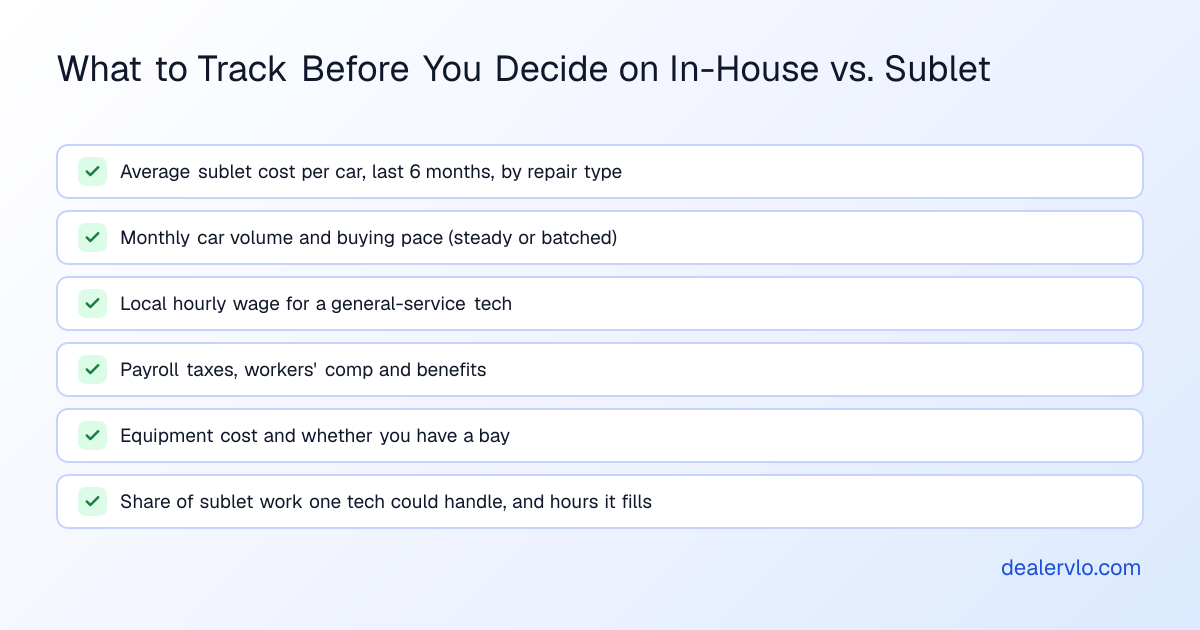
Sublet vendor management falls apart when invoices are scattered—some in email, some in paper files, some paid out of petty cash with no record. You can't make an informed in-house-vs-sublet decision six months from now if you don't know what you spent.
In DealerVLO, every recon cost is logged as a separate line on the vehicle: vendor name, description (e.g., "Joe's Transmission – R&R transmission, reseal, fluid"), and cost. When you pay the invoice, you record it there, and it rolls into the car's total cost. At quarter-end, go back through the recon lines on the cars you bought and total them by vendor and by type of work in a spreadsheet, and you'll see patterns.
Maybe 40 percent of your sublet spend goes to one transmission shop. That's useful to know when you're negotiating a volume discount, or when you're deciding whether to hire a trans specialist instead of a general tech. Maybe another shop consistently comes in under estimate and gets cars back in two days; that's your A vendor, and you should be sending them more work. Maybe a third shop has billed you $3,000 over six months but only hit the estimate twice; time to find a replacement.
The tracking also protects you when a repair fails a week after the car's sold. If you've got the sublet invoice tied to the VIN in your DMS, you can call the shop, reference the exact RO and date, and ask them to make it right under their warranty. If you're digging through a file cabinet, you've lost leverage and time.
### Build relationships with multiple vendors in each category
Don't rely on one transmission shop, one body shop, one glass installer. If your only transmission guy goes on vacation for two weeks, or decides he's not taking new work, you're stuck. Cultivate relationships with two or three vendors in every category, and rotate work among them based on availability and the job.
Pay your sublet invoices promptly. Shops that do dealer work know that some dealers pay in 30 days and others let invoices sit for 90. If you're the one who pays within a week, you'll get priority when they're busy and better pricing when you negotiate. If you're the 90-day guy, don't be surprised when your car sits in the queue behind someone else's.
Also visit the shop occasionally. Meet the owner, see the facility, understand how they operate. It's easier to have a hard conversation about a bill or a timeline issue when you've shaken hands and they know you're a real person, not just a PO number. That relationship also makes it more likely they'll call you when they spot something outside the scope of the RO, instead of just doing it and billing you.
### Inspect the work before you pay the invoice
When the car comes back, don't just sign the invoice and send the tech on their way. Start the car, test-drive it if the repair was mechanical, and confirm the issue is actually fixed. Check that the parts listed on the invoice were actually installed—if the RO says "new front rotors" and you can see through the wheel that the rotors are still scored and rusty, you've caught a billing error or worse.
If the repair didn't solve the problem, or if new issues appeared (for example, a transmission service that now has the car shifting rough when it was fine before), address it immediately with the shop while the car's still in their custody. Waiting three days and then calling them back costs you another round-trip and weakens your position. Most reputable shops will fix a comebacks at no charge if you bring it up right away; fewer will if you come back a week later.
Track vendor comebacks the same way you track costs. If one shop has a 15 percent comeback rate and another has 2 percent, that's decision-making information even if their prices are similar.
## Where DealerVLO fits in the build-or-sublet decision
Most dealers don't have the data they need to make this decision because their recon costs are scattered across paper invoices, email threads, and memory. DealerVLO consolidates every recon expense—parts, labor, sublet vendor charges, in-house tech hours if you add them as recon lines—into a per-car cost that rolls up into your all-in margin.
### Per-car recon lines with vendor and cost
When you buy a car, you add it to inventory and start a recon list. Every time you spend money getting that car ready to sell, you log a line: vendor name (or "in-house" if you did it yourself), a description of what was done, and the cost. Examples:
- Joe's Transmission — rebuild transmission, reseal, new filter, fluid — $950
- In-house — front brake pads, resurface rotors — $85 (parts only)
- Mobile Detail Plus — full detail, shampoo, compound, wax — $180
- Wholesale Glass — replace windshield, recalibrate camera — $420
Each line adds to the vehicle's total recon cost, which adds to its acquisition cost (what you paid at auction or on trade), which gives you the all-in cost. When you price the car and eventually sell it, DealerVLO shows your gross profit after accounting for every dollar you put into it.
That per-car detail matters when you're comparing scenarios. If you pull six months of history and see that your average sublet mechanical cost per car is $425, and 70 percent of those jobs were brake work, suspension, and fluid services—all things one general tech could have done in-house—you've just identified $300 per car in potential savings. Multiply that by your monthly volume, and you have the sublet-savings side of the break-even equation.
Because every line names the vendor, a quarterly pass through those lines surfaces patterns you wouldn't see from a pile of invoices. DealerVLO doesn't have a report that totals recon by vendor, so that pass is a spreadsheet step: list each car's recon lines, then sort by vendor. Maybe one shop consistently charges 20 percent more than another for the same category of work; maybe a third shop is fast but their comebacks rate is high. That's the information you need to either renegotiate, switch vendors, or decide that in-house is worth the investment.
### The Recon ROI Calculator
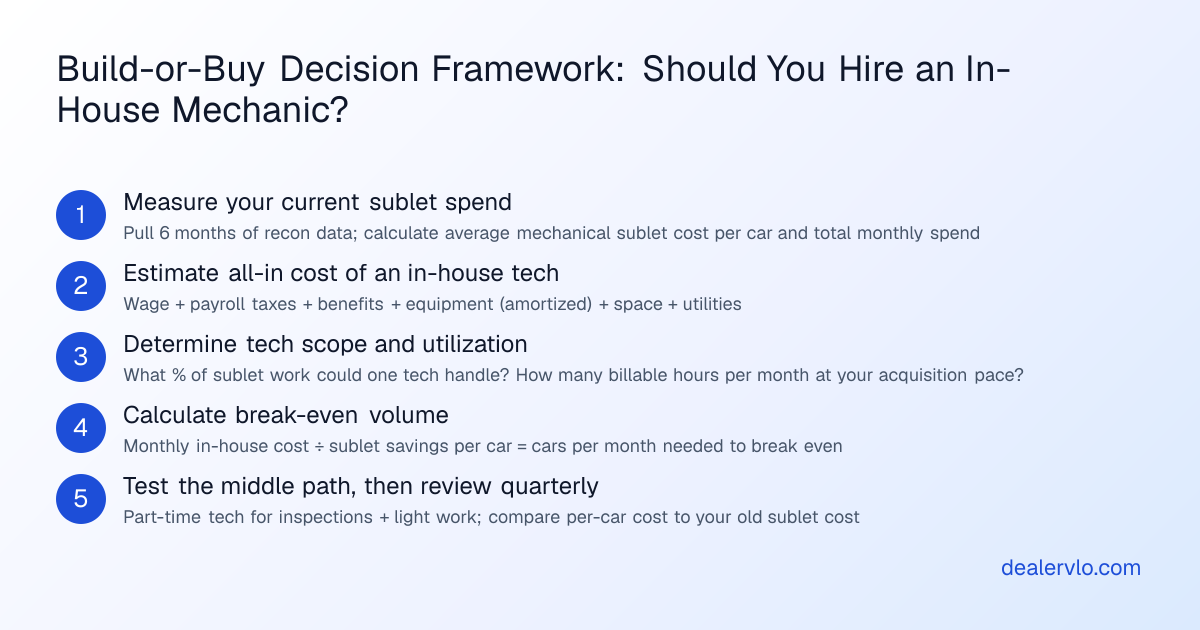
The in-house break-even is the worksheet and the division above: your monthly fixed cost divided by what you'd save per car. Run it with your real figures, not industry averages, then change one input at a time—what if you could grow to 18 cars a month, or hired a part-time tech at 25 hours a week instead of full-time?—and see where the tipping point moves.
The free [Recon ROI Calculator](/tools/recon-roi-calculator) answers the question underneath every sublet decision: is a given repair worth doing at all? You enter the recon cost, the days the car will spend in the shop, the retail value the work adds, and your daily holding cost. It shows the net gain after holding cost and the return on each dollar, plus what happens if the work adds only 50 or 75 percent of the value you expected. Run your most common sublet jobs through it before you decide which ones are worth bringing in-house.
### Building the case (or the exit plan)
If you decide to stay sublet for now but you want to revisit the decision in six or twelve months, DealerVLO gives you the baseline. Log every sublet invoice as a recon line on the car for the next six months, then total them again and see if your per-car average has changed. If you've tightened up your vendor management and cut your average from $450 to $350, maybe sublet still makes sense even at higher volume. If it's crept up to $550 because cars are getting older or you're doing more work per unit, the in-house case is stronger.
The data also protects you if you do hire a tech and it doesn't work out. If you bring someone in-house, log their hours or salary as recon lines the same way you logged sublet invoices, and compare per-car cost before and after. If you're six months in and your per-car recon cost has actually *increased* because of idle time, equipment cost, and comebacks you're now eating internally, you've got the evidence you need to course-correct—either by increasing volume, scaling the hire back to part-time, or returning to sublet with a better vendor process than you had before.
## Frequently asked questions
### Should a used car dealer have its own mechanic shop?
It depends on your volume and your sublet costs. If you're moving 20+ cars a month and your average sublet mechanical bill is $400 or more per car, hiring an in-house tech and equipping a bay will likely pay for itself within a year. If you're at 8 to 12 cars a month, the fixed cost of a full-time tech usually exceeds the sublet expense you'd eliminate, and you're better off tightening your vendor process or trying a part-time or hybrid model first. Run the break-even calculation with your actual numbers before you commit to the hire.
### What does it cost to hire a mechanic for a used car lot?
A full-time automotive technician costs roughly $6,000 to $8,000 per month all-in when you include wage, payroll taxes, benefits, and a prorated share of equipment, insurance, and shop space. Wages for general-service techs range from around $28 to $31 per hour depending on your market, which translates to about $4,800 to $5,300 per month in gross pay for a full-time employee. Add payroll taxes at 10 to 15 percent, health insurance if you offer it, and the monthly cost of a lift, tools, and utilities, and the total typically lands in the $6,500 to $7,500 range. Specialty techs—transmission, diesel, European—cost more, and you'll pay less for part-time or limited-scope hires.
### How much do sublet repair shops mark up dealer work?
Industry sources report sublet markup in the range of 20 to 30 percent. If a repair facility sends part of your job to a specialist—for example, a transmission shop or a glass installer—and that specialist charges them $800, the facility will bill you somewhere between $960 and $1,040 to cover their coordination time, warranty risk, and profit. That markup is standard business practice, not price-gouging, but it does mean every layer between you and the actual repair adds cost. If you're subletting work that involves multiple handoffs, those markups compound.
### When should I bring reconditioning in-house versus outsourcing it?
Bring reconditioning in-house when your monthly car volume and per-car sublet costs are high enough that the total sublet expense exceeds the all-in cost of employing a tech. A common break-even point is around 15 to 25 cars per month, depending on your market's labor rates, your sublet costs, and how much of the work your tech can realistically handle without specialty equipment or training. If you're below that volume, or if your cars are clean and your average recon cost is low, outsourcing to sublet vendors usually costs less and gives you more flexibility. The middle path—hire one tech for inspections and light work, sublet the heavy jobs—often makes sense for lots in the 10 to 20 car range.
### What kind of tech should I hire for in-house reconditioning?
For most independent used-car dealers, a general-service technician with five to ten years of experience is the right fit. Look for someone who can handle brakes, fluid services, suspension, light electrical, batteries, exhaust, and basic diagnostics—the high-frequency repairs that make up 60 to 80 percent of a typical recon list. You don't need a master tech or a specialist unless your inventory skews heavily toward a category that requires it (for example, diesels or European cars). Avoid hiring someone whose only experience is oil changes or tire shops; they won't have the diagnostic skill or the range you need. Also ask whether they own their tools—most experienced techs do, and it saves you several thousand dollars in up-front tooling cost.
### How do I manage sublet vendors if I'm not bringing recon in-house yet?
Write a clear repair order for every job with a not-to-exceed dollar cap, and require the shop to call you before doing any additional work. Set an approval threshold—for example, under $400 proceed, over $400 call first—so the shop knows when they have discretion and when they need authorization. Track every sublet invoice against the car's VIN in your DMS so you can see patterns: which vendors deliver on time and on budget, which ones consistently run over, and what you're actually spending per category. Build relationships with two or three vendors in each category so you have backup options and competitive pricing. Inspect the work before you pay the invoice, and address comebacks immediately while the car's still in the shop's custody.
## Bottom line
The decision to hire your own mechanic or stay with sublet vendors isn't about which model is better in theory—it's about which one costs you less at your actual volume with your actual recon needs. If you're moving enough cars that your monthly sublet spend exceeds the all-in cost of a tech, bay, and equipment, bringing the work in-house captures margin and gives you control over timing and quality. If you're not there yet, tightening up your sublet vendor process and considering a part-time or hybrid model often delivers most of the benefit without the fixed cost or the idle-time risk.
The only way to make an informed decision is to measure what you're actually spending today—by car, by vendor, by repair category—and model what changes if you bring some or all of that work inside. Track it, run the numbers, and adjust as your volume grows. Start your free DealerVLO trial and see where your recon dollars are really going.
Run your recon costs through DealerVLO and model your in-house break-even: start your free 14-day trial
---
## FAQ
### Should a used car dealer have its own mechanic shop?
It depends on your volume and your sublet costs. If you're moving 20+ cars a month and your average sublet mechanical bill is $400 or more per car, hiring an in-house tech and equipping a bay will likely pay for itself within a year. If you're at 8 to 12 cars a month, the fixed cost of a full-time tech usually exceeds the sublet expense you'd eliminate, and you're better off tightening your vendor process or trying a part-time or hybrid model first. Run the break-even calculation with your actual numbers before you commit to the hire.
### What does it cost to hire a mechanic for a used car lot?
A full-time automotive technician costs roughly $6,000 to $8,000 per month all-in when you include wage, payroll taxes, benefits, and a prorated share of equipment, insurance, and shop space. Wages for general-service techs range from around $28 to $31 per hour depending on your market, which translates to about $4,800 to $5,300 per month in gross pay for a full-time employee. Add payroll taxes at 10 to 15 percent, health insurance if you offer it, and the monthly cost of a lift, tools, and utilities, and the total typically lands in the $6,500 to $7,500 range. Specialty techs—transmission, diesel, European—cost more, and you'll pay less for part-time or limited-scope hires.
### How much do sublet repair shops mark up dealer work?
Industry sources report sublet markup in the range of 20 to 30 percent. If a repair facility sends part of your job to a specialist—for example, a transmission shop or a glass installer—and that specialist charges them $800, the facility will bill you somewhere between $960 and $1,040 to cover their coordination time, warranty risk, and profit. That markup is standard business practice, not price-gouging, but it does mean every layer between you and the actual repair adds cost. If you're subletting work that involves multiple handoffs, those markups compound.
### When should I bring reconditioning in-house versus outsourcing it?
Bring reconditioning in-house when your monthly car volume and per-car sublet costs are high enough that the total sublet expense exceeds the all-in cost of employing a tech. A common break-even point is around 15 to 25 cars per month, depending on your market's labor rates, your sublet costs, and how much of the work your tech can realistically handle without specialty equipment or training. If you're below that volume, or if your cars are clean and your average recon cost is low, outsourcing to sublet vendors usually costs less and gives you more flexibility. The middle path—hire one tech for inspections and light work, sublet the heavy jobs—often makes sense for lots in the 10 to 20 car range.
### What kind of tech should I hire for in-house reconditioning?
For most independent used-car dealers, a general-service technician with five to ten years of experience is the right fit. Look for someone who can handle brakes, fluid services, suspension, light electrical, batteries, exhaust, and basic diagnostics—the high-frequency repairs that make up 60 to 80 percent of a typical recon list. You don't need a master tech or a specialist unless your inventory skews heavily toward a category that requires it (for example, diesels or European cars). Avoid hiring someone whose only experience is oil changes or tire shops; they won't have the diagnostic skill or the range you need. Also ask whether they own their tools—most experienced techs do, and it saves you several thousand dollars in up-front tooling cost.
### How do I manage sublet vendors if I'm not bringing recon in-house yet?
Write a clear repair order for every job with a not-to-exceed dollar cap, and require the shop to call you before doing any additional work. Set an approval threshold—for example, under $400 proceed, over $400 call first—so the shop knows when they have discretion and when they need authorization. Track every sublet invoice against the car's VIN in your DMS so you can see patterns: which vendors deliver on time and on budget, which ones consistently run over, and what you're actually spending per category. Build relationships with two or three vendors in each category so you have backup options and competitive pricing. Inspect the work before you pay the invoice, and address comebacks immediately while the car's still in the shop's custody.