# How Do Used-Car Dealerships Actually Make Money?
> Used-car lots make money in three places: front-end gross, back-end F&I, and fast inventory turn. Here's how each one works — and how to see all three on your own deals.
- Source: https://www.dealervlo.com/blog/how-used-car-dealerships-make-money
- Published: 2026-09-13
- Author: Chris Abouraad
- Tags: how used car dealers make money, front-end vs back-end gross, F&I income, dealership profit centers
---
"How does a used-car lot actually make money?" is a fair question, and the honest answer is: in more places than the sticker price. A lot of dealers focus entirely on front-end gross — the spread on the car — and leave the other two profit centers barely touched. Understanding all three is the difference between a lot that's busy and a lot that's profitable.
## What are the three profit centers of a used-car lot?
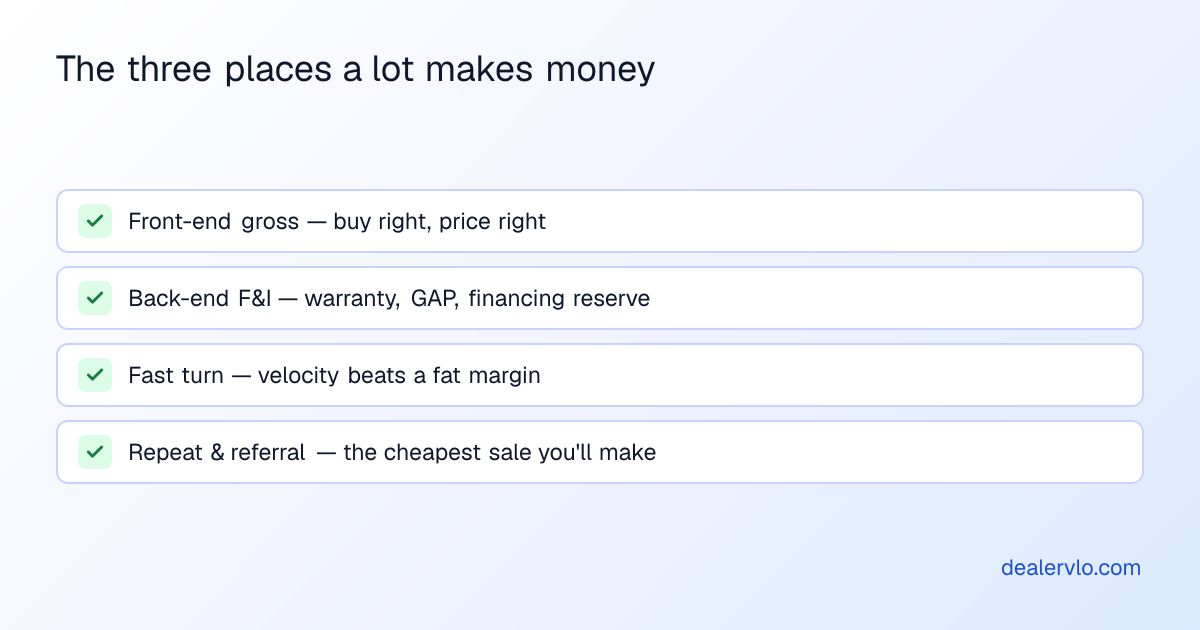
1. **Front-end gross** — the profit on the vehicle: sale price minus what it cost you, including acquisition and [recon](/blog/used-car-reconditioning-cost-budget). This is the one everybody watches.
2. **Back-end F&I** — financing reserve, extended service contracts, GAP. Sold alongside a car you're already selling.
3. **Fast turn** — velocity. A smaller gross earned three times a quarter beats a bigger gross earned once, because the same lot spot and the same capital did more work.
And the bonus that compounds over years: the [repeat and referral customer](/blog/repeat-referral-business-used-car-dealer) — the cheapest sale you'll ever make.
## The front-end is capped. The back-end isn't.
Here's the part that changes how you run the lot: front-end gross is limited by the market. Buyers can pull up comparable prices on their phone, so there's a ceiling on what the sticker will bear. The back-end is where the average per-car number is most improvable, because you're adding gross to a deal you've already made:
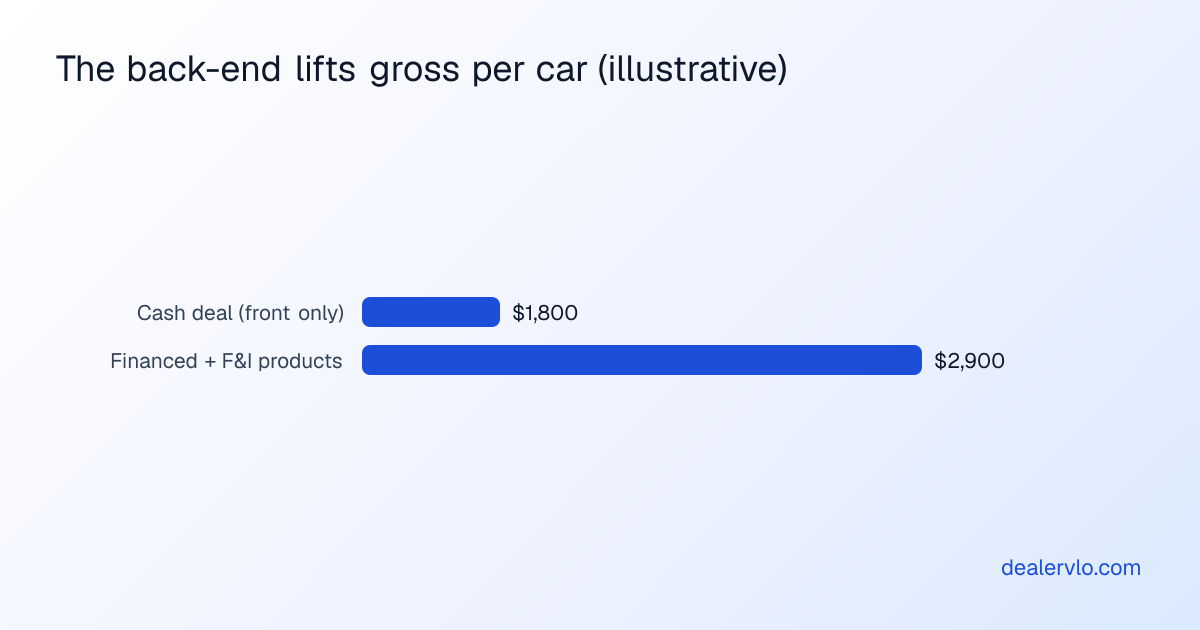
*(Illustrative — your numbers depend on your market and what you write. The point is the shape: presenting F&I consistently often moves your average faster than squeezing another hundred out of the sticker.)*
This is where the deal screen earns its keep. On a financed deal, front-end and back-end gross should both be visible as you structure it — not something you back into at tax time:
F&I only works when it's real value the customer actually wants — the goal is to *offer* it on every deal, not to pressure it. But a lot that never presents the back-end is leaving its most improvable margin on the table.
## Does selling more cars mean making more money?
The trap is thinking more cars automatically means more money. It doesn't. Volume becomes profit only when each car clears your [break-even](/tools/dealer-break-even-calculator) and carries real gross after cost. A lot can sell more units and make *less* — discounting to move metal, skipping the back-end, letting overhead climb with the volume.
So the scoreboard isn't units. It's total gross minus overhead. That's what a rolled-up sales report is for — units and revenue, yes, but front and back gross and your deal mix next to them:
## Make more on the cars you already sell

Buy below market, recondition lean, price to move, present F&I on every deal, and earn the repeat. None of these is a secret — they're just the five levers, and most lots are pulling two of them. The dealers who pull all five make more money on the same number of cars.
## Frequently asked questions
**How do used-car dealerships make money?**
In three places: front-end gross (the spread on the car), back-end F&I (financing reserve, warranties, GAP), and fast turn (a smaller gross earned more often). Total gross per car times units, minus overhead, is what the business keeps. The best operators work all three.
**What is front-end vs. back-end gross?**
Front-end is profit on the vehicle: sale price minus cost including recon. Back-end is profit from F&I products sold with the car. A cash deal usually earns only front-end; a financed deal can earn both. The split is often why two salespeople with equal units produce different gross.
**How much gross profit does a dealer make per car?**
It varies widely, so any single average misleads. What matters is your own number — total gross divided by units, tracked over time. Chasing a benchmark can push you to hold cars too long for a bigger front-end when faster turn would make more.
**Is F&I where dealers make the most money?**
For many it's where margin is most improvable, because front-end is capped by the market. F&I adds gross to deals you're already making — but only when it's genuine value the customer wants.
**Does selling more cars mean making more money?**
Not by itself. Volume is profit only if each car clears break-even with real gross after cost. Total gross minus overhead is the number that matters, not units sold.
## Bottom line
A used-car lot makes money on the front end, the back end, and the clock — and keeps it only after overhead. See all three on every deal and you stop leaving margin on the table. DealerVLO computes front and back gross as you build the deal and rolls it up so you know what's actually working. [Start a free trial](/signup).
---
## FAQ
### How do used-car dealerships make money?
Used-car lots make money in three places. First is front-end gross — the spread between what you paid for a car (plus reconditioning) and what you sell it for. Second is the back-end, or F&I: financing reserve, extended warranties, GAP, and other products sold alongside the car. Third is turn — how fast you sell, because a smaller gross earned three times in a quarter beats a bigger gross earned once. Total it up as gross per car times units sold, then subtract your overhead, and what's left is what the business actually keeps. The best operators work all three levers, not just the sticker price.
### What is front-end vs. back-end gross?
Front-end gross is the profit on the vehicle itself: sale price minus what the car cost you, including acquisition and reconditioning. Back-end gross is the profit from the finance and insurance products sold with the car — financing reserve, extended service contracts, GAP coverage, and the like. A cash deal typically earns only front-end gross; a financed deal can earn both. Knowing the split matters because two salespeople can move the same number of cars while producing very different total gross, and the difference is almost always the back-end.
### How much gross profit does a used-car dealer make per car?
It varies widely by price band, how well you buy, and how much back-end you write, so any single average is misleading. What matters more than a benchmark is your own number: total gross (front plus back) divided by units sold, tracked over time. Chasing a per-car figure you read somewhere can push you to hold cars too long waiting for a bigger front-end, when turning them faster at a smaller gross would have made more money. Know your real average, then work to raise it through better buying and a stronger back-end — not by letting inventory age.
### Is F&I where car dealers make the most money?
For many dealers the back-end is where the margin is most improvable, because front-end gross is capped by the market — buyers can see comparable prices online. F&I products like extended warranties and GAP add gross on deals you're already making, and presenting them consistently often moves the average per-car number faster than squeezing another hundred dollars out of the sticker. That said, F&I only works when it's genuine value the customer wants; the goal is to offer it on every deal, not to pressure it onto people who don't.
### Does selling more cars mean making more money?
Not by itself. Volume only becomes profit if each car clears your break-even and carries real gross after cost. A lot can sell more units and make less money if it's discounting to move metal, ignoring the back-end, or letting overhead climb with the volume. The number that matters isn't units — it's total gross minus overhead. That's why measuring gross per car and net profit, not just how many you sold, is what separates a busy lot from a profitable one.