# How Dealers Determine the Wholesale Value of a Car (and Turn It Into a Bid)
> How to determine the wholesale value of a car as a dealer: read MMR and book values, adjust for condition, then check it against your own retail-back math.
- Source: https://www.dealervlo.com/blog/how-to-determine-wholesale-value-of-a-car
- Published: 2026-10-08
- Updated: 2026-10-08
- Author: Chris Abouraad
- Tags: appraisal, wholesale, auction buying, pricing
---
How do you determine the wholesale value of a car? As a dealer, you work it out two ways and take the lower answer. First, read the market: wholesale data like the Manheim Market Report (MMR), Black Book, and trade-in guides, adjusted for this car's miles and condition. Second, work back from retail: what the car will sell for on your lot, minus every cost to get it there and the gross you need.
The first number tells you what other dealers would pay. The second tells you what *you* can pay. When they disagree, the second one wins, because you're the one who has to recondition it, hold it, and sell it. This post walks through both methods, step by step, and how to use the answer for trade offers, bid ceilings, and deciding when to wholesale a car you already own.
See live retail comps and every car's all-in cost in DealerVLO: start your 14-day free trial
## What "wholesale value" means for a dealer
The phrase means different things depending on who's asking, so it's worth pinning down.
- **Wholesale value:** what another dealer would pay for the car today, as-is, in your market. In practice, what it would bring at a dealer auction.
- **Trade-in value:** a guide's estimate of what a consumer can expect a dealer to pay. Kelley Blue Book [defines its trade-in value](https://b2b.kbb.com/kbb-vehicle-values/definitions-of-our-values/) as an estimate of what a consumer can expect to receive from a dealer, and says it's likely lower than private party value "because the reselling dealer incurs the cost of safety inspections, reconditioning and other costs of doing business."
- **Retail value:** what a customer pays you after the car is reconditioned, photographed, and on the lot.
Wholesale is the number that matters when you're the buyer. Retail is the number that pays you back. Everything between them is your cost and your gross.
## Step 1: Identify the exact car
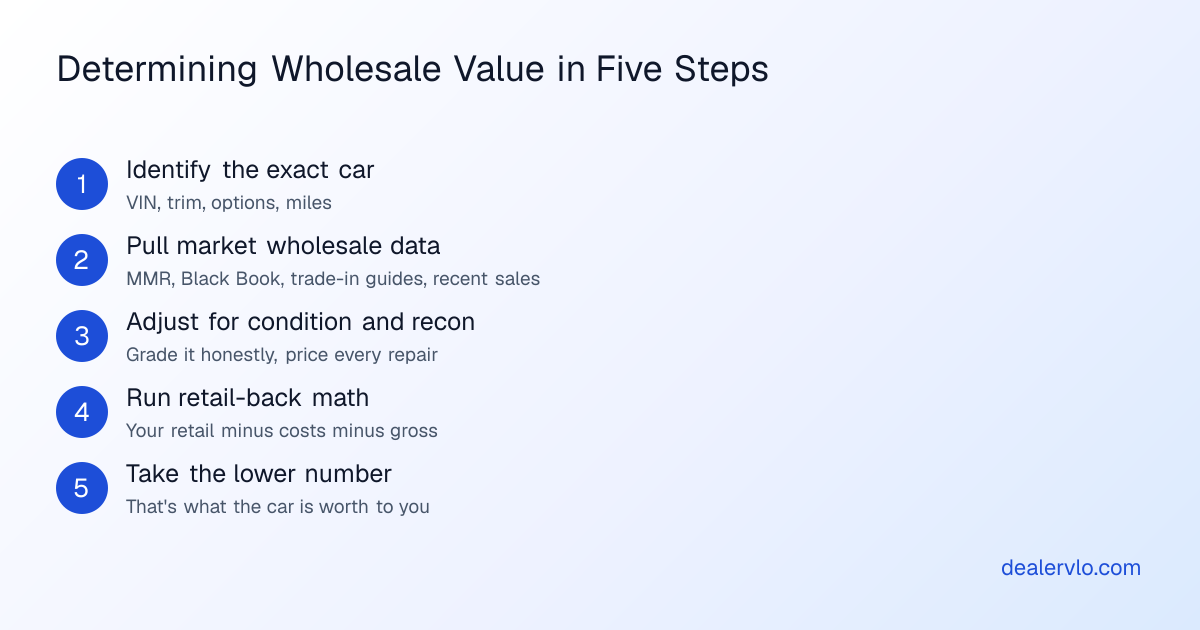
Values are tied to year, make, model, and trim, plus drivetrain and options. A 4WD crew cab and a 2WD regular cab of the same truck aren't the same car in any wholesale guide. Decode the VIN instead of trusting the window sticker or the seller's description, and write down the exact miles.
In DealerVLO, "Scan VIN" on the Add vehicle screen reads the barcode on the door-jamb label with your phone's camera and decodes it, so the year, make, model, and specs are right before you look anything up.
## Step 2: Pull market wholesale data
Start with what the wholesale market says. The main sources:
- **MMR (Manheim Market Report).** Manheim's wholesale value tool. Manheim says the [base MMR](https://site.manheim.com/en/help/mmr.html) reflects recent wholesale transactions for a year, make, model, and style, excludes outliers, and weights recent sales more heavily. The adjusted MMR adds adjustments for odometer, region, condition grade, and color. Use the adjusted number, not the base.
- **Black Book.** Black Book publishes [wholesale values by condition](https://www.blackbook.com/black-books-wholesale-value/), with Wholesale Average as the benchmark for an average-condition car at auction, adjusted for mileage, condition, and region.
- **Trade-in guides** from J.D. Power and Kelley Blue Book. Useful as a cross-check and for knowing what the customer across the desk has already looked up.
- **Recent sales of the same car.** The transaction list behind a valuation is the closest thing to real comps. Look at the condition and miles on the cars that actually sold.
If the sources roughly agree, you have a range. If one is way off, find out why before trusting it. Thin sales data for an unusual car is a common reason. The [MMR and Black Book guide](/blog/how-to-use-mmr-black-book-auction-pricing) goes deeper on reading and cross-checking these tools.
## Step 3: Adjust for condition and recon
The guide numbers assume a condition. Your car has a real one. Manheim grades condition on a 0 to 5 scale and [warns buyers](https://site.manheim.com/en/help/new-dealer-registration/new-dealer-buyer.html) never to make a buying decision on the grade alone. Walk the car, or read the condition report and photos like a skeptic.
Then price the recon line by line: tires, brakes, windshield, paintless dent repair, interior, detail, any warning lights. Every dollar of recon comes off what another dealer would pay, because they'll price it in too. The [trade-in appraisal guide](/blog/dealer-trade-in-appraisal-guide) has a condition grading system and a recon estimate worksheet.
In DealerVLO, reconditioning is tracked line by line on each car and rolls into its all-in cost and margin. Over time that's the best source you have for what recon actually costs on your lot, not what you hoped it would.
## Step 4: Run retail-back math
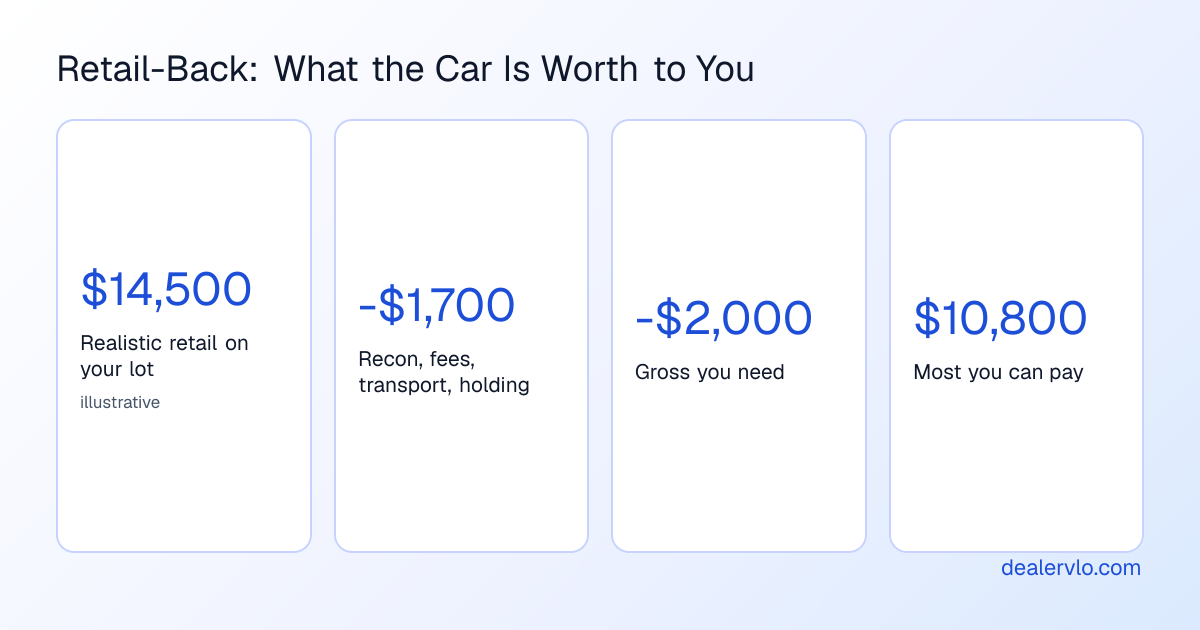
Now forget the guides for a minute and start from your exit. What will this car realistically retail for on *your* lot, at a price that sells in about 30 days? Then subtract:
- **Recon** from Step 3
- **Buy fee and transport** if you're buying at auction, or the cost to get a trade ready
- **Holding cost** for the days you expect to own it
- **The gross you need** to make the deal worth doing
Illustrative example: a car that will retail for $14,500 on your lot, with about $1,700 in recon, fees, transport, and holding, and a $2,000 target gross, is worth at most **$10,800** to you (14,500 − 1,700 − 2,000). That's your ceiling, whatever the guide says.
The retail number is the one dealers guess at most. DealerVLO's AI price suggestion shows a price range from live comparable listings and a target price for selling in about 30 days. Run it before you set a bid or a trade offer, and your retail-back math starts from the market instead of a hunch.
Start your retail-back math from live comps: try DealerVLO free for 14 days
## Step 5: Take the lower number
You now have two numbers: what the market says the car is worth wholesale, and what it's worth to you.
- **Market wholesale is below your retail-back ceiling:** good buy. You can pay up to market and still make your gross.
- **Market wholesale is above your ceiling:** someone else is the right buyer for this car. Their market, their recon costs, or their gross target is different from yours. Bid your ceiling and let it go if you lose.
The same logic sets a trade-in offer. Offer from your retail-back number, not from what the customer saw online. If the car doesn't fit your lot at all, your offer is what you can wholesale it for, minus what it costs you to get it there.
## Using wholesale value on cars you already own
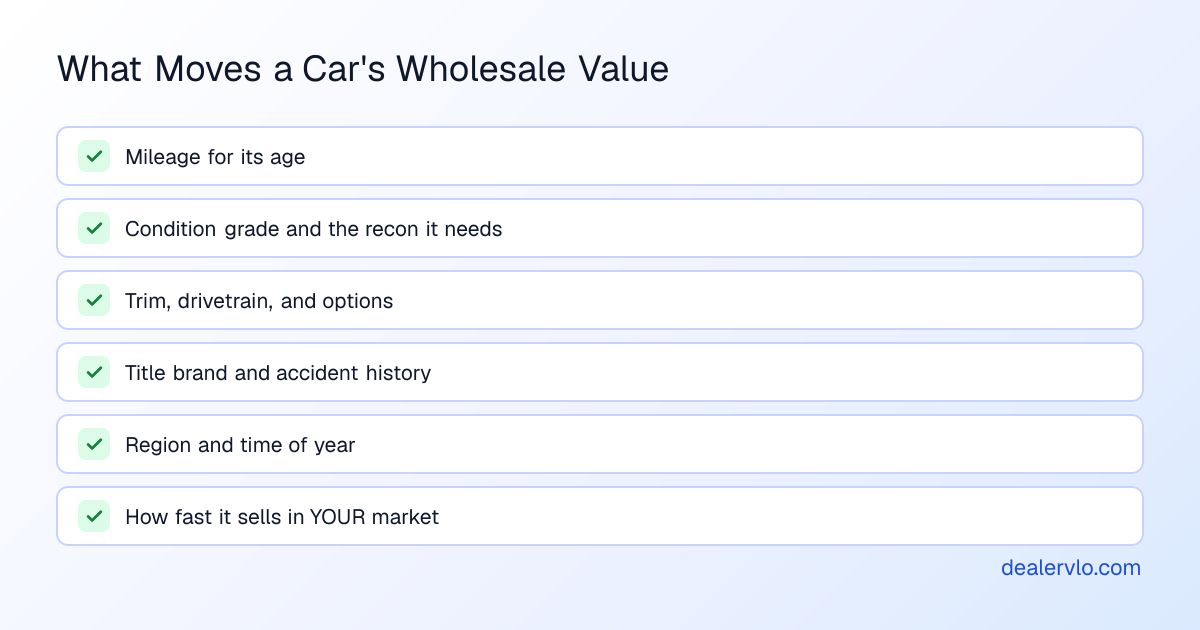
Wholesale value also tells you when to stop waiting on a retail sale. Once a car has sat long enough, compare what you'd net retailing it eventually against what you'd net wholesaling it now. Wholesale values move with the calendar, too. Manheim's long-term averages run strongest into spring and weakest in the fall, as covered in [used-car sales seasonality](/blog/used-car-sales-seasonality).
DealerVLO shows every car's days in inventory, flags it at 60 days with "aging, consider repricing," and puts your lot into 0–30, 31–60, 61–90, and 90+ day aging buckets. That's your shortlist for this comparison.
If a car keeps ending up on that list, the [auction vs. retail break-even decision tree](/blog/auction-vs-retail-breakeven-decision-tree) walks the choice step by step.
## Practice: guess the wholesale value every day
Like anything else, appraising gets better with reps. DealerVLO's free [Daily Appraisal](/tools/daily-appraisal) game shows one real used car a day, with its miles, condition notes, and history. You get three guesses at its wholesale value and three at retail, with higher or lower hints, and then it shows the comps behind the answer. It takes about a minute, and you'll quickly see whether you tend to guess high or low.
For buying at auction, also see [why cars are sold at auction](/blog/why-are-cars-sold-at-auction). The seller's reason predicts the recon, which feeds straight into Step 3.
Track every car's real cost, recon, and days on lot: start a 14-day DealerVLO trial
## Frequently asked questions
### What is the wholesale value of a car?
For a dealer, wholesale value is what another dealer would pay for the car today, in its current condition, in your market. It's the price the car would bring at a dealer auction, before anyone spends money reconditioning or advertising it. Retail value is what a customer pays for it after that work is done.
### How do dealers determine wholesale value?
Two ways, and then they compare them. Market-down: start from wholesale data such as the Manheim Market Report (MMR), Black Book wholesale values, and trade-in guides from J.D. Power and Kelley Blue Book, then adjust for this car's miles, condition, and region. Retail-back: start from what the car will realistically retail for on your lot and subtract recon, fees, transport, holding cost, and the gross you need. The lower of the two is what the car is worth to you.
### Is wholesale value the same as trade-in value?
They're close but not the same. A trade-in value from a guide like Kelley Blue Book is an estimate of what a consumer can expect a dealer to pay. Wholesale value is what dealers pay each other. Your actual trade offer should come from your own wholesale and retail-back math, because you're the one who has to recondition and resell the car.
### What is MMR?
MMR is the Manheim Market Report, Manheim's wholesale value tool. Manheim says the base MMR is built from recent wholesale transactions for a given year, make, model, and style, with outliers excluded and recent sales weighted more heavily, and that the adjusted MMR adds adjustments for odometer, region, condition grade, and color.
### How much lower is wholesale than retail?
There's no fixed percentage. The gap is whatever it costs to get the car retail-ready and sold, plus the dealer's gross: reconditioning, auction or transport fees, holding costs, and profit. It changes by car, by market, and by season. Work it out per car with retail-back math instead of using a rule of thumb.
### Can I practice estimating wholesale and retail values?
Yes. DealerVLO's free Daily Appraisal game shows one real used car a day and gives you three guesses at its wholesale value and three at retail, with higher or lower hints, then shows the comps behind the answer.
## Bottom line
The wholesale value of a car is what another dealer would pay for it today. What it's worth *to you* is your retail minus every cost and the gross you need. Pull the market data, adjust it honestly for condition, run the retail-back math, and take the lower number. That one habit protects more gross than any bidding trick.
If you want live retail comps, line-by-line recon, and days on lot for every car in one place, [start a free 14-day DealerVLO trial](/signup).
Start your free 14-day DealerVLO trial and set every bid from your own numbers
---
## FAQ
### What is the wholesale value of a car?
For a dealer, wholesale value is what another dealer would pay for the car today, in its current condition, in your market. It's the price the car would bring at a dealer auction, before anyone spends money reconditioning or advertising it. Retail value is what a customer pays for it after that work is done.
### How do dealers determine wholesale value?
Two ways, and then they compare them. Market-down: start from wholesale data such as the Manheim Market Report (MMR), Black Book wholesale values, and trade-in guides from J.D. Power and Kelley Blue Book, then adjust for this car's miles, condition, and region. Retail-back: start from what the car will realistically retail for on your lot and subtract recon, fees, transport, holding cost, and the gross you need. The lower of the two is what the car is worth to you.
### Is wholesale value the same as trade-in value?
They're close but not the same. A trade-in value from a guide like Kelley Blue Book is an estimate of what a consumer can expect a dealer to pay. Wholesale value is what dealers pay each other. Your actual trade offer should come from your own wholesale and retail-back math, because you're the one who has to recondition and resell the car.
### What is MMR?
MMR is the Manheim Market Report, Manheim's wholesale value tool. Manheim says the base MMR is built from recent wholesale transactions for a given year, make, model, and style, with outliers excluded and recent sales weighted more heavily, and that the adjusted MMR adds adjustments for odometer, region, condition grade, and color.
### How much lower is wholesale than retail?
There's no fixed percentage. The gap is whatever it costs to get the car retail-ready and sold, plus the dealer's gross: reconditioning, auction or transport fees, holding costs, and profit. It changes by car, by market, and by season. Work it out per car with retail-back math instead of using a rule of thumb.
### Can I practice estimating wholesale and retail values?
Yes. DealerVLO's free Daily Appraisal game shows one real used car a day and gives you three guesses at its wholesale value and three at retail, with higher or lower hints, then shows the comps behind the answer.