# How to Buy Salvage Cars at Copart and IAA as a Dealer: Licenses, Bidding, Run and Drive, and Pickup
> How a licensed dealer buys at Copart and IAA: membership and deposits, state license rules, what Run and Drive really means, bidding, payment deadlines, storage, and pickup.
- Source: https://www.dealervlo.com/blog/how-to-buy-salvage-cars-copart-iaa-dealer
- Published: 2026-10-04
- Updated: 2026-10-04
- Author: Chris Abouraad
- Tags: auction, salvage title, acquisition, copart, iaa
---
Copart and IAA sell most of the insurance total losses in the country, and for a dealer who rebuilds, that's where the inventory is. But they don't work like a dealer auction. There's no condition arbitration, your state decides which cars you can even bid on, and a car can rack up storage while you wait on a transporter. If you've only bought at Manheim or ACV, the first few wins at Copart or IAA can cost more than you planned.
This is the dealer's walkthrough: registering, the state license rules, deposits, what the listing labels actually mean, bidding, paying, and getting the car and the title home. Everything here comes from Copart's and IAA's own pages as of October 4, 2026. Whether a given car makes money is the other half; that's covered in [can you make money selling salvage title cars?](/blog/can-you-make-money-selling-salvage-title-cars).
Track what every auction car really costs, from the buyer fee to the last part, in DealerVLO: start your 14-day free trial
## Copart vs IAA for dealers: the short answer
They're more alike than different. Both sell mostly insurance total losses, both sell as-is, and [IAA's standard licensed-buyer fee schedule](https://www.iaai.com/marketing/standard-iaa-licensed-buyer-fees) matches [Copart's non-clean-title secured schedule](https://www.copart.com/content/us/en/member-fees-us-licensed-less) row for row. The differences that matter to a small dealer:
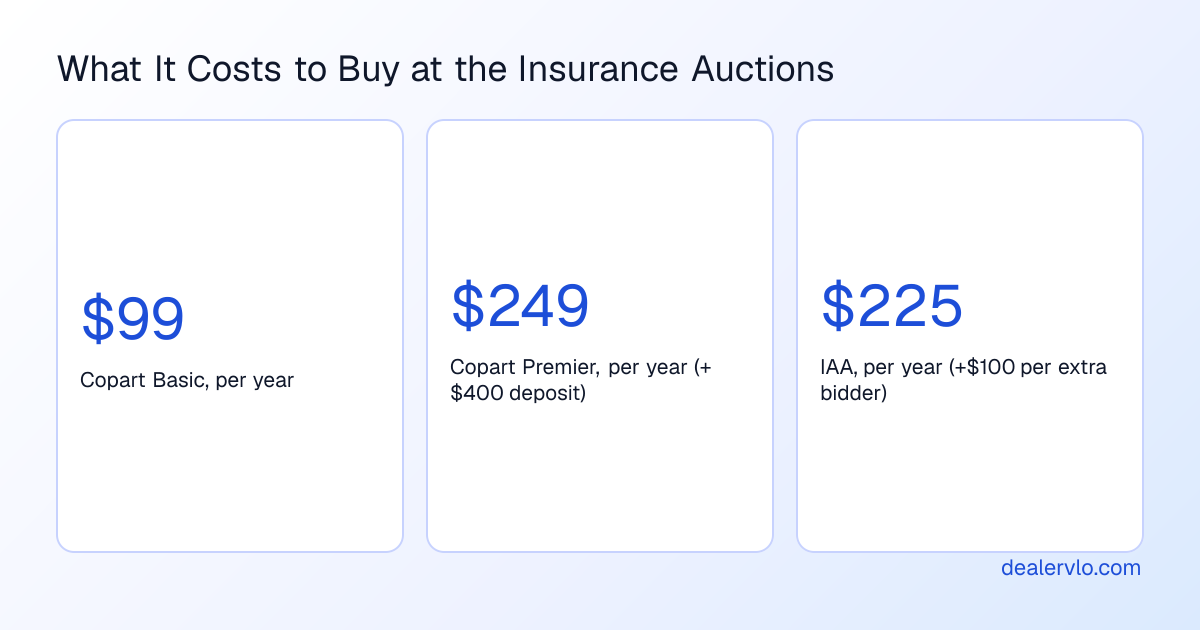
- **Membership:** Copart Basic is $99 a year and Premier $249 plus a $400 deposit. IAA is $225 a year, plus $100 for each additional bidder.
- **Buyer protection:** Copart has a Member Protection Pledge (below). IAA sends disputes to binding arbitration.
- **Storage and pickup:** Copart gives three free days including sale day. IAA's free days and daily rates are set by each branch.
In practice, most dealers register at both and buy where the cars they want are sitting, since transport from a far yard can wipe out a good bid.
## Step 1: Register as a licensed business buyer
Both auctions treat a licensed dealer as a business buyer, which opens inventory the public can't bid on directly.
- **Copart:** you upload your ID, dealer license, resale or tax-exempt certificate, and a Limited Power of Attorney (which Copart uses to handle titles for you). Copart says review usually takes about one business day. Membership tier doesn't change which lots you can bid on; the law of the state where the car is located does.
- **IAA:** you register as a licensed business buyer with an auto-related business license and a resale certificate to buy tax-free. The membership fee is $225 a year.
## Step 2: Check your state's salvage rules
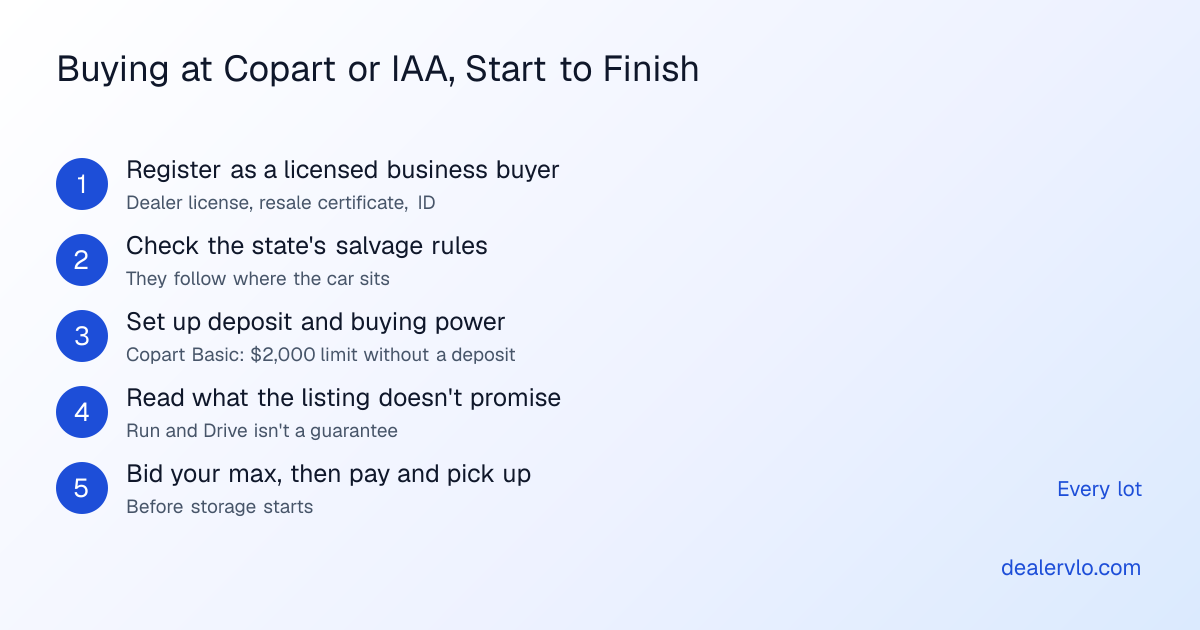
Who can buy a salvage title depends on the state where the car is located. [Copart's state licensing overview](https://www.copart.com/content/us/en/licensing/licensingoverview) shows licensed dealers can buy salvage in nearly every state, with exceptions. [IAA's licensing article](https://help.iaai.com/s/article/Additional-State-Licensing-Requirements-1590513134867?language=en_US) (November 2024) lists the add-ons:
- **Michigan:** a Salvage Vehicle Agent license ($50 ID card, $160 wall certificate, with fingerprinting).
- **Alabama:** a buyer ID card for salvage ($10).
- **Wisconsin:** a bid card for buying damaged vehicles, which Copart applies to business buyers even on titled cars.
- **Illinois:** salvage is limited to dismantlers at Copart. The Illinois Secretary of State also says Illinois dealers can't sell salvage vehicles to the public.
- **Utah and Nevada:** IAA lists salvage buyer cards for businesses based in those states.
Confirm the credential with your state before you need it, since the auctions restate these rules but the state issues them. When you can't buy a lot directly, the fallback is a broker: you buy from the broker, not the auction, and pay their fee on top.
## Step 3: Deposits and buying power
**Copart:** a Basic member can bid up to $2,000 without a deposit; above that, Copart requires a deposit of 10% of your total bids. Premier members put down a $400 deposit and can bid up to $100,000 a day. Upgrading from Basic to Premier costs $159.
**IAA:** IAA doesn't publish a single buying-power formula; it's set on your account, so ask your IAA rep before you need a bigger limit.
## Step 4: Read the listing, and what it doesn't promise
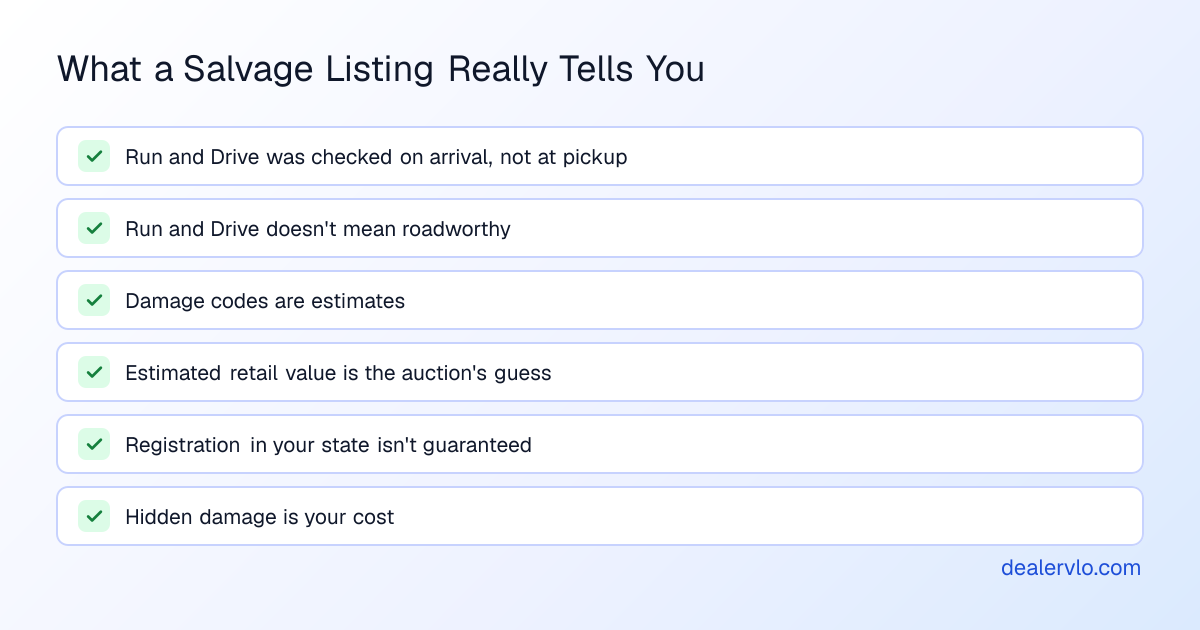
The labels are useful, but they describe the car when it arrived at the yard, and both auctions say so:
- **Copart Run and Drive:** at the time it was inventoried, the car started under its own power or with a jump box, was put into gear, and moved forward. Copart says the designation isn't a guarantee.
- **Copart Engine Start Program:** when the car arrived, Copart verified it started and ran at idle, with no guarantee it will at sale or pickup.
- **Copart Enhanced Vehicle:** the seller authorized a service like a wash or protective covering. It says nothing about condition.
- **IAA Run and Drive:** on arrival, the engine started (with or without a jump) and idled, forward and reverse engaged, and the steering wheel turned a full rotation each way. IAA says that doesn't mean the car is roadworthy, and it isn't guaranteed at pickup.
- **IAA Vehicle Score:** a 0–50 damage score that IAA's auction rules call "a subjective estimate," with no guarantee the vehicle can be repaired or that it runs.
Damage codes and estimated retail values are estimates too. If you can, look before you bid. IAA branches offer in-person previews (the two we checked hold one the day before the sale, 10 a.m. to 2 p.m.), and IAA works with a third-party inspection service. Copart doesn't allow tools in its yards, including code readers and jump boxes, so an in-person look is a visual one. Then price the car from the branded retail value, not the listing's estimate. The [salvage rebuild profit calculator](/tools/salvage-rebuild-profit-calculator) does that math.
## Step 5: Bid to your max
**Copart:** place a preliminary bid before the sale (Copart bids for you up to your max), then bid live in the online auction. Some lots offer Buy It Now. A Make an Offer is binding for two business days, and lots sold "On Approval" give the seller until the next business day to accept.
**IAA:** proxy bids go in up to an hour before the sale, then the live online auction runs; there are also Timed Auctions and Buy Now lots. One trap: if a seller counters within your proxy maximum, IAA accepts it automatically. Set your proxy at a price you'd actually pay.
The fees come on top of your bid, and on a cheap car they're a big share of it. On Copart's non-clean schedule for a standard buyer paying by a secured method, they come to about $875 on a $3,000 car and $1,270 on a $10,000 one. The [money post](/blog/can-you-make-money-selling-salvage-title-cars) breaks the fee table down.
Log the bid, the auction fees, and transport on the car the day you win it, in DealerVLO: start your 14-day free trial
## Step 6: Pay, pick up, and get the title
**Payment.**
- At IAA, payment is due by 5 p.m. local time two days after the award day.
- At Copart, a late-payment fee applies after three business days.
- How you pay changes your Copart fees. Wire, debit cards, ePay, and money transfers count as secured payment. Credit cards and wallet apps count as unsecured and carry the higher fee schedule.
- Neither auction takes a wire from a third party, so pay from the account the purchase is under.
**Storage.**
- Copart gives three free days including sale day.
- IAA sets free days and daily rates by branch: Los Angeles allows award day plus two days, then $50 a day; Providence award day plus three, then $60 a day.
- Some IAA branches require pickup within five business days.
**Pickup.** You can't drive a car off a Copart lot. Your transporter picks it up using a gate pass, so line up transport before you bid. The [auction transport guide](/blog/auction-transport-for-dealers) covers that side.
**Title.** Copart mails titles under the Limited Power of Attorney you signed at registration and charges a mailing fee, or your transporter can carry it. At IAA, unclaimed titles are eventually destroyed, so don't leave one sitting. Once it's home, the salvage title starts the [rebuild and disclosure process for your state](/blog/salvage-title-disclosure-by-state).
## What protection you actually have
Both auctions sell as-is. [Copart's terms](https://www.copart.com/content/us/en/member-terms-and-conditions) say vehicles may require substantial repairs and expense and aren't guaranteed to be registrable in any state. IAA sells "AS IS, WHERE IS" and sends disputes to binding arbitration.
Copart's [Member Protection Pledge](https://www.copart.com/content/us/en/Member-Protection-Pledge) is a narrow safety net on purchases under $50,000. It covers a wrong year, make, or model, an odometer off by more than 1,000 miles on a car under 10 years old, title documents that don't match the listed title state and type, unannounced liens, and ownership problems.
- **The claim windows are short:** "at time of delivery" for photos that don't match, 24 hours after delivery for year/make/model, odometer, or an unbranded title that turns out to be branded, and 90 days for ownership and liens.
- **The exclusions are broad:** cosmetic damage, damage that wouldn't show in a photo, and a title you can't register.
It's not condition arbitration. Hidden mechanical damage is yours.
## Where DealerVLO fits
DealerVLO is the DMS I built for my own lot in Tewksbury. It doesn't connect to Copart or IAA, bid for you, book transport, or pull history reports. What it does is keep the real cost of every auction car on the car itself. The buyer fee, transport, each part, the inspection fee, and the history report each go on as their own line, roll into the car's all-in cost and margin, and sit next to its days in inventory. After a few salvage buys, you'll know which yards and which kinds of damage actually made you money.
It's $29 a month, flat, with unlimited users.
## Frequently asked questions
### Can a dealer buy from Copart without a broker?
Usually, yes. Copart's state licensing overview shows licensed dealers can buy salvage vehicles in nearly every state; the public is the group that typically needs a broker. The rules follow the state where the car is located, and a few states add their own credential: Michigan and Alabama require a bid card for salvage, Illinois limits salvage to dismantlers, and Wisconsin requires a bid card for business buyers.
### What does Run and Drive mean on Copart?
Copart says a Run and Drive vehicle, at the time it was inventoried, started under its own power or with a jump box, was put into gear, and moved forward. Copart states the designation is not a guarantee. It says nothing about how far the car can go, how it brakes, or whether it'll still run at pickup.
### Is IAA better than Copart for dealers?
Neither is better across the board. IAA's standard licensed-buyer fee schedule matches Copart's non-clean-title secured schedule row for row, and both sell as-is. The differences are membership cost (Copart Basic $99 or Premier $249 a year; IAA $225 a year), payment and storage rules that vary by yard, and Copart's Member Protection Pledge. Most dealers buy where the cars they want are sitting.
### How long do you have to pay at Copart and IAA?
At IAA, payment is due by 5 p.m. local time two days after the award day. Copart charges a late-payment fee if you don't pay within three business days. Both refuse payment from a third party, so wire from the account the purchase is under.
### How much is a Copart membership for a dealer?
Copart's Basic membership is $99 a year with a $2,000 bid limit before a deposit is required (10% of total bids above that). Premier is $249 a year plus a $400 deposit for bidding up to $100,000 a day. IAA's membership is $225 a year, plus $100 a year for each additional bidder.
### Can you drive a car out of Copart?
No. Copart doesn't let vehicles be driven off the lot. Your transporter picks it up with the gate pass, and the car moves on a truck or tow. Free storage is three days including sale day at Copart; IAA's free days and daily rates vary by branch.
## Bottom line
Buying at Copart and IAA as a dealer is mostly paperwork and discipline. Register as a business buyer, confirm your state's salvage credential before you need it, and treat every label on the listing as a description of the car on the day it arrived, not a promise. Then bid your max, pay from your own account inside the deadline, and have transport lined up before the free storage runs out. The profit is decided by your bid, so price the branded retail first.
I built DealerVLO for my own lot, and it keeps every auction car's real cost, from the buyer fee to the last part, on the car. Try it free for 14 days.
See what every auction buy really cost and made in DealerVLO: start your 14-day free trial
---
## FAQ
### Can a dealer buy from Copart without a broker?
Usually, yes. Copart's state licensing overview shows licensed dealers can buy salvage vehicles in nearly every state; the public is the group that typically needs a broker. The rules follow the state where the car is located, and a few states add their own credential: Michigan and Alabama require a bid card for salvage, Illinois limits salvage to dismantlers, and Wisconsin requires a bid card for business buyers.
### What does Run and Drive mean on Copart?
Copart says a Run and Drive vehicle, at the time it was inventoried, started under its own power or with a jump box, was put into gear, and moved forward. Copart states the designation is not a guarantee. It says nothing about how far the car can go, how it brakes, or whether it'll still run at pickup.
### Is IAA better than Copart for dealers?
Neither is better across the board. IAA's standard licensed-buyer fee schedule matches Copart's non-clean-title secured schedule row for row, and both sell as-is. The differences are membership cost (Copart Basic $99 or Premier $249 a year; IAA $225 a year), payment and storage rules that vary by yard, and Copart's Member Protection Pledge. Most dealers buy where the cars they want are sitting.
### How long do you have to pay at Copart and IAA?
At IAA, payment is due by 5 p.m. local time two days after the award day. Copart charges a late-payment fee if you don't pay within three business days. Both refuse payment from a third party, so wire from the account the purchase is under.
### How much is a Copart membership for a dealer?
Copart's Basic membership is $99 a year with a $2,000 bid limit before a deposit is required (10% of total bids above that). Premier is $249 a year plus a $400 deposit for bidding up to $100,000 a day. IAA's membership is $225 a year, plus $100 a year for each additional bidder.
### Can you drive a car out of Copart?
No. Copart doesn't let vehicles be driven off the lot. Your transporter picks it up with the gate pass, and the car moves on a truck or tow. Free storage is three days including sale day at Copart; IAA's free days and daily rates vary by branch.