# Dealer Pack on Used Cars: What Goes In It and How to Set Yours
> A dealer pack is an internal cost added to every car. What belongs in it, hard vs. soft pack, and how to set yours from your own last 90 days of numbers.
- Source: https://www.dealervlo.com/blog/dealer-pack-used-cars
- Published: 2026-10-11
- Author: Chris Abouraad
- Tags: profit, pricing, operations, economics
---
A dealer pack is a fixed amount you add to every car's cost to cover real costs that don't belong to any one car: the recon you missed when you priced it, the goodwill repair after the sale, the shop supplies. It's internal. It never shows up on the buyer's paperwork. The right size comes from your own last 90 days of numbers, not from a range someone posted online.
That last part matters, because most of what you'll read about packs either quotes a "typical" number with no source or argues about whether packs should exist at all. This post does neither. It covers what belongs in a pack, what stays on the car, hard pack vs. soft pack, and a method you can run on your own books this afternoon. (If you're a buyer who saw a "pack" or add-on line on a buyer's order, that's a different issue; start with [the FTC's pricing rules for dealers](/blog/ftc-price-transparency-faqs-used-car-dealers).)
Add your pack as a cost line on every car and see true gross per deal in DealerVLO: start your 14-day free trial
## What a dealer pack is, and what it isn't
A pack is a cost you add to each car on your side of the ledger. If a car cost you $9,500 at the auction plus $900 in recon, and you carry a $150 pack, you treat that car as a $10,550 car when you measure the deal. The buyer never sees the $150. It changes the gross you look at, not the price you ask.
Three things get confused with it:
- **A doc fee.** That's charged to the buyer and appears on the buyer's order. A pack is never a line item the buyer pays. The two have nothing to do with each other.
- **Payment packing.** That's quietly stuffing add-ons into a buyer's monthly payment, and it's the kind of thing the FTC goes after; in August 2024 it [sued the dealer group Asbury Automotive over add-on charges at three Texas dealerships](https://consumer.ftc.gov/consumer-alerts/2024/08/car-dealerships-cant-charge-you-add-ons-you-dont-want). A pack never touches the buyer's numbers.
- **Your overhead.** Rent and payroll are real costs of selling cars, but whether they go in the pack is a choice you make on purpose (more on that below). They don't belong there by default.
## Hard pack vs. soft pack
You'll hear both terms, and they don't always mean the same thing.
In accounting terms, which is how David Keller, a CPA, laid it out in [Auto Dealer Today](https://www.autodealertodaymagazine.com/articles/identify-savings-in-these-dealership-operations): a **hard pack** is booked into the car's inventory cost, so the car costs more on your books. A **soft pack** only lowers the gross used to figure commission and never changes the car's cost.
Other people use the words for something else: hard meaning the same dollar amount on every car, soft meaning it varies by car. Neither usage is wrong, but if you have a salesperson on a commission, write down which one you mean. A pay plan that says "commission after pack" with no definition of the pack is an argument waiting to happen. Our [commission pay plan guide](/blog/used-car-sales-commission-pay-plan) covers the pay side.
How a hard pack gets booked is an accounting question, not a pricing one. The New Hampshire Automobile Dealers Association's piece on [pack accounting](https://www.nhada.com/news/pack-accounting-getting-the-balance-right) (September 2026, written by an audit manager) explains that a pack added to inventory has to come back out as cars sell, and that packs sitting on unsold cars may need a year-end adjustment. Have your CPA decide how yours is booked.
## What goes in the pack, and what stays on the car
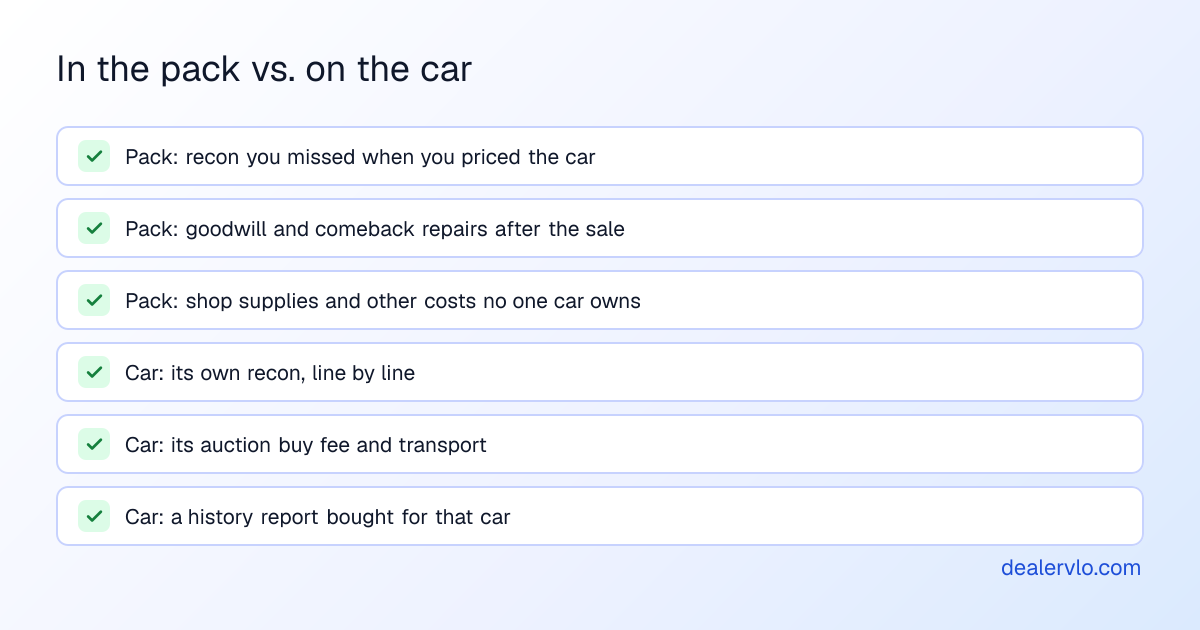
Here's the rule that keeps this clean: **if you can name the car, the cost goes on that car.** The car's recon, its auction buy fee, its transport, the history report you bought for it. Those are that car's costs, and they belong on its own cost lines where you can see them.
The pack is for costs you know will happen but can't assign to a specific car:
- **Recon you missed.** The A/C that died a week after you priced the car. The tire you didn't catch at inspection.
- **Goodwill and comeback repairs.** The battery you replace for a customer two weeks after the sale because it's the right thing to do.
- **Shop supplies and odds and ends.** The fluids, the detail chemicals, the plates and frames bought by the case.
- **Transport, if you pay it as one bill** and can't split it by car.
Then there's the bigger decision: **a narrow pack or an overhead pack.** A narrow pack covers only the per-car surprises above, and your rent, payroll and advertising stay on your P&L as overhead. An overhead pack spreads all of that across every car too, so the gross you see on a deal is close to net.
I'd keep the pack narrow. Overhead belongs on the P&L, where you can see it move month to month. Spread it into every car and a slow month quietly changes your "cost" on cars that haven't changed at all. If you want the overhead-per-car number anyway, it's worth knowing; our [monthly cost to run a lot](/blog/cost-to-run-a-used-car-lot-per-month) post walks through it. Just keep it as its own number rather than burying it in the pack.
## How to set your pack from your last 90 days
You don't need anyone's benchmark. You need three months of your own numbers.
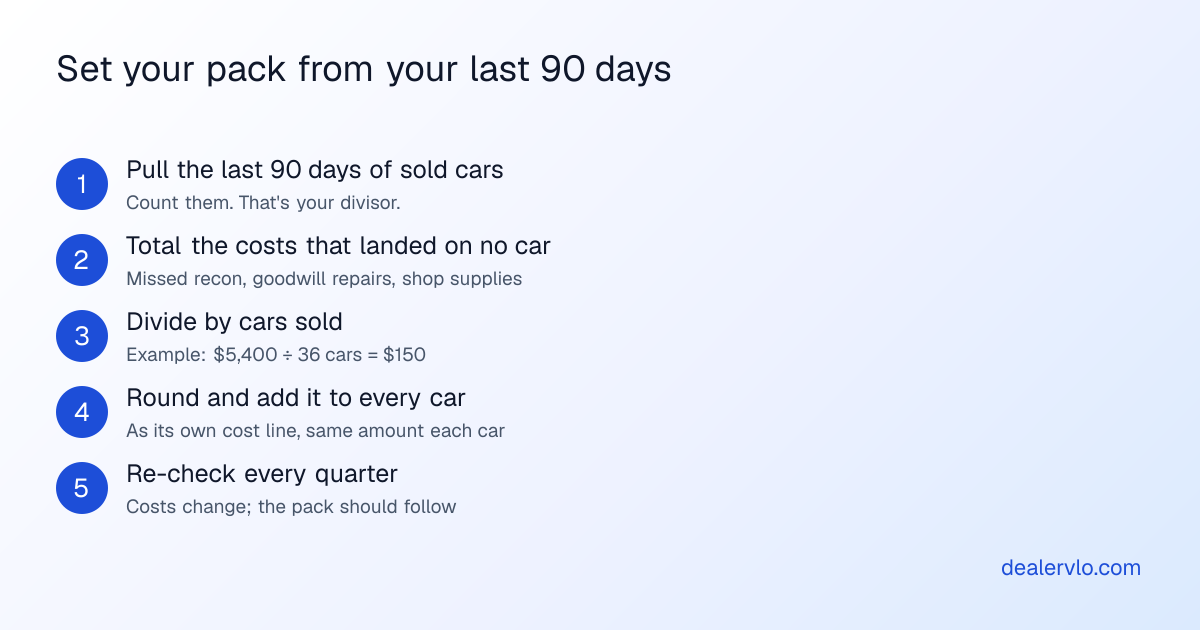
1. **Pull the cars you sold in the last 90 days** and count them. That's your divisor.
2. **Total the costs that landed on no car** in the same 90 days: the comeback repairs, the missed recon you paid for after pricing, the shop supplies, the pooled transport bills.
3. **Divide** the total by the number of cars sold.
4. **Round it** and add that amount to every car going forward, the same on each one.
5. **Re-check it every quarter.** If your comebacks drop because you started inspecting better, your pack should drop too.
Here's what that looks like with example numbers. Say you sold 36 cars in the last 90 days. In that stretch you paid $2,600 in goodwill and comeback repairs, $1,900 in recon you found after cars were already priced, and $900 in shop supplies. That's $5,400 that didn't land on any car. $5,400 ÷ 36 = $150 a car. That's your pack.
For comparison, an overhead pack on the same example lot: if overhead runs $12,000 a month, that's $36,000 over 90 days, ÷ 36 cars = $1,000 a car. Both are honest numbers. They answer different questions, which is why you have to pick on purpose.
To see what your pack does to one real deal, run a recent car through the free calculator below with your pack added to its costs.
## A pack that's too small vs. too big
Too small and your per-car gross looks better than it is. Every deal looks fine, and then the month closes and the money isn't there, because the comebacks and missed recon were real and nobody put them anywhere.
Too big has its own problem, and it's the one the critics of packs focus on. Dale Pollak, who founded vAuto, has argued for years that big packs [act like a tax on your own inventory](https://www.autoremarketing.com/guest_content/3-ways-packs-prove-problematic-dealers/): appraisers and buyers who see a bloated cost start passing on cars that would have made money, and cars sit while you hold out for a gross the market won't pay. Tommy Gibbs makes a similar point about [packs in a price-to-market world](https://tommygibbstraining.com/do-packs-make-sense-in-todays-market/). You don't have to agree with them to see the risk: a pack bigger than the costs it stands for makes good cars look bad.
Here's the same example car under four different packs. It cost $10,400 all-in and sold for $13,500.
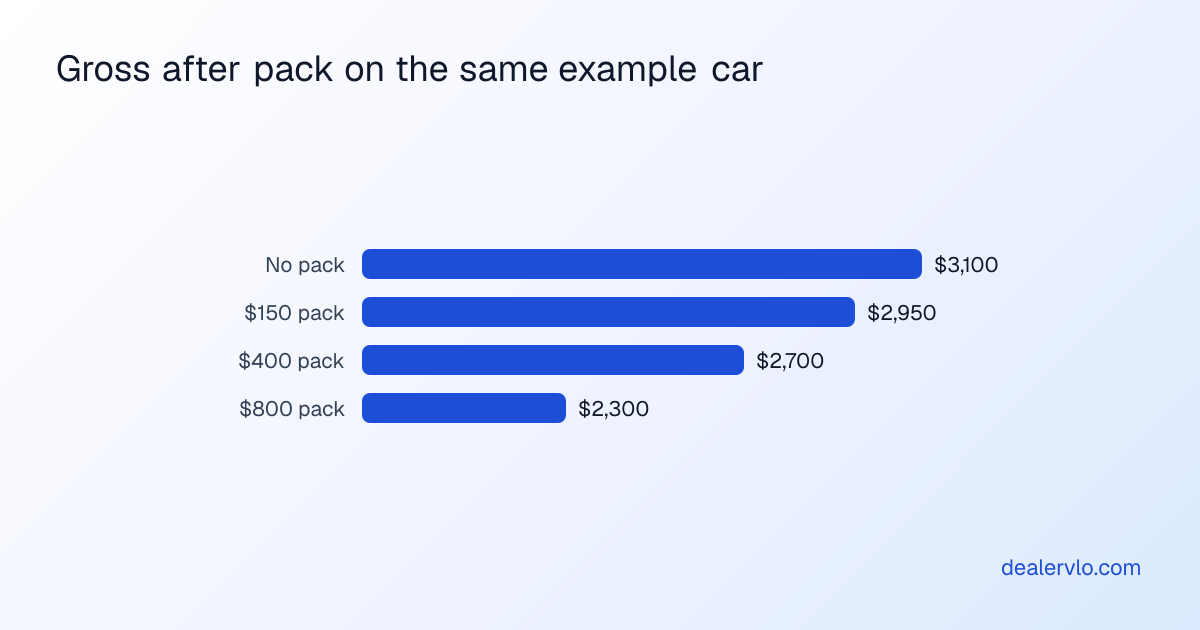
Nothing about that car changed. Only the number you're judging it by did. That's why the pack should match your real surprise costs and nothing more.
## How the pack changes your pricing
It shouldn't change your asking price much at all. Your asking price comes from the market: what comparable cars are listed for and how fast they're selling, which our [pricing from market comps](/blog/how-to-price-a-used-car-from-market-comps) guide covers step by step. Cost-plus-pack pricing is how you end up the highest-priced car on the page.
Where the pack does matter:
- **Your floor.** It tells you the lowest price you'll accept and still cover what the car really cost you.
- **Your buy number.** When you appraise a trade or bid at the auction, the pack is part of the all-in cost you're working back from.
- **Your read on which cars made money.** That's the whole point of it.
Log the pack on each car and see gross after pack on every deal: try DealerVLO free for 14 days
## Tracking a pack without counting it twice
Here's the trap. If you add a pack to every car and also record the same costs as expenses on your P&L, you've counted them twice, and your P&L will say you made less than you did.
In DealerVLO there's no pack setting. You add the pack yourself as its own line on each car's cost list, right next to the recon lines: vendor, description, cost. Every cost line rolls into that car's all-in cost and margin, so the car's gross on the sales report is already gross after pack. The deal itself computes front-end and F&I gross live as you write it.
Those cost lines also count in the P&L's Reconditioning total for the cars you sold. So pick one home for each cost:
- **Costs you pack:** put them in the pack line on each car, and don't also enter them as P&L expenses.
- **Costs you don't pack** (rent, payroll, advertising): enter them as P&L expenses by category, one-time or recurring.
Do it that way and the two reports agree with each other: the sales report shows gross after pack per car, and the P&L shows that gross minus your real overhead, with nothing counted twice. DealerVLO doesn't connect to QuickBooks or any outside accounting software, so if your CPA books a hard pack in your accounting system, tell them how you're tracking it here.
## Frequently asked questions
### What is a dealer pack on a used car?
A dealer pack is a fixed amount a dealer adds to each car's cost to cover real costs that can't be pinned to one car, such as the recon you miss at inspection, goodwill repairs after the sale, and shop supplies. It's internal: it never appears on the buyer's paperwork and the buyer doesn't pay it as a line item. It lowers the gross you see on each car so that gross is closer to what you actually keep.
### How much should my dealer pack be?
There's no market number worth copying. Set it from your own books: add up the last 90 days of costs that didn't land on any specific car, divide by the cars you sold in those 90 days, and round. Re-check it every quarter. Any "typical pack" range you read online describes someone else's costs, not yours.
### What goes in a dealer pack?
Costs you know will happen but can't assign to one car: recon you missed when you priced the car, goodwill and comeback repairs after the sale, shop supplies, and a share of transport if you pay it as one bill. Anything you can tie to a specific car (its recon, its auction fee, its transport, its history report) belongs on that car's own cost lines, not in the pack.
### What's the difference between a hard pack and a soft pack?
In accounting terms, a hard pack is booked into the car's inventory cost, so it changes what the car costs on your books. A soft pack only reduces the gross used to figure commission and doesn't change the car's cost. Some stores use the words differently (hard meaning a fixed amount, soft meaning it varies by car), so define them in writing for your own lot.
### Is a dealer pack the same as a doc fee?
No. A doc fee is charged to the buyer and shows on the buyer's order. A pack is internal and never charged to the buyer as its own line. They're unrelated except that both affect what you keep on a deal.
### Does the customer pay the pack?
Not as a line item. The pack sits inside your cost, so it affects the gross you measure, not the price the buyer sees. Your asking price should still come from the market, not from cost plus pack.
### Should a small used car lot use a pack at all?
Only if you have real costs that don't land on any car and you want your per-car gross to account for them. If every cost you have already goes on a specific car's cost lines, you may not need one. A pack that's bigger than those costs just hides which cars actually made money.
### Is a recon reserve the same thing as a pack?
It's the most common thing to put in one. A recon reserve covers the repairs you find after a car is priced or sold. Treat it as one line in your pack, sized from what those surprises actually cost you over the last few months.
## Bottom line
A pack is a tool for honesty, not a way to make cars look expensive. Keep it narrow, build it from the costs that really land on no car, divide by what you actually sold, and re-check it every quarter. Put every cost you can name on the car itself, keep overhead on the P&L, and make sure nothing is counted in both places. Do that and the gross you see on each car is the gross you keep.
If you'd rather see that on every car without a spreadsheet, DealerVLO tracks each car's cost lines (pack included), shows gross per deal on the sales report, and runs your P&L, all for $29 a month flat with unlimited users. See [what's included](/pricing).
Track every car's real cost and gross after pack in DealerVLO: start your free 14-day trial
---
## FAQ
### What is a dealer pack on a used car?
A dealer pack is a fixed amount a dealer adds to each car's cost to cover real costs that can't be pinned to one car, such as the recon you miss at inspection, goodwill repairs after the sale, and shop supplies. It's internal: it never appears on the buyer's paperwork and the buyer doesn't pay it as a line item. It lowers the gross you see on each car so that gross is closer to what you actually keep.
### How much should my dealer pack be?
There's no market number worth copying. Set it from your own books: add up the last 90 days of costs that didn't land on any specific car, divide by the cars you sold in those 90 days, and round. Re-check it every quarter. Any 'typical pack' range you read online describes someone else's costs, not yours.
### What goes in a dealer pack?
Costs you know will happen but can't assign to one car: recon you missed when you priced the car, goodwill and comeback repairs after the sale, shop supplies, and a share of transport if you pay it as one bill. Anything you can tie to a specific car (its recon, its auction fee, its transport, its history report) belongs on that car's own cost lines, not in the pack.
### What's the difference between a hard pack and a soft pack?
In accounting terms, a hard pack is booked into the car's inventory cost, so it changes what the car costs on your books. A soft pack only reduces the gross used to figure commission and doesn't change the car's cost. Some stores use the words differently (hard meaning a fixed amount, soft meaning it varies by car), so define them in writing for your own lot.
### Is a dealer pack the same as a doc fee?
No. A doc fee is charged to the buyer and shows on the buyer's order. A pack is internal and never charged to the buyer as its own line. They're unrelated except that both affect what you keep on a deal.
### Does the customer pay the pack?
Not as a line item. The pack sits inside your cost, so it affects the gross you measure, not the price the buyer sees. Your asking price should still come from the market, not from cost plus pack.
### Should a small used car lot use a pack at all?
Only if you have real costs that don't land on any car and you want your per-car gross to account for them. If every cost you have already goes on a specific car's cost lines, you may not need one. A pack that's bigger than those costs just hides which cars actually made money.
### Is a recon reserve the same thing as a pack?
It's the most common thing to put in one. A recon reserve covers the repairs you find after a car is priced or sold. Treat it as one line in your pack, sized from what those surprises actually cost you over the last few months.