# What does it cost to run a used-car lot each month? A line-by-line budget
> The monthly costs of running a used-car lot, line by line: what drives each one, how to estimate yours, a worked example, and the overhead-per-car number that matters.
- Source: https://www.dealervlo.com/blog/cost-to-run-a-used-car-lot-per-month
- Published: 2026-09-24
- Updated: 2026-09-24
- Author: Chris Abouraad
- Tags: dealer economics, operations, profit
---
The startup cost gets all the attention, but it's a one-time number. What decides whether a lot survives is the monthly nut: the bills that come due whether you sell three cars or thirty. Most dealers who get in trouble didn't overspend opening; they never added up what the place costs to run, so they never knew how much gross each car had to bring in.
Here's how to build that number line by line: what goes in it, what drives each cost, a worked example you can copy, and the one figure that tells you whether your lot is making money: overhead per car.
## The short answer
There's no honest single number for what a used-car lot costs to run. It swings with three things: your rent, your payroll, and how much inventory you floor. What you can do is add up about ten line items, then divide by the cars you sell. That gives you two numbers you should know cold: your **monthly fixed cost** and your **overhead per car**.
## The fixed costs: your monthly nut
These are the bills you pay whether or not a single car goes out the gate.
- **Lot rent or lease.** Usually the first or second biggest line. Our [startup cost breakdown](/blog/cost-to-open-used-car-dealership) puts a small commercial lot at $1,500 to $5,000 a month in most markets. Add property tax or common-area charges if your lease passes them through.
- **Payroll.** You, salespeople, a detailer, office help, plus payroll taxes. Payroll is the line that varies most from lot to lot, from nearly nothing at a one-person operation to the biggest bill in the building.
- **Insurance.** Garage liability plus a dealer open-lot policy for the inventory. The startup breakdown puts it at $3,000 to $10,000 a year, which is roughly $250 to $830 a month.
- **Utilities, phone, internet, and lot upkeep.** Lights, signage, repairs, snow removal if you're in the north.
- **Software.** DMS, website, CRM, e-signatures. This is where lots quietly overspend by stacking vendors, and per-user fees climb as you hire. We broke that down in [flat-fee versus per-user dealer software](/blog/dealer-software-cost-flat-fee-vs-per-user). DealerVLO puts the DMS, dealer website, listing feeds, lead inbox, and e-signatures in one plan at $29 a month for unlimited users, which is why software is the smallest line in the example below.
- **Advertising and listing sites.** Listing-site packages vary a lot by site, market, and tier, so get current quotes rather than guessing.
- **Bookkeeping and accounting.** A bookkeeper, plus your CPA at tax time.
- **License and bond renewals.** These come once a year, so divide them by 12. The [dealer license cost by state](/guide/dealer-license-cost-by-state) guide has the bond amounts for each state.
## The costs that move with your inventory
Some costs rise and fall with how many cars you carry and sell:
- **Floor-plan interest.** A monthly bill that grows with the inventory you floor. As an example, $200,000 floored at 7% costs about $1,167 a month in interest ($200,000 × 7% ÷ 12). Your rate and balance will differ; the [floor plan calculator](/tools/floor-plan-calculator) does it with your numbers, and [how dealer floor plans work](/blog/how-dealer-floor-plans-work) covers curtailments.
- **Reconditioning.** The startup breakdown puts it at $500 to $1,500 per unit.
- **Auction fees and transport.** $200 to $500 per purchased unit in the same breakdown.
- **Commissions and per-car fees.** Sales commissions, and any per-vehicle listing or posting charges.
Recon, auction fees, and transport belong in each car's cost, not your overhead. Put them on the vehicle so each car's gross is real, and keep the monthly nut for the bills that don't belong to any one car. In DealerVLO, recon is logged line by line on each vehicle and rolls into that car's all-in cost, so the margin you see on the vehicle page already accounts for it.
## A worked example
These are **made-up round numbers** to show the math, not averages. Swap in your own.
Picture a small lot with a couple of employees that floors about $200,000 of inventory:
| Monthly cost | Example |
|---|---|
| Payroll | $9,000 |
| Lot rent | $3,000 |
| Advertising and listing sites | $1,500 |
| Floor-plan interest ($200,000 at 7%) | $1,167 |
| Utilities, phone, and upkeep | $600 |
| Insurance ($6,000 a year ÷ 12) | $500 |
| Bookkeeping | $400 |
| License and bond renewals ($1,800 a year ÷ 12) | $150 |
| Software (DealerVLO, flat) | $29 |
| **Total** | **$16,346** |
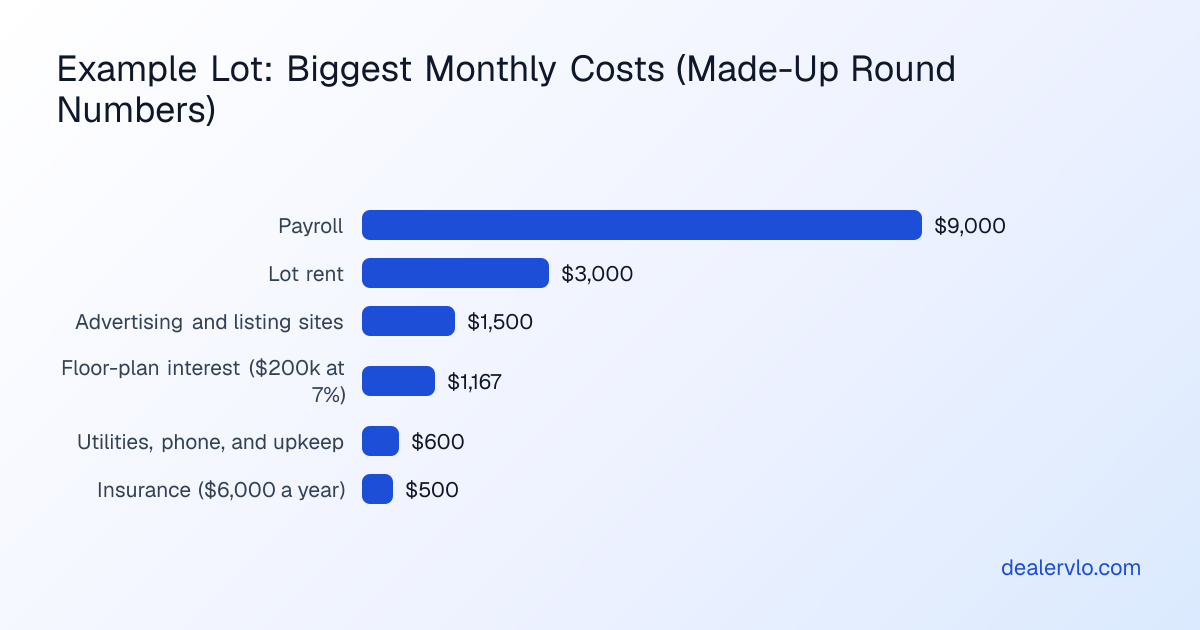
This table is the expenses screen in DealerVLO: enter each line once, mark the fixed ones as recurring monthly, and they carry forward every month without re-entering.
Put your own monthly costs into DealerVLO, free for 14 days
## The number that matters: overhead per car
Take the monthly total and divide by the cars you sell. For the example lot:
- **10 cars a month:** $16,346 ÷ 10 ≈ $1,635 per car
- **15 cars a month:** $16,346 ÷ 15 ≈ $1,090 per car
- **20 cars a month:** $16,346 ÷ 20 ≈ $817 per car
That's how much gross each car has to clear before it makes you a dollar. Look at how much it moves with volume: the same lot needs twice the gross per car at 10 sales as at 20. That's why a slow month hurts more than it feels like it should, and why [aged inventory](/blog/inventory-aging-automation-alerts-markdown-rules) is so expensive: it eats gross on cars that are already carrying their share of the nut.
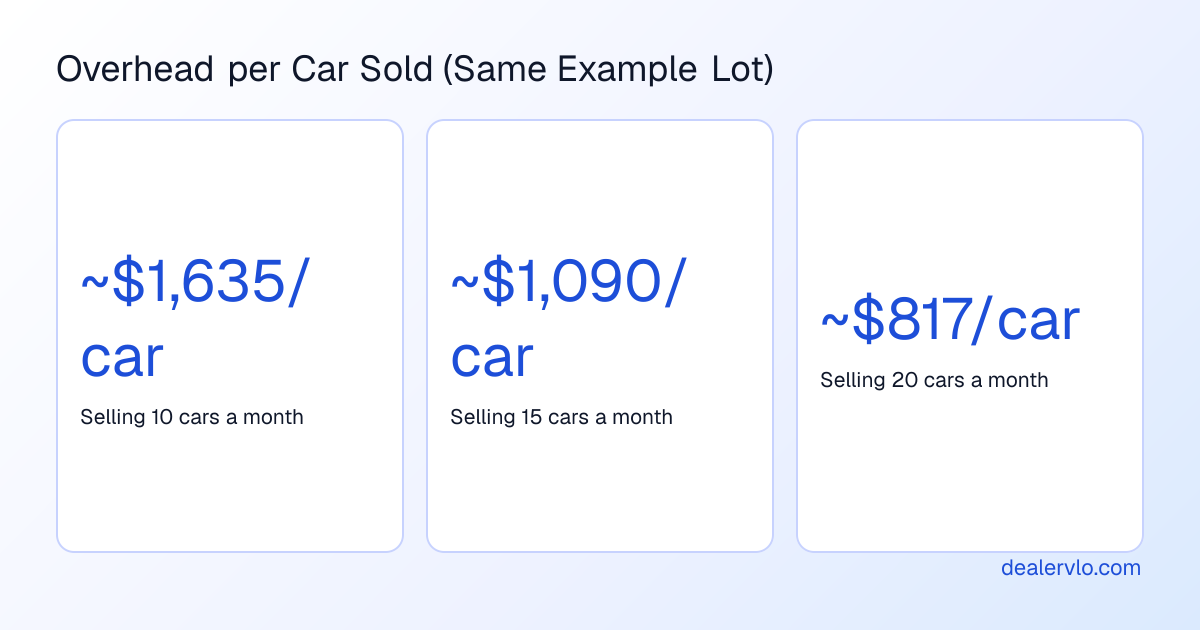
Compare your overhead per car with your average gross per car. If gross is lower, you're losing money on every sale no matter how busy the lot feels. [Gross versus net profit](/blog/used-car-dealership-gross-vs-net-profit) walks through that check, and the [break-even calculator](/tools/dealer-break-even-calculator) tells you how many cars you need to sell to cover the nut. DealerVLO's sales report shows front- and back-end gross on every deal, and its profit and loss subtracts the overhead you've recorded, so this comparison is on one screen instead of in a spreadsheet.
## Costs dealers forget to budget
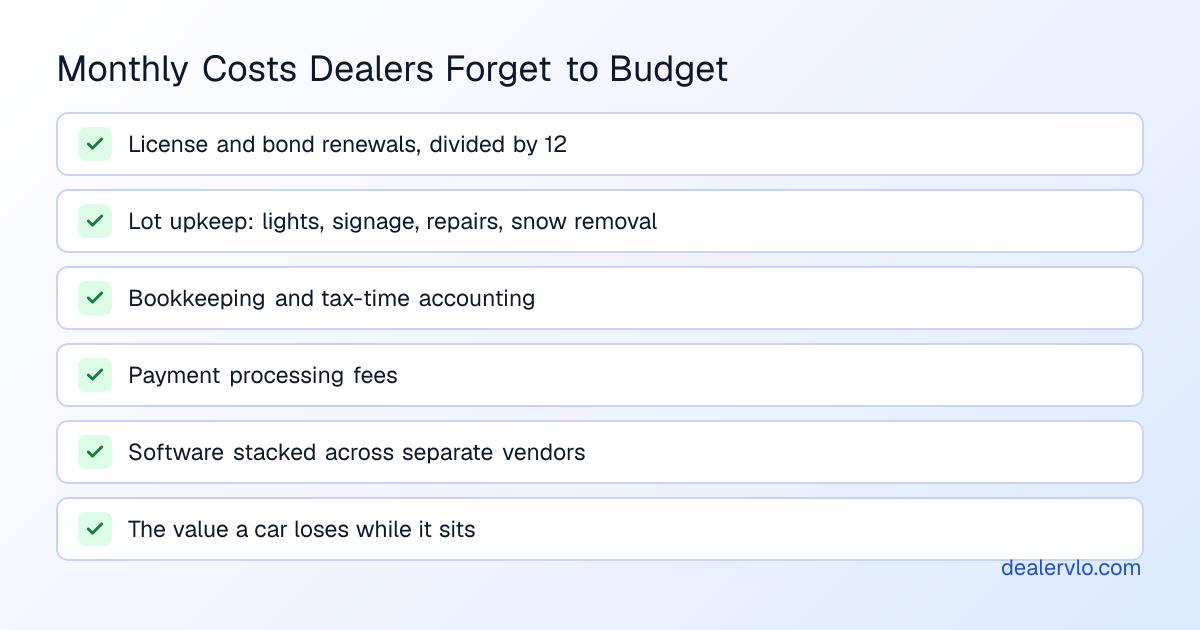
The last one is the sneaky one. Floor-plan interest shows up on a statement; the value a car loses while it sits doesn't. It only shows up as a smaller gross when you finally sell. That's why DealerVLO shows days in inventory on every car and flags anything past 60 days with "consider repricing," and the dashboard counts how many units are that old. For the weekly habit that keeps that number down, see our [inventory aging routine](/blog/inventory-aging-automation-alerts-markdown-rules).
## Tracking it in DealerVLO
I built DealerVLO for my own lot, and this is the part I wanted on one screen. You record your overhead once (rent, payroll, floor-plan interest, advertising, insurance, software) as a one-time or recurring monthly expense by category, and it flows into your profit and loss: gross profit minus overhead equals your real net. Recon is tracked line by line on each vehicle, so it rolls into that car's cost, and the sales report shows front- and back-end gross per deal. Our guide to [tracking expenses as a used-car dealer](/blog/how-to-track-expenses-used-car-dealer) walks through the habit.
See your real net profit in DealerVLO: start your free trial
## Frequently asked questions
### How much does it cost to run a used car lot per month?
There's no honest single number; it swings with your rent, your payroll, and how much inventory you floor. Add up your fixed monthly bills (rent, payroll, insurance, utilities and upkeep, software, advertising, bookkeeping, and your license and bond renewals divided by 12), add your floor-plan interest, and you have your monthly nut. In our worked example, a small lot with a couple of employees comes to about $16,300 a month, but that uses made-up round numbers to show the math; plug in your own.
### What is overhead per car?
It's your monthly fixed costs divided by the cars you sell that month. It tells you how much gross each car has to clear before it makes you a dollar. In our example, $16,346 a month is about $1,635 per car at 10 sales, $1,090 at 15, and $817 at 20.
### Should floor-plan interest count as overhead?
Track it either way, but be consistent. It's a monthly bill that rises with the inventory you carry, so many dealers watch it on its own line. If you'd rather assign it to each car, add each unit's interest to that car's cost instead, and leave it out of overhead so you don't count it twice.
### What's the easiest way to lower monthly costs on a used car lot?
Start with the bills that don't sell cars: stacked software subscriptions (a separate DMS, website, and CRM), per-user fees that climb as you hire, and floor-plan interest on cars that have sat too long. Rent and payroll are harder to move, so they're usually the last lever, not the first.
## Bottom line
Know your nut. Add up the ten or so bills that come due every month, divide by the cars you sell, and you have the gross each car has to clear before the lot makes money. Most dealers who get in trouble never ran that math until the bank account forced them to.
DealerVLO puts your overhead, your per-car costs, and your real net on one profit and loss, for $29 a month flat. [Start a free trial](/signup) and put your own numbers in.
---
## FAQ
### How much does it cost to run a used car lot per month?
There's no honest single number; it swings with your rent, your payroll, and how much inventory you floor. Add up your fixed monthly bills (rent, payroll, insurance, utilities and upkeep, software, advertising, bookkeeping, and your license and bond renewals divided by 12), add your floor-plan interest, and you have your monthly nut. In our worked example, a small lot with a couple of employees comes to about $16,300 a month, but that uses made-up round numbers to show the math; plug in your own.
### What is overhead per car?
It's your monthly fixed costs divided by the cars you sell that month. It tells you how much gross each car has to clear before it makes you a dollar. In our example, $16,346 a month is about $1,635 per car at 10 sales, $1,090 at 15, and $817 at 20.
### Should floor-plan interest count as overhead?
Track it either way, but be consistent. It's a monthly bill that rises with the inventory you carry, so many dealers watch it on its own line. If you'd rather assign it to each car, add each unit's interest to that car's cost instead, and leave it out of overhead so you don't count it twice.
### What's the easiest way to lower monthly costs on a used car lot?
Start with the bills that don't sell cars: stacked software subscriptions (a separate DMS, website, and CRM), per-user fees that climb as you hire, and floor-plan interest on cars that have sat too long. Rent and payroll are harder to move, so they're usually the last lever, not the first.