# Carfax vs AutoCheck for Dealers: Which History Report Earns Its Keep on a Small Lot
> Carfax vs AutoCheck for dealers: what each report is best at, why neither publishes dealer pricing, what to ask in a quote, and the cheap NMVTIS title check.
- Source: https://www.dealervlo.com/blog/carfax-vs-autocheck-for-dealers
- Published: 2026-10-03
- Updated: 2026-10-03
- Author: Chris Abouraad
- Tags: acquisition, auctions, vehicle history, carfax, autocheck
---
Every independent dealer ends up paying for a vehicle history report, and the question is which one. Carfax vs AutoCheck for dealers is a different question than it is for a shopper. You're using the report three ways: to decide what to bid at auction, to appraise a trade, and to reassure a retail buyer on your listing. The two products aren't equally strong at all three, and neither one publishes what a dealer subscription costs.
This post covers what each report is actually built for, based on what Experian and CARFAX say on their own pages, what to ask for in a quote, the federal NMVTIS title check most small lots skip, and what no history report will ever catch. No accuracy scores, because nobody publishes an honest one.
Decode every VIN you buy and track each car's all-in cost in DealerVLO: start your 14-day free trial
## Carfax vs AutoCheck for dealers: the short answer
AutoCheck is Experian's report, and Experian pitches it to dealers as a buying tool: auction announcements on the report, the AutoCheck Score, and sign-in from inside Manheim. CARFAX pitches its dealer product, CARFAX Advantage, on accident, damage, and service records and on the brand shoppers already know, with a listings product on top.
So the usual split is: AutoCheck leans toward the buy side, Carfax toward the sell side. That's a tendency, not a rule. Plenty of lots buy on Carfax and plenty retail with AutoCheck. And if your real worry is title brands, there's a cheaper federal check that covers that part (more below).
## What each report is best at: buying vs selling
Here's what each vendor's own pages say, as of October 3, 2026.
**AutoCheck (Experian).** Experian's [AutoCheck dealer page](https://www.experian.com/automotive/autocheck-business) leads with exclusive auction announcements on the report and the patented AutoCheck Score, which it says compares vehicles of similar age and class and predicts the likelihood a car will still be on the road in five years. Report sections include accident and damage, an odometer check, and a detailed history timeline.
**CARFAX.** The [CARFAX Advantage page](https://www.carfaxfordealers.com/advantage) pitches the most accident, damage, and service information and calls CARFAX the brand consumers know and trust.
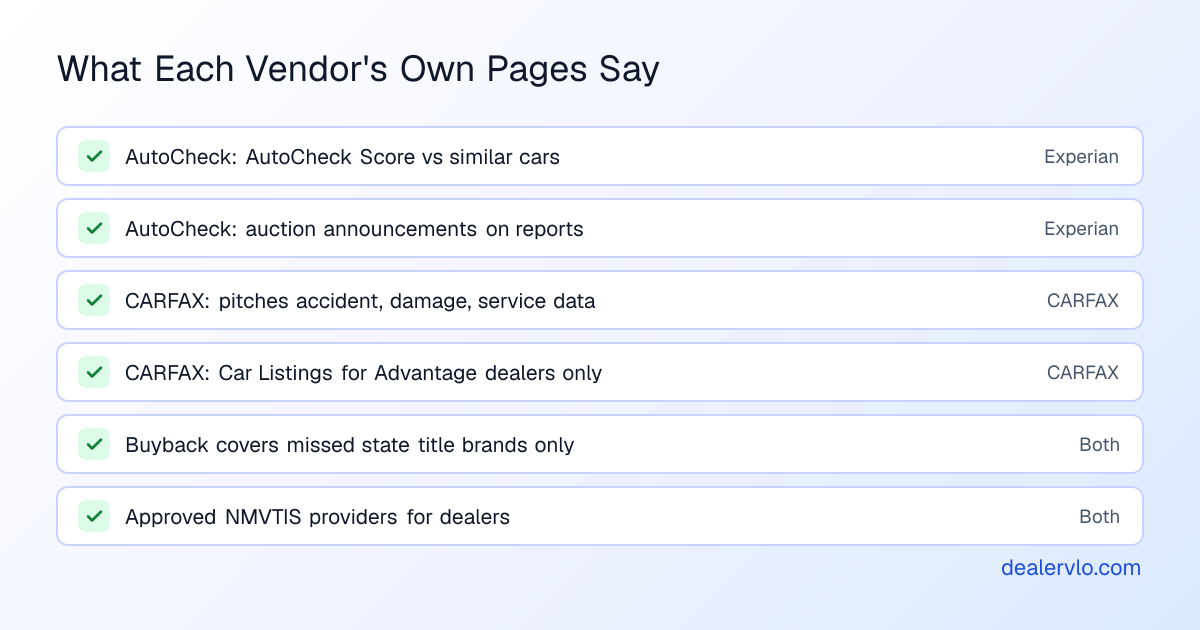
Both buyback programs are narrower than they sound. [AutoCheck Buyback Protection](https://www.autocheck.com/vehiclehistory/vehicle-buyback-protection) only applies to state-reported title brands the report missed, not to accidents or other records from commercial sources. The [CARFAX Buyback Guarantee](https://support.carfax.com/article/what-is-the-carfax-buyback-guarantee/) is likewise about DMV-issued title brands, such as salvage, flood, or not actual mileage, that were reported but left off the report. Neither one protects you from an unreported accident.
## AutoCheck at the auction lane
If you buy at Manheim, you'll see some AutoCheck data whether you subscribe or not. Manheim's July 2023 [marketplace notice](https://site.manheim.com/news/access-autocheck-reports-in-the-manheim-marketplace) says buyers see an abbreviated AutoCheck report on a listing, and AutoCheck subscribers can sign in through their Manheim account settings to view the full report. Manheim's [Simulcast buyer's guide](https://site.manheim.com/en/help/simulcast/simulcast_buyers_guide_en.html) lists linkable AutoCheck and Carfax reports on the vehicle in the lane, so Carfax subscribers aren't locked out either.
The practical point: whichever report you carry, pull the full report on your shortlist the night before, not while the car is on the block. Our [dealer auction buying guide](/blog/dealer-auction-buying-guide) covers the run-list routine, and [reading condition reports for red flags](/blog/dealer-auction-condition-reports-red-flags) covers the part history reports don't. If a title brand shows up after the sale, the auction's own policy decides your options, which is what the [arbitration guide](/blog/auction-arbitration-dispute-guide) walks through.
DealerVLO doesn't connect to Manheim, ACV, OPENLANE, or any other auction. Once you win a car, you add it by VIN and DealerVLO decodes it, then you log the buy fee, transport, and the report itself as cost lines on that car so its all-in cost is right from day one. Before you bid, the free [auction profit calculator](/tools/auction-profit-calculator) turns your resale and costs into a max bid.
## Carfax on your listings
On the sell side, the question is what shoppers see. CARFAX's [Car Listings page](https://www.carfaxfordealers.com/car-listings) says the product puts your inventory on CARFAX.com, and that only CARFAX Advantage dealers are eligible to upgrade to it. So a listings plan on CARFAX.com starts with the history subscription.
On the other big marketplaces, how a history link or badge appears depends on that site's own program and your report vendor's terms. Ask both reps, in writing, which sites your subscription covers before you assume a badge will show up.
In DealerVLO, your inventory feeds to CarGurus, Cars.com, and Autotrader once you enroll with each, and every feed carries the car's VIN. Your included dealer website carries the VIN on each car page too. DealerVLO does not pull, attach, or display Carfax or AutoCheck reports, and it doesn't add history badges. Those come from the report vendor and the listing site.
## What dealer subscriptions cost (and why neither publishes a price)
Neither vendor publishes dealer subscription pricing. As of October 3, 2026:
- **CARFAX for Dealers** routes pricing through a request form on its [home page](https://www.carfaxfordealers.com/), where "Pricing/Package Information" is one of the options.
- **Experian** says AutoCheck has unlimited plans with extras (open recall reports, vehicle listings, integrations, an account manager) and a monthly option for smaller dealers, and sends you to a contact form on its [dealer page](https://www.experian.com/automotive/autocheck-business).
A number in a forum thread is someone else's deal. Yours comes from a quote, so make the quotes comparable.
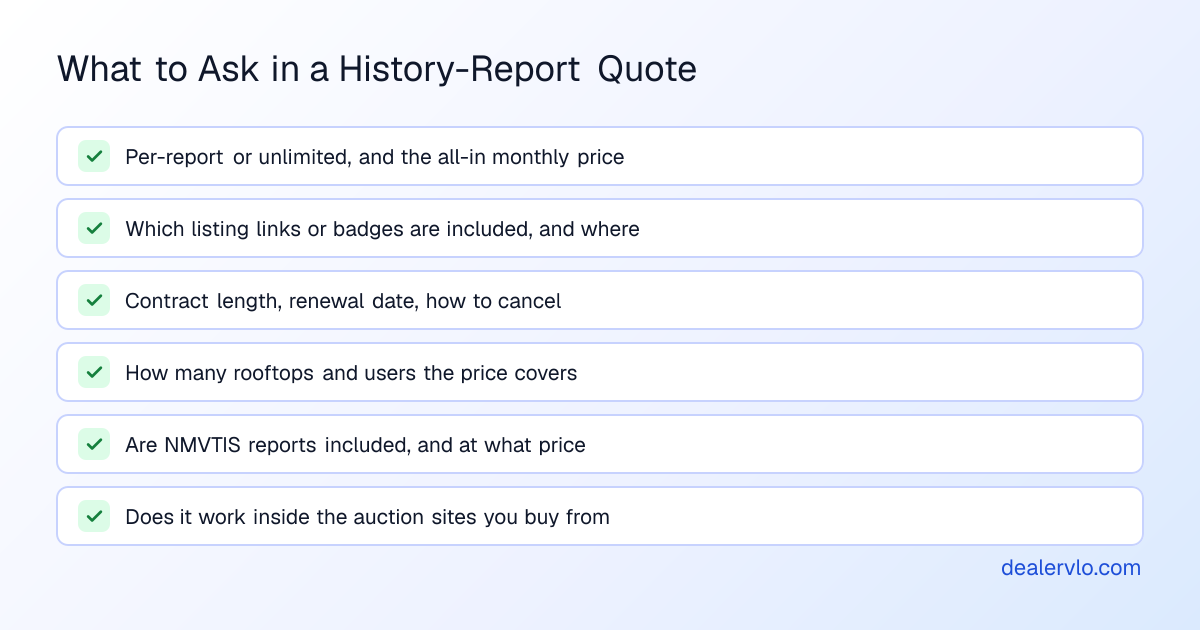
The per-report vs unlimited choice is volume math. Count how many VINs you actually run in a month, including cars you appraise and don't buy, then compare the per-report total to the unlimited price. A lot that runs a report on every trade appraisal burns through reports faster than one that only checks auction wins.
In DealerVLO, the car's page shows its cost, margin, and days on lot next to the specs. If you buy reports one at a time, log each one as a cost line on the car it was pulled for, so it rolls into that car's all-in cost. If you pay a flat monthly subscription, record it as a recurring monthly expense in the P&L, where it sits with the rest of your overhead.
Put every history report on the car it was pulled for and see true all-in cost in DealerVLO: start your 14-day free trial
## NMVTIS: the cheap title check most dealers skip
The National Motor Vehicle Title Information System is the federal title database run under the Department of Justice. Its own [explainer](https://vehiclehistory.bja.ojp.gov/nmvtis_understandingvhr) says an NMVTIS report covers five things: the current title state and last title date, brand history, odometer reading, total loss history, and salvage history. State titling agencies, insurance carriers, junk and salvage yards, and auto recyclers are required to report to it.
What it doesn't cover, per the same page: repair history, recall information, and other care and maintenance data. So NMVTIS is a title check, not an accident or service history.
You buy it through an approved data provider. The [official provider list](https://vehiclehistory.bja.ojp.gov/nmvtis_vehiclehistory) notes that Carfax and Experian provide NMVTIS reports only to car dealerships, so both of your likely vendors can sell you one. Experian's [dealer NMVTIS page](https://www.experian.com/automotive/automotive-autocheck-nmvtis-new-customer) lists NMVTIS reports at $0.43 each for its AutoCheck dealer customers, as listed on October 3, 2026. That page also mentions California's NMVTIS rules for dealers, so if you're unsure whether your state has its own requirement, ask your dealer board. For street buys, our [private-party buying guide](/blog/private-party-vehicle-acquisition-independent-dealers) explains why a title check comes before the offer.
## The history check before you bid
Put the pieces in order and it becomes a routine you run on every car:
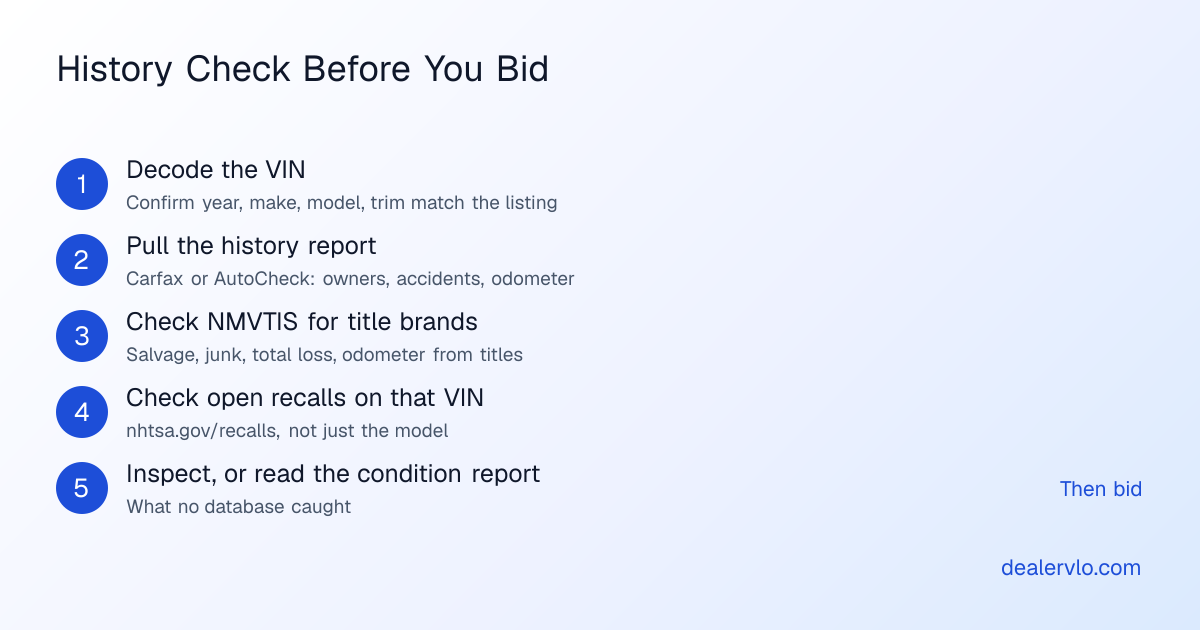
Decoding first catches the simplest problem: a listing that says one trim while the VIN says another. The recall step matters because recall lists are model-level, but the remedy is per car. Check the exact VIN at [nhtsa.gov/recalls](https://www.nhtsa.gov/recalls) to see whether it's still open.
The free VIN decoder pulls year, make, model, trim, and engine from NHTSA, and lists the NHTSA safety recall campaigns for that year, make, and model. Those are model-level, not VIN-specific, so still confirm the car itself at nhtsa.gov. Inside DealerVLO, a VIN decode from NHTSA data fills in a car when you add it to inventory by VIN. Then value it against the market with your usual guide; [reading MMR and Black Book](/blog/how-to-use-mmr-black-book-auction-pricing) covers that side.
## What no history report will catch
Both vendors say it themselves. CARFAX's [support page](https://support.carfax.com/article/i-know-this-vehicle-has-had-an-accident-why-isn-t-it-listed-on-the-carfax-vehicle-history-report/) says not every accident or damage event is reported, and not all reported events reach CARFAX, and it recommends a pre-purchase inspection and test drive. AutoCheck's buyback page says not all records are reported to AutoCheck.
A car fixed for cash with no claim filed can come back clean on both. Treat a clean report as "nothing reported," not "nothing happened." Look for panel gaps, overspray, replaced glass, and mismatched tires, and read the condition report line by line. For trades, our [trade-in appraisal guide](/blog/dealer-trade-in-appraisal-guide) covers the walkaround that a report can't replace.
When the inspection finds something, put the repair on the car as a line item (vendor, description, cost) in DealerVLO, and it rolls into that car's all-in cost and margin. That's how you learn which buys a clean report talked you into.
## Do dealers have to provide a Carfax?
There's no general federal rule requiring a dealer to give a buyer a Carfax or AutoCheck report. The FTC's [Dealer's Guide to the Used Car Rule](https://www.ftc.gov/business-guidance/resources/dealers-guide-used-car-rule) has the Buyers Guide tell shoppers to get a vehicle history report themselves and points them to ftc.gov/usedcars. The same rule, at [16 CFR 455.1](https://www.ecfr.gov/current/title-16/part-455/section-455.1), makes it a deceptive practice to misrepresent a used car's mechanical condition.
Your state may layer its own rules on top, so check with your state's dealer board. The practical rule is simpler: don't describe a car's history in a way your own records contradict. If you pulled a report showing damage, don't advertise "clean history."
DealerVLO prints the FTC Buyers Guide from each car's page, no deal needed, so it can hang in the window while the car is for sale.
## Where DealerVLO fits
End to end, for the history-report part of buying and selling:
- **Adding the car:** VIN decode fills in the year, make, model, and specs when you add a car by VIN.
- **Before you buy:** the free VIN decoder, with the model-level NHTSA recall list, and the free auction profit calculator for your max bid.
- **Cost tracking:** report fees, buy fees, transport, and repairs as line items on the car, rolling into its all-in cost and margin; a flat subscription as a recurring monthly P&L expense.
- **Selling:** listing feeds to CarGurus, Cars.com, and Autotrader (you pay their fees), the included website, and the FTC Buyers Guide from the car's page.
What it doesn't do: pull, integrate, or display Carfax or AutoCheck reports, run NMVTIS checks, check recalls per VIN inside the app, or connect to any auction. You still buy the history report and NMVTIS check from the vendor, and confirm recalls at nhtsa.gov. It's $29 a month flat, unlimited users, in a browser.
## Frequently asked questions
### How much does CARFAX cost for a dealer?
CARFAX doesn't publish dealer subscription pricing. As of October 3, 2026, CARFAX for Dealers routes pricing questions through a request form, so your number comes from a rep. Get it in writing: per-report or unlimited, listings included or not, contract length, and rooftops and users covered.
### How do I get CARFAX as a dealer?
Use the request form on carfaxfordealers.com and pick what you need: vehicle history, car listings, service, or pricing. The core dealer product is CARFAX Advantage, and Car Listings is only available to Advantage dealers.
### What is more accurate, AutoCheck or Carfax?
Neither company publishes an independent accuracy comparison, so nobody can honestly rank them. They pull from different data sources, which is why the same VIN can show different events on each. Both say not every event gets reported to them, and both recommend a pre-purchase inspection.
### How much does an AutoCheck dealer subscription cost?
Experian doesn't publish it. Its dealer page describes unlimited plans and a monthly option for smaller dealers, and sends you to a contact form. The one dealer price it lists, as of October 3, 2026, is NMVTIS reports at $0.43 each for AutoCheck dealer customers.
### Is there a better option than Carfax?
It depends on the job. AutoCheck sits inside the auction workflow and adds the AutoCheck Score. For title brands alone, any approved NMVTIS data provider works, and Carfax and Experian both sell NMVTIS reports to dealers.
### Do dealers have to provide a Carfax?
No general federal rule requires it. The FTC's Used Car Rule has the Buyers Guide tell shoppers to get a history report themselves, and makes misrepresenting a car's mechanical condition a deceptive practice. Check your state's dealer board for state rules, and never describe a car's history in a way your own records contradict.
## Bottom line
Carfax vs AutoCheck for dealers comes down to the job. AutoCheck leans toward buying, with auction announcements, the AutoCheck Score, and Manheim sign-in. Carfax leans toward selling, with the brand shoppers recognize and a listings product for Advantage dealers. Neither publishes a dealer price, so get comparable quotes in writing. Add a cheap NMVTIS title check, confirm recalls on the exact VIN, and inspect every car, because no database catches everything.
I built DealerVLO for my own lot in Tewksbury, and it keeps the cost side of this in one place: VIN decode when you add a car, every report and repair on that car's cost list, and the subscription in your P&L. Try it free for 14 days.
Track what every car really cost, history reports included, in DealerVLO: start your 14-day free trial
---
## FAQ
### How much does CARFAX cost for a dealer?
CARFAX doesn't publish dealer subscription pricing. As of October 3, 2026, CARFAX for Dealers routes pricing questions through a request form, so your number comes from a rep. Get it in writing: per-report or unlimited, listings included or not, contract length, and rooftops and users covered.
### How do I get CARFAX as a dealer?
Use the request form on carfaxfordealers.com and pick what you need: vehicle history, car listings, service, or pricing. The core dealer product is CARFAX Advantage, and Car Listings is only available to Advantage dealers.
### What is more accurate, AutoCheck or Carfax?
Neither company publishes an independent accuracy comparison, so nobody can honestly rank them. They pull from different data sources, which is why the same VIN can show different events on each. Both say not every event gets reported to them, and both recommend a pre-purchase inspection.
### How much does an AutoCheck dealer subscription cost?
Experian doesn't publish it. Its dealer page describes unlimited plans and a monthly option for smaller dealers, and sends you to a contact form. The one dealer price it lists, as of October 3, 2026, is NMVTIS reports at $0.43 each for AutoCheck dealer customers.
### Is there a better option than Carfax?
It depends on the job. AutoCheck sits inside the auction workflow and adds the AutoCheck Score. For title brands alone, any approved NMVTIS data provider works, and Carfax and Experian both sell NMVTIS reports to dealers.
### Do dealers have to provide a Carfax?
No general federal rule requires it. The FTC's Used Car Rule has the Buyers Guide tell shoppers to get a history report themselves, and makes misrepresenting a car's mechanical condition a deceptive practice. Check your state's dealer board for state rules, and never describe a car's history in a way your own records contradict.