# BDC Benchmarks and Pay Plans: What "Good" Actually Looks Like by Funnel Stage
> Published BDC benchmarks for used-car set, show and close rates, what practitioners hold a BDC to, and the three pay plan shapes on record, with sources.
- Source: https://www.dealervlo.com/blog/bdc-benchmarks-pay-plans-funnel-stages
- Published: 2026-10-30
- Updated: 2026-10-30
- Author: Chris Abouraad
- Tags: BDC, pay plans, sales process, lead management, used car dealers
---
Every dealer who stands up a BDC (business development center, which on a small lot is usually one person answering leads and booking appointments, or the owner doing it at night) ends up asking the same three questions: what's a good set rate, what's a good show rate, and how do I pay the person doing it without overpaying for appointments that never buy. Search for "BDC benchmarks" and you get a lot of round numbers with no source attached.
So this post sticks to numbers someone actually published, with the link, the year and who measured it, including used-car numbers specifically. Then it lays out the three BDC pay plan shapes dealers have described in public, and the federal wage rules that sit underneath any draw-against-commission plan. Where nobody has published a number, I say so and tell you how to get your own.
Track every website lead's status from New to Converted: start your free 14-day DealerVLO trial
## The four stages, and why you measure them separately
A BDC funnel has four handoffs: the lead gets **contacted**, the contact turns into a **set appointment**, the appointment **shows**, and the show **buys**. Foureyes, a dealership sales-analytics vendor that publishes benchmark studies, defines its contact rate as leads where the dealer established two-way communication for the first time, divided by total leads in the same period ([Foureyes press release, Jan 2024](https://www.prweb.com/releases/automotive-dealership-data-study-identifies-appointment-rate-benchmarks-across-q3-and-q4-2023-302049252.html)). Use the same denominator every month or your rates won't compare to anything, including last month.
The reason to keep the stages apart: each one breaks for a different reason. A low set rate is a response-speed or phone-skills problem. A low show rate is a confirmation problem. A low close rate on shows is a floor or inventory problem, and the BDC mostly can't fix it. DealerRefresh founder Jeff Kershner made the same point in the forum's [BDC benchmarks thread](https://forum.dealerrefresh.com/threads/what-are-the-modern-bdc-benchmarks.7419/): separate appointment-to-show from lead-to-show, because the quality of follow-up moves lead-to-show even for buyers who walk in without ever answering you.
If you don't know where your leads come from yet, start there. [Tracking lead source on a small lot](/blog/car-dealership-lead-source-tracking) comes before any argument about conversion rates.
## What's actually been published, including used cars
The most detailed public study I found is Foureyes' look at roughly 700 U.S. dealerships over the second half of 2023, split by new and used inventory and by internet lead versus phone up ([Foureyes, Feb 2024](https://www.foureyes.io/blog/dealership-data-study-appointment-rates)). It's a vendor study (Foureyes sells lead and sales analytics to dealers), so read it as an average across its own customers, not an industry census.
| Stage | Used, internet leads | Used, phone ups | New, internet leads |
| --- | --- | --- | --- |
| Contact rate | 64% | 79% | 60% |
| Appointment set rate | 41% | 81% | 32% |
| Appointment show rate | 50% | 63% | 56% |
| Close rate on shows | 40% | 42% | 42% |
*Source: [Foureyes study of ~700 U.S. dealerships, Q3–Q4 2023](https://www.prweb.com/releases/automotive-dealership-data-study-identifies-appointment-rate-benchmarks-across-q3-and-q4-2023-302049252.html).*
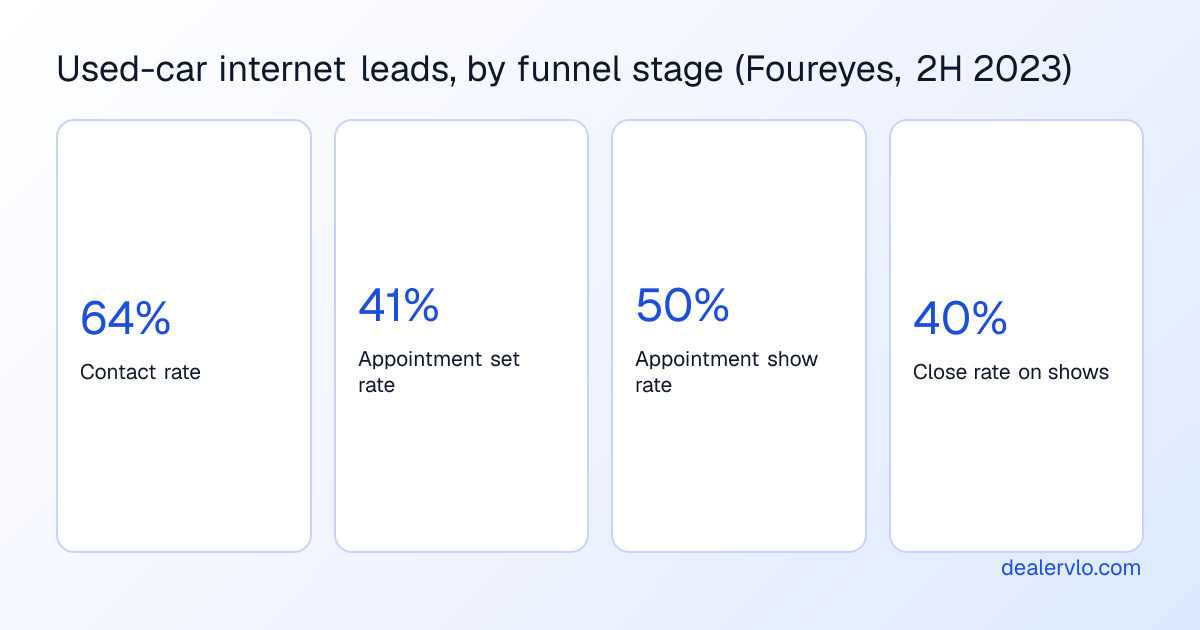
Two things jump out for a used-car lot. Used-vehicle internet leads set appointments more often than new-vehicle ones (41% vs. 32%). And phone ups convert to appointments at about double the rate of internet leads. Foureyes' follow-up data for Q4 2024 through April 2025 shows the same pattern: across new and used, internet leads set appointments 40–42% of the time and phone leads 75–80%, with used inventory ahead of new on internet leads (44% vs. 35% in April 2025) ([Foureyes, May 2025](https://www.foureyes.io/blog/dealership-appointment-set-rates)).
One caution before you multiply those columns into a lead-to-sale number: the definitions in Foureyes' release don't make it clear that each rate uses the previous stage as its denominator, so chaining them can mislead you. Use the table to see where leads tend to fall out, then work out your own rates from your own counts: leads, contacted, set, shown, sold.
## What practitioners say they hold a BDC to
Averages tell you what's normal. Operators on the DealerRefresh forum have also posted what they personally expect, which is a different, higher bar. All of these are one person's numbers, posted under their own name, and dated:
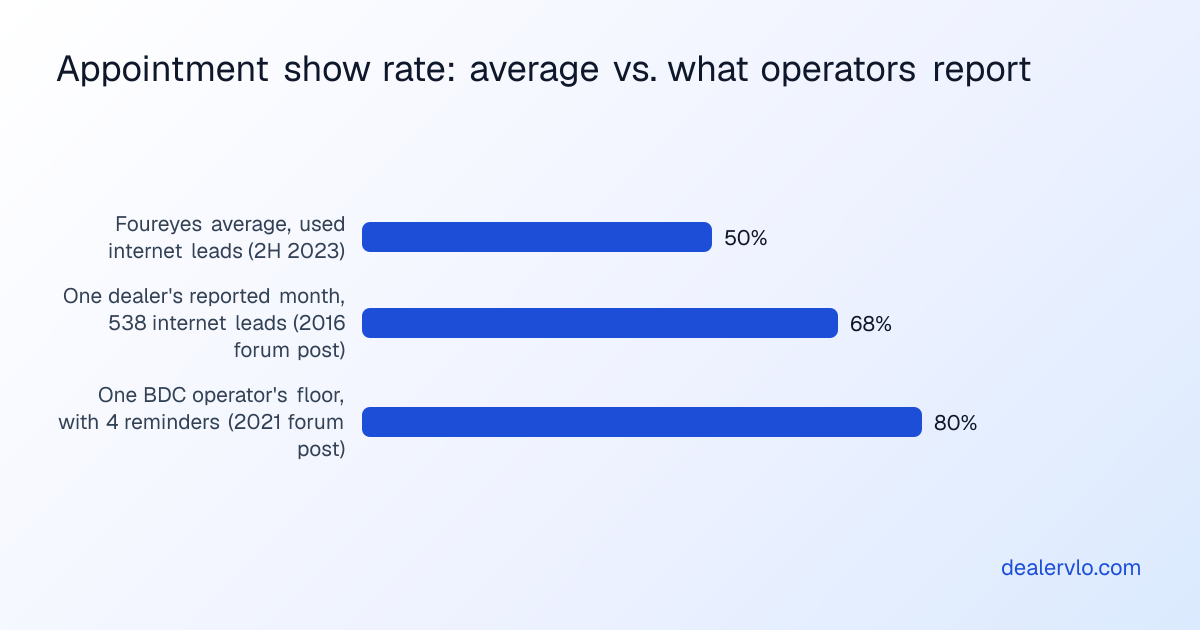
- **Marc Lavoie** (2021) said he isn't happy with anything under a 30% appointment ratio within 60 days for new-vehicle leads and 40% within 15 days for used, with 80% appointment-to-show because his team confirms and sends four reminders between booking and the appointment. He put show-to-sold at 31% to 74% across the dealerships whose data he sees, and said the BDC doesn't control it ([thread](https://forum.dealerrefresh.com/threads/what-are-the-modern-bdc-benchmarks.7419/)).
- **Dan Sayer** (2021), with no BDC at his store, said they expect 26.2% internet lead-to-visit (unique visits divided by leads with a name and one contact method) and 60% visit-to-sold ([same thread](https://forum.dealerrefresh.com/threads/what-are-the-modern-bdc-benchmarks.7419/)).
- **Derrick Woolfson** (2016) reported one month of his team's results: a 40% set rate on 538 internet leads, a 68% show rate and a 43% sold rate ([thread](https://forum.dealerrefresh.com/threads/dealership-bdc-pay-plans.206/)).
The most useful line in either thread is Lavoie's caution about universal targets: an 8% lead-to-sale ratio might be good on high-margin units, while a 22% ratio might be needed on lower-profit units, and he said he hates quoting percentages because they vary so much from dealer to dealer ([thread](https://forum.dealerrefresh.com/threads/what-are-the-modern-bdc-benchmarks.7419/)). On a lot running thin front-end gross, the BDC has to convert more of its leads to pay for itself. Work your target backward from your own gross per car, your lead cost and what the BDC costs you each month.
### The show rate is the stage you control
Look at the gap in that chart: the 2023 average for used internet leads is 50%, and the operator holding his team to 80% credits a process, not better leads. A confirmation plus several reminders is something a one-person BDC on a 30-car lot can copy tomorrow. The wording of those touches, and what to do once a lead goes quiet, is covered in [converting online leads into appointments](/blog/converting-online-leads-to-appointments) and the longer [dead-lead follow-up cadence](/blog/dead-leads-follow-up-used-car-dealers).
In DealerVLO, every lead from your dealer website lands in one inbox with the form it came through (vehicle inquiry, contact, financing or credit application), the car it was about, how long ago it came in, and a status you move from New to Contacted, Qualified, Converted or Lost. Filter to Contacted and you have the list of people to confirm today. Be clear on the limits: DealerVLO doesn't text, doesn't place calls (its Call and Email buttons open your own phone and email app), doesn't set reminders or due dates, and phone ups and walk-ins aren't in the inbox because there's no manual lead entry. If phone is your biggest channel, pair it with [call tracking](/blog/car-dealership-call-tracking-small-lot).
Work your confirmation list from one lead inbox: try DealerVLO free for 14 days
## BDC pay plans: the three shapes on record
Nobody publishes an industry-standard BDC pay plan. What does exist is a handful of plans dealers and consultants have described in public, and they fall into three shapes.
**1. Pay on appointments that show (Stauning).** Consultant Steve Stauning's plan is the one quoted most on DealerRefresh. His rule, verbatim: "Pay the BDC on APPOINTMENTS THAT SHOW; not on sold units and not hourly" ([forum post, 2016](https://forum.dealerrefresh.com/threads/dealership-bdc-pay-plans.206/)). In a [March 2016 DealerRefresh article](https://www.dealerrefresh.com/car-dealer-bdc-simple-pay-plan/) he laid out the numbers:
- Target compensation of $2,500 to $3,000 a month, expecting 50–60 shown appointments per coordinator
- A draw of $10–$13 an hour against commissions (his forum post the month after put it at "$10-$12 to even $15/hour")
- $50 for every appointment that shows within 45 minutes either way of the scheduled time
- A $100 bonus at 10, 20, 30, 40 and 50 shown appointments in a month
The floor salesperson who closes a BDC appointment gets a split: either a true half deal, or half the commission with a full mark toward their volume bonus. Stauning calls the split non-negotiable, because paying the floor a full commission on BDC appointments makes total pay unsustainable as the BDC gets better.
**2. Pay per stage (set, shown, sold).** In the same thread, Drew Ament described a plan he built in 2009 for a 12-store group: a base salary (he generally sizes it to cover federal and state minimum wage), then a small amount per appointment set, more per appointment shown and more per sale. His example used a $1,300 monthly salary plus $2.50 per set, $5 per show and $50 per sold, with each agent expected to handle 100 calls a day ([thread](https://forum.dealerrefresh.com/threads/dealership-bdc-pay-plans.206/)). It pays for activity the agent controls (setting) while still rewarding the outcome.
**3. Hourly plus a team bonus.** Alex Snyder described a 9-person BDC paid salary tiered on quarterly performance, a department-wide bonus so nobody fought over whose customer it was, and a monthly "Employee of the Month" bonus for whoever set the most appointments that bought. Woolfson's team was paid hourly with bonuses on the whole BDC's set and show rates (both in the [same thread](https://forum.dealerrefresh.com/threads/dealership-bdc-pay-plans.206/)). Stauning's reply is worth weighing: pay a group, and the top people end up carrying the stragglers until they leave.
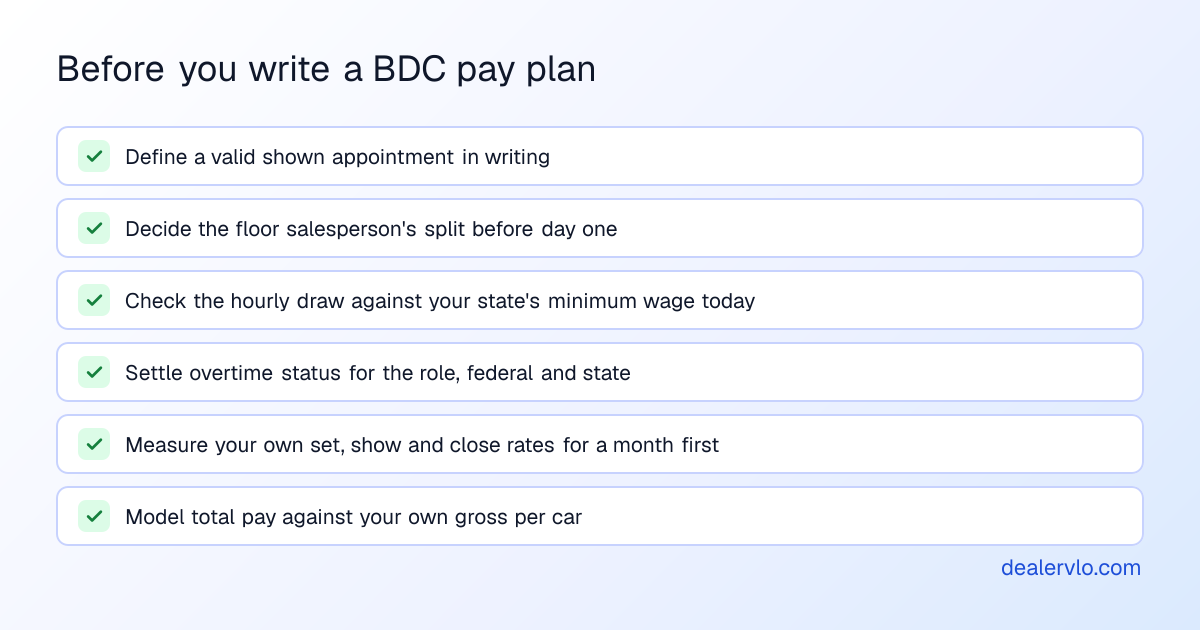
Those dollar figures are 2009 and 2016 numbers. Use the structures, not the amounts: build yours from your own gross per car. Say a BDC appointment that buys makes your lot $1,500 front-end (an example, not a benchmark): you can see quickly what a $50 show bonus plus a half-commission split costs per sale. The floor side of the split, with the pack and the mini, is in [how to build a used-car sales pay plan that doesn't leak gross](/blog/used-car-sales-commission-pay-plan), and [how much commission a car salesman makes](/blog/how-much-commission-car-salesman-makes) works the per-car math with a hypothetical deal.
## The federal wage rules under any draw
This isn't legal advice, and state law can be stricter than federal. But a few federal points from the Department of Labor's [Fact Sheet #11 for auto dealerships](https://www.dol.gov/agencies/whd/fact-sheets/11-flsa-auto-dealers) apply to any BDC plan with a draw:
- **Coverage.** Enterprise coverage under the Fair Labor Standards Act applies to all employees of new or used dealerships with at least $500,000 a year in gross sales. Below that, individual coverage can still apply to an employee whose work regularly involves interstate commerce.
- **Draws.** The fact sheet says draws paid against commissions during the settlement period may be less than the minimum wage, and the employer may credit them against its minimum-wage obligation. A commission settlement period is generally treated as the pay period.
- **Overtime.** Non-exempt employees get time and a half over 40 hours in a workweek. The dealership exemption in section 13(b)(10)(A) is described as covering certain mechanics and sales and parts personnel. An agent whose job is booking appointments, not selling or servicing vehicles, may not fit it, so settle that before you schedule a BDC agent past 40 hours.
One practical check: Stauning's $10–$13 draw dates from 2016, and many states' minimum wages have risen since. Look up your state's current rate before you copy any hourly figure from an old forum post.
## Where DealerVLO fits, and where it doesn't
DealerVLO is the DMS I built for my own lot, and the part a BDC uses is the lead inbox plus the dashboard. The dashboard shows how many new leads came in this week, and its "Needs attention" list counts new leads still waiting for contact, next to active deals missing a price or odometer reading and cars sitting 60+ days. On a lot where the BDC is the owner at 8 p.m., that's the daily check.
Once a lead buys, the deal jacket shows front- and back-end gross on that deal, and the sales report totals gross per deal with a salesperson leaderboard for this month, the last 30 days, year to date or all time, so you have the gross numbers a split commission gets figured from.
What it won't do for a BDC: it doesn't calculate commissions or run payroll, doesn't text or call, doesn't set follow-up reminders or send automated email, and doesn't report leads or sales by marketing channel (a lead's source is the website form it came through). Your set, show and close rates by channel come from your own tracking. If you're weighing software that does the calling for you, [do you actually need an AI BDC](/blog/ai-bdc-for-car-dealerships) walks through when that math works on a small lot.
## Frequently asked questions
### What's a good appointment set rate for a BDC?
The most-cited published numbers come from Foureyes, a dealership sales-analytics vendor. Its study of about 700 U.S. dealerships in the second half of 2023 found used-vehicle internet leads setting appointments at 41% and used-vehicle phone ups at 81%. Its later April 2025 data had internet leads (new and used) setting at about 40%. Treat those as the shape of the funnel, then measure your own lot's rate by lead source.
### What's a realistic appointment show rate?
In the same Foureyes 2023 study, appointments from used-vehicle internet leads showed 50% of the time and phone-up appointments 63%. One BDC operator on the DealerRefresh forum said he holds his team to 80%, crediting a confirmation plus four reminders between booking and the appointment. The show rate is the stage a small lot can move most with process alone.
### How should I pay a BDC appointment setter?
The plan cited most on the dealer forums, from consultant Steve Stauning, pays the BDC agent on appointments that actually show (he wrote $50 per show in 2016, plus a $100 bonus at every 10 shows) on top of an hourly draw against those commissions, and pays the floor salesperson who closes the appointment a split commission. Other dealers pay per appointment set, shown and sold, or pay hourly plus a team bonus. Model whichever you pick against your own gross per car.
### Is a draw against commission legal for a BDC agent?
Under federal law, the Department of Labor's Fact Sheet #11 for auto dealers says draws paid during a commission settlement period may fall below the minimum wage and be credited against the minimum-wage obligation, with the settlement period generally treated as the pay period. State law can be stricter, so check your state labor department before you finalize a plan. This isn't legal advice.
### Are BDC agents exempt from overtime?
Don't assume it. DOL Fact Sheet #11 describes the dealership overtime exemption in section 13(b)(10)(A) as covering certain mechanics and sales and parts personnel. Someone whose job is setting appointments rather than selling or servicing vehicles may not fit it, and state rules differ, so get that answered before you schedule a BDC agent past 40 hours.
### Why don't published benchmarks match my lot?
Most published BDC numbers are averages across many dealerships, including franchise stores with different lead volume and gross. One forum veteran put it plainly: an 8% lead-to-sale ratio might be fine on high-margin units while a 22% ratio might be needed on lower-profit ones. The useful target is the one that pays for your lead cost and your BDC's pay at your own gross per car.
## Bottom line
The published used-car averages are about 41% set, 50% show and 40% close on internet leads, with phone ups converting far better, and operators who confirm and remind report show rates well above that average. Pay plans that hold up pay the BDC on appointments that actually show and split the floor commission on those deals, with a draw that clears your state's current minimum wage. Measure your own four stages for a month before you set a target or write the plan, and build both off your own gross per car. If your leads live in an email inbox and a notepad right now, start a free DealerVLO trial and put them in one list with a status.
Put your BDC's leads and your deals in one system: start your free 14-day DealerVLO trial
---
## FAQ
### What's a good appointment set rate for a BDC?
The most-cited published numbers come from Foureyes, a dealership sales-analytics vendor. Its study of about 700 U.S. dealerships in the second half of 2023 found used-vehicle internet leads setting appointments at 41% and used-vehicle phone ups at 81%. Its later April 2025 data had internet leads (new and used) setting at about 40%. Treat those as the shape of the funnel, then measure your own lot's rate by lead source.
### What's a realistic appointment show rate?
In the same Foureyes 2023 study, appointments from used-vehicle internet leads showed 50% of the time and phone-up appointments 63%. One BDC operator on the DealerRefresh forum said he holds his team to 80%, crediting a confirmation plus four reminders between booking and the appointment. The show rate is the stage a small lot can move most with process alone.
### How should I pay a BDC appointment setter?
The plan cited most on the dealer forums, from consultant Steve Stauning, pays the BDC agent on appointments that actually show (he wrote $50 per show in 2016, plus a $100 bonus at every 10 shows) on top of an hourly draw against those commissions, and pays the floor salesperson who closes the appointment a split commission. Other dealers pay per appointment set, shown and sold, or pay hourly plus a team bonus. Model whichever you pick against your own gross per car.
### Is a draw against commission legal for a BDC agent?
Under federal law, the Department of Labor's Fact Sheet #11 for auto dealers says draws paid during a commission settlement period may fall below the minimum wage and be credited against the minimum-wage obligation, with the settlement period generally treated as the pay period. State law can be stricter, so check your state labor department before you finalize a plan. This isn't legal advice.
### Are BDC agents exempt from overtime?
Don't assume it. DOL Fact Sheet #11 describes the dealership overtime exemption in section 13(b)(10)(A) as covering certain mechanics and sales and parts personnel. Someone whose job is setting appointments rather than selling or servicing vehicles may not fit it, and state rules differ, so get that answered before you schedule a BDC agent past 40 hours.
### Why don't published benchmarks match my lot?
Most published BDC numbers are averages across many dealerships, including franchise stores with different lead volume and gross. One forum veteran put it plainly: an 8% lead-to-sale ratio might be fine on high-margin units while a 22% ratio might be needed on lower-profit ones. The useful target is the one that pays for your lead cost and your BDC's pay at your own gross per car.