# Giving AI to Your Salespeople: An Internal Sidekick, Not a Customer-Facing Bot
> An AI sidekick for salespeople should answer specs and financing math internally — not talk to shoppers directly.
- Source: https://www.dealervlo.com/blog/ai-sidekick-for-salespeople
- Published: 2026-10-23
- Updated: 2026-10-23
- Author: Chris Abouraad
- Tags: AI, sales process, dealership staff, compliance
---
Most of the AI pitch a small lot hears is aimed at the customer: a chat widget on your website, an automated text that answers leads at 11pm, a bot that "qualifies" a shopper before a human ever talks to them. That's one category of AI. There's a different one that gets a lot less marketing noise, and it might matter more on a lot where the salesperson, not a BDC, is the one closing the deal: AI as a tool the salesperson uses for themselves, mid-conversation, to get a fast answer on a spec, run financing math, or pull up a better way to handle an objection — without the customer ever knowing AI was involved at all.
That's the internal-sidekick model this post is about, and it's worth being precise about what it is, what it isn't, and where it runs into real compliance lines.
See every car's specs, costs and deal math in one place in DealerVLO: start your 14-day free trial
## Internal sidekick vs. customer-facing bot — what's actually different
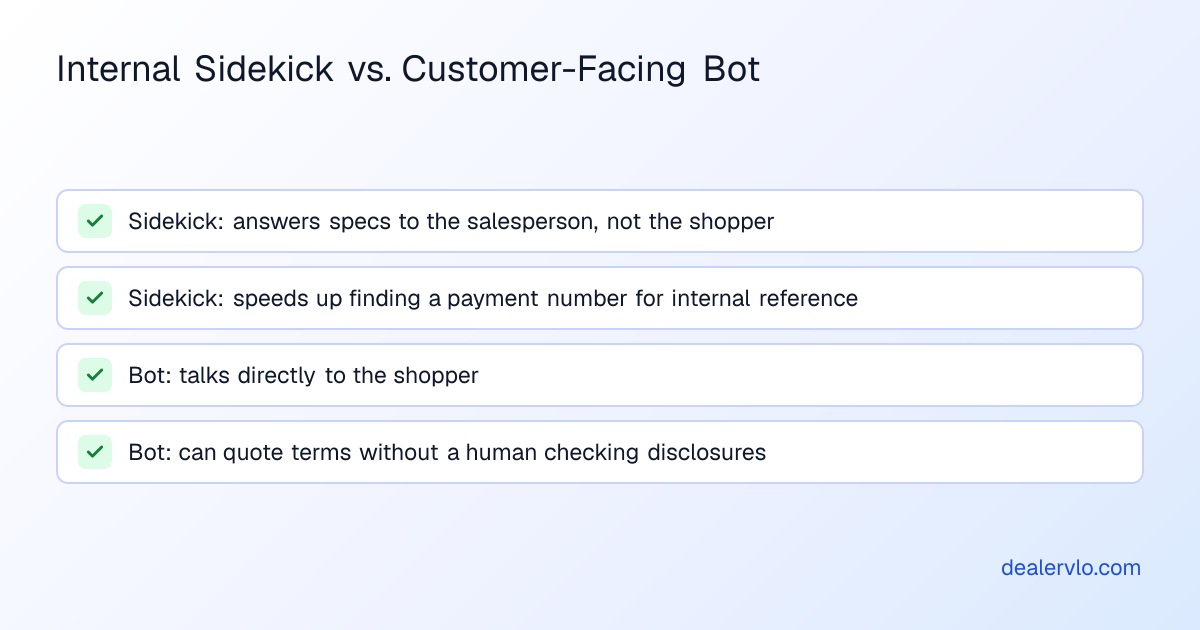
A customer-facing bot talks directly to the shopper: a website chat widget, a text-back tool, something that represents itself (or fails to clearly represent itself) as the dealership. An internal sidekick talks only to your salesperson. The customer is still talking to a human the entire time — the AI is just helping that human find an answer faster or think through what to say next.
That distinction isn't just semantics. The FTC has put companies on notice that AI tools shouldn't mislead a consumer about the nature of an interaction, and guidance on chatbots and deepfakes flags concealed AI involvement in a human-presenting interaction as a potential problem ([Holland & Knight](https://www.hklaw.com/en/insights/publications/2023/07/the-ftc-is-regulating-ai-a-comprehensive-analysis)). An internal tool sidesteps that concern entirely, because the person on the other end of the conversation is your salesperson the whole time, not a bot pretending to be one. That's a legitimate reason to keep AI internal rather than customer-facing on a small lot where you don't have the staff to monitor a public bot closely.
That gap is easy to picture: the salesperson needed an answer, fast, and didn't want to make the customer wait while they dug through a spec sheet or a stack of paper.
## Three jobs a sidekick is actually good for
**1. Specs and inventory facts.** "Does this one have the tow package?" "What's the real mileage on the one we just took in trade?" A salesperson standing next to a car shouldn't have to walk back to a desktop to check. This is the lowest-risk use of AI on a sales floor because it's pulling facts that already exist in your system — it isn't generating anything, it's retrieving. This is really a data problem before it's an AI problem: an AI sidekick can only answer correctly if the car's record is accurate and complete in the first place.
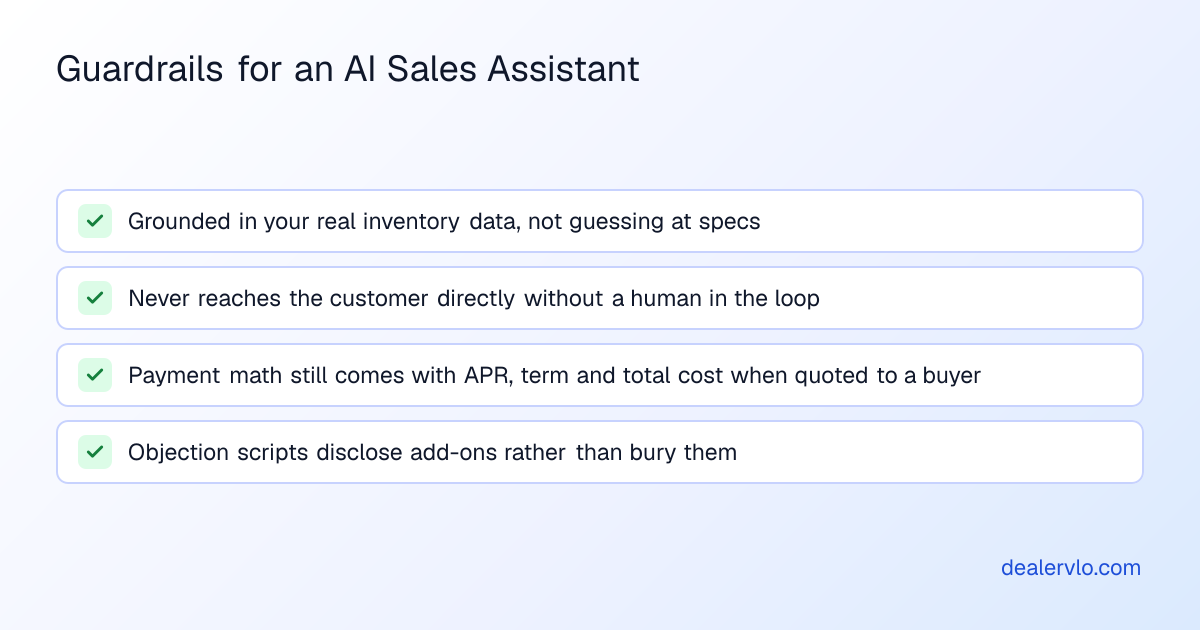
If you're using AI to answer spec questions on top of that, it has to be grounded in your actual inventory data, not a general model guessing at what a given trim probably has. A bot that invents trim details because it wasn't tied to your real listing is a separate problem worth understanding on its own — see [why an AI chatbot gives customers wrong specs](/blog/ai-chatbot-wrong-specs-inventory-grounding) if you're evaluating any AI tool that touches your vehicle data, internal or customer-facing.
**2. Financing math, with a hard caveat.** This is where "internal sidekick" earns its keep — and where it also needs guardrails. A salesperson working a deal might want a quick gut-check on what a trade value does to a monthly payment before they go back to the customer. That's useful. What it can't become is a shortcut that lets the payment number get quoted to the buyer without the disclosures the law requires.
Regulation Z is specific about this: if you're going to state a monthly payment to a buyer, you also have to disclose the APR, the term, and the other terms that affect total cost — a payment number by itself doesn't satisfy the requirement ([Fullpath](https://www.fullpath.com/blog/ftc-dealership-rules-what-every-dealer-needs-to-know-in-2026/)). An AI tool that whispers a number to your salesperson so they can sanity-check a deal in their head is fine. An AI tool (or a salesperson) that hands a buyer a payment figure with no APR or term attached is a Reg Z problem whether AI was involved or not. The rule to enforce internally: AI can help your person find the right number fast; it can't replace the disclosure that has to go with it when that number reaches the customer.
This is also where having your deal math live in one place pays off regardless of whether you add any AI on top of it. In DealerVLO, the deal jacket computes the totals, trade equity, payment, and front-end and F&I gross live as you build the deal, so your salesperson or finance person is working from one accurate number instead of a mental estimate — and when there's negative equity on a trade, the deal shows it and carries it onto the bill of sale and retail installment contract as its own line, so nothing gets glossed over in a quick verbal estimate. If you want to see how the math actually ties out on a specific structure, the [deal structuring calculator](/tools/deal-structuring-calculator) and [out-the-door price calculator](/tools/out-the-door-price-calculator) are free tools built for exactly that kind of gut-check, without touching anything that would need a customer disclosure.
**3. Objection and conversation help.** "They're saying the price of a competitor's listing, what do I say back?" "They want to think about the warranty — what's the right framing?" An internal tool that surfaces talking points for your salesperson to use in their own words is a coaching aid. The line not to cross is letting it generate pricing or add-on pitches that work around transparency rules. Even with the FTC's CARS Rule formally withdrawn, the agency has signaled that pricing and add-on transparency remains an active enforcement priority under its general unfair-and-deceptive-practices authority — the specific rule is gone, but the underlying expectation that dealers disclose the real price and get genuine consent before adding charges hasn't changed ([Crowell & Moring](https://www.crowell.com/en/insights/client-alerts/auto-dealers-the-ftc-is-back-in-the-drivers-seatwarning-letters-signal-renewed-federal-scrutiny)). If an AI tool ever suggests a script for presenting an add-on, the script should help your salesperson disclose it clearly, not bury it.
Similarly, if a customer is asking about "as-is" versus a warranty, that's not a sidekick's call to make up — the FTC's Used Car Rule has governed the Buyers Guide on used vehicles and still applies broadly to dealers selling used cars ([Elite F&I Partners](https://www.elitefipartners.com/blog/staying-compliant-with-the-ftc-s-used-car-rule-what-dealers-need-to-know)). An AI tool can remind your salesperson what the Buyers Guide on that specific car says — "As-Is," "Implied Warranties Only," or the coverage description on a Dealer Warranty — but the actual document is what governs, not whatever the AI paraphrases. In DealerVLO, each deal records its warranty type — As-Is, Implied Warranties Only, or Dealer Warranty with a coverage description — and the Buyers Guide prints with the matching heading automatically. If a deal is marked As-Is while a service contract is also being sold, the deal shows a warning so a salesperson or finance person sees the mismatch before the paperwork goes out, with a one-click switch to Implied Warranties Only — it's a flag the dealer still has to act on, not an automatic block.
## What the adoption numbers actually say (and don't)
It's worth being honest about where the industry data stands, because a lot of AI marketing implies more than it proves. The 2025 Cox Automotive AI Readiness study surveyed hundreds of dealers and found real momentum: a large majority said AI is here to stay and worth learning about, and most said investing in it now is critical to long-term success ([Cox Automotive](https://www.coxautoinc.com/wp-content/uploads/2025/10/Cox-Automotive-AI-Readiness-media-summary-FINAL.pdf)). But when you look at where dealers are actually using AI today, it skews heavily toward marketing and lead response — things like automated text and chat engagement and personalized email/text generation — not staff-facing tools on the sales floor ([Cox Automotive](https://www.coxautoinc.com/insights/automotive-dealers-are-ready-for-ai-to-deliver-outcomes-and-skip-the-hype-according-to-new-cox-automotive-study/)).
A newer Cox tracker found most dealers now say they use AI in some form, with top uses including automating routine tasks and coordinating follow-up ([PR Newswire](https://www.prnewswire.com/news-releases/new-cox-automotive-ai-in-auto-retail-tracker-finds-growing-gap-between-dealers-and-ai-powered-car-shoppers-302847666.html)). But that same study found only a minority of AI users report actually seeing the sales and revenue growth they expected, and a meaningful share of dealers aren't measuring AI's impact at all ([PR Newswire](https://www.prnewswire.com/news-releases/new-cox-automotive-ai-in-auto-retail-tracker-finds-growing-gap-between-dealers-and-ai-powered-car-shoppers-302847666.html)). None of this data is broken out specifically for "internal sidekick used mid-conversation on the floor" — that's a newer, less-measured slice of the category, closer to what forum threads are describing anecdotally than to anything a survey has quantified yet. Treat vendor claims about this exact use case as early-stage marketing, not proven outcomes.
## Where this fits with the tools you already have
If you're a small independent lot — a deal a week, maybe two — you're probably not evaluating a standalone AI sidekick platform on its own; you're deciding whether it's worth layering on top of whatever you're already running your deals and inventory through. That's a reasonable place to start, because the fastest wins (accurate specs, clean deal math, the right paperwork triggered automatically) often come from the system of record being solid before any AI gets added on top.
See a warranty-type mismatch flagged on the deal before the paperwork goes out: try DealerVLO free for 14 days
The dashboard's "needs attention" list in DealerVLO flags cars without a price or photos and deals missing a price or odometer reading, which catches the kind of gap a salesperson would otherwise have to notice themselves mid-conversation. And because the FTC Buyers Guide and a one-page window sticker print straight from each vehicle's page without needing a deal, there's one accurate document a salesperson can hand over or reference instead of guessing at warranty terms or specs from memory.
None of that is "AI" — it's just a clean system of record. But it's the foundation an internal sidekick needs to be accurate rather than making things up, the same way a map has to be accurate before a GPS is any good. If you're weighing AI tools generally, not just the sidekick model, the [best AI tools for used-car dealers](/blog/best-ai-tools-for-used-car-dealers) roundup covers the broader landscape by job, and the [marketing ROI calculator](/tools/marketing-roi-calculator) is a useful gut-check before you spend anywhere on an AI add-on, internal or customer-facing.
## A quick framework before you roll one out
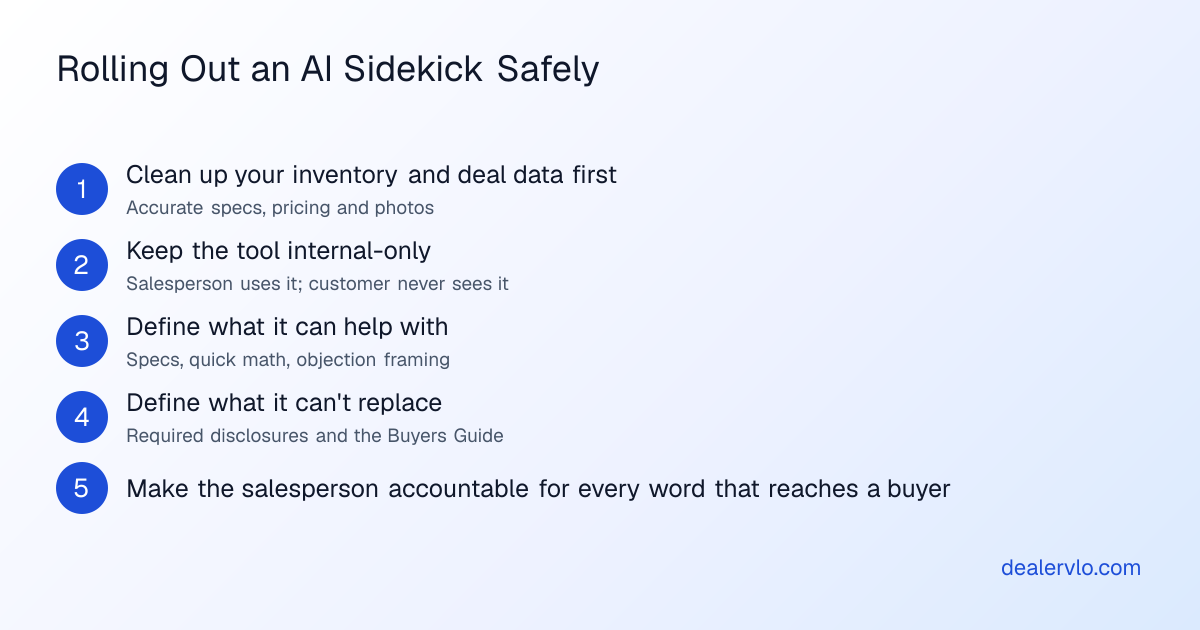
Before you hand a salesperson any AI tool, mid-conversation or otherwise, run it through four questions:
1. **Is it grounded in your real data, or guessing?** A sidekick that answers spec questions from your actual inventory is useful. One hallucinating trim details from a general model is a liability — see the [inventory grounding](/blog/ai-chatbot-wrong-specs-inventory-grounding) piece for how that failure mode happens.
2. **Does it ever reach the customer directly, even accidentally?** If a salesperson could paste or forward an AI-generated answer straight into a text or email to a buyer, you've effectively built a customer-facing bot without meaning to — and the Reg Z disclosure and FTC transparency expectations above follow it there.
3. **Does it replace a disclosure, or just speed up finding the number?** Financing math is the clearest test case. Speeding up the lookup is fine; skipping the APR and term that go with a payment quote isn't, regardless of whether a human or an AI generated the number.
4. **Can a human still explain every word of it?** If your salesperson can't defend why the AI suggested a particular script or number, it shouldn't go to a customer. The salesperson, not the tool, is accountable for what gets said on your floor.
A lot of small lots land on a simpler version of this same rule without needing a formal policy: if a salesperson wouldn't say it to a buyer's face without checking, an AI tool shouldn't be allowed to say it either. That's a reasonable way to think about the internal-sidekick model specifically — it's a tool that makes a good salesperson faster, not a replacement for the judgment and disclosures that still have to come from them.
## Frequently asked questions
### What's the difference between an internal AI chatbot for dealership staff and a customer-facing AI bot?
An internal chatbot only talks to your salesperson — it helps them find specs, run quick math, or think through an objection, but the customer is talking to a human the whole time. A customer-facing bot (like a website chat widget or automated text) interacts directly with the shopper, which brings in FTC concerns about disclosing when AI, not a person, is on the other end of a conversation.
### Can an AI sales assistant quote a monthly payment to a car buyer?
Be careful here — Regulation Z requires that any stated monthly payment also come with the APR, loan term, and other material financing terms, not just the number itself. An internal tool can help a salesperson estimate a payment quickly for their own reference, but the actual quote delivered to a buyer still needs the full disclosure, whether a human or an AI produced the underlying number.
### Is giving AI to car salespeople actually common yet?
Adoption of AI broadly is accelerating — recent industry surveys from Cox Automotive put general AI use among dealers in the strong majority — but most current use is concentrated in marketing and automated customer messaging, not internal floor-sales sidekicks specifically. The internal-sidekick use case is an emerging, less-measured category that's showing up more in dealer forum discussion than in formal adoption studies right now.
### Does the FTC's CARS Rule still apply to how AI helps with pricing or add-ons?
No — the CARS Rule was vacated by a federal appeals court before its compliance date and the FTC formally withdrew it, so it is not current law. However, the FTC has continued signaling interest in pricing and add-on transparency under its existing general consumer-protection authority, so the underlying expectation of disclosing real prices and getting genuine consent for add-ons hasn't gone away even without that specific rule.
### Is an AI assistant for car salespeople legal advice or financial advice I can rely on?
No — this isn't legal advice, and neither is any AI sidekick tool. Compliance requirements like Regulation Z disclosures and the FTC Used Car Rule's Buyers Guide requirements still apply regardless of what an AI tool suggests, so confirm your obligations with your state regulator or compliance counsel rather than relying on an AI's output as the final word.
### What should I set up before adding an AI sidekick for my sales staff?
Make sure your inventory data (specs, pricing, photos) and deal math are accurate and centralized first, since an AI tool is only as reliable as the data it pulls from. A clean system of record — accurate vehicle records, live deal totals, and documents like the Buyers Guide generated correctly — does most of the "fast accurate answer" job on its own, which makes any AI layered on top safer and less likely to guess wrong.
## Bottom line
The internal-sidekick model is a reasonable way to bring AI onto a sales floor without touching the parts of the job — disclosures, pricing transparency, warranty representations — that carry real compliance weight. Keep it pointed at your own salespeople, grounded in your actual inventory and deal data, and treat it as a tool that speeds up finding the right answer, never one that replaces the disclosure that has to go with it. Get your inventory and deal math clean and centralized first, and a sidekick — AI or otherwise — becomes a lot more useful and a lot less risky.
Run your next deal through DealerVLO: start your free 14-day trial
---
## FAQ
### What's the difference between an internal AI chatbot for dealership staff and a customer-facing AI bot?
An internal chatbot only talks to your salesperson — it helps them find specs, run quick math, or think through an objection, but the customer is talking to a human the whole time. A customer-facing bot (like a website chat widget or automated text) interacts directly with the shopper, which brings in FTC concerns about disclosing when AI, not a person, is on the other end of a conversation.
### Can an AI sales assistant quote a monthly payment to a car buyer?
Be careful here — Regulation Z requires that any stated monthly payment also come with the APR, loan term, and other material financing terms, not just the number itself. An internal tool can help a salesperson estimate a payment quickly for their own reference, but the actual quote delivered to a buyer still needs the full disclosure, whether a human or an AI produced the underlying number.
### Is giving AI to car salespeople actually common yet?
Adoption of AI broadly is accelerating — recent industry surveys from Cox Automotive put general AI use among dealers in the strong majority — but most current use is concentrated in marketing and automated customer messaging, not internal floor-sales sidekicks specifically. The internal-sidekick use case is an emerging, less-measured category that's showing up more in dealer forum discussion than in formal adoption studies right now.
### Does the FTC's CARS Rule still apply to how AI helps with pricing or add-ons?
No — the CARS Rule was vacated by a federal appeals court before its compliance date and the FTC formally withdrew it, so it is not current law. However, the FTC has continued signaling interest in pricing and add-on transparency under its existing general consumer-protection authority, so the underlying expectation of disclosing real prices and getting genuine consent for add-ons hasn't gone away even without that specific rule.
### Is an AI assistant for car salespeople legal advice or financial advice I can rely on?
No — this isn't legal advice, and neither is any AI sidekick tool. Compliance requirements like Regulation Z disclosures and the FTC Used Car Rule's Buyers Guide requirements still apply regardless of what an AI tool suggests, so confirm your obligations with your state regulator or compliance counsel rather than relying on an AI's output as the final word.
### What should I set up before adding an AI sidekick for my sales staff?
Make sure your inventory data (specs, pricing, photos) and deal math are accurate and centralized first, since an AI tool is only as reliable as the data it pulls from. A clean system of record — accurate vehicle records, live deal totals, and documents like the Buyers Guide generated correctly — does most of the "fast accurate answer" job on its own, which makes any AI layered on top safer and less likely to guess wrong.