# Getting Your Sales Team to Actually Use AI Every Day (Adoption, Not Just Prompts)
> Most dealership AI tools go unused after week one — here's how a small sales team actually builds a daily AI habit that sticks.
- Source: https://www.dealervlo.com/blog/ai-adoption-sales-team-habit-forming
- Published: 2026-10-24
- Updated: 2026-10-24
- Author: Chris Abouraad
- Tags: AI, sales team, change management, used car dealer
---
Buying the AI tool is the easy part. Getting a salesperson to open it on day 40, unprompted, before they write a follow-up text — that's the part almost nobody solves. Most dealerships now have some form of AI running somewhere in the building. Very few have a sales team that actually uses it every day without being told.
That gap — tool live, habit never formed — is the actual problem this post is about. Not which AI to buy, not a list of prompts to paste in. How you get three or five or ten people on a sales floor to change what they do by default, day after day, until it's just how the job gets done.
Run your deals through one system your team actually opens daily: start your 14-day free trial
## Why "we rolled it out" isn't the same as "they use it"
Industry-wide, AI adoption at the dealership level has moved fast — one widely cited tracker put dealership AI use at 82% of dealers currently using some form of AI, and a separate industry study found adoption roughly jumped from 28% to 39% in a single year, with virtual assistants leading the way ([Cox Automotive](https://www.coxautoinc.com/retail/ai-in-auto-retail-tracker/); [CDK Global](https://www.cdkglobal.com/insights/video-how-ai-helps-dealerships-overcome-sales-challenges)). That's the store level — somebody signed up, somebody turned it on.
But "the dealership uses AI" and "my sales team uses it every day" are two completely different claims, and the research backs that up. Across the general U.S. workforce, Gallup's ongoing survey found only 15% of employees use AI daily in their role, and just three in ten have it in their regular weekly workflow at all — most use is occasional experimentation, not habit ([Gallup](https://www.gallup.com/699797/indicator-artificial-intelligence.aspx)). There's no reason to think a used-car sales floor beats that baseline by default. If anything, a sales job is built around closing the deal in front of you, not stopping to open another tab.
This matters because the same dealer tracker shows a real gap between what dealers expected from AI and what they actually got: 69% expected sales or revenue growth, but only 22% experienced it; 54% expected a productivity boost, only 26% got one; 51% expected a better bottom line, and only 9% saw it ([Cox Automotive](https://www.coxautoinc.com/retail/ai-in-auto-retail-tracker/)). About a third of AI-using dealers in that same survey either aren't measuring the impact or have no clear way to measure it — which means a lot of dealerships genuinely don't know whether their team is using the tool day to day, let alone whether it's helping.
Poor change management and undefined workflows, rather than the technology itself, are the common explanation given for why so many AI rollouts stall — the direction lines up with everything else here: most AI rollouts stall not because the tool is bad, but because nobody built the habit around it.
## The CRM problem, again
A sales-tech adoption analysis puts the mechanism plainly: a tool that adds data entry without removing work gets minimal compliance, no matter how much training or how firm the mandate, because reps optimize for closing the deal in front of them, not for feeding a system ([Authority Solutions](https://www.authoritysolutions.com/articles/ai-crm-adoption-sales-reps/)). HubSpot's sales research makes the same point from the training side: if the tool feels like one more thing layered on top, reps will ignore it, the same way many sales leaders still can't get reps to keep a CRM updated ([HubSpot](https://blog.hubspot.com/sales/generative-ai-in-sales)).
AI tools fail on a sales floor for exactly the same reason CRMs do — if it doesn't visibly save the rep time or close deals they'd otherwise lose, it's dead within two weeks. The same source frames the window bluntly: adoption is an arithmetic problem, and it has to pay off for the rep within the first couple of weeks or the habit never forms ([Authority Solutions](https://www.authoritysolutions.com/articles/ai-crm-adoption-sales-reps/)).
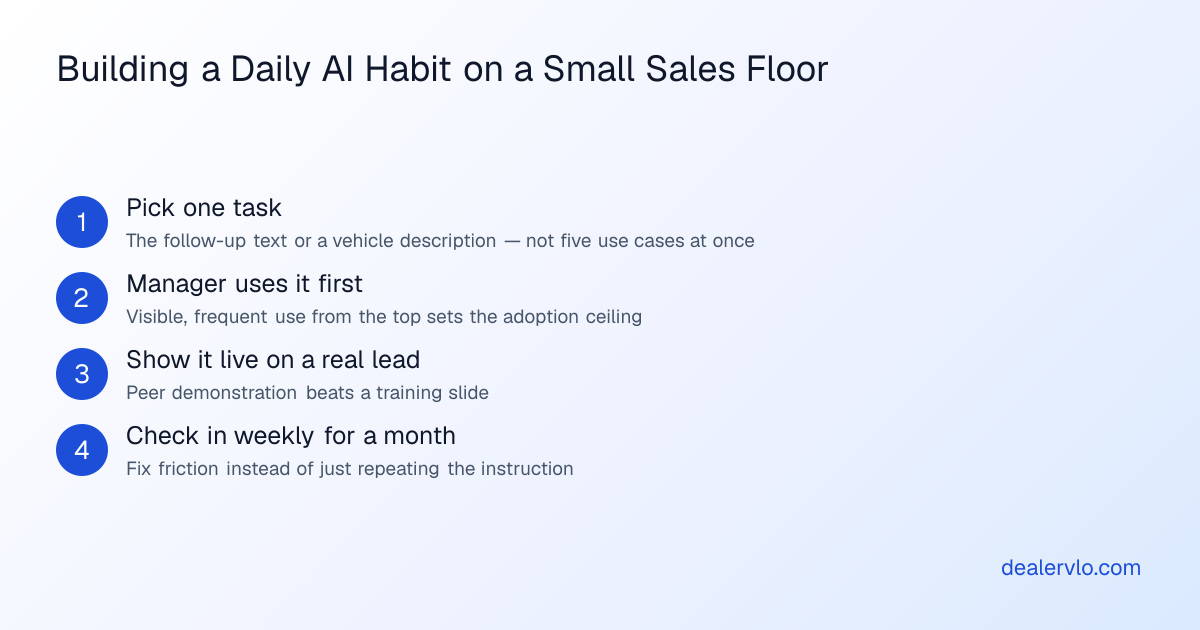
That's useful, because it tells you where to aim. Don't roll out AI as a general capability ("we now have AI, use it"). Pick the one task your team already hates doing by hand — writing the first follow-up text, drafting a vehicle description, answering a lead at 9pm — and make the tool visibly faster at that one thing before you ask for anything broader. If you want to see what that narrow, task-specific version looks like on an actual deal, the breakdown in [what a small lot should hand off to AI during negotiation](/blog/can-ai-negotiate-used-car-deal-for-dealers) is a useful companion read — it draws the same line between tasks worth automating and ones that still need a human.
## The manager's own use is the strongest lever you have
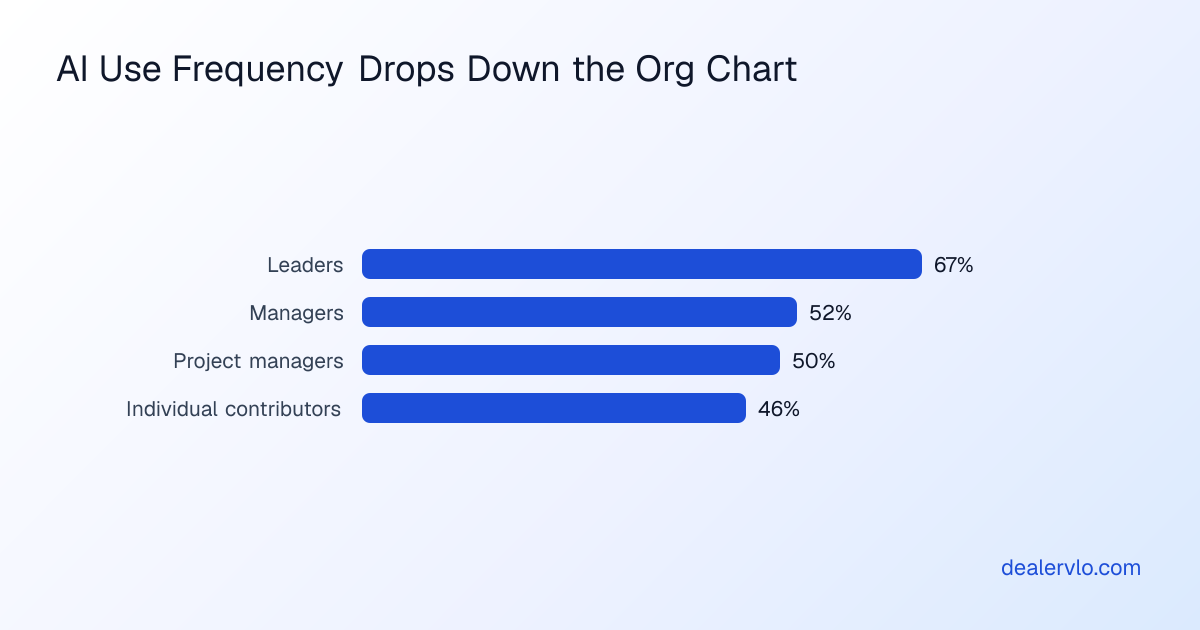
This is the single most actionable finding in the whole dataset: Gallup found that in organizations where AI tools are available, 67% of leaders use them frequently — a few times a week or more — compared with 52% of managers, 50% of project managers, and only 46% of individual contributors ([Gallup](https://www.gallup.com/workplace/704252/workplace-separates-adopters-holdouts.aspx)). Usage drops as you go down the org chart. Gallup also states plainly that manager support is the strongest driver of widespread adoption.
On a small lot, there's no layer between the owner and the sales floor — so this isn't a theoretical "leadership" problem, it's whoever runs the store. If you're the one who also answers leads and closes the deal, the tool you actually open yourself, every day, is the one your team will believe is worth opening too. If you only mention it in a meeting and never touch it, that's the signal that actually lands.
## Build the habit around one workflow, not a tool
The mistake most rollouts make is treating AI as a feature announcement — "we have this now" — instead of changing one specific daily task. A cleaner model, and one independent dealers themselves have been pushing at industry events rather than vendors pitching from a stage, is peer demonstration: show the exact workflow, in the exact tool, solving the exact task a rep does every day. NIADA's 2026 convention ran a fireside-chat session where two working independent dealers — Mark Fuerbacher of Universal Imports and John Parsons of 865 Autos — talked through how they'd actually used AI in their own stores, rather than a vendor demo ([NIADA](https://niada.com/dashboard/learn-how-ai-can-benefit-your-dealership-during-5-sessions-at-niada-convention/)). That's the right instinct for a small team: a rep watching another rep use the thing and close a deal faster beats a training slide every time.
Practically, that means:
- Pick ONE task first — the follow-up text after a test drive, or the first draft of a vehicle description. Don't launch five use cases at once.
- Show it live, on a real lead, not a demo scenario. Let the team see the before-and-after time, not just hear about it.
- Make the faster path the default path — if the old way (a blank text box) is still sitting right next to the new way, most people take the familiar one under pressure.
- Check in weekly for the first month, not once at launch. Ask what's getting skipped and why, and fix the friction instead of repeating the instruction.
This is also where picking the right system matters more than picking the flashiest AI feature. A used-car lot's day-to-day already runs through a DMS/CRM for inventory, leads, and deal paperwork — folding a new habit into that same screen a rep is already in beats asking them to also check a separate AI app. DealerVLO's lead inbox records every website lead with its source and status, and the Email and Call buttons open straight into the dealer's own email and phone — so the new habit (writing a sharper, faster first reply) happens inside the screen the rep already has open for every lead, not in a fourth app they have to remember to check.
## Measure the habit, not just the rollout
One of the clearer findings in the data: roughly a third of AI-using dealers either aren't measuring AI's impact or have no clear way to measure it ([Cox Automotive](https://www.coxautoinc.com/retail/ai-in-auto-retail-tracker/)). If you can't tell whether the tool is actually being used day to day, you can't fix adoption — you're just hoping it's working. Dealers who worked with an outside AI partner were considerably more likely to report they were using AI well (66% versus 46% without one) and far more likely to have high confidence in the outputs they were getting (30% versus 8%) ([AutoRemarketing](https://www.autoremarketing.com/ar/retail/cox-automotive-dealer-survey-82-use-ai-but-still-early-in-the-journey/)) — which suggests that having someone check in on usage, even informally, changes behavior more than the tool itself does.
See every lead, deal and days-on-lot number your team touches in one place: try DealerVLO free for 14 days
For a small lot, you don't need a dashboard of AI usage metrics to do this. You can watch the proxy numbers you already have. On DealerVLO's dashboard, the "needs attention" list flags new leads still waiting on a first contact and active deals missing a price or odometer reading — if that list isn't shrinking week over week after you roll out a faster follow-up habit, the habit didn't take, whatever anyone tells you in a meeting. Days-in-inventory on every car and the 60+ day aging count work the same way for a repricing habit — the number either moves or it doesn't.
## Where AI habits actually fit a sales floor's day
To make this concrete instead of abstract, here's roughly where daily AI use tends to land on a small lot, and what each one actually requires to become a habit rather than a one-time experiment.
| Workflow | What changes day to day | What makes it stick |
|---|---|---|
| First reply to a new lead | Faster, sharper first text/email instead of a generic template | Lives inside the lead inbox the rep already checks |
| Vehicle description drafting | AI first draft, human edits for accuracy | Faster than starting from a blank box every time |
| Objection prep / negotiation notes | Quick talking points before a call, not during it | Still human-led at the table — see the [AI negotiation breakdown](/blog/can-ai-negotiate-used-car-deal-for-dealers) |
| Checking who still needs a reply | A glance at who's untouched, not a memory exercise | Visible in the same screen as the lead's status |
If you're building or rebuilding a pay plan around this, it's worth tying some of the "activity" expectations — number of follow-ups sent, leads worked within a day — into the plan itself rather than leaving it as a vague ask. Note that pulling an actual follow-up list isn't something the lead inbox automates for you — it tracks status and source, but a human still has to decide who gets the second and third touch and send it.
## What not to do
A few patterns reliably kill adoption on a small team:
- **Announcing the tool once and moving on.** A kickoff meeting isn't a habit. If you don't check back in for a month, you'll find out the tool quietly died around week two.
- **Making it extra work.** If the AI step sits outside the system reps already use for leads and deals, it competes for attention with everything else on their plate — and it loses.
- **Skipping the qualifying step.** AI-drafted replies still need a human checking the basics before they go out — the [qualifying questions guide](/blog/car-sales-qualifying-questions) is a good reminder of what a lead actually needs answered before you quote a price, AI-assisted or not.
- **No feedback loop.** If a rep's faster AI draft gets no response because it still sounds generic, nobody tells them why, and they conclude the tool doesn't work.
If you're still deciding what system should sit underneath all of this — inventory, leads, deal paperwork, and whatever AI habit you're trying to build — the [guide to choosing dealer management software](/blog/how-to-choose-dealer-management-software) walks through the tradeoffs for a small independent lot, and [getting started](/guide/getting-started) covers what the first week actually looks like once you pick one.
## Frequently asked questions
### Why doesn't my sales team use the AI tool I already bought them?
Almost always because it adds a step instead of removing one, or it lives in a separate app nobody has open by default. Gallup's workforce research found manager support, workflow fit, and whether the employee sees clear value are the three things that actually drive regular AI use — not whether the tool exists. If it doesn't visibly save your rep time on a task they already do every day, it won't get opened twice.
### How long does it take to build a daily AI habit on a sales floor?
Sales-tech adoption research frames it as roughly a two-week window — if the tool doesn't pay off for the rep within the first couple of weeks, the habit typically never forms. That's a reason to pick one narrow, high-friction task to automate first rather than rolling out five use cases at once and hoping something sticks.
### Does the sales manager's own AI use actually matter that much?
Yes — it's one of the stronger findings in the data. Gallup found leaders in AI-enabled organizations use AI frequently at a noticeably higher rate than individual contributors, and manager support is described as the strongest driver of widespread adoption. On a small lot where the owner is also the closer, that means visible use from the top sets the ceiling for the team's own habit.
### Is AI adoption actually paying off for dealerships right now?
It's mixed, and dealers are honest about that. One tracker found most AI-using dealers expected gains in sales, productivity, and profit that only a minority actually experienced, and about a third aren't measuring the impact at all. That gap is usually a workflow and habit problem, not proof the tools don't work.
### Should I train my whole sales team on AI at once, or one person at a time?
Peer demonstration beats a one-time group training — showing one rep using the tool on a real lead and getting a real result tends to spread faster than a mandate. Independent dealers have taken this approach at industry events themselves, with working dealers demoing their own AI use rather than a vendor pitch. Start with your strongest or most tech-comfortable rep, let the result be visible, then expand.
### What's the difference between AI "adoption" and AI "capability" at a dealership?
Capability is whether the tool exists and technically works. Adoption is whether your team actually opens it, unprompted, as part of how they do their job every day. Most of the industry data on dealership AI measures the first thing — whether a dealership has turned a tool on — not the second, which is why adoption numbers at the store level look much higher than daily individual use numbers across the broader workforce.
## Bottom line
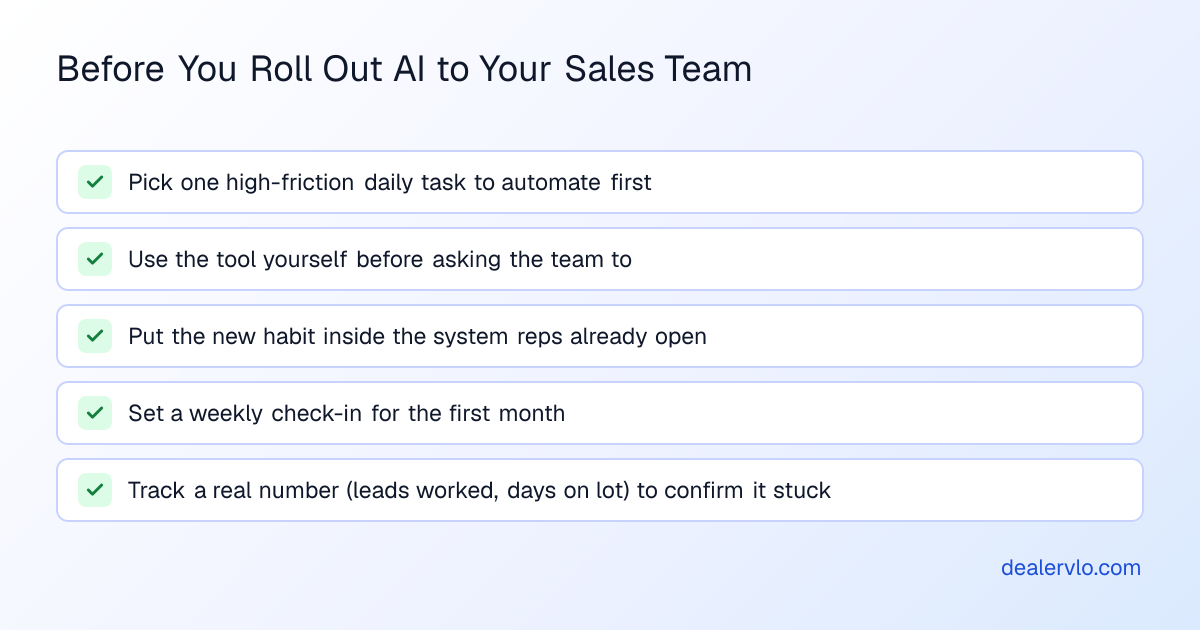
AI adoption fails on sales floors for the same reason CRM adoption fails: the tool adds a step instead of removing one, nobody measures whether it's actually being used, and the manager isn't visibly doing it themselves. Fix those three things before you buy anything new — pick one task, use it yourself first, and check the real numbers (leads worked, days on lot, follow-ups sent) weekly instead of hoping the kickoff meeting did the job. If your deals, leads, and inventory are already scattered across a few disconnected tools, that's usually the first thing worth fixing before you layer AI habits on top.
Run your next deal through DealerVLO: start your free 14-day trial
---
## FAQ
### Why doesn't my sales team use the AI tool I already bought them?
Almost always because it adds a step instead of removing one, or it lives in a separate app nobody has open by default. Gallup's workforce research found manager support, workflow fit, and whether the employee sees clear value are the three things that actually drive regular AI use — not whether the tool exists. If it doesn't visibly save your rep time on a task they already do every day, it won't get opened twice.
### How long does it take to build a daily AI habit on a sales floor?
Sales-tech adoption research frames it as roughly a two-week window — if the tool doesn't pay off for the rep within the first couple of weeks, the habit typically never forms. That's a reason to pick one narrow, high-friction task to automate first rather than rolling out five use cases at once and hoping something sticks.
### Does the sales manager's own AI use actually matter that much?
Yes — it's one of the stronger findings in the data. Gallup found leaders in AI-enabled organizations use AI frequently at a noticeably higher rate than individual contributors, and manager support is described as the strongest driver of widespread adoption. On a small lot where the owner is also the closer, that means visible use from the top sets the ceiling for the team's own habit.
### Is AI adoption actually paying off for dealerships right now?
It's mixed, and dealers are honest about that. One tracker found most AI-using dealers expected gains in sales, productivity, and profit that only a minority actually experienced, and about a third aren't measuring the impact at all. That gap is usually a workflow and habit problem, not proof the tools don't work.
### Should I train my whole sales team on AI at once, or one person at a time?
Peer demonstration beats a one-time group training — showing one rep using the tool on a real lead and getting a real result tends to spread faster than a mandate. Independent dealers have taken this approach at industry events themselves, with working dealers demoing their own AI use rather than a vendor pitch. Start with your strongest or most tech-comfortable rep, let the result be visible, then expand.
### What's the difference between AI "adoption" and AI "capability" at a dealership?
Capability is whether the tool exists and technically works. Adoption is whether your team actually opens it, unprompted, as part of how they do their job every day. Most of the industry data on dealership AI measures the first thing — whether a dealership has turned a tool on — not the second, which is why adoption numbers at the store level look much higher than daily individual use numbers across the broader workforce.