# ACV vs OPENLANE: Which Online Dealer Auction Fits an Independent Lot?
> ACV vs OPENLANE for independent dealers: what each publishes on buyer fees, condition reports, arbitration, payment and title, plus a 30-day test.
- Source: https://www.dealervlo.com/blog/acv-vs-openlane-online-dealer-auctions
- Published: 2026-10-03
- Updated: 2026-10-03
- Author: Chris Abouraad
- Tags: auctions, wholesale, buying, acv, openlane
---
If you buy wholesale from your desk, the question comes up fast: ACV vs OPENLANE, which one should a small independent lot actually buy on? Both are dealer-only online auctions, both hand you a condition report, and both say they make wholesale easy. Neither will tell you which one makes you more money on the cars you retail.
This post compares what each company publishes as of October 3, 2026: how the sales run, buyer fees, condition reports, arbitration, payment, title and transport. Then a 30-day test settles it with your own numbers: all-in cost per car, days to the front line, and gross.
Log every auction car's buy fee, transport and recon in DealerVLO and see its real margin: start your 14-day free trial
## ACV vs OPENLANE: the short answer for a small lot
Both are legitimate, dealer-only platforms run by companies that file annual reports with the SEC. Neither is better for every lot. The differences that matter to a small independent:
- **Format.** ACV is built around timed live online auctions. OPENLANE mixes scheduled live auctions with a 24/7 marketplace, Buy It Now, and a same-day Absolute Sale.
- **Protection.** ACV says buyers get 10-day arbitration at no charge, with paid options to extend it. On OPENLANE, the As Described Guarantee is a fee shown on each listing, and declining it means you buy the car as-is.
- **Fees.** Neither shows a full buyer fee schedule on a public page. Both say the fee scales with the price of the car.
So register on both, buy the same kind of car on each for a month, and compare what each car cost all-in and what it made.
## How each one works: timed auctions vs a 24/7 marketplace
**ACV.** Only licensed dealers can buy; ACV's [buyer page](https://www.acvauctions.com/buy) says you register with AuctionACCESS, a resale certificate and power of attorney, and ACH banking details. ACV's [seller FAQ](https://www.acvauctions.com/sell) says auction lengths vary from 20 minutes to 2+ hours, and a car sells when the high bid meets or beats the reserve. Its [annual report](https://www.sec.gov/Archives/edgar/data/1637873/000163787326000011/acva-20251231.htm) describes a Run List that lets you pre-screen cars up to 24 hours before they run. There's also a [No Reserve Sale](https://www.acvauctions.com/no-reserve-auctions) Monday through Saturday at noon Eastern, where the final bid wins.
**OPENLANE.** OPENLANE's [buyer page](https://www.openlane.com/buyers/) lists four ways to buy: an always-on marketplace, live auctions every Monday and Thursday, Buy It Now, and Absolute Sale, where cars sell to the highest bidder at the end of the day. Its [top-10 buyer FAQ](https://www.openlane.com/insights/top-10-faqs-about-buying-wholesale-on-openlane/) (from 2024) puts the scheduled auctions at 2 to 4 pm Central.
On a small lot: if you can sit at the desk during a short auction window, ACV's rhythm works. If you buy at night after closing, a marketplace with Buy It Now fits better. Either way, set your max before the clock starts.
DealerVLO helps with the retail side of that max. On the add-vehicle screen, paste the VIN (it decodes the year, make and model), enter the mileage, and the AI price suggestion shows a price range from live comparable listings plus a target price for selling in about 30 days. That's your ceiling to work back from.
## Fees as listed: what ACV and OPENLANE actually publish
**ACV buyer fees.** ACV's [pricing page](https://www.acvauctions.com/pricing) says the fee schedule has moved and links to a page inside the logged-in ACV app, so the numbers aren't public. ACV's 2025 annual report says buyer fees "are variable based on the price of the vehicle," and notes higher buyer fee rates in 2025 than in 2024. ACV's support center adds that some featured seller events may carry their own fixed buyer fee. Read the schedule in the app or ask your rep.
**OPENLANE buyer fees.** OPENLANE's help center says [buyer fees are on a sliding scale](https://help.openlane.com/en/articles/8391032-what-are-the-buy-fees) set by the final purchase price, that registration and bidding are free, and that the fee shows on each car's listing before you bid. Two more costs to watch: the [As Described Guarantee](https://help.openlane.com/en/articles/8392169-what-is-the-as-described-guarantee) fee, and an administrative fee if you [pay with a floor plan other than AFC or NextGear](https://help.openlane.com/en/articles/8396272-how-can-i-pay).
OPENLANE calls its buy fees the most competitive in the industry, based on its own survey. Skip the marketing lines and compare the fee on a specific car in your price band, plus everything else it takes to get that car retail-ready. Here's a made-up example of that stack. None of these figures are ACV or OPENLANE prices.
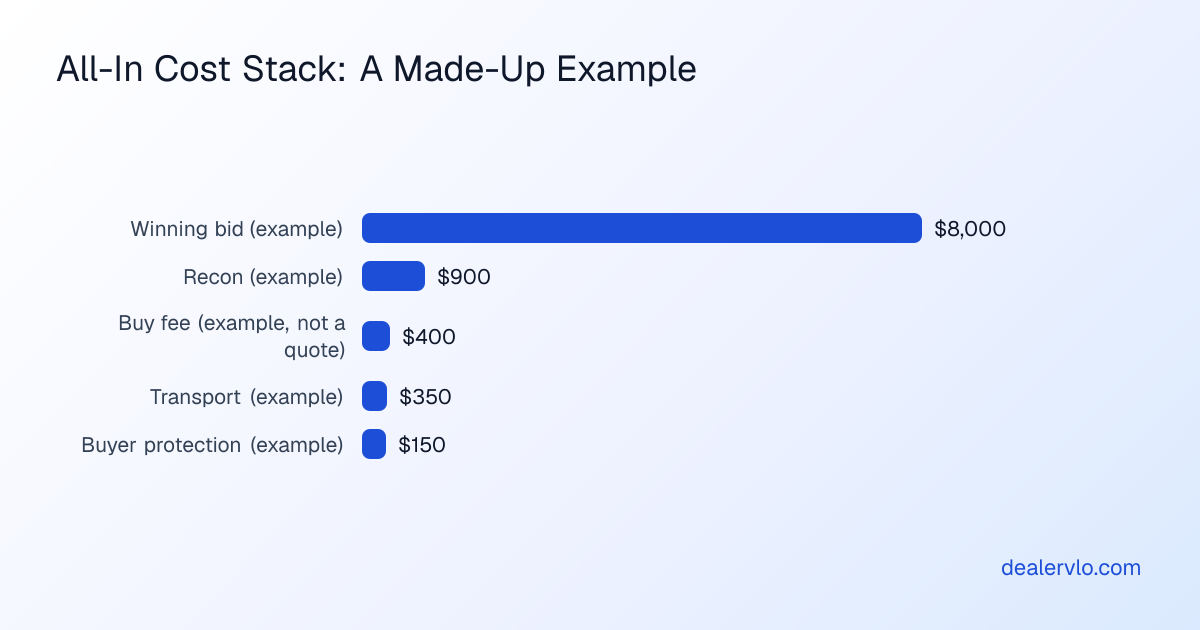
The math: $8,000 + $900 + $400 + $350 + $150 = $9,800. That's $1,800 over the hammer. If your retail target is $12,000, your gross isn't $4,000, it's $2,200, before floor plan interest. Our guide to [buying at dealer auctions](/blog/dealer-auction-buying-guide) covers the all-in number in more depth, and [MMR and Black Book](/blog/how-to-use-mmr-black-book-auction-pricing) covers the wholesale side.
In DealerVLO, the purchase price is its own field on each car, and the buy fee, transport and recon go on the car's cost list as separate lines, each with a vendor and a cost. They roll into that car's all-in cost and the margin shown on the car. Put "ACV" or "OPENLANE" in the vendor field on the buy-fee line and you can see at a glance where each car came from.
## Condition reports: what you get and what you don't
**ACV.** ACV's [wholesale page](https://www.acvauctions.com/wholesale) says its reports feature 60+ photos, engine sound recordings, OBDII scans and paint meter readings, done by full-time ACV inspectors. The buyer page names the engine recording tool APEX and describes Virtual Lift, an undercarriage image. One thing to know: ACV's annual report describes the seller's condition report fee as optional, so check what inspection backs each car you bid on.
**OPENLANE.** OPENLANE's buyer page describes inspections with test drives and mechanical checks by experienced inspectors, 25+ photos, AI-highlighted damage, engine audio analysis, a condition report score, and a complimentary AutoCheck report.
Neither replaces your judgment: a report is one inspector's look at one moment. Our guide to [condition report red flags](/blog/dealer-auction-condition-reports-red-flags) covers what to read between the lines.
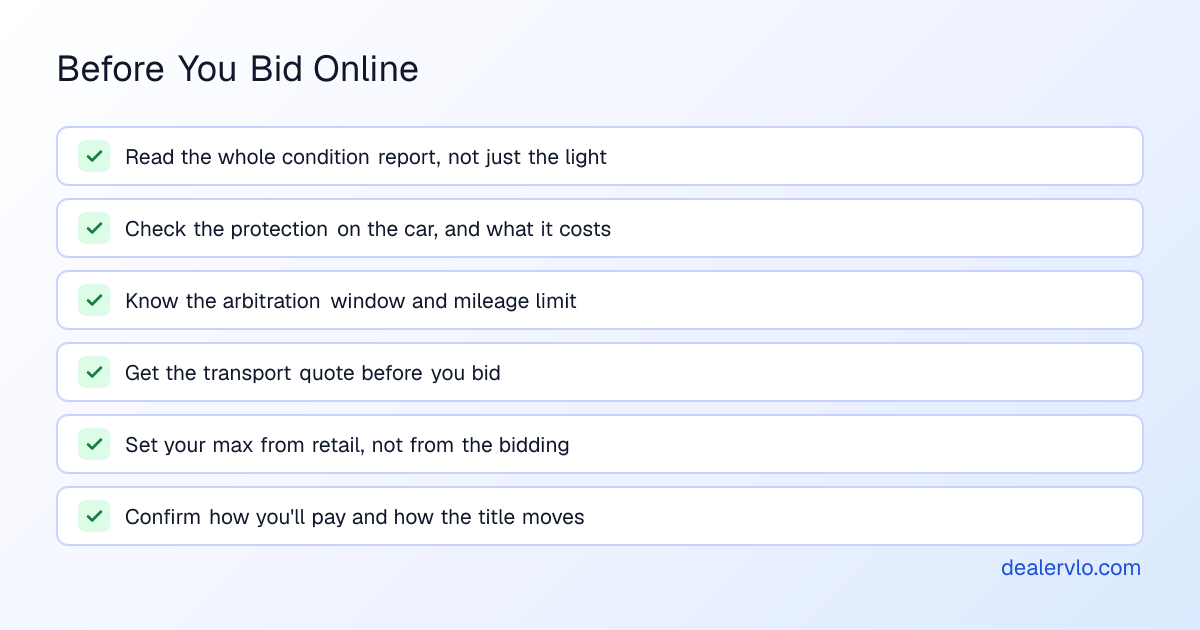
When the car lands and you find what the report missed, add the fix to the car's cost list in DealerVLO the same day, so your platform comparison stays honest.
## Arbitration and buyer protection
The detail lives in our [auction arbitration guide](/blog/auction-arbitration-dispute-guide). The short version for this comparison:
- **ACV** gives [10 calendar days from purchase](https://www.acvauctions.com/legal/arbitration), counting the purchase date as day one, and lets you buy an extended window of 10 more days. The policy also says you must finish checkout within 24 hours of your bid being accepted, or you may lose your arbitration rights.
- **OPENLANE** ties protection to the As Described Guarantee: decline it and you buy as-is. Each claim carries a deductible, and coverage widens above $6,000. Its help center says to [open a claim within 7 days](https://help.openlane.com/en/articles/8318963-how-do-i-submit-an-arbitration-claim) of delivery (with its transport) or purchase, under 100 miles driven, while the buyer page mentions an Extended Guarantee of up to 14 calendar days. Read the current policy in the platform before you rely on either.
## Payment, title and transport
**Payment.** On OPENLANE, [you pay OPENLANE](https://help.openlane.com/en/articles/8396253-do-i-pay-you-or-the-seller), not the seller, by ACH or most major floor plans. ACV says you select payment in the app and that it accepts most major floor plans. ACV also runs ACV Capital, its own floor plan, and OPENLANE's corporate family includes AFC. Our comparison of [NextGear, AFC and Westlake](/blog/nextgear-vs-afc-vs-westlake) covers how that choice interacts with where you buy.
**Title.** ACV says a dedicated titles team handles transfers, and its support center covers unwinding a deal over a late title. OPENLANE's help center says you can [request a title status](https://help.openlane.com/en/articles/8336970-where-is-my-title) two weeks after purchase. Either way, the car can't retail until the title is in hand, so count those days.
**Transport.** Both build it in. ACV's annual report says buyers see real-time transport quotes on the vehicle page and can add transport at checkout. OPENLANE advertises instant, upfront transport quotes. Our [auction transport guide](/blog/auction-transport-for-dealers) covers what to check before a truck shows up.
In DealerVLO, the transport bill goes on the car as its own cost line, so it's in the margin from day one. Floor plan interest belongs in your profit and loss, which has a Floor plan expense category. DealerVLO doesn't book or quote transport and isn't a lender.
Put every auction car's transport and fees on its cost list in DealerVLO: start your 14-day free trial
## eBlock, Manheim digital and the rest
OPENLANE's [annual report](https://www.sec.gov/Archives/edgar/data/1395942/000139594225000007/kar-20241231.htm) explains its family tree: OPENLANE, Inc. was formerly KAR Auction Services, sold the ADESA U.S. physical auctions to Carvana in 2022, and rebranded in 2023. The same filing lists ACV Auctions and EBlock among its digital rivals.
**eBlock** is another dealer-to-dealer online auction. Its site blocked our automated check on October 3, 2026, so confirm where it operates, how its sales run and what it charges with eBlock directly.
**Manheim's digital channels.** Manheim's [marketplace overview](https://site.manheim.com/solutions/marketplace-overview) describes Simulcast Live, which puts its physical lanes online, auctioneer-led Manheim Live Sales, and OVE Timed inventory you can bid on and buy 24/7. If you already buy at a Manheim lane, the digital side is worth adding to your test.
And don't forget the cars that never go to auction. [Trades and street buys](/blog/where-to-find-used-car-inventory-besides-auction) often carry the best gross on a small lot.
## How to decide: a 30-day test on cost per retail-ready car
Run both for 30 days and judge each car, not the brand.
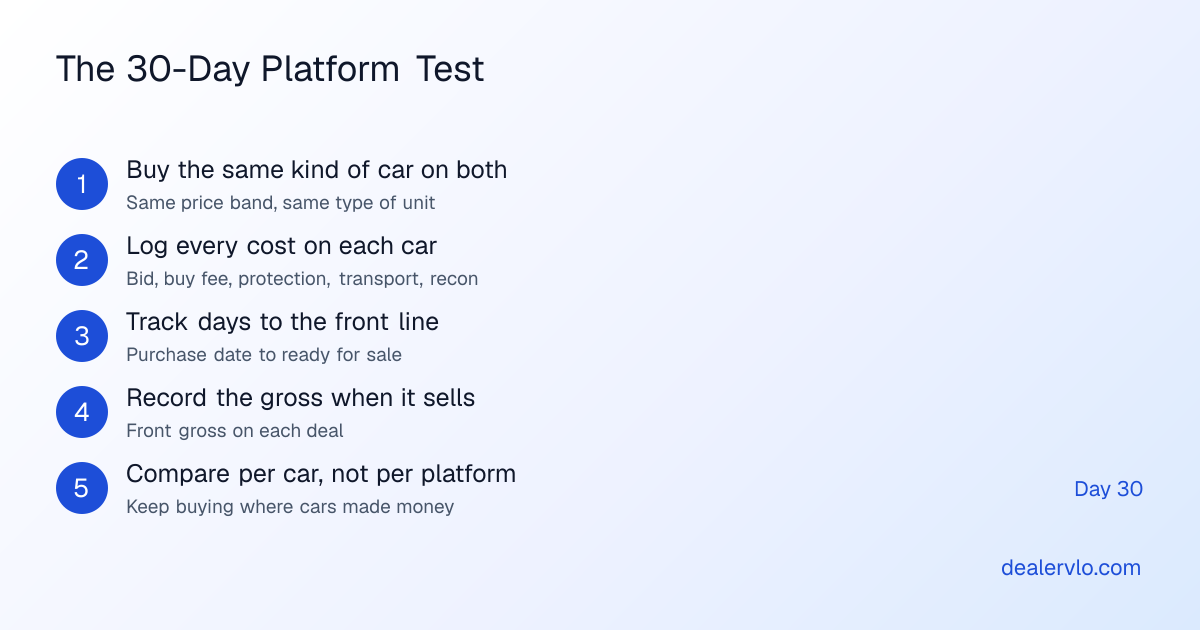
Buy the same kind of car on each, in the same price band, so you're not comparing a $6,000 commuter to a $20,000 truck. Log every cost. Count the days from purchase to ready for sale: title, transport and recon delays all show up there. Record the front gross when each car sells, and keep logging the unsold ones past day 30 until they do. The platform whose cars came in cheaper all-in, reached the front line sooner and sold with more gross is the one to lean on.
DealerVLO puts most of that on each car's page: cost, margin and days in inventory next to the specs. When the car sells, the sales report shows front- and back-end gross on every deal. DealerVLO doesn't group cars by platform for you, so tally each platform's cars from the vendor field.
## Where DealerVLO fits
End to end, for a dealer buying on ACV, OPENLANE or both:
- **Before the bid:** the AI price suggestion shows a range from live comps and a 30-day target price, and the free [Auction Profit Calculator](/tools/auction-profit-calculator) turns that into a max bid.
- **After the win:** purchase price on the car, with the buy fee, protection, transport and recon as cost lines rolling into all-in cost and margin.
- **While it sits:** days in inventory on every car and an aging flag at 60+ days.
- **When it sells:** gross per deal in the sales report, and floor plan and overhead in the profit and loss.
What it doesn't do: DealerVLO doesn't connect to ACV, OPENLANE, eBlock or Manheim, so you bid, pay and arbitrate on the platform itself and type the car's numbers in. It doesn't book or quote transport, pull Carfax or AutoCheck reports, or provide floor plan financing. It's $29 a month flat, unlimited users, in a browser.
## Frequently asked questions
### What are the buyer fees for ACV Auctions?
ACV doesn't publish its buyer fee schedule on a public page. As of October 3, 2026, its pricing page links the fee schedule to a page inside the logged-in ACV app. Its 2025 annual report says buyer fees vary with the price of the vehicle. Read the schedule after you register, or ask your rep.
### What are the buy fees for OPENLANE?
OPENLANE's help center says buyer fees are on a sliding scale set by the final purchase price, and the fee shows on each car's listing before you bid. Registration and bidding are free. The As Described Guarantee is a separate fee, and floor plans other than AFC or NextGear add an administrative fee.
### Is ACV Auctions legit?
Yes. ACV is a dealer-only wholesale platform: you need a dealer license and an active AuctionACCESS account to register, and the company files annual reports with the SEC. That doesn't make every car a good buy, so read each condition report and the arbitration policy before you bid.
### Who are ACV Auctions' main competitors?
ACV's 2025 annual report names Manheim (part of Cox Enterprises), Adesa (part of Carvana) and OPENLANE, plus smaller digital marketplaces and independent auctions. OPENLANE's annual report lists ACV Auctions and EBlock among its digital rivals.
### How is payment handled on OPENLANE?
You pay OPENLANE, not the seller, by ACH at checkout or with most major floor plans. ACH upon Title Receipt holds payment until OPENLANE has the title, for an additional fee, and floor plans other than AFC or NextGear carry an administrative fee.
### What auctions do dealerships get their cars from?
Physical auctions such as Manheim, ADESA (owned by Carvana), America's Auto Auction and independent lanes, and digital marketplaces such as OPENLANE, ACV Auctions and EBlock. Most independent lots also take trade-ins and buy off the street.
## Bottom line
ACV vs OPENLANE isn't settled by a comparison chart. Fees scale with the car, protection works differently on each, and the answer depends on the cars you retail. Buy the same kind of car on both for 30 days, log every cost, and keep buying where your cars came in cheaper and sold with more gross.
I built DealerVLO for my own lot in Tewksbury, and it keeps the numbers for that test on each car: purchase price, every fee and recon line, days in inventory, and the gross when it sells. Try it free for 14 days.
Track all-in cost, days on lot and gross for every auction car in DealerVLO: start your 14-day free trial
---
## FAQ
### What are the buyer fees for ACV Auctions?
ACV doesn't publish its buyer fee schedule on a public page. As of October 3, 2026, its pricing page links the fee schedule to a page inside the logged-in ACV app. Its 2025 annual report says buyer fees vary with the price of the vehicle. Read the schedule after you register, or ask your rep.
### What are the buy fees for OPENLANE?
OPENLANE's help center says buyer fees are on a sliding scale set by the final purchase price, and the fee shows on each car's listing before you bid. Registration and bidding are free. The As Described Guarantee is a separate fee, and floor plans other than AFC or NextGear add an administrative fee.
### Is ACV Auctions legit?
Yes. ACV is a dealer-only wholesale platform: you need a dealer license and an active AuctionACCESS account to register, and the company files annual reports with the SEC. That doesn't make every car a good buy, so read each condition report and the arbitration policy before you bid.
### Who are ACV Auctions' main competitors?
ACV's 2025 annual report names Manheim (part of Cox Enterprises), Adesa (part of Carvana) and OPENLANE, plus smaller digital marketplaces and independent auctions. OPENLANE's annual report lists ACV Auctions and EBlock among its digital rivals.
### How is payment handled on OPENLANE?
You pay OPENLANE, not the seller, by ACH at checkout or with most major floor plans. ACH upon Title Receipt holds payment until OPENLANE has the title, for an additional fee, and floor plans other than AFC or NextGear carry an administrative fee.
### What auctions do dealerships get their cars from?
Physical auctions such as Manheim, ADESA (owned by Carvana), America's Auto Auction and independent lanes, and digital marketplaces such as OPENLANE, ACV Auctions and EBlock. Most independent lots also take trade-ins and buy off the street.